

Official White House Photo by Adam Schultz via Flickr / Andi Weiland via Flickr
Heated Relations

Christoph Mayer
German Bundestag
Christoph Mayer is Chief of Staff and Policy Advisor to a member of the German Bundestag. His work focuses on digital sovereignty, AI, transatlantic relations, and the intersection of digitalization and democracy. He previously worked as a Research Fellow in the Technology and Global Affairs Program at the German Council on Foreign Relations (DGAP) and as a Project Manager at the Heinrich Böll Foundation.
He holds a Master’s degree in War and Conflict Studies from the University of Potsdam and Universidad Autónoma de Madrid. His academic background includes working visits at the German Embassy in Washington, D.C., and the Federal Foreign Office in Berlin, as well as a year abroad at National Chengchi University in Taiwan. He is particularly interested in class-conscious and intersectional approaches to politics, technology, and society.

Eric Langenbacher
Senior Fellow; Director, Society, Culture & Politics Program
Dr. Eric Langenbacher is a Senior Fellow and Director of the Society, Culture & Politics Program at AGI.
Dr. Langenbacher studied in Canada before completing his PhD in Georgetown University’s Government Department in 2002. His research interests include collective memory, political culture, and electoral politics in Germany and Europe. Recent publications include Comparative Politics: Mapping Institutions, Power, and Legitimacy (2025), Shifting Paradigms in Contemporary German Politics and Policy (edited volume, 2024), The German Polity, 12th ed. (2021), and Twilight of the Merkel Era: Power and Politics in Germany after the 2017 Bundestag Election (edited volume, 2019).
Dr. Langenbacher remains affiliated with Georgetown University as Teaching Professor and Director of the Honors Program in the Department of Government, as well as the Director of the Master in European Studies Program in the School of Foreign Service. He has also taught at George Washington University, Washington College, The University of Navarre, and the Universidad Nacional de General San Martin in Buenos Aires, Argentina, and has given talks across the world. He was selected Faculty Member of the Year by the School of Foreign Service in 2009 and was awarded a Fulbright grant in 1999-2000 and the Hopper Memorial Fellowship at Georgetown in 2000-2001. Since 2005, he has also been Managing Editor of German Politics and Society, which is housed in Georgetown’s BMW Center for German and European Studies. Dr. Langenbacher has also planned and run dozens of short programs for groups from abroad, as well as for the U.S. Departments of State and Defense on a variety of topics pertaining to American and comparative politics, business, culture, and public policy.

Jack Fornasiero
Program Associate
Jack Fornasiero is the Program Associate at AGI. In his role, he develops and implements grant-funded programs, strategic initiatives, conferences, symposia, and exchanges that strengthen U.S.-German relations. Since joining AGI, he has co-led a multi-year exchange program on LGBTQ+ issues, organized high-profile public events featuring leading transatlantic policymakers and experts, supported AGI’s activities at the Munich Security Conference, and contributed to AGI research and analysis. He oversees AGI’s internship program, mentoring and supervising emerging professionals.
Before joining AGI, Mr. Fornasiero served as a legislative intern in the offices of Senator Kirsten Gillibrand and Congresswoman Susie Lee. Additionally, he completed an Executive Office and Communications Fellowship with Meridian International Center, where he supported cultural exchange programs, diplomatic leadership engagement, and internal communications.
Mr. Fornasiero received a Bachelor of Arts in Political Science and German Studies from Wayne State University with university and departmental honors. He spent his third undergraduate year at Ludwig Maximilian University of Munich through Wayne State University’s Junior Year in Munich program. In addition to his studies in political science, German language, and literature, he has completed coursework in Italian language and European history.
__

Jasmin Gräwel
CSD Leipzig e.V.
Jasmin Gräwel grew up in Leipzig, Saxony. Currently, she works as a journalist for a tv production company in Leipzig called Level4Films. She produces tv reports for different magazines for public broadcasting and private tv channels. In january 2025 Gräwel finished her one year part-time online training as a diversity manager at the University of Hamburg. Gräwel studied American Studies at the University of Leipzig and completed a bachelor's degree in 2010.
Since 2018 Gräwel has volunteered as press officer, podcast host and member of the management board at Leipzig pride (CSD Leipzig). CSD Leipzig is the oldest pride organization in East Germany after Berlin. Gräwel also hosts a monthly podcast called “Inside CSD Leipzig”. On this podcast, Gräwel speaks with queer people in and around Leipzig, listening to their individual stories about coming out as queer, and sharing experiences as queer people with a wider audience.

Mieko Kuramoto
U.S. House of Representatives
Mieko Kuramoto serves as the Senior Legislative Assistant in the office of Congressman Mark Takano (D-CA-39, Congressional Equality Caucus Chair). Originally from Milwaukee, Wisconsin, Mieko came to Congress through the Asian Pacific American Institute for Congressional Studies (APAICS) Fellowship Program and is in her fifth year with the office. Her portfolio includes the Education and Workforce committee, appropriations, oversight, homeland security, and LGBTQ+ issues.
Mieko graduated from Smith College with bachelor’s degrees in American Studies and Spanish. When not at work, she enjoys playing softball, reading, and going to live music around Washington, DC.

Samantha Rosenthal
Journalist
G. Samantha Rosenthal (she/her/hers) is an independent journalist and professional historian. Over fifteen years, she has written widely about the United States, with an abiding commitment to Appalachia and the U.S. South. Samantha is the author of two books, most recently Living Queer History: Remembrance and Belonging in a Southern City. Her writing has been featured in the Los Angeles Times, Scientific American, Salon, The Advocate, The Conversation, Southern Cultures, Lilith, and Them. Samantha is co-founder of the Southwest Virginia LGBTQ+ History Project, an award-winning queer community history organization; Second Friday, a lesbian social monthly pop-up; and the Southwest Virginia Trans Wellness Fund, a mutual aid initiative that empowers transgender people through financial assistance. Her work has been recognized with awards and honorable mentions from the National Council on Public History, the Oral History Association, the LGBTQ+ History Association, the American Society for Environmental History, and the Working Class Studies Association.
Susanne Dieper
Director of Programs and Grants
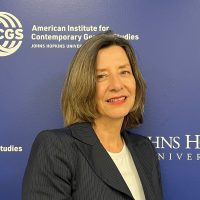
Susanne Dieper is the Director of Programs and Grants at AICGS. She oversees the Institute’s programs and projects within the three AICGS program areas, manages all AICGS fellowships, and is in charge of grant writing. Her current focus is on issues related to transatlantic relations, immigration and integration, diversity, the next generation of leaders, workforce education, and reconciliation. She develops programs that align with the mission of AICGS to better understand the challenges and choices facing Germany and the United States in a broader global arena.
Previously, Ms. Dieper was in charge of organizational and project management at AICGS as well as human resource development and board of trustees relations. Prior to joining AICGS, she worked in transatlantic exchange programs, language acquisition, as well as the insurance industry in Germany.
Ms. Dieper holds an MBA from Johns Hopkins University with a concentration in International Business and an MA in English Linguistics and Literature, History, and Spanish from the University of Cologne. She has completed course work in nonprofit management at Johns Hopkins University.
__
The Past, Present, and Future of the LGBTQ+ Community in Germany and the United States
For over a century, LGBTQ+ communities in Germany and the United States have fought for rights and recognition, built robust civil society structures, and influenced culture, business, and politics. To better understand how these transatlantic movements have intertwined and what can be learned to maintain and further advance LGBTQ+ equality, the American-German Institute developed the project, “Building LGBTQ+ Communities in Germany and the U.S.: Past, Present, and Future.” Over three years, this comparative study of the history, present, and future of LGBTQ+ rights brought together members of the LGBTQ+ community for site visits and discussions across the United States and Germany.
The final publication reflects themes from throughout the three years of the project: the history of LGBTQ+ movements across the Atlantic; the role healthcare research and access have played in LGBTQ+ rights; LGBTQ+ culture’s inherent political nature; how online rhetoric has fueled anti-LGBTQ+ policies; the interplay of public opinion and funding for LGBTQ+ organizations and initiatives, and how the community participates in and contributes to economies.
It is crucial at this juncture—as LGBTQ+ rights are under threat in both countries and the broader transatlantic relationship is undergoing a fundamental transformation—to promote expertise on LGBTQ+ issues in a transatlantic context and to strengthen the special bonds and solidarity among experts and advocates. The shared experiences gained through this project have deepened understanding of the joint efforts and achievements of the past, present, and future.
This publication is generously funded by the Transatlantik-Programm der Bundesrepublik Deutschland aus Mitteln des European Recovery Program (ERP) des Bundesministeriums für Wirtschaft und Energie (BMWE) (Transatlantic Program of the Federal Republic of Germany with Funds through the European Recovery Program (ERP) of the Federal Ministry for Economic Affairs and Energy (BMWE)).