

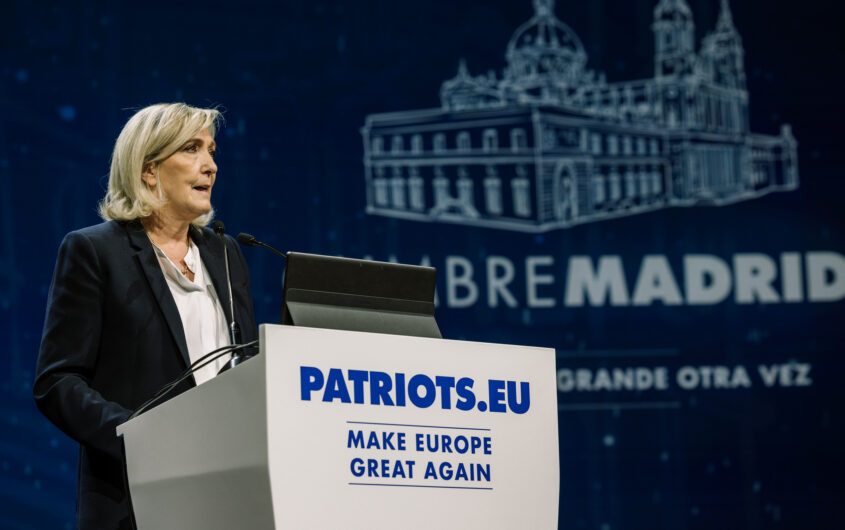
Vox España via Flickr
The European Far Right’s Response to the 2026 Midterm Elections

Henk de Berg
University of Sheffield
Henk de Berg is Professor of German at the University of Sheffield in the UK with particular expertise in political communication and German political culture, above all the AfD and the sociology and psychology of far-right populism. He has also taught, lectured, and written on the rise of Hitler in the 1920s and 1930s and on the National Socialist era. Henk de Berg is the author of four monographs—including Freud’s Theory and Its Use in Literary and Cultural Studies, which received a Choice Outstanding Academic Title Award and has been translated into three European languages as well as Chinese—and the co-editor of eight collections of essays in literary and cultural studies. His most recent book is Trump and Hitler: A Comparative Study in Lying, which argues that it is historically misleading to see Trump as a fascist, but that one can draw parallels between the circumstances Hitler and Trump exploited to come to power (economic upheaval, dented national confidence, social division, male anxiety, loss of faith in the political establishment, and an enabling conservative elite) and also that the two men use similar rhetorical strategies.
Trumpism with a Human Face?
The November 2026 U.S. midterms delivered a huge electoral blow to the Republican Party, with the Democrats making significant inroads into Trump country. Even deep-red states such as Kansas and South Carolina saw important Democratic gains. The president had urged his supporters to vote as if he were on the ballot, and yet his party lost both the House and the Senate. This is a problem not just for him, but also for his European brothers-and-sisters-in-arms. What has been their response to Trump’s fall from grace?
Despite the differences between the various far-right populist European leaders, their reactions have been strikingly similar. Rather than defending Trump, they have homed in on what they describe as the president’s mistakes, above all the Iran war and the accompanying skyrocketing fuel costs. These mistakes are seen as Trump having gone against his own original MAGA agenda and breaking campaign promises. The Alternative for Germany’s (AfD) co-leader Tino Chrupalla, for example, focused prominently on Trump’s second-term interventionism. Asked if this was a defeat of the AfD as well as of the Republican Party, he replied, “No, this was of course above all Donald Trump’s and the Republicans’ loss. In 2024, and especially during their election campaign, they promised the American people something very different—namely, peace and security—and what happened was the exact opposite. They started new wars, which have massively driven up the cost of living in America, and now they’re suffering the consequences.” The party’s other co-leader, Alice Weidel, concurred: “Trump promised his voters he would not pursue an interventionist foreign policy. […] This broken promise has now come back to haunt the Republicans. […] The extent of the Republicans’ defeat […] can be explained primarily by the devastating consequences of the Iran War.” Other European far-right leaders have taken the same stance.
Their comments dovetail with the critique that current and former MAGA supporters, such as Steve Bannon, Tucker Carlson, and Marjorie Taylor Green, have been making of Trump 2.0’s foreign policy. Even Vice President Vance put the burden of the midterm defeat squarely on the Iran war. This internecine struggle is nothing new for MAGA world—or indeed for populist parties generally. Like all far-right populisms, MAGA offers the voters a container ideology, an inconsistent mix of neoliberalism, socialism, ethno-nationalism and xenophobia, social conservatism, and a critique of the establishment and what it sees as wokeism. In this way, populists “hoover up” many more voters than do traditional parties, because the voters can detect and embrace their own preferred political orientation in the populist offering. Yet such strategic ambiguity and interpretive openness also tend to produce ideological struggles within the movement because it contains so many different factions, each stressing its favorite element of the container ideology. MAGA world, for example, includes economic nationalists like Steve Bannon, globalists and supporters of free trade like Elon Musk, anti-immigration supporters like Stephen Miller, social conservatives and the Christian right, and bellicose Trump supporters like Secretary of Defense (or “War”) Pete Hegseth.
The European far right will continue to embrace the ideological pillars of Trump 1.0 while keeping their distance from Trump 2.0’s nastiness in home affairs and its interventionism in foreign affairs.
The European Far Right and Trump 2.0
European far-right populist leaders have their own reasons for distancing themselves from Trump. They all believe in “My own country first,” and that does not mean “America First,” but “Germany First,” “Italy First,” “France First,” and so on. They know that the nasty, violent aspects of Trump 2.0’s deportation policy play badly with the European electorate, including many potential anti-immigration voters. Accordingly, Germany’s AfD, France’s Rassemblement National, and Italy’s Fratelli d’Italia make sure they do not cozy up too much to the president. In addition, European populist leaders are genuinely worried about Trump’s increasingly aggressive geopolitical behavior, such as his threat to take Greenland by force or to ensure the complete demise of Iranian civilization. Finally, whatever their stance on Ukraine (Giorgia Meloni is pro-Ukraine, whereas the AfD wants Germany to stop supporting the country), they all want the war to be over; and they are not happy that Trump shows little interest in making this happen.
Trump’s International Standing
None of this is going to change Trump’s international standing in the short term. Here, for once, the European far right and their establishment colleagues are in agreement. Both have always had an essentially pragmatic approach to Trump, and both know, as German Chancellor Friedrich Merz said, that “for the past two years, Trump has largely governed by bypassing Congress. Why should things be any different now?” European far-right leaders are also conscious of the fact that Trump is still only halfway through his second term, and if—as former British Prime Minister Harold Wilson famously said—a week is a long time in politics, two years is an eternity. They need Trump, and they are very much aware that Trump requires what he calls “respect,” so they will continue to give it to him, while trying to pivot—slowly and cautiously, but surely—to JD Vance. Trump, after all, will increasingly become a lame duck; and for all Vance’s awkwardness, Trump’s most likely successor is still the vice president.
Trumpism with a Human Face
What we can expect, then, is two things: the European far right will continue to embrace the ideological pillars of Trump 1.0—its ethno-nationalist, anti-immigration, and anti-woke stance—while keeping their distance from Trump 2.0’s nastiness in home affairs and its interventionism in foreign affairs. This is what they have been doing already anyway. Marine Le Pen was the first with her attempt to “un-demonize” her party (the so-called dédiabolisation), while Meloni in Italy has developed her own brand of populism, which is at pains to avoid clashes with European Union legislation. Even the AfD is beginning to abandon its erstwhile aggressive stance. In the recent elections in Saxony-Anhalt, the party’s popular leader, Ulrich Siegmund, managed to get a whopping 43 percent of the vote by means of what Johannes Hillje has called a “feel-good campaign” and posters with the reassuring text Alles wird gut, “Everything will be alright.” What we are looking at is Trumpism with a human face. We will have to wait and see whether that can be more than just cosmetics or whether it will eventually descend, like the American variety, into something much darker.