
Rufus46 and Gage Skidmore via Wikimedia Commons
The Transatlantic Situationship

Zsuzsanna Végh
German Marshall Fund of the United States
Zsuzsanna Végh is a DAAD/AGI Research Fellow in Spring/Summer 2026.
Zsuzsanna Végh is a program officer with the European Resilience program of the German Marshall Fund of the United States, an associate researcher at the European Council on Foreign Relations, and a doctoral candidate in comparative politics at the European University Viadrina. Her research focuses on challenges to liberal democracy in Europe, particularly the rise of the far right and its influence on EU politics, foreign policy, and democratic governance. She analyzes processes of democratic backsliding and resilience, with expertise in Central Europe and a particular focus on Hungary. Previously she worked at the European University Viadrina as a researcher and lecturer and at the Center for European Neighborhood Studies of Central European University. She is a frequent commentator in international media and has been quoted in outlets including in The New York Times, The Washington Post, Foreign Policy, Politico, The Guardian, Le Monde, and Deutsche Welle.
Her research at AGI examines how the rise of a transatlantic “New Right” alliance is reshaping American-German relations. Focusing on the growing ties between MAGA and Germany’s far-right Alternative for Germany (AfD), she explores how an intensifying culture war between liberal and illiberal actors affects bilateral cooperation and the broader transatlantic partnership. Combining policy analysis with expert interviews, her research explores how ideological contestation and external political influence intersect with formal diplomacy and assesses how democratic stakeholders can strengthen the resilience of the transatlantic relationship and safeguard cooperation in an increasingly contested political environment.
How MAGA-AfD Ties Are Reshaping American-German Relations
In September 2026, U.S. President Donald Trump publicly celebrated the radical-right Alternative for Germany’s (AfD) electoral victory in the German state of Saxony-Anhalt, attributing its success to Germans’ rejection of the country’s immigration policies. His remark prompted Chancellor Friedrich Merz’s spokesperson to reiterate the chancellor’s opposition to foreign involvement in German elections. Only weeks earlier, Merz himself had explicitly warned against interference by the U.S. government or government-affiliated institutions, following the State Department’s announcement of funding opportunities for ideologically aligned European organizations.
These episodes illustrate the growing tension in American-German relations: while the two countries remain indispensable partners, the engagement between Germany’s radical-right opposition party and the “Make America Great Again” movement, whose leaders now shape policy from the White House, has become a source of friction between Berlin and Washington. Unlike policy disputes over trade or defense spending, these confrontations concern Germany’s domestic politics and, more deeply, what is considered legitimate in a democracy. These evolving partisan ties are putting the normative foundations of the longstanding German-American strategic partnership to the test.
From the shadows to the limelight
The AfD’s connections with MAGA predate Trump’s return to the White House. In 2018, former Trump strategist Steve Bannon met AfD co-leader Alice Weidel while seeking to build a pan-European nationalist network, although the party’s other leader, then Alexander Gauland, was skeptical of the viability of an alliance. AfD parliamentary group deputy leader Beatrix von Storch also cultivated early contacts with Bannon, even interviewing him for the Freie Welt TV, a right-wing online video platform. Another channel of connection emerged through the New York Young Republican Club (NYYRC), a longstanding Republican youth organization that has become a hub for MAGA-aligned activists and politicians. Several AfD politicians, including then-European Parliament member Maximilian Krah and Bundestag member from Saxony-Anhalt Jan Wenzel Schmidt, attended its 2023 gala, where Trump himself spoke. In parallel, German far-right influencer Naomi Seibt developed online ties with Elon Musk in 2024, preceding his public endorsement of the AfD. These contacts were largely informal and individually driven, reflecting ideological sympathy and offering the AfD access to influential American networks.
Trump’s re-election in November 2024 and return to office marked a qualitative shift. Musk endorsed the party in December 2024 and hosted Weidel for a discussion on X in January 2025, while AfD co-chair Tino Chrupalla and von Storch traveled to Washington for Trump’s inauguration. In February 2025, Vice President JD Vance used his speech at the Munich Security Conference to criticize Europe’s alleged restrictions on free speech and reject political “firewalls” against the far right. He met Weidel later that day, elevating the relationship to the highest political level, right before the German federal election the same month. Washington’s support continued beyond the election, too: in May, Secretary of State Marco Rubio condemned Germany’s domestic intelligence agency for classifying the AfD as a confirmed right-wing extremist organization, calling the decision “tyranny in disguise.”
From fall 2025 into spring 2026, engagement intensified across political and activist networks. AfD parliamentary group deputy chair and foreign policy spokesperson Markus Frohnmaier emerged as a key driver. During repeated Washington visits, he met Republican members of Congress, including Republican Representatives Anna Paulina Luna and Tim Burchett, and State Department officials, among them Darren Beattie and Sarah Rogers. In December, around twenty AfD representatives attended the NYYRC gala, where Frohnmaier received an award. MAGA figures also traveled to Germany: Trump-aligned strategist Alex Bruesewitz addressed AfD parliamentarians in November, while NYYRC president Stefano Forte spoke at a Bundestag event in March 2026. Meanwhile, the administration’s December 2025 National Security Strategy (NSS) provided a broader ideological framework, welcoming the growing influence of Europe’s “patriotic” parties and calling for “cultivating resistance” to Europe’s current political trajectory.
Ideological affinity only provides the foundation for their engagement; political interests drive it.
Yet cracks had already appeared in January 2026, when Weidel and Chrupalla criticized Trump’s military intervention in Venezuela and claims on Greenland. Weidel accused Trump of breaking his promise not to intervene in other countries, while Chrupalla denounced his “Wild West methods.” The subsequent war against Iran deepened the disagreements. AfD leaders publicly distanced themselves from Trump, and Weidel reportedly urged parliamentarians to reduce their visits to the United States.
Nevertheless, contacts continued through other channels. Members of the NYYRC participated in events with the AfD’s youth organization in June. Following the AfD’s September electoral victory in Saxony-Anhalt, Trump praised the result, while Musk and former U.S. Ambassador to Germany Richard Grenell congratulated the party. Later that month, von Storch appeared on Steve Bannon’s War Room podcast, presenting the AfD’s electoral gains and attacking Germany’s governing mainstream. In October, Weidel herself praised Trump’s agreement with Russia on diesel supplies, highlighting it as an example Germany should follow. The relationship thus remained active but uneven across different layers: while direct high-level contacts became less visible amid policy disagreements, other channels continued to operate, leaving room for renewed engagement as political costs diminished and positions converged on specific issues.
Ideologically informed, instrumentally driven, structurally constrained
The ideological positions of MAGA and the AfD show notable overlap. Both sides emphasize national sovereignty, opposition to immigration and supranational constraints, rejection of progressive social and climate policies, and the defense of free speech against alleged censorship by liberal elites. Increasingly, both frame their political struggle as a battle over the identity and survival of Western civilization. Their shared opposition to liberal establishments rather than a common positive program is the connective tissue. Yet ideological affinity only provides the foundation for their engagement; political interests drive it.
For the AfD, the political rewards are tangible. Recognition from senior U.S. officials and MAGA figures offers international visibility and a claim to legitimacy that the political mainstream still contests domestically. American attacks on the political firewall reinforce the AfD’s portrayal of itself as unfairly excluded from democratic competition and increase pressure on Germany’s mainstream parties when they themselves are conflicted about their approach to the AfD. Social media amplification expands the party’s reach, while Republican contacts offer networking opportunities and potentially transferable campaign experience.
For MAGA, Germany is a consequential arena. As the EU’s largest economy and political reference point, it can shape Europe’s responses to U.S. policies on trade, digital regulation, security, and Ukraine. The AfD is a partner in challenging the German mainstream’s positions on immigration, European integration, and what MAGA describes as censorship. The Trump administration’s National Security Strategy, calling for “cultivating resistance” to Europe’s political trajectory, signals that this alignment fits a wider ambition to reshape European politics, resonant with the position of AfD vis-a-vis the European Union, too.
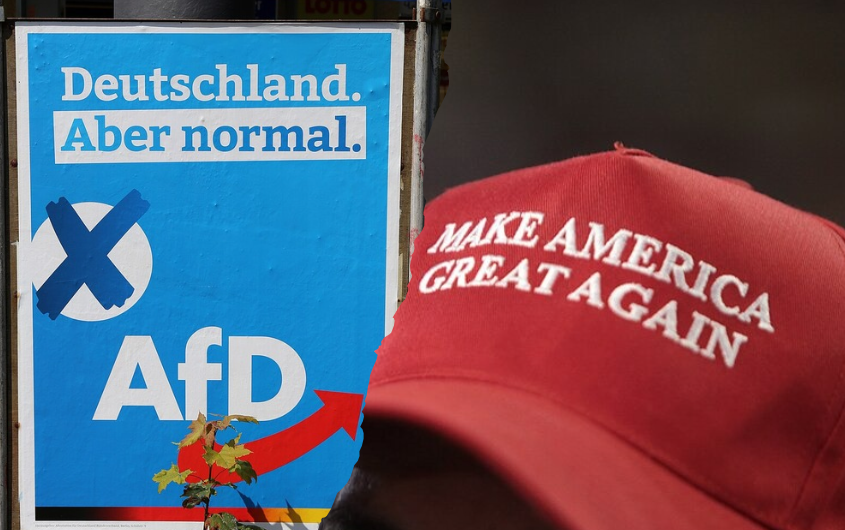
However, the AfD has traditionally had an ambivalent relationship with the United States, with significant anti-American currents within the party. Its factions differ over the United States, Russia, and their preferred orientation of Germany’s foreign policy. The prominent Saxony-Anhalt politician and party ideologue Hans-Thomas Tillschneider illustrates this tension—and an attempt to its resolution—well. Previously a vocal critic of American dominance, Tillschneider praised Trump in the state parliament in February 2025 for ushering in a political Zeitenwende and declared the culture war open. He subsequently joined the December 2025 U.S. delegation. In April 2026, a Deutschlandfunk report described a red MAGA mug displayed prominently in his office, alongside a portrait of Vladimir Putin. Markus Frohnmaier embodies this dual orientation even more strikingly: while spearheading the AfD’s outreach to Washington over the past two years, he also met senior Russian officials, including Putin adviser Kirill Dmitriev and Gazprom CEO Alexei Miller, in St. Petersburg in June 2026. Both examples show how ideological affinity with MAGA can coexist with continued engagement with Russia in individual cases, without resolving the underlying geopolitical contradictions in the party.
Through the emergence of parallel political channels, partisan disputes intrude into diplomacy; meanwhile, the friction between Washington and Berlin corrodes the partnership’s shared democratic foundations.
Nationalist interests also collide, forcing the AfD to reckon with the consequences of Trump’s policies for Germany and Europe. His tariffs have hurt Germany’s export-oriented economy, while U.S. interventions in Venezuela and Iran and claims on Greenland clash with the AfD’s professed commitment to national sovereignty and non-intervention. These policy disagreements also create political risks for the AfD, as close association with Trump could alienate voters beyond its core constituency. A 2026 Pew Research Center survey found that only 16 percent of Germans had confidence in Trump to do the right thing in world affairs. Even among AfD supporters, attitudes have become ambivalent: a February 2026 Forsa poll found that 51 percent considered Trump an adversary of Europe, compared with 39 percent who regarded him as a reliable partner. A May 2026 ECFR survey similarly found that AfD voters did not predominantly view the United States as an ally sharing the EU’s interests and values. The political appeal of close association with MAGA thus has limits even within the AfD’s own electorate.
Finally, the relationship remains more networked than institutionalized. It relies heavily on individual politicians, activists, and intermediaries, rather than formal structures capable of coordinating priorities and sustaining cooperation. The relationship is also highly asymmetrical. MAGA benefits from an extensive ecosystem of think tanks, advocacy organizations, and media platforms, with some of its leading figures now occupying positions in the U.S. administration. The AfD, by contrast, remains excluded from the German federal government and lacks a comparably developed organizational ecosystem capable of embracing and sustaining its transatlantic opening. While these connections offer the AfD access, visibility, and political support, its limited institutional resources and political influence constrain its ability to turn ideological affinity into stable cooperation. The relationship’s informal character allows it to remain flexible but also makes it dependent on individual initiative and shifting political interests.
What MAGA-AfD ties mean for American-German relations
The constrained nature of MAGA-AfD cooperation should not obscure its wider consequences. Its significance lies less in the ability to establish a shared agenda than in how the interactions impact the political environment of American-German relations: through the emergence of parallel political channels, partisan disputes intrude into diplomacy; meanwhile, the friction between Washington and Berlin corrodes the partnership’s shared democratic foundations.
MAGA-AfD ties have created a dual-track dynamic in American-German relations, through which German domestic political disputes increasingly spill into bilateral diplomacy. Official relations continue due to shared interests. Chancellor Merz’s June 2025 White House visit underscored both governments’ intention to maintain workable ties. Yet alongside these official relations, figures within the Trump administration, Congress, and the broader MAGA movement cultivate the AfD as an alternative political interlocutor. Although these channels are neither equivalent nor necessarily coordinated, they provide opportunities for the AfD to mobilize American allies in its domestic political struggles. Vice President JD Vance’s criticism of Germany’s political firewall provoked a sharp rebuke from then-Chancellor Olaf Scholz, while Secretary of State Marco Rubio’s attack on the AfD’s extremism classification prompted a similar response from the German Foreign Office. The State Department’s August 2025 human rights report, which cited restrictions on freedom of expression in Germany, further embedded this criticism in Washington’s official narrative about the country.
The pattern extends beyond rhetoric. In September 2025, Beatrix von Storch and Joachim Paul, an AfD politician barred from a mayoral election in Rhineland-Palatinate, met administration officials in Washington to discuss political participation in Germany. A year later, upon the AfD’s request, Representative Luna submitted a statement to a Thuringian parliamentary committee considering an AfD-ban initiative, pledging to seek U.S. entry restrictions against its proponents if the party were banned. Although this was an individual legislator’s intervention rather than U.S. government policy, it illustrates how the AfD’s domestic disputes can become internationalized. Such tensions started to burden official diplomatic exchanges, too. In September 2026, shortly after Trump celebrated the AfD’s electoral victory in Saxony-Anhalt, the German government postponed a planned phone call between Merz and Trump. While no causal connection was officially established, the chancellor’s spokesperson reiterated Merz’s opposition to foreign interference in German elections.
More fundamentally, these disputes go beyond competing political interests and strike at the normative foundations of the partnership. American-German relations have long rested not only on converging strategic interests but also on shared commitments to liberal democracy and the rule of law. Yet parts of Washington now question Germany’s very understanding of what democracy is and, importantly, how it should protect itself. Rooted in the historical experience of Nazism, Germany’s postwar constitutional order embraces the principle of wehrhafte Demokratie (militant democracy), which empowers democratic institutions to defend the constitutional order against forces seeking to dismantle it, subject to legal safeguards and judicial oversight. By portraying constitutional scrutiny of the AfD as censorship and political repression, the Trump administration presents instruments designed to protect democracy as evidence of its erosion. Following the publication of the NSS, Chancellor Merz rejected the notion that Americans needed to rescue European democracy. Yet, whether Merz wants it or not, Germany is becoming a battleground over who gets to define and defend democracy—with the German government and the Trump administration now finding themselves on opposing sides of that contest.
Supported by the DAAD with funds from the Federal Foreign Office (FF).