
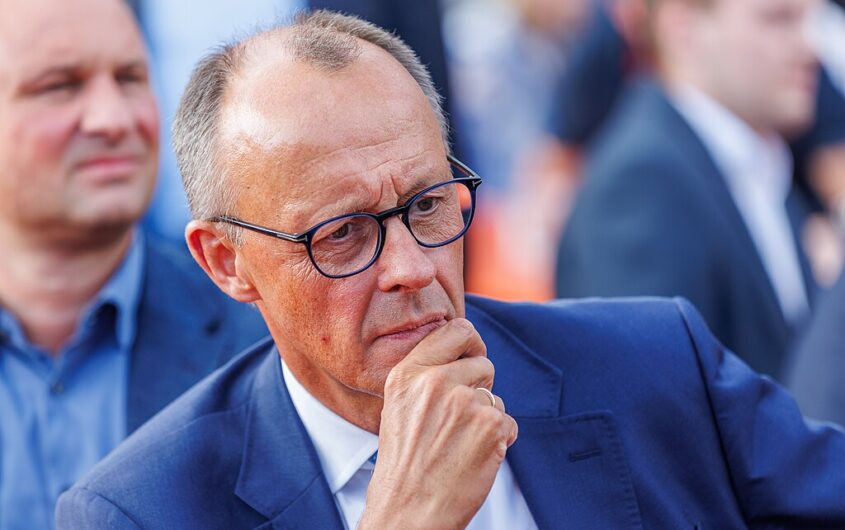
Steffen Prößdorf via Wikimedia Commons
In Search of Reforms

Alexander Privitera
AGI Non-Resident Senior Fellow
Alexander Privitera a Geoeconomics Non-Resident Senior Fellow at AGI. He is a columnist at BRINK news and professor at Marconi University. He was previously Senior Policy Advisor at the European Banking Federation and was the head of European affairs at Commerzbank AG. He focuses primarily on Germany’s European policies and their impact on relations between the United States and Europe. Previously, Mr. Privitera was the Washington-based correspondent for the leading German news channel, N24. As a journalist, over the past two decades he has been posted to Berlin, Bonn, Brussels, and Rome. Mr. Privitera was born in Rome, Italy, and holds a degree in Political Science (International Relations and Economics) from La Sapienza University in Rome.
Why Merz is Struggling to Put Germany on a Growth Path
Those who expected the Merz government to quickly fix Germany’s sluggish economy have good reasons to be disappointed. So far, the infusion of public money unleashed by the reforms of the debt brake in 2025 has not allowed the economy to find its way back to a growth path in 2026. And the war in Iran has all but dashed hopes that it may happen later this year. To top it all off, U.S. President Donald Trump has made new tariff threats that would disproportionately hit the German car industry. There is undoubtedly an external Trump factor that is holding back Germany’s recovery in 2026. As a result, consumers remain reluctant to spend, export dependent manufacturing companies struggle to regain momentum, and the only true silver lining is represented by defense spending. But it would be too easy to only blame outside factors for Germany’s current difficulties.
Domestic reforms
Most German analysts, from the media to influential research institutes such as the Ifo Institute, prefer to point the finger at the reluctance of the government to spend public money efficiently and its inability to quickly deliver on a set of urgent reforms. Most agree that a bold simplification agenda to cut red tape as well as tax and welfare reforms should be at the center of such a policy package.
The Christian Democratic (CDU) chancellor and his coalition partner, the Social Democrats (SPD), are still struggling to overcome largely self-made ideological hurdles. Merz’s conservatives are wedded to a traditional, ordoliberal free market set of recipes, which the chancellor believes was erroneously abandoned by his CDU predecessor Angela Merkel during her sixteen years in power, while the SPD intends to preserve the welfare state with as little changes as possible.
Merz remains much more suspicious of large public spending programs than his Social Democratic allies. He has consistently tried to convey the message that relaxing the constitutional debt brake was necessary as a one-off measure to boost defense spending and support the modernization of Germany’s creaking infrastructure. But it should not be interpreted as a sign that he has abandoned fiscal prudence to embrace Keynesian big public spending programs, neither at home nor at the European level. Merz remains attached to economic recipes that are based on supply-side economics (which postulates that increased and more efficient production leads to higher demand and growth) and thus, largely dependent on exports, large current account surpluses, and, as a consequence, global imbalances. Strangely, that also appears to be the main message he took away from the famous Draghi report on Europe’s (lost) competitiveness.
This is only one example of Merz’s apparent contradictions. The chancellor likes to see himself as one of the main European champions on the continent, yet he is also determined to reduce the role of the Brussels executive. He is trying to keep the European Commission and its German president, Ursula von der Leyen, on the shortest possible leash.
Merz the European?
Merz has been intrusive even in areas in which Europe’s executive traditionally should play a central and more independent role. One is the single market, arguably the most powerful growth engine at Europe’s disposal. His fingerprints are all over the recent tendency of the European Council, the institution that represents national governments, to be much more prescriptive in what it asks the Commission to do and, thus, to reduce its maneuvering room as much as possible ex ante, well before any new proposals are tabled.
Under increasing German pressure, the Commission has launched ten so-called omnibus proposals with the objective of cutting red tape across the economy. But Merz’s conservatives want more and faster action. Taken too far, simplification becomes a convenient cover for greater national leeway, a hands-off approach that would allow member states to do as they please. Not surprisingly, Merz has found an ally in Giorgia Meloni, Italy’s once Euroskeptic prime minister, who is also pushing for a less intrusive Brussels. It is an approach that risks fragmenting the single market.
In fact, while Merz keeps on advocating for a strong common market, including its financial system, in practice, his government has thrown all sorts of spanners into realizing the goal. One example is his government’s stubborn political resistance to the possible merger/takeover of the German commercial bank Commerzbank by Italian rival Unicredit. This is classic German industrial policy. Incumbent industries tell the government what to do, and Berlin is usually willing to help. In theory, Merz is in favor of European champions taking up the fight with global rivals. In practice, his behavior suggests that when he says Europe, the chancellor often means Germany.
The chancellor likes to see himself as one of the main European champions on the continent, yet he is also determined to reduce the role of the Brussels executive.
The commission has been forced to push back. Its Commissioner for Economy and Productivity Valdis Dombrovskis recently reminded member states—read Germany—that most red tape is generated at the national level. He argued that it is the sum of national wishes that makes almost every piece of European legislation overly complex.
Another challenge in which all the limits of a national approach have become evident is energy, arguably the biggest risk for the future of the energy intensive parts of Germany’s manufacturing sector. Here the Berlin government has pushed to relax the so-called green agenda that should lead to a carbon-neutral European economy. Unfortunately, the Iran war has highlighted how relying on greater dependencies on fossil fuels can suddenly turn out to be counterproductive. Importantly, without a real push to integrate fragmented energy markets in Europe, any national solution will prove to be insufficient.
Finally, trade. This is the area in which Merz’s approach has openly clashed with the more protectionist instincts of his French counterpart Emmanuel Macron.
The differences underlined the limits of the recent Franco-German reset. Merz is a believer in free trade because he still cannot imagine Germany managing to thrive without it. He is a staunch supporter of the Mercosur trade deal between the EU and a group of Latin American countries. He is pushing the EU Commission to close as many additional trade deals as possible. He also supports the imperfect trade agreement with the U.S. administration. During the lopsided negotiations, he was reluctant to allow the EU Commission to deploy its biggest bazooka as a negotiating tool, the anti-coercion instrument. As to China, arguably the biggest elephant in the room, Merz’s strategy can best be described as in flux.
Thus, while France insists on a Europe-centered growth model, in response to a fragmenting global economic order, Germany still hopes that frictions in global trade can be contained. While Macron’s France is fiscally constrained and pushes for a greater role for common funds to fuel European investment and demand—and wants to benefit from it—Merz’s Germany refuses to increase the size of the common budget and instead focuses on making Germany more competitive in global markets.
France and others are also, once again, pushing to introduce a common safe asset to foster greater integration of Europe’s fragmented capital markets and reduce the overall cost of debt. Here, too, Merz is not budging. In part because greater common fiscal firepower could support a more independent political role of the Commission, which he resists. But also, and more importantly, because Merz still appears to be a prisoner of the ideological debates that dominated the euro crisis in the last decade, when Berlin considered many European partners to be a risk to German taxpayers.
The German obsession with risk aversion
‘Risk reduction’ was in fact the mantra that dominated much of the European debates on fiscal and financial matters between Germany and its European partners until quite recently. This approach came at a cost. One reason for Europe’s weaker economic performance compared to the United States since 2008 is arguably its risk aversion. In part, it is the result of the shock caused by the great financial crisis of 2008. But in large measure, it is also due to a generally more cautious, risk-averse approach to innovation. Amongst European peers, Germany has proven to be particularly risk-averse.
One of the problems with that behavior is that it produces complicated rulebooks. In fact, overly prescriptive, and thus complicated, regulations are mainly designed to reduce risks. And as long as this is the main goal, it is difficult to imagine how Germany can lead a real push to cut red tape at home and in Brussels.
Is Merz aware of some of these inconsistencies? Does he realize that while he advocates for a stronger Europe, some of his behavior may in fact be weakening it? Does the chancellor realize that in order to regain Germany’s lost dynamism, he will have to do a better job at questioning a few old assumptions, about his country’s growth model and about Europe? Perhaps Merz is pursuing a daring and coherent long-term strategy that will remake his country and the European Union. Or maybe he is more simply tossed about by events, prisoner of both old recipes and a contradictory, ad hoc approach that could very well end up in paralysis, at home and in Brussels.