
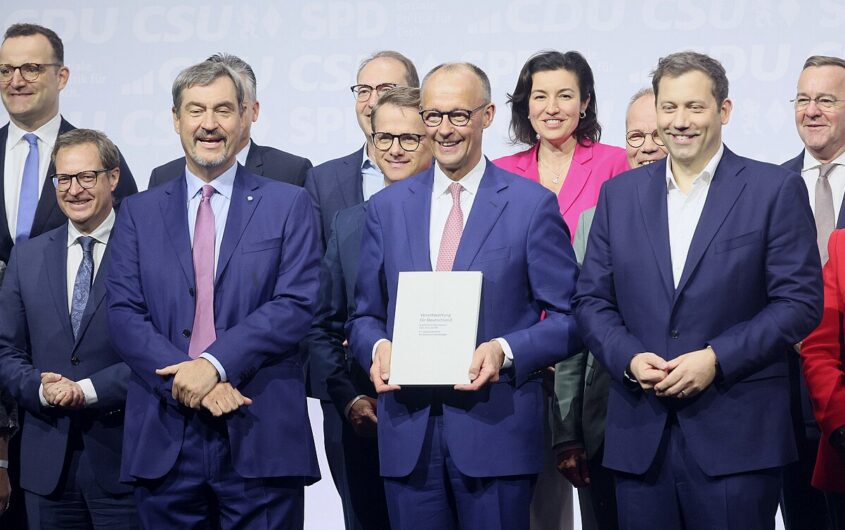
Sandro Halank via Wikimedia Commons
AGI Asks: Assessing the First Year of the Merz Government

Alexander Privitera
AGI Non-Resident Senior Fellow
Alexander Privitera a Geoeconomics Non-Resident Senior Fellow at AGI. He is a columnist at BRINK news and professor at Marconi University. He was previously Senior Policy Advisor at the European Banking Federation and was the head of European affairs at Commerzbank AG. He focuses primarily on Germany’s European policies and their impact on relations between the United States and Europe. Previously, Mr. Privitera was the Washington-based correspondent for the leading German news channel, N24. As a journalist, over the past two decades he has been posted to Berlin, Bonn, Brussels, and Rome. Mr. Privitera was born in Rome, Italy, and holds a degree in Political Science (International Relations and Economics) from La Sapienza University in Rome.

Alexander Reisenbichler
University of Toronto
Dr. Alexander Reisenbichler is Associate Professor in the Department of Political Science at the University of Toronto and Research Director of the Joint Initiative in German and European Studies (JIGES) at the Munk School of Global Affairs and Public Policy. His work explores the politics of housing, financial, and labor markets in Germany and the United States. His articles have appeared in leading academic journals such as Comparative Political Studies and policy outlets such as Foreign Affairs.
Dr. Reisenbichler is a former John F. Kennedy Memorial Fellow at Harvard University’s Minda de Gunzburg Center for European Studies. Dr. Reisenbichler holds a PhD and Master of Arts from George Washington University and a Bachelor of Arts from the University of Leipzig.
Alexander Reisenbichler was a DAAD/AICGS Fellow in July and August 2014. He was a 2016-2017 participant in AICGS’ project “A German-American Dialogue of the Next Generation: Global Responsibility, Joint Engagement,” sponsored by the Transatlantik-Programm der Bundesrepublik Deutschland aus Mitteln des European Recovery Program (ERP) des Bundesministeriums für Wirtschaft und Energie (BMWi).

Andrea Rotter
Hanns-Seidel-Stiftung
Andrea Rotter heads the Foreign and Security Policy Division at the Academy for Politics and Current Affairs of the Hanns Seidel Foundation (HSF) in Munich, Germany. Her research focuses on transatlantic security cooperation as well as German and European security and defense policy. Her current research projects address the evolution of Germany’s strategic culture, the transformation of NATO in the wake of Russia’s war of aggression against Ukraine, and the link between geopolitical rivalry and space security policy. She is a non-resident fellow at AGI.
Prior to joining HSF, she was a researcher in the Americas Research Division at the German Institute for International and Security Affairs (SWP) in Berlin and taught at the Chair of International Politics and Transatlantic Relations at the University of Regensburg. In 2018, she was a visiting fellow at the German Marshall Fund of the United States (GMF) and the American-German Institute (AGI) at Johns Hopkins University in Washington, DC. From 2018-2022, she was a member of the Young Leaders Program of the Federal Academy for Security Policy (BAKS), Berlin, and is an alumna of the International Visiting Leadership Program (U.S. Department of State) and the Manfred Wörner Seminar (GMF & German Federal Ministry of Defense). She is also a member of the extended board of WIIS (Women in International Security) Germany and heads the regional chapter in Munich.
Rotter holds a master’s degree in European-American Studies from the University of Regensburg and a bachelor’s degree in International Cultural and Business Studies from the University of Passau and Stirling, UK.

Eric Langenbacher
Senior Fellow; Director, Society, Culture & Politics Program
Dr. Eric Langenbacher is a Senior Fellow and Director of the Society, Culture & Politics Program at AGI.
Dr. Langenbacher studied in Canada before completing his PhD in Georgetown University’s Government Department in 2002. His research interests include collective memory, political culture, and electoral politics in Germany and Europe. Recent publications include Comparative Politics: Mapping Institutions, Power, and Legitimacy (2025), Shifting Paradigms in Contemporary German Politics and Policy (edited volume, 2024), The German Polity, 12th ed. (2021), and Twilight of the Merkel Era: Power and Politics in Germany after the 2017 Bundestag Election (edited volume, 2019).
Dr. Langenbacher remains affiliated with Georgetown University as Teaching Professor and Director of the Honors Program in the Department of Government, as well as the Director of the Master in European Studies Program in the School of Foreign Service. He has also taught at George Washington University, Washington College, The University of Navarre, and the Universidad Nacional de General San Martin in Buenos Aires, Argentina, and has given talks across the world. He was selected Faculty Member of the Year by the School of Foreign Service in 2009 and was awarded a Fulbright grant in 1999-2000 and the Hopper Memorial Fellowship at Georgetown in 2000-2001. Since 2005, he has also been Managing Editor of German Politics and Society, which is housed in Georgetown’s BMW Center for German and European Studies. Dr. Langenbacher has also planned and run dozens of short programs for groups from abroad, as well as for the U.S. Departments of State and Defense on a variety of topics pertaining to American and comparative politics, business, culture, and public policy.
Jeff Rathke
President of AGI
Jeffrey Rathke is the President of the American-German Institute in Washington, DC.
Prior to joining AGI, Jeff was a senior fellow and deputy director of the Europe Program at CSIS, where his work focused on transatlantic relations and U.S. security and defense policy. Jeff joined CSIS in 2015 from the State Department, after a 24-year career as a Foreign Service Officer, dedicated primarily to U.S. relations with Europe. He was director of the State Department Press Office from 2014 to 2015, briefing the State Department press corps and managing the Department's engagement with U.S. print and electronic media. Jeff led the political section of the U.S. Embassy in Kuala Lumpur from 2011 to 2014. Prior to that, he was deputy chief of staff to the NATO Secretary General in Brussels. He also served in Berlin as minister-counselor for political affairs (2006–2009), his second tour of duty in Germany. His Washington assignments have included deputy director of the Office of European Security and Political Affairs and duty officer in the White House Situation Room and State Department Operations Center.
Mr. Rathke was a Weinberg Fellow at Princeton University (2003–2004), winning the Master’s in Public Policy Prize. He also served at U.S. Embassies in Dublin, Moscow, and Riga, which he helped open after the collapse of the Soviet Union. Mr. Rathke has been awarded national honors by Estonia, Latvia, and Lithuania, as well as several State Department awards. He holds an MPP degree from Princeton University and BA and BS degrees from Cornell University. He speaks German, Russian, and Latvian.
__

Klaus-Dieter Frankenberger
Non-Resident Senior Fellow
Klaus-Dieter Frankenberger is non-Resident Senior Fellow at AICGS.
Laura von Daniels
German Institute for International and Security Affairs (SWP)
Dr. Laura von Daniels is Deputy Head of Research Division "The Americas" at the German Institute for International and Security Affairs (Stiftung Wissenschaft und Politik). Her areas of expertise include the international financial system, financial and debt crisis, and foreign trade policy, with a focus on U.S. economic policy, monetary policy, trade policy, trade agreements, Investor-State Dispute Settlement (ISDS), financial crisis, and financial regulation.

Peter S. Rashish
Vice President; Director, Geoeconomics Program
Peter S. Rashish, who counts over 30 years of experience counseling corporations, think tanks, foundations, and international organizations on transatlantic trade and economic strategy, is Vice President and Director of the Geoeconomics Program at AICGS. He also writes The Wider Atlantic blog.
Mr. Rashish has served as Vice President for Europe and Eurasia at the U.S. Chamber of Commerce, where he spearheaded the Chamber’s advocacy ahead of the launch of the Transatlantic Trade and Investment Partnership. Previously, Mr. Rashish was a Senior Advisor for Europe at McLarty Associates, Executive Vice President of the European Institute, and a staff member and consultant at the International Energy Agency, the World Bank, UN Trade and Development, the Atlantic Council, the Bertelsmann Foundation, and the German Marshall Fund.
Mr. Rashish has testified before the House Financial Services Subcommittee on International Monetary Policy and Trade and the House Foreign Affairs Subcommittee on Europe and Eurasia and has advised three U.S. presidential campaigns. He has been a featured speaker at the Munich Security Conference, the Aspen Ideas Festival, and the European Forum Alpbach and is a member of the Board of Directors of the Jean Monnet Institute in Paris and a Senior Advisor to the European Policy Centre in Brussels. His commentaries have been published in The New York Times, the Financial Times, The Wall Street Journal, Foreign Policy, and The National Interest, and he has appeared on PBS, CNBC, CNN, NPR, and the BBC.
He earned a BA from Harvard College and an MPhil in international relations from Oxford University. He speaks French, German, Italian, and Spanish.
Friedrich Merz was sworn in as Germany’s chancellor on May 6, 2025. The country faces its biggest challenges in a generation: a sluggish economy, Russia’s ongoing aggression in Ukraine, a fracturing political landscape at home, and discord in the German-American bilateral relationship. Merz’s ambitions to address these challenges were high; he focused on strengthening Germany’s partnerships in Europe, loosened fiscal rules to allow for massive increases in infrastructure and defense spending, and promised a number of badly needed domestic reforms. The chancellor made efforts to work closely with President Trump while at the same time preparing Germany and Europe to take on the principal burden for European security.
On the one-year anniversary of Merz’s chancellorship, AGI experts assess the results of the CDU/CSU-SPD coalition across foreign, defense, economic, and domestic policy.
Laura von Daniels
German Institute for International and Security Affairs (SWP); AGI Non-Resident Senior Fellow
Transatlantic relations have proven resilient despite major political crises following from President Trump’s unilateral decisions since his return to office. A prime example was the “Liberation Day” announcement of a 39 percent tariff on EU goods, which threatened to choke off trade, alongside ongoing crises involving Ukraine, Greenland, and Iran. German investment in the United States has increased despite continued policy uncertainty regarding tariffs, central bank independence, and broader political risks, including threats to the stability of democratic norms and institutions.
Merz’s push for closer cooperation with the United States is most visible in three areas of economic policy in his first year in office. First, he has advocated an early tariff deal with Trump. Although Germany’s export sector is bearing significant costs, a 15 percent tariff cap was seen as preferable to potentially higher tariffs resulting from escalation. Second, Germany has committed to increasing its defense spending to reach 3.5 percent of GDP by the end of the decade. It will be procuring $33 billion in U.S. defense goods over the coming years, in an effort to sustain mutual security cooperation. Third, the government is working more closely with the European Commission and member states to recalibrate its policy toward China. While a planned German Economic Security Strategy is still pending, policymakers have become more open to higher tariffs as safeguards against a surge of technology-intensive imports from China as well as to other countermeasures against Beijing’s growing use of economic coercion, including export controls on critical resources.
However, by criticizing Merz publicly and threatening a rapid drawdown of U.S. troops in Germany, Trump risks undermining Merz’s efforts to promote a recalibrated, interest-driven yet cooperative approach to the United States within Europe.
Klaus-Dieter Frankenberger
AGI Non-Resident Senior Fellow
When Russia attacked Ukraine in February 2022, then-Chancellor Scholz proclaimed a sea change (Zeitenwende) for Germany and Europe. That was no exaggeration, but rather a bitter reality. When Donald Trump began his second term in January 2025 and his subversive momentum began to unfold, the metaphor was apt once again: now there is a “sea change” 2.0, an Atlantic version.
As chancellor of a CDU/CSU-SPD coalition, CDU Chairman Friedrich Merz found himself facing a radically transformed world order. Profoundly new were the politics, style, and rhetoric of the Trump administration. Merz, well aware of Germany’s dependency on the United States, has sought to preserve the partnership in any way that he could. But Trump’s attacks on Europe and NATO, his threats against Ukraine, the near-complicit advances towards Russian President Putin, and his obsession with tariffs made that ever more difficult. Merz sees America as a partner that has turned uncertain and unpredictable. That critical view of the United States now permeates the center-right more than it ever did in previous transatlantic disagreements.
Trump’s attempt to claim Greenland caused the trust in Europe’s security guarantor to dwindle further, with both policymakers and the public aghast about what was coming out of Washington. The American and Israeli war against Iran exacerbated Germany’s doubts and irritations even further. Merz has publicly criticized the Trump administration for lacking a convincing strategy in the Iran war and has said Washington was being humiliated by Tehran’s skillful negotiating and tactics. These indiscretions are unusual. The German government stance that “this is not our war” makes the German-American estrangement on this issue clear.
Merz, an avowed transatlanticist, said last year that it “hurts his soul,” but “we must achieve greater independence in Europe from Russia, from China, and likewise from America.” While Trump is deeply unpopular in Germany, this shift is a result of what Merz experiences as Trump’s unreliability and untrustworthiness. The Merz government naturally neither wants to nor is able to abandon the relationship with America. But its priorities now lie in making Europe a strong, globally political agent capable of taking action. That is the strategic consequence of the Zeitenwende 2.0—Europe First.
Eric Langenbacher
AGI Senior Fellow and Director, Society, Culture & Politics Program
At the one-year mark of the CDU/CSU-SPD government led by Friedrich Merz, the assessment is rather bleak. Both parties have slipped in the polls, and support for the coalition is at near-record lows. The far-right Alternative for Germany (AfD) is now the most popular party and looks poised to come in first (perhaps even with a majority of seats) in two eastern state elections this fall. Economic stagnation persists—admittedly negatively affected by U.S. President Donald Trump’s erratic tariffs and an inflationary energy price spike due to fallout from his war against Iran. Three policy areas where movement has most visibly occurred are defense spending, facilitated by an unprecedented maneuver in March 2025 that loosened the debt brake; infrastructure; and migration, where the number of first-time asylum applications was halved in 2025 compared to previous years. But the massive increase in spending is causing budgetary pressure despite new debt. To save €16 billion, the recently introduced budget calls for changes to the health care system, including increasing co-pays, denying coverage to non-contributing spouses, imposing caps on remuneration, and introducing a new tax on sugary beverages. In December 2025, pension levels were assured (a floor of 48 percent of average wages until 2031) and a new “active pension” was implemented, allowing retirees to earn up to €2000 per month tax-free without affecting entitlements. This is widely considered inadequate, and a commission will research deeper reforms. The long-term unemployment benefit (Bürgergeld most recently) will be renamed “basic security” (Grundsicherung) and introduces various sanctions to incentivize recipients to get back into the workforce. The government has also loosened various climate measures, such as the renewable energy home heating mandate, which was introduced by the Scholz government. Many of these policy changes are unpopular with the public, causing tensions within the coalition, and helping to fuel the rise of the AfD.
Alexander Privitera
AGI Non-Resident Senior Fellow
Those who expected the Merz government to quickly fix Germany’s sluggish economy have many reasons to be disappointed. So far, the infusion of public money unleashed by the reforms of the debt brake in 2025 has not allowed the economy to find its way back to a growth path in 2026. And the war in Iran has all but dashed hopes that it may happen later this year. Consumers remain reluctant to spend, manufacturing struggles to regain momentum, and the only silver lining is represented by defense spending. One underlying problem of the Merz government is that so far coalition partners have failed to agree on what would allow Germany to grow again. Not surprisingly, the current debate on welfare spending reforms and modest tax cuts remains mired in controversy. But the biggest challenge is that, even if enacted, such reforms would not manage to overhaul an export-oriented growth model that has largely run its course. This is why any comparison with the reforms enacted by Chancellor Schroeder more than twenty years ago is misleading. At the time, the government managed to unshackle a fundamentally sound economic engine that was held back by a rigid labor market. This time, politics needs to find a way to nurture the overhaul of the entire economic model.
Peter Rashish
AGI Vice President and Director, Geoeconomics Program
Chancellor Friedrich Merz is the only German leader to have served as a Member of the European Parliament; his first trips abroad—just one day after becoming head of government on May 6, 2025—were to France and Poland, both symbolically rich in meaning for Germany’s European vocation. On the same day, he co-authored an opinion article with French President Emmanuel Macron for Le Figaro in which they committed themselves to “bring the Franco-German reflex and coordination to full swing for a more sovereign Europe, focusing on security, competitiveness and convergence.” Yet looking back on his year in office, the government appears to have reframed its European ambitions. Growth is slowing in Germany—mainly the result of Chinese manufacturing competition and high energy prices exacerbated by the war in Iran. As a result, the coalition between the Christian Democrats/Christian Social Union and the Social Democrats is now placing a priority on the economic gains to be had from EU deregulation rather than on avenues to deepen the EU single market through a savings and investment, energy, or defense union. In the long run, both will be necessary for Germany’s prosperity and security.
Jeff Rathke
AGI President
Chancellor Merz has ended decades of ambivalence in German defense policy. His government has set the country on a course toward realizing the promises that previous leaders have made to rebuild the Bundeswehr and live up to Germany’s responsibility for security in Europe—promises that were never backed up by the long-term resource commitments they required. In that respect, Merz has accomplished more in one year than his predecessors did since the Russian aggression against Ukraine began in 2014.
The German government has focused its security resources and attention on NATO and the relationship with the United States, which is understandable given the primacy of NATO in German strategic thinking. The German push for General Carsten Breuer to become the next Chairman of the NATO Military Committee is an example. The transatlantic fallout over the U.S. war with Iran highlights a potential flaw in the NATO-centric approach: the reliability of U.S. security commitments, especially under the stress of crisis and war. The NATO structures have been designed around American leadership—they are untested in circumstances of U.S. political ambivalence toward a European security threat. Germany and its European allies need to invest in the key political relationships that will ensure European cohesion and a decisive response in a crisis.
The chancellor, the defense minister, and the foreign minister have devoted time to creating flexible formats for dialogue in Europe: with the United Kingdom and France in the E3, with Poland and France in the Weimar Triangle, with the E5 (which brings in Italy), as well as with the Nordic and Baltic nations. A key challenge for the remainder of this legislative term is to marry Germany’s prodigious defense resources with European political ambition—to create the circumstances for effective and timely decision-making among the key nations that can rise to foreseeable security challenges.
Alexander Reisenbichler
University of Toronto; Author, Through the Roof: Housing, Capitalism, and the State in America and Germany
German voters are increasingly concerned with the rising cost of living, especially housing. In his first Regierungserklärung (government policy statement) in May 2025, Chancellor Merz called unaffordable housing “one of the most important social questions of our time.”
Yet nearly a year on, the reality is sobering. Rents and house prices continue to rise, and housing completions for both 2025 and 2026 are projected to fall below the already dismal 252,000 homes completed in 2024 under Chancellor Scholz.
Merz’s housing agenda has been strikingly unambitious. Pushed above all by the Social Democrats, the coalition extended the Mietpreisbremse (rental brake law) to 2029 and agreed on a sensible reform to tighten rules on short-term leases, furnished apartments, and index rents, although the bill still has to pass the Bundestag. The Bau-Turbo (construction-turbo law) allows municipalities to speed up approvals until 2030, though they are under no obligation to do so. The coalition also increased federal funds for social housing, from 3.5 billion euros in 2025 to 4 billion euros in 2026, but that is far too little to rebuild a social housing stock that has shrunk to only around one million units.
The coalition also plans to roll back the core provision of the Scholz government’s controversial Heizungsgesetz (heating law requiring newly installed heating systems use at least 65 percent renewable energy) by again allowing landlords to install new oil and gas heaters. This would slow decarbonization, lock in fossil-based dependence, and expose renters to rising fossil-fuel costs, even if costs are shared between landlords and renters.
In short, this policy patchwork will do little to address the core problem: an insufficient supply of affordable housing. What the country needs is a massive revival of social housing. As I have argued elsewhere, producing affordable homes at scale would not only help ease social tensions but also give the German economy a much-needed boost.
Andrea Rotter
Hanns-Seidel-Stiftung; AGI Non-Resident Fellow
Expectations were high and challenges substantial when the government led by Friedrich Merz took office in May 2025. Compared to slower progress on domestic issues, the CDU/CSU-SPD coalition initially set a decisive pace in defense policy. The early reform of the debt brake, enabling a significant increase in defense spending to more than €108 billion ($127 billion) in 2026 and €153 billion ($189 billion) by 2029, laid the financial foundation for Chancellor Merz’s pledge to do “whatever it takes” to strengthen German defense capabilities in light of Russia’s continued aggression and increasingly strained transatlantic relations.
Underlying this is the growing conviction that Germany must assume a central role in a more autonomous European security architecture. This ambition is reflected in the first-ever military strategy, which envisions the Bundeswehr becoming the strongest conventional army in Europe by 2039. The government also sought to address longstanding structural weaknesses in Germany’s foreign and defense policy by placing both the Chancellery and the Federal Foreign Office under the same party’s control and by establishing a National Security Council to improve whole-of-government coordination, whose effectiveness still remains to be seen.
However, despite a tangible sense of urgency and a realistic threat assessment, progress in strengthening Germany’s defense readiness still falls short of what is needed given Russia’s potential window of aggression against NATO. The 2026 Procurement Acceleration Act alone is unlikely to overcome entrenched red tape or create the conditions for the German defense sector to rapidly scale up production capacity. Similarly, the new conscription model, which—as a compromise between the coalition partners—so far relies solely on a voluntary basis, is unlikely to generate the personnel growth necessary for the Bundeswehr to meet Germany’s NATO commitments. Reforming systems and adapting mindsets shaped by peacetime conditions remains one of the central challenges.
One notable achievement has been to position Germany credibly as a reliable actor within both the EU and NATO, willing to assume more responsibility and not shying away from leadership debates. Berlin remains committed to Ukraine’s defense and has arguably emerged as Kyiv’s most important bilateral partner in 2026. At the same time, Germany’s defense efforts have become more German- and European-oriented, while its relationship with the United States is defined by a pragmatic balancing act—aware of Europe’s continued dependence on American security commitments in the foreseeable future, yet more willing to assert European interests when necessary.