
Rüdiger Trautsch via Wikimedia Commons
Building on Legacy

Ben Conard
Fair Trade USA
As Chief of Staff at Fair Trade USA, Ben Conard serves the nonprofit generating $1 billion of financial impact for farmers and workers in 53 countries. For his work in the movement, Conard was named one of the Top 10 Fair Trade Advocates in the World and 40 LGBT Leaders Under 40. His passion for social entrepreneurship has taken him from the TEDx stage to farms in Ecuador and factories in Vietnam. Ben's work has been recognized by Forbes, President Clinton, Nasdaq, and the U.S. Department of State.

Marie Dietrich
Hannover Medical School
Marie Dietrich is a student in her final year at Hannover Medical School (MHH). Growing up in rural North Rhine-Westphalia, Germany, she discovered activism and volunteer work as a way to connect with her community. After moving to Hanover in 2020, she joined the student project Critical Medicine Hanover and has since organized multiple workshops and lectures on LGBTQ+ healthcare and reproductive rights.
Dietrich is a volunteer for the anti-discriminatory project SCHLAU and regularly visits local schools, conducting educational workshops on LGBTQ* topics for students. Dietrich is part of the student union at her university and holds the chair for Political Education and Participation. Her topics include issues related to systematic discrimination in health care, local and global political ongoings, and political conflict resolution. She is currently working on her PhD thesis on LGBTQ* experiences and needs in the context of end-of-life care at the Institute of General Medicine and Palliative Medicine at MHH.
Generational Differences Within the Queer Community
In 1980s Berlin, queer life existed largely in the shadows. While reforms to Paragraph 175 in 1969 and 1973 partially decriminalized sex between men, the law and its societal legacy continued to shape queer life, and criminalization persisted in important ways. Community was often built quietly, within tightly knit subcultures that offered protection, refuge, and resistance. Decades later, walking through the same city as part of our American-German Institute project, we encountered a very different landscape, one shaped by visibility, representation, and hard-won rights. Yet beneath this progress lies a growing tension within the queer community itself, one defined not only by politics but by generational experience. As social conditions have shifted, so, too, have the ways in which queer individuals understand identity, activism, and belonging. This poses the question: What can different generations of queer people learn from each other and the various ways they perceive their realities as the whole community faces growing hostilities from the outside?
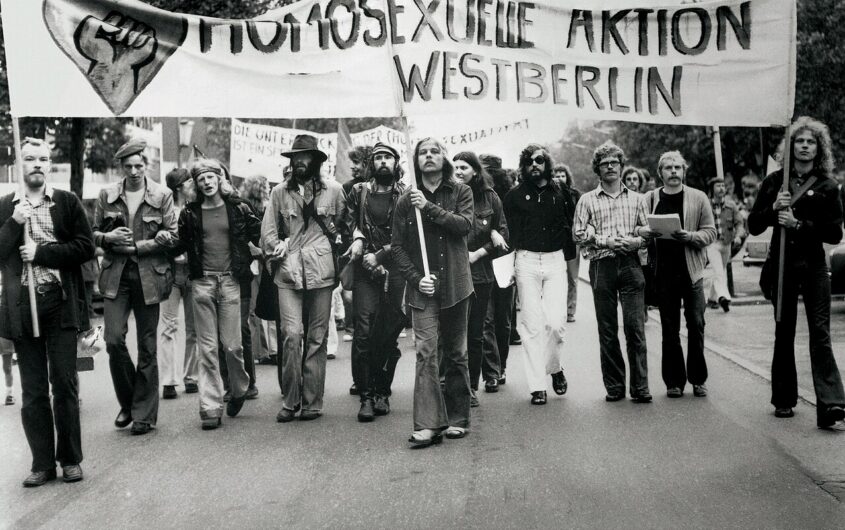
The queer liberation movement of the 70s and 80s was a time of activism and protest for queer communities in both Germany and the United States. In the many squats of the West Berlin housing wars, small communities of outsiders found their spaces in the growing metropolis. Among them were not only artists, punks, and conscription refugees from all over Europe but also an ever-growing community of queer people carving out their own separate subcultures.
At the same time, despite reforms to Paragraph 175 that narrowed criminalization primarily to homosexual acts involving minors under the age of consent,[1] much of society still stigmatized and discriminated against queer people in public life.[2] This created a divide between underground LGBTQ+ life and public life in the city, resulting in an activism strongly tied to crisis response and anti-assimilation politics. Visibility oftentimes meant street confrontation and protests, with a need for direct action and collective survival at its center. At the same time, political organizing and liberation efforts were centered around the bigger cities and rarely reached rural areas.[3] In turn, queer people living in these regions remained isolated through secrecy or faced harsh discrimination and stigmatization with no community to fall back on.
Together, older and younger perspectives may strengthen the movement’s ability to respond both to immediate political threats and to deeper structural inequalities.
It is due to these efforts that LGBTQ+ life today has become much more visible and legally secure: Many millennial and Gen Z LGBTQ+ youth in Germany grew up with public representation, online networks, and greater access to a global and local community. Even if those gains remain uneven across region, race/ethnicity, and class, the understanding of identity has become more diverse, visible, and publicly represented, if also more fragmented. While queer belonging might have been built through shared risk and local spaces, such as squats, bars, and activist circles, it is now shaped by a much broader range of online spaces, pop culture, and institutions.
As a result, the LGBTQ+ rights movement seems to have shifted some of its focus inward, increasingly confronting its own sexism, racism, transphobia, ableism, and class bias. What counts as activism has expanded from a struggle of survival and direct confrontation to now include visibility and representation, memory and care work, and structural inclusion as well.[4]
Yet this progress seems also to have produced a new tension within the queer community, shaped by different generational experiences of safety, activism, and belonging.[5] Speaking to baby boomer and Gen X activists, who witnessed the queer movement of the 80s, we found a nostalgia for its direct confrontation, subcultures, and political organizing. Some older activists criticized what they viewed as the increasing institutionalization and commercialization of queer identity, often associated with forms of “rainbow capitalism” and assimilation politics. On the other side of the conflict, younger queer people accuse their elders of slowing down intersectional progress within the LGBTQ+ community. To them, it seems clear that in order to come together as a whole, the community must recognize that queer identities do not protect from being socialized by the same systems that oppress. This means that queer communities are not automatically free from broader biases such as racism, sexism, transphobia, or class exclusion, making internal reflection and accountability part of activism as well. They feel that a misplaced nostalgia for older, more purist forms of activism divide the LGBTQ+ movement in the face of economic and cultural pressures in modern society.
In order to move beyond this conflict, it is important to recognize that activism has adapted to changing historical conditions without necessarily losing its political urgency. In the face of rising far-right and conservative hostility, what is needed might be a two-way exchange between younger and older generations. Older activists carry political memory, organizational discipline, and experience navigating periods of open hostility and legal discrimination. Younger generations, meanwhile, have helped expand LGBTQ+ activism toward intersectionality, visibility, and institutional change in schools, workplaces, healthcare systems, and public policy. Together, these perspectives may strengthen the movement’s ability to respond both to immediate political threats and to deeper structural inequalities. Because ultimately, a fragmented movement is more vulnerable than a united one, especially one that combines historical memory with broader, more inclusive forms of resistance.
[1] Craig Griffiths, The Ambivalence of Gay Liberation: Male Homosexual Politics in 1970s West Germany (Oxford University Press, 2021).
[2] Andrea Rottmann, Queer Lives Across the Wall: Desire and Danger in Divided Berlin, 1945-1970 (Toronto: University of Toronto Press, 2023).
[3] Allison T Steger, “Paving the Way for a Public Presence: Gay and Lesbian Activism, Methods, and Successes in East Germany” (bachelor’s thesis, University of Iowa, 2022).
[4] Carolina P Seigler, Kristopher Velasco, and Pamela Paxton, “ ‘Choppy Waters’: Navigating Political Generational Conflict in Social Movement Organizations,” American Sociological Review 90, no. 6 (2025).
[5] Siegler et. al.
This article is part of the project “Building LGBTQ+ Communities in Germany and the United States: Past, Present, and Future” and is generously funded by the Transatlantik-Programm der Bundesrepublik Deutschland aus Mitteln des European Recovery Program (ERP) des Bundesministeriums für Wirtschaft und Energie (BMWE) (Transatlantic Program of the Federal Republic of Germany with Funds through the European Recovery Program (ERP) of the Federal Ministry for Economic Affairs and Energy (BMWE)).