
President of Ukraine via Wikimedia Commons
Germany’s Changed View of Ukraine Driving Closer Military Cooperation

Phyllis Berry
Non-Resident Senior Fellow
Phyllis Berry is a Non-Resident Senior Fellow at the American-German Institute. She was the National Intelligence Officer for Europe from June 2021 until March 2025. She also served at the National Intelligence Council as Acting NIO for Europe from July 2017 through April 2018, Deputy NIO from April 2018 through July 2020, and senior advisor on governance for the NIC’s Strategic Futures Group during 2015-16. She authored the European futures papers for the 2017 and 2021 NIC Global Trends reports. From late 2014 to mid-2015 she was Director for Ukraine at the National Security Council. Dr. Berry has a Ph.D. in comparative politics from Georgetown University and has taught European comparative politics, French politics, German politics, and comparative leadership.
Russia’s full-scale invasion of Ukraine, Ukraine’s ability to defend itself and innovate on the battlefield, and U.S. unreliability if not outright hostility toward Germany have transformed Berlin’s view of Ukraine and its role in European security. Germany has shed its previous, long-standing tendency to see Ukraine as an appendage to its Russia policy and now views Ukraine as central to European security and a leader in military innovation. As Germany has lost faith in the reliability of the United States as a security partner and provider of key weaponry, Berlin increasingly believes Ukraine can help enable Europe to defend itself.
Three key events in the bilateral relationship mark this transformation: Chancellor Olaf Scholz’s “Zeitenwende” (historic turning point) speech in February 2022, the Memorandum of Understanding on Security Cooperation and long-term support between Ukraine and Germany signed in February 2024, and the Declaration of a Strategic Partnership signed in April 2026.
Germany’s Zeitenwende: Sea Change in View of Russia Opens Door to New Relationship with Ukraine
Russia’s full-scale invasion shattered Germany’s view of Russia and the long-standing German belief that European security had to be built with Russia, leading to a reexamination of Berlin’s view of and approach to Ukraine. While Germany had grown increasingly critical of Russia since its first invasion of Ukraine in 2014 and tried to mediate between the two countries, Berlin remained reluctant to accept that Russia had become a revisionist force. However, on February 27, then-Chancellor Olaf Scholz used his “Zeitenwende” address to the Bundestag to argue that the world will no longer be the same as it was before because Putin, the “warmonger,” was seeking to turn back the clock to nineteenth-century power politics. Scholz, who little more than a week earlier was still advocating for using the failed Minsk peace process to try to solve the crisis, acknowledged that Putin was seeking to demolish the post-Cold War European security order and “wipe an independent country off the map.”
Scholz’s speech was primarily focused on Russia—and presumed its likely success—and the need for NATO to strengthen its deterrence and defense against it. He promised Ukraine military support—a precedent-shattering decision as big as his call for a special defense fund to enable Germany to reach the then-NATO goal of spending two percent of GDP on defense. Germany remained reluctant to move forward on Ukraine’s drive for NATO membership, however, seeing it as an obstacle to a future peace settlement, and hesitant to provoke further Russian escalation. Significant military support for Ukraine only began in earnest once Boris Pistorius became Defense Minister in January 2023 and Germany started providing ammunition, armored vehicles and tanks, and air defense.
German-Ukrainian Security MOU
By 2024, hopes for a quick end to the war had dimmed, while Russia’s expanded use of hybrid attacks on Europe had further heightened German threat perceptions and raised the stakes of sustaining Ukraine’s ability to defend itself. By this time, Germany was a leading contributor of military assistance to Ukraine and in February of that year, signed a security cooperation MOU. The United Kingdom and the Netherlands had signed such agreements the previous month, and France concluded an agreement with Ukraine on February 16, the same day as Germany. The ten-year German-Ukraine MOU states that Ukraine is “integral to Euro-Atlantic and global security” and promises German military assistance, but that assistance was still seen as a one-way street. The agreement called for joint procurement among European partners to strengthen Ukrainian security while also advocating a closer defense partnership and increased defense industrial cooperation with Ukraine—but without specifics.
April 2026 Strategic Partnership
The return of Donald Trump to the White House led to a kind of second Zeitenwende in which the fear of Russian aggression combined with the fear of U.S. abandonment, prompting Germany and other European countries to ramp up defense spending faster and further. Europe—led by the EU, Germany, and other northern European countries—stepped in to fill most of the void caused by the end of U.S. financial support for Ukraine. And Ukraine showed a remarkable level of defense innovation to adapt to the changing nature of the war. Friedrich Merz’s shock at Trump’s approach to Ukraine—and Russia—led to his support for an end to the debt brake on defense spending. Even before he was elected chancellor in May 2025, a coalition of centrist parties approved a change in the constitution that removed security spending from the balanced budget requirement, enabling Germany to spend more on its own, European, and Ukrainian security.
Merz and Pistorius repeatedly emphasize that Ukraine provides lessons on how to defend against Russia and adapt to the changing battlefield.
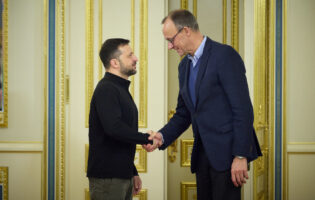
In April of this year, Germany and Ukraine held their first cabinet-to-cabinet consultations in twenty years and signed a fourteen-page declaration elevating their relationship to a “strategic partnership.” It prioritized increasing defense industrial cooperation, with the goal of strengthening Ukrainian air defense capabilities, speeding up the production of ballistic missiles, and supporting Ukraine’s drone industry. Ukraine will provide anti-drone training and is also working with the state of Schleswig-Holstein on civil defense training. A number of specific joint venture projects, all largely financed by Germany, are listed.
The declaration also confirms the evolution in the German view of Ukraine’s place in the EU and NATO. It calls for Ukraine’s membership in the EU “as soon as possible,” along with an immediate opening of all accession clusters to advance that goal. And while Scholz in 2022 said NATO membership was not on the table and the 2024 MOU remained silent on the issue, the 2026 declaration commits Germany to work toward producing consensus for NATO membership, echoing MOUs signed by the United Kingdom and most Baltic-Nordic governments. It further states that Germany stands by all commitments for Ukraine’s integration into NATO. This goal is no doubt aspirational, and Germany continues to see an end to hostilities as a prerequisite for full EU or NATO membership, but Germany is closer to the forefront than an obstacle to Ukraine’s integration into a European political, economic, and security order.
Implications of the Changed View of Ukraine
Russia’s war of aggression against Ukraine, combined with the Trump administration’s often hostile approach to Europe and pledge to reduce its military presence there, has shattered the European security order and prompted Germany to take steps to increase its military capabilities. And although Germany continues to see NATO as the only institution in which Europe’s defense can be organized, Berlin is now working toward a more self-sufficient European pillar to the Alliance. Germany’s first-ever military strategy, which was released in May, does not directly address Ukraine, but its description of the battlefield is very much influenced by the war in Ukraine. The strategy’s call for self-sufficiency, reform of procurement, and closer military-industrial cooperation reflect lessons learned from Ukraine, as does Germany’s new focus on drone and electronic warfare and the integration of these developments into its own planning. Merz and Pistorius repeatedly emphasize that Ukraine provides lessons on how to defend against Russia and adapt to the changing battlefield. Merz has noted that no army in Europe is as combat-tested as Ukraine’s and that joint efforts also create a greater degree of independence for Europe.
Germany is also increasingly looking to Ukraine as a partner to develop capabilities that may not be available from the United States. After it became clear in early May that Trump was not going to honor the Biden administration’s agreement to deploy a battalion to Germany with Tomahawk missiles, Pistorius made an unexpected trip to Ukraine and discussed possible cooperation on deep strike missiles. Germany is a lead participant in Kyiv’s “Build with Ukraine” initiative to establish production lines in European countries via joint production. One such effort began in December 2025, when Frontline Robotics (Ukraine) and Quantum Systems (Germany) launched an agreement to produce drones in Germany for Ukraine; the first batch was delivered in March 2026. The Ukrainian firm Fire Point is working with Hensoldt, a new German firm that will provide the radar to manufacture a new ballistic missile interceptor to be deployed by the end of the year. German plants will also produce reconnaissance drones as well as remotely operated machine guns and grenade launchers for Ukraine. Ukraine will share information gleaned from the use of these weapons, further tying the two militaries together.
Old habits persist, however. A recent study of German defense procurement suggests that it continues to buy too much traditional materiel and not enough autonomous systems and AI-supported reconnaissance, networked air defense, and electronic warfare. A disproportionate amount of spending is going to German firms, particularly Rheinmetall, whose CEO has been dismissive of Ukrainian firms. The United Kingdom has been more forward-leaning in how it partners with Ukraine, taking Ukrainian designs, such as the Octopus drone, and using its own engineers to refine the technology and produce a more sophisticated model that it is manufacturing in the UK. Denmark shows more flexibility in certification requirements that allows it to be more agile in its partnering with Ukraine.
German procurement remains slow and burdened by too much bureaucracy, but the government appears to be serious about Merz’s repeated emphasis on the need for simplification, standardization, and supply. The government has been willing to cancel big projects that are over budget and well behind schedule, such as the Franco-German-Spanish project to build a sixth-generation fighter jet, and there are recent reports that Pistorius is cancelling the F-126 frigate project and instead buying a less expensive and already existing frigate. He is also reorganizing the Bundeswehr procurement office—although these efforts echo those of previous ministers of defense. Germany is taking some lessons from Ukraine and has participated in recent NATO exercises that seek to address changes in the battlefield. The results so far have been mixed but are important in reversing the shortcomings that persist in the German military. Germany’s growing defense partnership with Ukraine is helping to move the German defense sector away from its traditional reliance on exquisite and very expensive items, while joint production is boosting many of Germany’s new and more innovative firms. The more Germany looks to partner with Ukraine, the more their two fates become intertwined, the higher the cost of failure, and the more likely Germany is to adjust to a changing European security landscape.
All statements of fact, opinion, or analysis expressed are those of the author and do not reflect the official positions or views of the U.S. government. Nothing in the contents should be construed as asserting or implying U.S. government authentication of information or endorsement of the author’s views.