

Fred Romero via Flickr
From Leipzig to Jerusalem
Tim Eydelnant
Non-Resident Fellow
Tim Eydelnant is a former senior U.S. Foreign Service Officer with more than two decades of experience in transatlantic affairs, diplomacy, humanitarian response, and public policy.
Most recently, he served as Executive Director of the Shalom Hartman Institute’s Washington, DC, Center for Judaism, Israel, and Public Policy, where he helped build a new platform for engagement with policymakers, think tanks, and international organizations around questions of democratic resilience, antisemitism, pluralism, and the future of the transatlantic relationship.
Previously, he was a Senior Diplomatic Fellow at the Wilson Center, where his research focused on the rise of antisemitism and extremism in eastern Germany following October 7, as well as broader societal fragmentation in Central and Eastern Europe.
During his Foreign Service career, Tim served as Principal Officer (Consul-General) at the U.S. Consulate General in Leipzig, Germany, where he directed U.S. engagement in Saxony, Saxony-Anhalt, and Thuringia, worked closely with Jewish communities and civil society partners, and led initiatives related to Holocaust remembrance, democratic resilience, and U.S.-German relations in eastern Germany. His diplomatic assignments also included Jerusalem, Iraq, Austria, Brazil, Russia, and Finland, as well as senior Washington roles in the Bureau of Energy Resources, the Bureau of Population, Refugees, and Migration during the Syrian refugee crisis, Consular Affairs, and the State Department Operations Center.
He is a graduate of Georgetown University’s School of Foreign Service and the National Defense University’s Eisenhower School.
Israel’s Elections and Eastern Germany’s Unfinished Reckoning
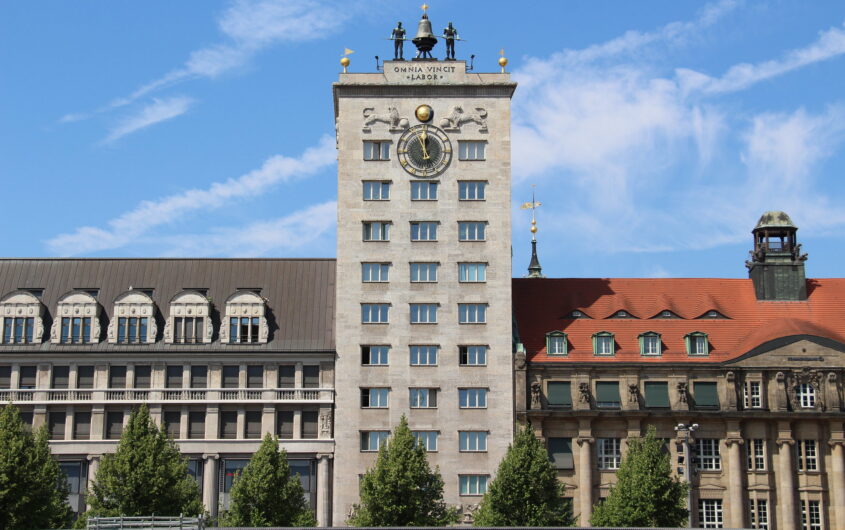
Early in my tenure as American consul-general in Leipzig, I visited Jerusalem, the city of my first diplomatic posting, and encountered an unexpected reminder of Leipzig. Beside a large outdoor model of Jerusalem during the Second Temple period at the Israel Museum stood a plaque honoring Hans Kroch, a Jewish banker whose name I knew from the Kroch Tower on Leipzig’s Augustusplatz. Kroch’s life connected two cities through achievement and devastating loss. The Nazis confiscated his businesses and forced him into exile. He commissioned the Jerusalem model in memory of his son who was killed in Israel’s War of Independence in 1948, a father’s memorial in the shape of the city his people had mourned for two thousand years.
Later on in my tenure, at a Leipzig city event, I met Howard Kroch, a member of the extended Kroch family who was visiting from Hamburg. We spoke about the family’s history in Leipzig, where its name had once been synonymous with commercial success. The conversation connected the story I had discovered in Jerusalem to a family member who remained engaged with Leipzig’s history.
As Israelis prepare to vote on October 27, the Kroch family’s story offers a perspective on a relationship that reaches beyond electoral politics. Israel’s election will determine Benjamin Netanyahu’s political future and shape the country’s relations with European partners. For eastern Germany, however, it raises a question rooted in its own history: can a society that has spent decades rebuilding its relationship with Israel distinguish support for the Jewish state from support for any particular Israeli government?
An Inheritance from the GDR
The German Democratic Republic never established diplomatic relations with Israel. Its official antifascist ideology presented the socialist state as a decisive break with Nazism, allowing its leaders to assign responsibility for Germany’s past largely to West Germany, while avoiding a reckoning with the Holocaust.
Israel was portrayed as an instrument of Western imperialism. In June 1967, following the Six-Day War, Walter Ulbricht, then First Secretary of the GDR’s ruling socialist party, used a speech in Leipzig to condemn Israel and associate its actions with the policies of the United States, Britain, and West Germany. The GDR subsequently cultivated close relations with Yasser Arafat’s Palestine Liberation Organization (PLO), providing political and military support alongside educational opportunities for Palestinians.
Yet official policy never entirely defined personal relationships. Eugen Gollomb, a Holocaust survivor who chaired Leipzig’s Jewish community from 1967 until his death in 1988, challenged the regime’s anti-Israel policies while working to sustain Jewish communal life. He also helped advance Christian-Jewish dialogue in Saxony, demonstrating that Jewish engagement with German society did not require acquiescence to the government’s position on Israel. The first decisive political break came before reunification. In April 1990, East Germany’s first freely elected parliament acknowledged responsibility for the persecution of Jews and asked forgiveness for the GDR’s hostility toward Israel. Eastern Germans were beginning to confront a history their former government had distorted.
Leipzig’s Transformation
After reunification, Leipzig developed a different relationship with Israel and its own Jewish history. Beginning in 1992, the city invited former Jewish residents and their descendants from all over the world to return. Jewish Week, established in 1995 through a partnership between the City of Leipzig and local Jewish institutions, helped reconnect Leipzig with a community devastated by Nazi persecution. In 2011, the city formalized its sister-city partnership with Herzliya, Israel, creating opportunities for cultural, educational, and youth exchanges.
Returning for Jewish Week in June 2026, I took part in a discussion of Jewish life in America as the United States approached its 250th anniversary. It was a reminder that Jewish history in Leipzig was not only something to commemorate, but also part of the city’s present. A significant new chapter is now taking shape. In May 2026, Yad Vashem announced plans for its first educational center outside Israel, with its principal German location in Munich and a branch in Leipzig. The Leipzig facility will be housed at the Ariowitsch-Haus, the city’s established Jewish cultural and community center.
Eastern Germany’s institutions changed quickly, but developing a shared understanding of historical responsibility has been a more complicated process.
The historical contrast is striking. In 1967, Leipzig provided the setting for Ulbricht’s denunciation of Israel. Nearly sixty years later, the city is preparing to host an educational branch of Israel’s foremost Holocaust remembrance institution, even as political disagreements over Israel continue to divide eastern German society.
Israel and Eastern Germany’s Political Divisions
The debate over Israel exposes divisions within eastern German society that cannot be explained simply through the rise of the far right.
The GDR’s anti-imperialist interpretation of the Middle East conflict still resonates in parts of the eastern German left. Die Linke, which emerged from the Socialist Unity Party of Germany (SED), the GDR’s ruling socialist party, reflects some of these unresolved contradictions. Although Die Linke has evolved considerably since reunification and contains differing views on Israel, elements of its eastern German political milieu continue to interpret the conflict primarily through the language of anti-imperialism, occupation, and Palestinian solidarity. The concern is not criticism of Israeli government policies, which is entirely legitimate, but the tendency in some quarters to treat Israel less as a complex democratic society than as an extension of Western power.
These tensions extend beyond Die Linke into the broader eastern German left, including the political environment from which the BSW, the party founded by Sahra Wagenknecht, emerged. The Palestinian cause commands genuine sympathy, but debates over Israel sometimes reveal a striking imbalance—considerable attention to Israeli military actions, with less willingness to confront Hamas’s violence, antisemitism, or the security concerns of Israeli civilians. Yet eastern Germany also has left-wing traditions that place opposition to antisemitism and solidarity with Israel at the center of their political identity. The resulting divisions reflect a deeper question about how the region has absorbed the lessons of its twentieth-century history and whether solidarity with Palestinians can coexist with an equally principled commitment to Israel’s security and Jewish life.
On the right, the Alternative for Germany (AfD) presents another contradiction. Some of its politicians express support for Israel, particularly in opposition to Islamist extremism, while advancing nationalist narratives that challenge Germany’s established culture of remembrance. Expressions of support for Israel do not necessarily translate into solidarity with Jewish communities in Germany.
Beyond party politics, the figures are troubling. According to the Research and Information Center on Antisemitism (RIAS), reported antisemitic incidents in Saxony-Anhalt, part of my consular district during my Leipzig tenure, rose from 202 in 2024 to 270 in 2025, an increase of roughly one-third.
These developments demonstrate why the relationship with Israel cannot be reduced to diplomatic declarations or partisan positions. Jewish communities must not be held responsible for the decisions of Israeli governments, and criticism of those governments must not become a vehicle for antisemitism.
An Election That Tests Relationships
Israel’s October 27 election arrives amid profound disagreements over the future of Israeli democracy, the consequences of war, the Palestinian question, and regional security.
Germany faces difficult choices in responding to those debates. Its commitment to Israel’s security remains grounded in historical responsibility, yet German leaders must also address concerns about settlement expansion, humanitarian conditions, and prospects for regional peace.
President Trump has taken a more personal approach. On October 18, he publicly endorsed Prime Minister Netanyahu and suggested that he might not “finish the job” against Iran if Netanyahu lost. German leaders have not made a comparable electoral endorsement, generally maintaining a distinction between Germany’s commitment to Israel and support for its incumbent prime minister.
For eastern Germany, that distinction carries particular significance. Unlike western Germany, which developed its relationship with Israel over decades, eastern Germany inherited much of that commitment through reunification. Its institutions changed quickly, but developing a shared understanding of historical responsibility has been a more complicated process.
Whether Netanyahu remains in office or a different coalition takes power, eastern Germans will face the challenge of maintaining their commitment to Israel while responding to policies they may profoundly disagree with.
Leipzig’s relationship with Herzliya, the work of the Ariowitsch-Haus, and the planned Yad Vashem educational center demonstrate what sustained engagement can accomplish. Their significance lies in the possibility of preserving these relationships even when Israeli policies generate serious disagreement.
A Relationship Larger Than Politics
Hans Kroch could hardly have imagined the Leipzig of today. The city that stripped his family of its livelihood and drove him into exile now celebrates its Jewish heritage and is building new institutional connections with Israel.
Eastern Germany has traveled an immense distance since 1989, measured not only in institutions and memorials but in the relationships it has rebuilt and its willingness to preserve them through changing political circumstances.
The Jerusalem model Hans Kroch commissioned in memory of his son remains a testament to a family history belonging to both Leipzig and Israel. It reminds us that the connections between Germany and Israel were built through individual lives long before they became matters of government policy. For eastern Germany, the challenge now is to ensure that these hard-won connections remain strong, regardless of who governs Israel.