
President Of Ukraine via Flickr
Merz’s Initiative on Ukraine’s EU Membership

Phyllis Berry
Non-Resident Senior Fellow
Phyllis Berry is a Non-Resident Senior Fellow at the American-German Institute. She was the National Intelligence Officer for Europe from June 2021 until March 2025. She also served at the National Intelligence Council as Acting NIO for Europe from July 2017 through April 2018, Deputy NIO from April 2018 through July 2020, and senior advisor on governance for the NIC’s Strategic Futures Group during 2015-16. She authored the European futures papers for the 2017 and 2021 NIC Global Trends reports. From late 2014 to mid-2015 she was Director for Ukraine at the National Security Council. Dr. Berry has a Ph.D. in comparative politics from Georgetown University and has taught European comparative politics, French politics, German politics, and comparative leadership.
Will He Follow Through?
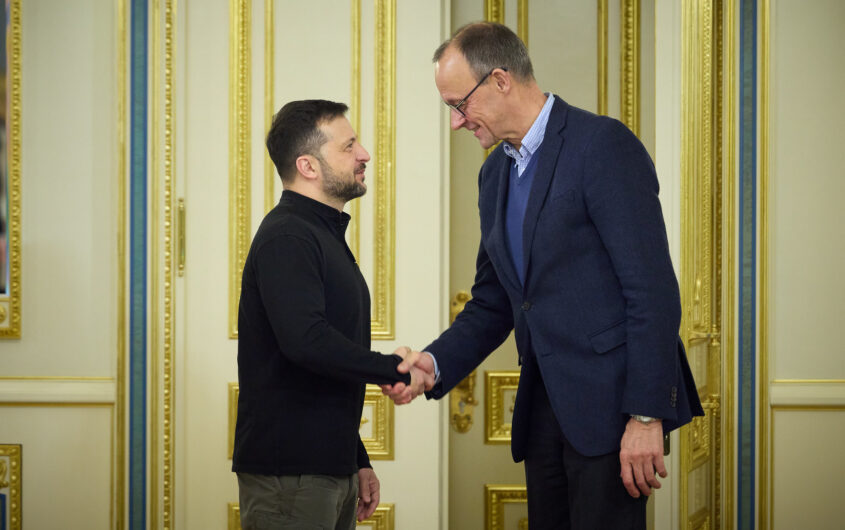
Chancellor Merz sees anchoring Ukraine in Europe as a security imperative for both sides and wants to move forward quickly to do so. He will try to use the upcoming European Council summit on June 18-19 to jumpstart a debate on how to provide Ukraine with a credible path to full EU membership as well as more immediate benefits in the interim. On May 18, Merz sent a letter to European Council President Costa, European Commission President von der Leyen, and Cypriot Prime Minister and current President of the Council of the EU Christodoulides proposing an “associate membership” with Ukraine for the period before its full EU membership, which Merz emphasizes remains the end goal. Such an agreement would allow Ukraine to participate in all key EU institutions—albeit without a vote—and make the political commitment to apply the EU’s mutual defense on behalf of Ukraine. According to Merz, Ukraine is unique among applicant countries in its significance to European security and therefore should be given special consideration while maintaining the principle of merit-based accession. At the same time, Merz rejects Ukrainian President Zelensky’s demands for full membership in 2027 as unrealistic due to the state of war and Ukraine’s current inability to fulfill the EU accession criteria.
Why Now?
There are a number of factors contributing to Merz’s push for moving forward on Ukraine’s EU membership. German officials believe that Ukraine’s strengthened position on the battlefield combined with Russia’s worsening economy may be opening a window for cease-fire negotiations, and the EU has to be ready with a credible plan for EU membership and sustained financial and military support. This is important both to strengthen Ukraine’s position in negotiations—to show Russia that it cannot outlast Ukraine—and to make more palatable the likely concessions Ukraine will have to accept in a future agreement on the de facto loss of occupied territories. In addition, with the new Hungarian government’s readiness to work with Ukraine, the EU has a window of opportunity to act between now and early 2027, when presidential and parliamentary elections in France begin in April, and the politics of Italian and Polish parliamentary elections that fall almost certainly will make agreement more difficult.
The Plan(s)
Germany remains focused squarely on Ukraine, but Merz’s May 18 letter was just the first of a set of proposals related to enlargement that Germany has either drafted or signed onto, including a Franco-German proposal on a phased integration for the Western Balkans and Moldova, and a Dutch-drafted non-paper signed onto by France, Germany, and the other Benelux countries limiting, at least temporarily, the veto powers of new members and imposing a more stringent “snap back” provision should they fail to maintain the EU’s rule of law requirements. Merz no doubt recognizes the need to address all applicant countries to come to a consensus in the EU and satisfy member states whose first priority is not Ukraine. In addition, these proposals attempt to address some of the greatest concerns about enlargement—the need to protect against democratic backsliding and corruption, the impact of enlargement on the EU budget, and the requirement to consider the EU’s ability to absorb new members. And for Ukraine—which would be the fifth-largest member state based on its pre-2022 population—this final requirement may be the most daunting as long as it is at war and unable to fully fund its government.
The Ukraine proposal is more of a political framework than a fully developed plan. As Merz writes, Ukraine has made significant—and under the circumstances remarkable—progress in preparing the groundwork for accession (which it has done with the assistance of the Commission). Enlargement is a geopolitical necessity but takes too long and leads to frustration. Therefore, a political solution is necessary to bring Ukraine closer to the EU. Merz advocates for immediately opening negotiations on all the accession chapters, so that Ukraine and the EU can focus on the substance of what Ukraine must do to fulfill them. Opening negotiations on the first cluster of chapters on fundamentals, such as rule of law, was approved earlier this month, and official talks begin on June 15. At the same time, Merz wants the EU to provide Ukraine with “associate membership”—which would not be based on a treaty but would be a political decision that could be approved by qualified majority. This associate membership would allow Ukraine to participate in meetings of the European Council, have a representative to the Commission and European Parliament, as well as an associate judge on the European Court of Justice. None of these representatives would have a vote but would be heard within the institutions. The EU would also offer a political commitment to apply the mutual defense clause in Article 42.7 (which obliges EU members to provide aid and assistance to another member that is the victim of armed aggression but does not prescribe what form that assistance should take). Ukraine would also be offered step-by-step access to EU programs while remaining outside of the regular budget. A strong snap back mechanism in the case of rule of law backsliding would be included.
Merz has achieved his immediate goal of fueling debate on EU enlargement and Ukraine’s path to membership, but he has a spotty record so far in follow-through and building consensus for his initiatives.
Merz acknowledges questions about the proposal’s legal and technical feasibility but argues that these can be overcome with a constructive attitude. His immediate aim is reaching overall agreement and setting up a dedicated task force to work out the details. This is characteristic of Merz; he generally does not suffer the details and has been ready to adjust long-held positions when he believes it necessary. He is also willing to stake out a position that does not necessarily have majority support—and anonymous Commission officials have suggested that the proposal was not particularly well coordinated. It was not really a surprise, however, as Merz presented a verbal version of the proposal in April at an informal European Council meeting in Cyprus, where Zelensky was also present. The letter’s emphasis on maintaining the goal of full membership and offering incentives that go beyond what Ukraine has today were efforts to address initial Ukrainian objections.
Overall reactions have been mixed. Zelensky continues to call the proposal unfair and insists that Ukraine deserves membership in 2027 or 2028 because it is fighting for all of Europe. No member state supports this position, however, and even Ukraine’s strongest proponents—the Nordic and Baltic member states—have said that Ukraine should be a member “as soon as possible,” while echoing the plan’s demand to open all negotiating clusters immediately. European Commissioner for Enlargement Marta Kos praised the proposal for prompting the debate and agreed that the EU needs to consider how it could improve the process while maintaining the accession criteria. No member state leaders have directly commented on the proposal.
What Comes Next?
Critics of the Merz proposal have dismissed it as mainly symbolic in nature or offering a watered-down version of membership that is unfair to Ukraine. However, without flexibility, member-state concerns about the impact of Ukraine’s future membership will almost certainly make accession impossible or fail to provide sufficient immediate benefits until membership is possible. The criteria simply do not foresee the accession of a country at war, under martial law, and unable to support itself. Previous new members have had to accept transition periods before being fully integrated into all EU policies and programs. The Dutch-led proposal to withhold veto rights from new members on budgetary and foreign policy issues for a transition period is unprecedented—but may be necessary to win consensus for membership. In addition, such a restriction could help set the precedent for restricting the veto rights of current members and add impetus for institutional reform.
Merz has achieved his immediate goal of fueling debate on EU enlargement and Ukraine’s path to membership, and member state leaders will begin to address the issue at the upcoming Council meeting. Merz has a spotty record so far, however, in follow-through and building consensus for his initiatives. He will need to reach out to like-minded member states, which should include most if not all of the Nordic and Baltic member states, and work more closely with the Commission to address some of the legal questions about how to better integrate Ukraine into EU institutions. He and Ukraine’s other northern supporters may also have to make concessions on financial aspects of enlargement to placate member states less committed to Ukraine and worried about its impact on their economies or EU funding on non-Ukraine or enlargement policies. The Commission has a strong record of finding a legal justification for major political initiatives, and these concerns should not be insurmountable, particularly if Merz and his staff reach out better to the Commission, which is committed to the enlargement process. A general agreement by early 2027 on how to reform the accession process would make the promise of future membership more credible and serve as encouragement to Ukraine and other applicants to continue reforming while at least somewhat insulating the process from upcoming member state elections. In addition, providing more immediate or intermediary benefits will offer concrete assistance to Ukraine and anchor it in the EU in the likely situation that Russia remains unwilling to negotiate and the war continues.
All statements of fact, opinion, or analysis expressed are those of the author and do not reflect the official positions or views of the U.S. government. Nothing in the contents should be construed as asserting or implying U.S. government authentication of information or endorsement of the author’s views.