
Dr. Frank Gaeth via Wikimedia Commons
AGI Profiles: Kristin Brinker

Zara Khan
Halle Foundation/AGI Intern
Zara Khan is a Summer 2026 Halle Foundation intern and a rising third-year at the University of Southern California, where she studies International Relations and Global Economics with a minor in Finance. At USC, she serves as communications director and programming lead for the Global Policy Institute, the University’s student-run foreign policy think tank. Prior to university, Zara lived, studied, and worked in Vienna and Lunz am See, learning about Austria’s history, politics, and regional dialects. Zara’s research interests include election dynamics pertaining to the rise of Alternative for Germany (AfD) and the evolving relationship between other political parties; the changing nature of Germany’s economic and fiscal priorities, and the evolving role of private markets in international relations more broadly.
Member of the Berlin House of Representatives; AfD State Chairwoman in Berlin
The outcome of Berlin’s September 20, 2026, election is far from clear. Polling remains volatile, with the positions of each party changing weekly. Germany’s right-wing Alternative für Deutschland (AfD) has maintained a competitive position throughout these fluctuations. For a city historically characterized by its left-wing and cosmopolitan culture, the AfD’s inclusion in the ebb and flow of candidates is unprecedented. However, amid continued strife over security, immigration, housing, and discontent with Christian Democratic Mayor Kai Wegner, a record number of Berliners see the AfD as a potential solution to the problems across the city.
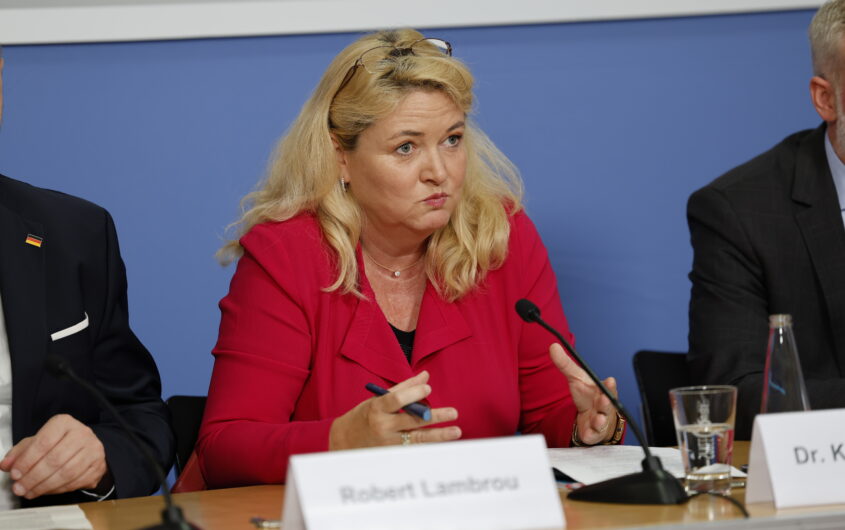
Kristin Brinker has led Berlin’s AfD since defeating Beatrix von Storch for the state chair position in 2021. Having been a member since the party’s founding in 2013, Brinker’s roots run deep in the party, but her demeanor is different. Unlike von Storch and other members of the party, Brinker’s rhetoric is softer. She is a self-proclaimed “people person,” hoping to construct a more “respectable face” for the AfD. Yet her positions remain closely aligned with the national party, moderating the presentation of the AfD’s policies rather than the party’s stances.
From Volunteer to State Chair
Brinker was born in Saxony-Anhalt in 1972, a “classic working-class child of the GDR.” Brinker’s connection to former Soviet control represents a broader trend for AfD support; former East Berlin leans more in favor of the AfD than the west.
From 1991 to 1994, Brinker trained as a bank advisor, and from 1994 to 1999, she studied architecture, receiving her doctorate in 2005. Her experience in finance, project development, and real estate management contributed to her previous role as the budget and finance speaker for the Berlin AfD. Brinker’s entry into politics was somewhat unconventional: she began by volunteering with her husband, Günter Brinker, while he served as the first chairman of the Berlin AfD. After he lost his re-election in 2016, she was instead asked to run for the Berlin House of Representatives (Berlin’s state parliament) sixth on the AfD’s party list. Of the twenty-five AfD representatives elected that year, she was one of three women representing the AfD.
Within the next five years, she gained enough prominence within the party to run for state chair against Beatrix von Storch. The previous state chair, Georg Pazderski, was a proponent of an AfD with softer policies, becoming more moderate to appeal to potential coalition partners and voters. Members on the right of the party were displeased, finding the course to be overly centrist. Other party members were dissatisfied with the division forming in the party through these policies.
Brinker channeled these critiques in her campaign for chair. She accused Pazderski of creating a climate of mistrust, poor treatment of staff, and dividing the party internally. Brinker’s own discontent with Pazderski ran deeper. He was partly responsible for the ousting of Günter Brinker as party chairman in 2016. In August 2020, she stepped down as the deputy parliamentary group leader in exasperation with Pazderski amid a legal conflict with the auditor’s report and the group’s finances. As she campaigned for party chair in 2021, she highlighted this episode as evidence of the leadership’s poor financial management.
Beatrix von Storch, by contrast, supported Pazderski, even seeking a dual leadership structure with Pazderski as co-chair. When delegates shut down this proposal at the party convention, she was left to run alone against Brinker. Von Storch does not hold profoundly different views than Brinker; these factions emerged from internal power struggles rather than a true ideological split.
The election took four rounds of voting, and even then, Brinker won narrowly with 50.2 percent of the vote. As the new chair, Brinker hoped to “bridge divides,” while being a “breath of fresh air” after Pazderski’s leadership.
Contradiction or Cohesion?
Brinker is frequently painted as a liberal voice within the party. She emphasizes how she joined the AfD because of the euro bailout and misuse of taxpayer money. By contrast, von Storch prioritizes hard-line immigration policies and constitutional issues. While Brinker believes these issues give the party a sharp edge that drives away Berliners, she still aligns with von Storch and the broader party’s positions.
This tension between Brinker’s public rhetoric versus real political associations is perhaps best illustrated in her engagement with, and consequent denial of, far-right organizations. Brinker’s 2021 election to state chair was only made possible by votes from former members of the far-right Flügel (Wing) faction, which the AfD disbanded in 2020 for extremism after it came under surveillance by the German domestic intelligence office. Later in July 2021, Brinker participated in an interview with a far-right monarchist newspaper, Deutsche Geschichte. Europa und die Welt (German History. Europe and the World). She denied knowing the paper’s true extremist perspectives. In 2023, she attended a meeting with Austrian identitarian leader Martin Sellner and far-right German activist Götz Kubitschek. She denied knowing they were in attendance and stated that upon learning they were there, she left immediately. However, another guest, the AfD’s lead candidate for the European Parliament Maximilian Krah, responded that she stayed well into the night.
What Brinker Offers Berlin
Brinker achieved the party unity she sought in 2021. In 2023 and 2026, over 90 percent of the Berlin AfD supported her renomination as the AfD’s top candidate. Her success and connections across the party have proven resolute. Recently, she met with Ulrich Siegmund, leader of the AfD in Saxony-Anhalt. She continues working with von Storch despite earlier tension. Whereas in the late 2010s the party was riddled with leadership disputes, today’s unity has allowed the party to continue growing in prominence within the nation’s capital.
In Berlin, as of July 2026, government dissatisfaction sat around 78 percent. Housing prices remain high, and in 2025, crime rose. When reports revealed that Mayor Kai Wegner responded to the January power outage with a few text messages and a tennis game, comments about Wegner’s dishonesty overpowered the conversation about the entire CDU, prompting his resignation from the 2026 campaign on July 10. Despite resigning, distrust in the CDU has been sown by both his actions and comments from other candidates. Brinker herself did not waste this public dissatisfaction, stating that “Kai Wegner has failed not only politically, but also morally. Berlin can’t afford such a liar.” She has also criticized the CDU for administrative backlog and being overly liberal in debt use.
As housing remains financially inaccessible and in short supply, Brinker blames migrants. She believes that those who have lived in Berlin or were born in Germany ought to be given priority over asylum seekers. To that end, Brinker hopes to end the asylum process in Berlin. Brinker wants to increase police funding, creating a district police force specialized in searches and identity checks. On July 25, 2026, the AfD utilized a terrorist attack on a Berlin gay pride festival led by a man of Lebanese descent to continue the conversation against immigration. Brinker called for Berlin’s protection “from violent Islamists.”
The anti-migrant rhetoric is characteristically AfD. In true populist fashion, it is tailored to the people’s dissatisfaction: housing and crime. Brinker’s motto, “Berlin. Stark. Machen,” offers a direct response to the questions and concerns felt by the people of Berlin. By appealing to the interests of the people, the traditional AfD messages are consequently accepted, and the softer tones associated with the Berlin AfD have begun to fade. Housing, security, and administrative efficiency are issues shared by the CDU campaign. However, as the people of Berlin are dissatisfied with how these issues have been managed by the current government, the AfD’s growth in the polls indicates that Berliners are turning to a more radical approach in hopes it may generate better results.
The Firewall Holds
In Berlin, the AfD continues to be met with both protests and support. In 2026 and 2025, the Berlin AfD conventions could not take place within the city because no one would rent the party a hall. In 2025, the relocated convention in Brandenburg an der Havel was met with protesters. Despite these conflicts, support for the AfD in Berlin has grown in 2026.
Regardless of the AfD’s support reaching close to 20 percent, Brinker, as the party’s leader, remains much less popular. This could be because of a lack of name recognition. However, it may also indicate that while Berliners are open to voting AfD candidates into parliament, there is still minimal desire for an AfD member to lead the state. It also highlights a continued expectation that the AfD will remain excluded from governing coalitions despite electoral strength.
There will continue to be a firewall in the Berlin House of Representatives. Even if the AfD may see an increase in parliamentary seats, their success is limited, and it is unlikely that Brinker will find herself in the Rote Rathaus. However, Kristen Brinker’s trajectory highlights the extent of dissatisfaction in Berlin and the greater evolution of the nation into deepened polarization.