
Defense Visual Information Distribution Service via picryl
Germany and Foreign Military Intervention

Jacobsen Gamble
Halle Foundation/AGI Intern
Jake Gamble is a Spring 2026 Halle Foundation Intern at the American-German Institute and a first-year graduate student in the Master of Arts in European Studies (MAES) program at Georgetown University’s Walsh School of Foreign Service. Prior to Georgetown, he earned a Bachelor of Arts in International Relations and Security Studies from the University of Lynchburg, with minors in German, History, and Political Science. While there, he partook in a semester abroad at Freie Universität Berlin to enhance his understanding of German language, politics, history, and culture.
Jake’s research interests include Germany’s role in matters of foreign and security policy, especially pertaining to the Russo-Ukrainian War; the growing influence of the Alternative für Deutschland on German political culture; transatlantic relations, and democracy and authoritarianism more broadly. During his internship at the American-German Institute, he hopes to focus on the increasing intersection of security and culture in Germany.
With wars raging in Ukraine, the Middle East, and elsewhere, Germany is responding with seriousness and urgency. Berlin has committed to spending 3.5 percent of its GDP on defense by 2029, with the goal of having “the strongest conventional army in Europe.” German support for Ukraine has been unyielding, but what about for the United States in its campaign against Iran? Rising prices and diplomatic rows between Berlin and Washington give legitimacy to the idea of possible German involvement, but the prospect remains largely absent.
Although Germany may not become heavily involved in Iran, is there a way that Berlin could decide to take a more supportive position to assist its transatlantic partner? Through historical examples, this article presents four factors that have influenced when and how Germany has supported U.S.-led military engagements abroad: constitutionality, international obligations and systems of collective defense, political will, and national security.
The Post-Cold War Era (1990-1999)
Prior to reunification, West Germany maintained massive armed forces. The looming threat of a Soviet-backed invasion was real, but the end of the Cold War brought about significant downsizing of the Bundeswehr. The question of German military action began to apply less to its own defense, but rather to active deployments outside of NATO territory. In the immediate post-Cold War era, the first test was the Gulf War.
In November 1990, one month after reunification, United Nations Security Council Resolution (UNSCR) 678 was adopted, allowing member states “to use all necessary means” to force Iraq out of Kuwaiti territory. In January 1991, U.S.-led Operation Desert Storm commenced. Bonn contributed financially and provided military aid to Turkey and Israel, but further action was impossible. Chancellor Helmut Kohl was constrained by the Reunification and Two-Plus-Four Treaties; bold international action could have antagonized the Soviet Union, which still maintained forces in Germany. Furthermore, apart from UN peacekeeping missions, Germany was constitutionally prohibited from deploying troops outside NATO’s area of responsibility. This began to change in Somalia and Bosnia.
In April 1993, Kohl’s government announced the deployment of 1,600 troops to Somalia for humanitarian and peacekeeping operations under UNOSOM II (UNSCR 814). The Social Democratic Party questioned the constitutionality of the deployment and submitted a review request to the Federal Constitutional Court; in June, the Court decided that troops could remain if the Bundestag approved, which they did the following month. In July 1994, after the Bundeswehr had exited Somalia, the Court ruled on the “out-of-area” question. This ruling found the deployment of military forces to be constitutional if they satisfy two factors: approval is given by the Bundestag, and deployments occur within systems of collective security, such as NATO or the UN. The Court’s decision effectively reshaped Germany’s post-Cold War international security doctrine. The first real test was Bosnia.
Prior to the Court’s “out-of-area” decision, Germany participated logistically in the UN’s Western Balkans peacekeeping mission, UNPROFOR (UNSCR 743), and in monitoring maritime embargoes (UNSCRs 713 and 757). Chancellor Kohl had ruled out direct involvement of German soldiers in the Balkans, but the bloodshed of Bosnian Muslims warranted increased involvement. NATO’s Operation Deny Flight (UNSCR 816), which enforced a no-fly zone beginning in April 1993, involved German troops aboard surveillance aircraft. That same month, the Court found it constitutional for troops to remain on surveillance planes. The “out-of-area” question, settled in July 1994, allowed for participation in NATO’s Operation Deliberate Force (UNSCR 836), in which Germany provided airbases, fighter jets, and a contingent of 1,500 to 1,700 troops for logistical support to the UN Rapid Reaction Force (UNSCR 998). By the end of the Bosnian War in 1995, questions of constitutionality had been resolved.
The immediate post-Cold War era showcased the development of German military involvement.
President Milošević of Yugoslavia left Western leaders with uneasy feelings. When he started his campaign in Kosovo in 1998, NATO quickly decided on a bombing campaign, Operation Allied Force. This was not sanctioned by the UN Security Council, due to possible vetoes from Russia and China. Germany, now led by Chancellor Gerhard Schröder, was highly supportive of these measures, which did take place in a system of collective defense, thereby satisfying the constitutionality question. The Air Force deployed fighter jets to engage air defense, flew Unmanned Aerial Vehicles for surveillance, and supplied air bases. Ground troops were not committed, except for the Macedonia-based Extraction Force (UNSCR 1203). This was the Bundeswehr’s boldest step in becoming an army of operations, until Afghanistan.
The War on Terror (2001-Present)
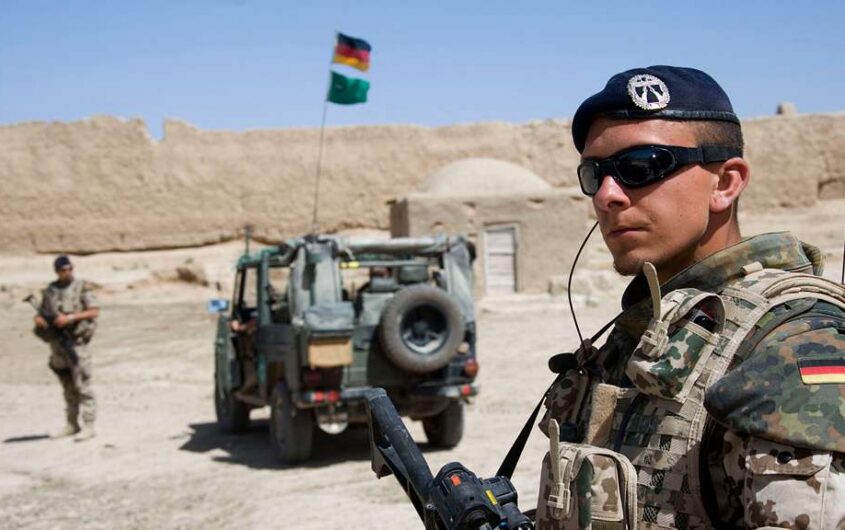
One day after the September 11, 2001, attacks, NATO’s Article 5 was invoked for the first and only time. Chancellor Schröder expressed “unlimited solidarity” with the United States. In November, the Bundestag approved the participation of 100 special forces soldiers in the U.S.-led Operation Enduring Freedom. In December, UNSCR 1386 was adopted, which established the International Security Assistance Force (ISAF). German forces began participating in northern Afghanistan in February 2002 with security, stabilization, and reconstruction mandates under ISAF; until 2014, roughly 132,500 German troops had been deployed. Berlin’s support was robust, in part due to their unwillingness to participate in Iraq. German support continued in Afghanistan through ISAF’s 2015 follow-on mission, Operation Resolute Support (UNSCR 2189), which maintained 1,300 troops for security and police training annually.
Washington’s 2003 invasion of Iraq was not supported by many allies, including Berlin. Grounds for support in Germany were minuscule; the operation was not part of a system of collective defense, there was no threat to national security, and there was simply no political will in the German government. However, Schröder continued to allow the United States to operate its military bases on German soil, which guaranteed unrestricted overflight rights and easy transit for American and other participating nations’ troops.
In response to the brutal crackdown on protests in Libya, the UN Security Council adopted Resolution 1973 in March 2011, which allowed collective defense organizations to take “all necessary measures” to protect civilians. Five members of the Security Council abstained, including Germany, which remained opposed to military action. NATO took up Resolution 1973 under Operation Unified Protector, and although under a system of collective defense, there was no political will in Chancellor Angela Merkel’s government to become involved in another U.S.-led military adventure, despite high opposition to the Gaddafi regime. In 2014, Berlin shifted policy in response to the Islamic State of Iraq and Syria (ISIS).
In June 2014, Iraq asked the United States to intervene to halt the advance of ISIS forces. In August, President Barack Obama ordered air strikes, per Article 51 of the UN Charter, and organized the U.S.-led Operation Inherent Resolve. That same month, the Kurdish Regional Government requested German support, for which the Bundestag approved deliveries of weaponry and training personal. This broke an unwritten rule in Germany of not providing weapons to active conflict regions; however, the basis for these deliveries were rooted in reasons of national security. These justifications were amplified in November 2015 following the Paris Attacks. France requested support per Article 51, UNSCR 2249, and Article 42.7 of the Maastricht Treaty, which gave Berlin legitimate standing in supporting an ally in systems of collective defense. Accordingly, the Bundestag approved the provision of reconnaissance jets, a frigate, 1,200 logistical personnel, and a tanker aircraft for both American and French operations.
To Intervene, or not to Intervene, that is the Question
Since the end of the Cold War, Berlin has become more active in military deployments abroad, and they are not limited to those initiated by the United States. The immediate post-Cold War era showcased the development of German involvement. The conflicts in Iraq, Somalia, and Bosnia led Germany to develop a more assertive role in international military affairs, a role that was largely championed by Chancellor Kohl. When the war in Kosovo began, the question of constitutionality had been settled.
When the war in Afghanistan began, two factors became most relevant: an international legal framework and political will. These factors were present in Afghanistan and later in the campaign against ISIS. However, in the Second Iraq War, they were not; in Libya, a legal framework was present, but political will was not. Furthermore, ISIS introduced a new consideration to Germany: national security.
The question today is whether to support the U.S.-Israeli war against Iran. So far, there is little political will to do so, with some exceptions. Chancellor Friedrich Merz has been openly critical of the campaign, leading President Donald Trump to withdraw 5,000 American troops from Germany, despite Berlin’s accommodating stance allowing American forces to use military bases in Germany for the operations. Furthermore, the campaign in Iran does not meet the German constitutional requirement for an international legal basis. Even if NATO or the UN were involved, the decision would depend on Bundestag approval.
Still remaining is the factor of national security. Due to the war, Germany is experiencing negative economic impacts, such as rising prices, supply chain issues, and consumer uncertainty, but this may not be enough to outweigh other considerations. However, according to extremism expert Hans-Jakob Schindler, Tehran could try “to increase the economic and political costs of military confrontation globally by using terror attacks,” as has been done before. State branches of Germany’s domestic intelligence agency have warned that threats of extremism and terrorism may be heightened, but Merz and other leaders have downplayed this threat. Still, possible future developments may lead to a more pronounced role for Berlin. After all, soon the Germans will have the strongest military in Europe.