
German Federal Archives via Wikimedia Commons
Militant Democracy

Jacobsen Gamble
Halle Foundation/AGI Intern
Jake Gamble is a Spring 2026 Halle Foundation Intern at the American-German Institute and a first-year graduate student in the Master of Arts in European Studies (MAES) program at Georgetown University’s Walsh School of Foreign Service. Prior to Georgetown, he earned a Bachelor of Arts in International Relations and Security Studies from the University of Lynchburg, with minors in German, History, and Political Science. While there, he partook in a semester abroad at Freie Universität Berlin to enhance his understanding of German language, politics, history, and culture.
Jake’s research interests include Germany’s role in matters of foreign and security policy, especially pertaining to the Russo-Ukrainian War; the growing influence of the Alternative für Deutschland on German political culture; transatlantic relations, and democracy and authoritarianism more broadly. During his internship at the American-German Institute, he hopes to focus on the increasing intersection of security and culture in Germany.
The Party Banning Process in Germany
The prospect of banning Germany’s premier right-wing populist party, the Alternative für Deutschland (AfD), now classified as a suspected extremist party, is a topic of intense debate. Since Chancellor Friedrich Merz’s election last May, the Bundestag has faced an increasingly relentless AfD, which now leads in the polls. Because of this, a Parteiverbot (party ban) could be politically fraught. Despite this, conversations about banning Germany’s most popular political party continue among lawmakers in Berlin.
Following the end of World War II, the Federal Republic sought to prevent the rise of antidemocratic forces. In pursuing this goal, the concept of militant democracy was enshrined in the Grundgesetz (Basic Law, Germany’s constitution). German philosopher and historian Jan-Werner Müller defines militant democracy (wehrhafte/steitbare Demokratie) as “a democratic regime which is willing to adopt pre-emptive, prima facie illiberal measures to prevent those aiming at subverting democracy with democratic means from destroying the democratic regime.” According to Germany’s domestic intelligence agency, the Federal Office for the Protection of the Constitution (BfV), militant democracy is necessary “to prevent rights and liberties from being exploited with a view to abolishing the free democratic basic order.”
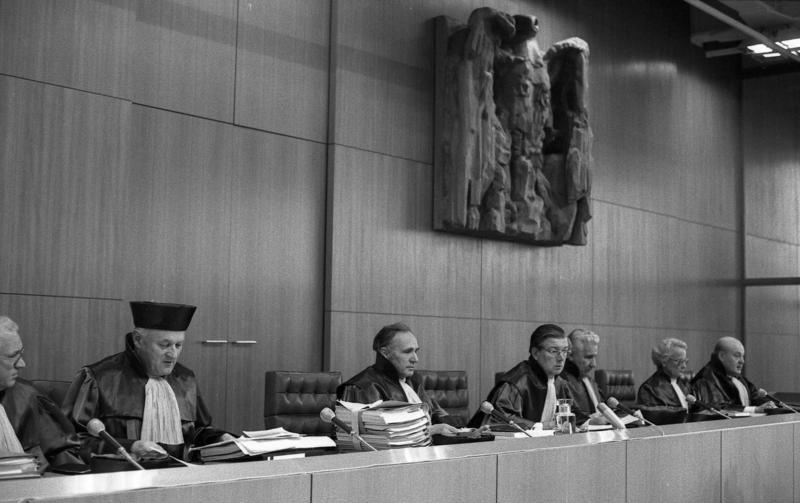
To prevent the destruction of democracy, Article 21 of the Grundgesetz, specifically paragraphs 21(2), 21(3), and 21(4), allows for political parties to be banned. Paragraph 21(2) states that parties that “seek to undermine or abolish the free democratic basis order or to endanger the existence of the Federal Republic of Germany shall be unconstitutional.” Paragraph 21(3) cuts state funding to parties deemed a danger to democracy, pursuant to paragraph 21(2), while paragraph 21(4) gives the Federal Constitutional Court (Bundesverfassungsgericht) in Karlsruhe the ultimate authority to decide whether a party is unconstitutional or not.
In addition to the Grundgesetz, the Federal Constitutional Court Act of 1951 set guidelines for the banning procedure. Section 43(1) mandates that applications for bans can only go through the Bundestag, Bundesrat (upper house of parliament), or the Bundesregierung (federal government). Section 43(2) allows the same institutions in the Bundesländer (federal states) to submit a Parteiverbot, but only if the party is confined to the territory of that state.
To prove that a party is unconstitutional, strong evidence is required, for which the BfV is responsible. The agency has three tiers of classification for these parties: “observation, suspicion, and confirmed designation as ‘definitely extremist.’” The lowest level, observation, starts with the collection of open-source intelligence, while suspicion and confirmation entail more intricate measures, such as the usage of undercover informants, confidential sources, wiretapping, photography, audio recording, and message interception, among other methods. It is important to note that, while the extremism confirmation helps gather evidence for the banning process, it is not a prerequisite to ban a party. Ultimately, a party simply must have the goal of overthrowing the free democratic order.
History of the Parteiverbot
Although closely associated with Germany, the Parteiverbot has been used by many democracies. In response to Adolf Hitler’s attempted coup, the 1923 Beer Hall Putsch in Munich, the Nazi Party was banned by Bavarian authorities until 1925. In Austria, the Prohibition Act of 1947 banned the NSDAP, affiliated organizations, and successive parties that embrace Nazi rhetoric and actions, such as the National Democratic Party in 1988. Many more European democracies have used this tool before, but so have autocracies, albeit for very different reasons. For instance, as of 2024, Russia has banned fifty-three political parties, while Turkey has banned twenty-three.
Since the founding of the Federal Republic of Germany in 1949, there have been two instances of party bans: the 1952 ban of the Socialist Reich Party and the 1956 ban of the Communist Party of Germany. Two attempts were made in 2003 and 2017 to ban the National Democratic Party, but these were unsuccessful.
The Socialist Reich Party (SRP) was formed in 1949 as one of Germany’s first postwar neo-Nazi parties. Members of this party employed actions, rhetoric, and style that were strikingly similar to those used by the Nazi Party. In 1950, the party was classified as confirmed extremist, and in 1951, the SRP made strong strides in regional elections. In Lower Saxony and Bremen, the party received 11 percent and 8 percent of the vote, respectively; in local elections, these results were even higher.
In November 1951, Chancellor Konrad Adenauer’s government filed an application for a Parteiverbot, although it was accompanied by little evidence. However, party leaders made a series of incriminating statements, which, along with the party’s impressive electoral performance, led to the SRP’s ban in October 1952. In its judgment, Karlsruhe believed that the SRP wanted to “dismantle the political system, liquidate human rights guarantees and revive antisemitism.”
When Adenauer’s government submitted the SRP application, it was done in conjunction with a bid against the Communist Party of Germany (KPD). This party, formed in 1918, had a history of turbulence and violence, particularly during the interwar period. From 1933 to 1945, under the Third Reich, the party was banned, along with all other political parties except the NSDAP. After being reestablished following the end of World War II, the KPD experienced a short-lived boost in the first federal elections in 1949, garnering over 5 percent of the vote.
If subject to a ban, the AfD could claim that the undemocratic machine is working against them. On the other hand, if the governing coalition is to solve its AfD problem “through better politics,” then it is time to start.
After the government submitted its ban, the Communists decided to resist, unlike the SRP, which dissolved prior to the Court’s ruling. In the 1953 federal elections—the first after the nation-wide 5-percent threshold was introduced into the Bundestag—the KPD’s support officially began to wane. The party only achieved 2.2 percent of the vote, which meant no seats in the Bundestag. This led to the Communists’ “Program for the National Reunification of Germany,” which advocated for the “revolutionary struggle of German patriots,” “revolutionary overthrow of the Adenauer regime,” establishment of a “dictatorship of the proletariat,” and reunification with East Germany under a complete, Soviet-style German state. In 1956, after a nearly five-year process, Karlsruhe found the KPD to be averse to democracy, resulting in a ban.
Unlike the SRP and the KPD, the National Democratic Party (NPD), despite portraying “racist, anti-Semitic, and revisionist” views, a “recognizable affinity” for the NSDAP, and a militant nature, never received a Parteiverbot from Karlsruhe. In 2003, the case was dismissed because it was unclear whether the NPD’s misdemeanors were carried out by party members or undercover BfV informants. In 2017, Karlsruhe argued that the “NPD pursues anti-constitutional goals but at the moment there is an insufficient weight of evidence to make it appear possible that their behavior will result in success.” The party only received 1.3 percent of the vote in the 2013 federal elections, confirming its insignificant footprint. However, in 2024, the NPD, under its new moniker, Die Heimat (The Homeland), had its right to public financing stripped by the Court, despite failing to reach the 0.5 percent threshold required for a party to receive funding.
Clear and Present Danger
In May 2025, the Alternative für Deutschland was classified as a certified extremist party by the BfV. According to the intelligence agency, the party’s “ethnicity- and ancestry-based conception of the people that predominates within the party is not compatible with the free democratic order.” In response, the AfD’s co-leaders, Alice Weidel and Tino Chrupalla, claimed this to be a “heavy blow” to democracy. U.S. Secretary of State Marco Rubio called the designation “tyranny in disguise.”
In February 2026, the BfV’s extremist designation was put on hold by the Cologne Administrative Court, which claimed that, despite evidence of potential unconstitutionality, there was not sufficient justification to believe that the entirety of the party possessed extremist ideals. However, the verdict of the case is ongoing and still allows the BfV to surveil the party as a “suspected extremist” party.
Among lawmakers in Germany’s democratic parties, the AfD is broadly viewed as an enemy or danger to democracy. For them, the question is whether to pursue a Parteiverbot or not. An attempt was pursued in early 2025, when a cross-party coalition of 124 lawmakers motioned for a ban; ultimately, it failed due to lack of support. Within the governing coalition, the SPD officially favors a ban, while Merz’s CDU, although maintaining its non-cooperation position, does not. Instead, the chancellor hopes to govern the AfD out of significance. However, there could be ramifications for both solutions.
If subject to a ban, the AfD, which is leading in polls at roughly 27 percent, could embrace the victim frame and claim that the undemocratic machine is working against them. Furthermore, a quarter of the electorate would effectively be disenfranchised. On the other hand, if the governing coalition is to solve its AfD problem “through better politics,” then it is time to start. Just 15 percent of Germans are satisfied with Chancellor Merz’s performance, while 83 percent are not, due to the perception that his promised reforms have not materialized. Although the next federal election takes place in 2029, if reforms do not materialize soon, the AfD will likely continue to pull ahead.
Despite these hurdles, the authorities may have one other method to limit the AfD’s influence. According to German investigative outlet Correctiv, the Federal Constitutional Court Act may allow the banning of state party branches classified as extremist by the BfV. A state-level Parteiverbot could not be done by a state government, due to the AfD’s nationwide status, but perhaps through an application made by the Bundestag, Bundesrat, or federal government. German constitutional law experts argue that this could be a solution, one which diminishes the AfD incrementally; however, this approach is subject to debate among legal scholars and could still yield negative political consequences. For Georg Maier, the Interior Minister of Thuringia and member of the SPD, the problem remains clear: “If [Germany’s] democracy does not show its weapons, the AfD will destroy it.”