
J.-H. Janßen via Wikimedia Commons
Looking for Germany’s Future in the Former East

Tim Eydelnant
Non-Resident Fellow
Tim Eydelnant is a former senior U.S. Foreign Service Officer with more than two decades of experience in transatlantic affairs, diplomacy, humanitarian response, and public policy.
Most recently, he served as Executive Director of the Shalom Hartman Institute’s Washington, DC, Center for Judaism, Israel, and Public Policy, where he helped build a new platform for engagement with policymakers, think tanks, and international organizations around questions of democratic resilience, antisemitism, pluralism, and the future of the transatlantic relationship.
Previously, he was a Senior Diplomatic Fellow at the Wilson Center, where his research focused on the rise of antisemitism and extremism in eastern Germany following October 7, as well as broader societal fragmentation in Central and Eastern Europe.
During his Foreign Service career, Tim served as Principal Officer (Consul-General) at the U.S. Consulate General in Leipzig, Germany, where he directed U.S. engagement in Saxony, Saxony-Anhalt, and Thuringia, worked closely with Jewish communities and civil society partners, and led initiatives related to Holocaust remembrance, democratic resilience, and U.S.-German relations in eastern Germany. His diplomatic assignments also included Jerusalem, Iraq, Austria, Brazil, Russia, and Finland, as well as senior Washington roles in the Bureau of Energy Resources, the Bureau of Population, Refugees, and Migration during the Syrian refugee crisis, Consular Affairs, and the State Department Operations Center.
He is a graduate of Georgetown University’s School of Foreign Service and the National Defense University’s Eisenhower School.
A Week in Saxony
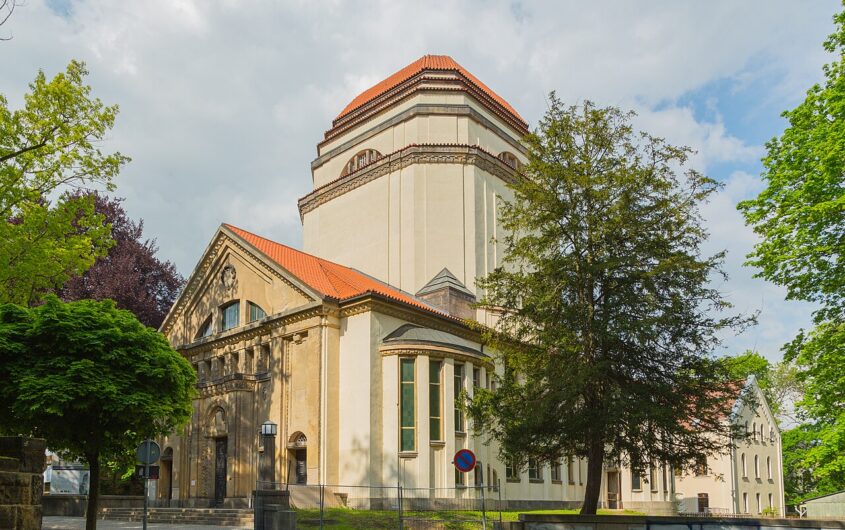
On a warm Friday evening in late June, nearly 140 people gathered inside the former synagogue in Görlitz, Germany’s easternmost city. They had come from the United States, Israel, Canada, Argentina, Norway, and beyond. What united them was family history: parents, grandparents, or great-grandparents who had once lived in Görlitz and the surrounding towns of Upper Lusatia before the Nazi regime forced them to flee or murdered most of those who could not.
Earlier that day, they had stood on residential sidewalks as new Stolpersteine were set into the pavement, each marking the last home of a Jewish family before the Holocaust. That evening, they welcomed Shabbat together and celebrated a Bar Mitzvah for the first time since the Holocaust, a moment almost impossible to imagine eighty years ago.
I could not think of a better place to begin thinking about eastern Germany today.
I had returned to Saxony six years after concluding my assignment as U.S. Consul General in Leipzig. Officially, I came for Jewish Week events and to speak about Jewish life in America. In practice, I spent the week doing what diplomats rarely stop doing: listening. I spoke with entrepreneurs, officials, old friends, and ordinary Saxons. Their conversations revealed a region wrestling with economic anxiety and political frustration but also something less noticed, the quiet resilience of communities determined to build rather than withdraw. The Germany I encountered was more complicated than either its critics or admirers acknowledge.
The story of Görlitz’s Jewish community should have ended in 1945. Before the Holocaust, Jews had been integral to life in Görlitz. Like countless other German Jewish communities, it was destroyed through persecution, deportation, and murder. For decades, few imagined that descendants of those families would return, not as visitors to memorial sites, but to celebrate Jewish life again.
Yet the Shabbat and the Bar Mitzvah were not hosted by the city, a local congregation, or even the descendants. Both were organized by young Jews living in the region and a chapter of the Jewish youth organization TaMaR to hold services where Jewish practice had effectively ended in 1938. That detail matters. In much of eastern Germany, Jewish life does not reappear on its own or through remembrance programs alone. It returns when individuals take personal responsibility for reviving it.
The Holocaust sought to erase not only individual lives but a civilization, and every Bar Mitzvah in a building the Nazis had emptied is a quiet answer to that effort. Görlitz became a lens: eastern Germany is not a region defined by its past, but one struggling, through the initiatives of a determined few, to shape its future.
Renewal remains possible even where pessimism has become familiar.
During my three years as Consul General, from 2017 to 2020, I came to know a region that rarely reached international headlines: capable local leaders, active civil society, and a Jewish community quietly rebuilding. This visit was different. Without the responsibilities of official representation, conversations became more candid, many made possible by local partners such as the Deutsch-Amerikanisches Institut Sachsen (German-American Institute Saxony). Friends no longer saw me as a U.S. government representative but as someone interested in how their country had changed. One theme emerged almost immediately: people wanted to talk about politics. Not American politics, despite the inevitable questions about Washington, but German politics: economic stagnation, bureaucracy, immigration, and disappointment with Berlin. The tone surprised me. It was less anger, more fatigue.
One evening in Leipzig offered an unexpected metaphor. Germany’s national soccer team was knocked out of the World Cup on a shootout loss to Paraguay. There was shouting in the streets that night, but by morning, the city had returned to normal, little outrage, only quiet acceptance that another source of national pride had fallen short. Perhaps I read too much into a match. Yet the mood seemed to fit a country grown used to lowering its expectations.
A small-business owner who runs stores in both Bavaria and Saxony described herself as politically moderate. She had voted for Chancellor Friedrich Merz, hoping his government would make it easier to run a small business. Instead, she spoke of frustration with bureaucracy, labor regulations, and a political class she saw as detached from the realities facing employers. When I asked about rising support for the Alternative for Germany (AfD) in the east, her answer was revealing. She did not defend the party’s ideology; she had real reservations about it. But she believed many eastern business owners increasingly saw a vote for the AfD less as an endorsement than as a protest, a way of signaling that the established parties had stopped listening. What struck me was the motivation: not ideology but the loss of confidence that government understood everyday life.
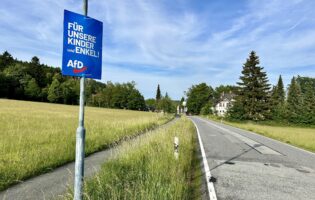
That distinction is about to be tested. On September 6, voters in neighboring Saxony-Anhalt go to the polls, and the AfD is running far ahead, polling around 41 percent against roughly 26 for the governing CDU. Its lead candidate, Ulrich Siegmund, has named an open goal—an absolute majority, something no far-right party has achieved in a German state since 1945. The state’s own domestic intelligence service classifies the party as confirmed right-wing extremist, and every other party has so far refused to govern with it, the so-called firewall. Yet the numbers complicate that reading. Asked not which party they prefer but whom they want as minister-president, voters put the AfD candidate behind the CDU’s, a sign that some of that 41 percent is protest rather than conviction. The uncomfortable truth is that the distinction may not hold much longer. A protest sustained election after election stops being a protest. It becomes power.
The train from Munich to Leipzig was a reminder that Germany’s internal borders have not vanished, though not in the way outsiders expect. Munich in summer feels almost Mediterranean, polished and confident. But the east is not visibly poorer. After decades of investment and transfer payments from west to east, towns around Leipzig and Dresden can look newer than their Bavarian counterparts: renovated facades, resurfaced squares. The unease shows only in the cracks. Behind the fresh paint are families with far less inherited wealth, villages quietly emptying, and reminders of a world that never fully disappeared: an old Trabant, a Freie Sachsen banner, the occasional Russian flag. Eastern Germany is in many ways a success story, and yet grievance politics keeps gaining ground, a pattern we Americans may recognize from the Rust Belt. Thirty-six years after reunification, the former East remains recognizable, not in poverty, but in habits, expectations, and public mood.
Germans call it the Mauer im Kopf, the Wall in the mind. Eastern Germans were not simply absorbed into a unified state; they lived through a rupture in which institutions vanished, careers were invalidated, and towns lost their young. Western expertise arrived, sometimes helpfully, sometimes arrogantly. For many, it brought freedom; for others, humiliation. That history still shapes politics and explains why protest parties thrive where people feel studied, managed, and judged more often than heard.
Yet, the most important lesson from my week in Saxony was not pessimism. On my first evening in Leipzig, I met young Jews at the Torah Zentrum (Torah Center). We discussed the Book of Jeremiah and its instruction to the exiled community in Babylon to “seek the welfare of the city.” Many in the room were building Jewish lives where, not long ago, Jewish continuity could not be assumed. Later I visited the Ariowitsch-Haus, a center of Jewish life in Leipzig, where the community is not merely preserving memory but creating programs, educating the young, welcoming immigrants, and giving Jewish life a public presence. The region is not simply a landscape of resentment, easily reduced to polling numbers or AfD headlines. It is also full of people working to sustain civic life, from officials keeping cities running under budget pressure to citizens keeping friendships across political divides. Those efforts rarely make headlines. They may matter more.
The temptation is to choose a single story—the east as a warning, economically frustrated and vulnerable to extremism, or the east as misunderstood, patronized by western elites and reduced to election maps. Both contain truth; neither is sufficient.
What I saw was a region caught between grievance and renewal. The grievances are real, and this fall they may hand the far right its strongest result yet. But eastern Germany is not waiting passively for decline. In Leipzig and Görlitz, I saw communities rebuilding and investing in the future, and Jewish life offered the clearest counter-narrative: in places where history should have ended, people were beginning again. Societies do not renew themselves through optimism alone, but when people keep building even as the mood darkens.
That is why I kept returning to Jeremiah. His message to the exiles was not sentimental: not that history would be easy or belonging natural, but that they should build houses, plant gardens, raise families, and seek the welfare of the city where they lived. That instruction is not only theological. It is civic.
A week in Saxony did not leave me with easy optimism. It left me with something more serious: evidence that renewal remains possible even where pessimism has become familiar. Germany’s future will not be decided only in Berlin, Munich, or Brussels. It will also be decided in places like Leipzig and Görlitz, and this September in Magdeburg, where the burdens of history are unmistakable, the frustrations real, and the work of rebuilding civic trust continues, quietly, imperfectly, but still.