

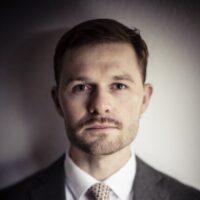
Leonard Schuette is an International Security Program Fellow at the Belfer Center for Science and International Affairs, Harvard Kennedy School. His work at the intersection of academia and policy focuses on European defense, transatlantic relations, and the crisis of multilateralism.
Previously, he was a senior researcher at the Munich Security Conference, a DAAD Fellow at the American-German Institute, a visiting researcher at the University of Oxford, and an O’Donnell Fellow at the Centre for European Reform in London.
Leonard has co-edited recent Munich Security Reports and co-authored The Survival of International Organisations (OUP). He has also published various policy briefs and academic articles in journals such as International Affairs and the Journal of European Public Policy. He also regularly provides commentaries for newspapers and briefings for decision-makers.
Leonard holds a PhD from Maastricht University, an MPhil from Cambridge University, and an MA from the University of St Andrews.
During his fellowship at AGI in 2024, Dr. Schütte built on previous research to develop a typology of rebalancing options for the transatlantic relationship, with a focus on NATO and Ukraine policy. Whichever way the U.S. elections go, the next U.S. administration will likely shift at least some resources and attention away from Europe, given the multiple parallel threats to the United States, ballooning public debt, and an underperforming defense industrial base. Rebalancing can take many forms, however. Between the extreme ends of the spectrum—with a formal U.S. withdrawal from NATO and abandonment of Ukraine on the one and the status quo on the other end—there are various shades, each with different policy implications. Based on interviews with (former) officials and experts, this project spelled out the various scenarios, which in turn can serve to inform European policymaking.
Episode 148: Weaponized Interdependence in a Changing International System
The United States has exploited strategic networks and dependencies to its advantage in foreign policy. As the international system has transformed, more countries seek to play at the game of …

Seize the Burden
A European Initiative to Put NATO on a Sustainable Footing Shortly after entering office in 2021, U.S. President Joe Biden exclaimed at the (virtual) Munich Security Conference that “America is …

Leonard Schütte, DAAD/AGI Research Fellow
AGI is pleased to welcome Dr. Leonard Schütte as a DAAD/AGI Research Fellow in March and April 2024. Dr. Schütte is Senior Researcher at the Munich Security Conference, where he …