
Lang Jingshan via Wikimedia Commons
Here Today and Gone Tomorrow
Kevin Ostoyich
Valparaiso University
Prof. Kevin Ostoyich was a Visiting Fellow at AGI during the summers of 2017 and 2018. He is Professor of History at Valparaiso University, where he served as the chair of the history department from 2015 to 2019. He is also Guest Professor at the Center for Applied Policy Research at Ludwig Maximilian University of Munich and Historian for the Florence and Laurence Spungen Family Foundation. Prior to moving to Valparaiso, he taught at the University of Montana. He has served as a Guest Professor at the Institute of Bavarian History at Ludwig Maximilian University of Munich, Fellow at the Käte Hamburger Kolleg at Ludwig Maximilian University of Munich, Eadington Fellow at University of Nevada Las Vegas, Fellow at the Center for Advanced Studies at Ludwig Maximilian University of Munich, Distinguished Guest Professor at Shanghai University, Senior Fellow at the German Historical Institute Pacific Regional Office/University of California, Berkeley, Research Associate at the Harvard Business School, and Erasmus Fellow at the University of Notre Dame. He currently is an associate of the Center for East Asian Studies of the University of Chicago, a board member of the Sino-Judaic Institute, and an inaugural member of the Shanghai Jewish Refugees Museum International Advisory Board. He has published on German migration, German-American history, the Holocaust, and the history of the Shanghai Jews. He holds his BA from the University of Pennsylvania and his AM and PhD from Harvard University.
While at AGI, Prof. Ostoyich conducted research on his project, “The Wounds of History, the Wounds of Today: The Shanghai Jews and the Morality of Refugee Crises.” The Shanghai Jews were refugees from Nazi Europe who found haven in Shanghai and thus escaped the Holocaust. For this project Ostoyich interviewed many former Shanghai Jewish refugees and conducted research at the National Archives at College Park, MD, and United States Holocaust Memorial Museum. At Valparaiso University he co-teaches a course titled “Historical Theatre: The Shanghai Jews,” which fuses the disciplines of history and theatre. To date, he has written and produced four original plays with university students based on the history of the Shanghai Jewish refugee community: Knocking on the Doors of History: The Shanghai Jews (2016), Shanghai Carousel: What Tomorrow Will Be (2019), The Singer of Shanghai (2020), and Lyrics and Laughter from Shanghai: A Relevant Cabaret Evening with Historical Commentary (2025). He has been involved in the creation of two films: Gary’s Letter (2024) and Three Girls of Shanghai (2024).
Click here for an article by Ostoyich on the Shanghai Jews.
He is currently trying to interview as many former Shanghailanders as possible. If you would like to be interviewed or know someone who might want to be interviewed, please contact Professor Ostoyich at kevin.ostoyich@valpo.edu.
Helga Silberberg and Shanghai’s Life Lesson
Under the watchful eye of the policeman, the Meyer family packed their belongings into the wooden container.[1] This intrusion into the Meyer residence was not out of the ordinary for Jews living in Berlin in 1939. Samuel Meyer, husband to Lieselotte and father of Helga, had spent time in a Berlin jail the previous year for nothing more than being Jewish. Lieselotte had been reluctant to emigrate, not wanting to leave her parents. But Samuel had had enough. He thought the time had come for Jews to flee the country. As so often was the case, Samuel Meyer was right.
After the last items were packed into the container, the policeman sealed it and left. Enclosed within were all the things the Meyers were allowed to take with them out of the country, including items Samuel had selected from his furniture store. Absent was the family jewelry. Initially, Samuel had been informed that the family would be allowed to bring their jewelry with them on their journey. All Samuel needed to do—it was said—was submit an inventory list of their jewelry to the authorities. This Samuel did. Afterwards, Samuel was informed that this permission had been revoked, and Jews were forbidden to take jewelry out of the country. Armed with Samuel’s meticulous list, the Berlin authorities knew exactly what jewelry the Meyer family had to hand over. One piece escaped the clutches of the Nazis, however.
Samuel had forgotten about it when he had filled out the inventory form. Consequently, as the Meyer family fled Nazi Germany for Shanghai, China, they were accompanied by six-year-old Helga’s little gold ring.
A Marriage of Love
Samuel (Sally) Meyer was born in Sullenschin, Germany, on September 26, 1881.[2] His birthplace was transferred from Germany to the newly constituted Poland after the First World War, the so-called “War to End all Wars.”[3] Unfortunately for the members of the Meyer family—including Samuel, who had served in the war—this appellation did not stand the test of time.[4] Samuel was the third of nine children born to Heymann (Hermann) and Pauline (née Warschawski) Meyer.[5] Helga does not know much about her paternal grandparents; they both died well before she was born. She says ruefully that she had been told that her grandfather had a pub and was his own best customer. Samuel had six brothers, Adolf, Arthur, Bruno, Julius, Max, and Walter, and two sisters, Hedwig and Wally. After perhaps eight years of schooling, Samuel set out to learn the business trade. He found initial success with spices but eventually set up a furniture store in the Spittelmarkt section of Berlin.
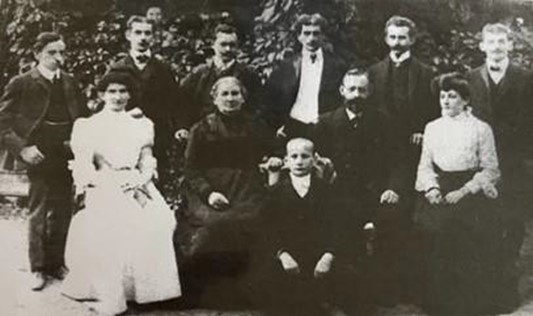
Top row from left to right: Bruno – Arthur – Max – Samuel (Sally) – Adolf – Walter
Sitting from left to right: Wally – Pauline (née Warschawski) Meyer – Heymann (Hermann) Meyer – Hedwig Meyer
Squatting in center: Julius Meyer.
Photo courtesy of Helga Silberberg.
On February 1, 1931, Samuel became engaged to Lieselotte Schlesinger. Lieselotte’s parents, Richard[6] and Martha[7] (née Salomon) Schlesinger, were from Posen but lived in Berlin by the time Lieselotte was born on July 20, 1910. Richard worked as a salesman for a large company that sold office supplies. Martha was a homemaker. In addition to Lieselotte, the Schlesingers had an older daughter named Kaete (sometimes Käthe or Kaethe), who was born on January 11, 1903.[8]
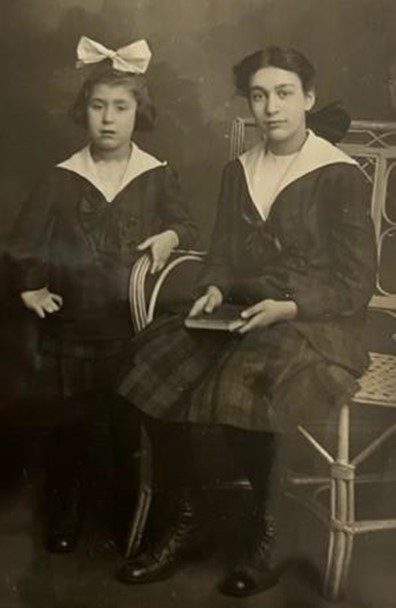
Photo courtesy of Helga Silberberg.
The members of both the Schlesinger and Meyer families were not thrilled with the match. Samuel was twenty-nine years older than Lieselotte. Richard and Martha Schlesinger thought Samuel was too old for their daughter, and the members of the Meyer family believed Lieselotte was after Samuel’s money. Samuel and Lieselotte were undaunted. Helga says unequivocally that her parents’ marriage was one of love, pure and simple. On November 8, 1931, Samuel and Lieselotte got married. Unfortunately, there are no photographs of the wedding because the photographer never showed up.
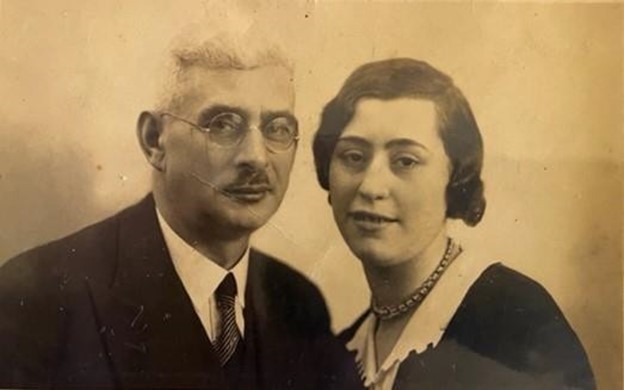
Photo courtesy of Helga Silberberg
Born on November 25, 1932, Helga is the only child of Samuel and Lieselotte Meyer. Two months after her birth, Adolf Hitler came to power. The family lived on Neue Grünstraße in Berlin. Samuel’s furniture store was located just a few blocks away on Wallstraße. The store was successful until Germans were no longer permitted to buy goods from Jews.
Helga remembers the beautiful bakery across the street from the Meyers’ apartment. She also remembers attending a Jewish kindergarten. Her most vivid memories, though, are of spending weekends with extended family members and visiting her maternal grandparents. The Schlesingers had a huge apartment. As Helga remembers, “Besides the living quarters, [my grandfather] also had the supplies there because he would deliver what he sold.” Helga played hide-and-go-seek in her grandparents’ apartment with her cousin, Inge. Inge was six years older than she, and, until Helga came along, the only grandchild. Thus, Helga thinks she must have been a nuisance to her cousin.[9] Inge was later murdered in Auschwitz.
In July 1938, Samuel was incarcerated in Berlin for a few days by the Nazis. Helga explains that her uncle, Arthur Rainowitz (husband of Samuel’s sister, Wally), had a store and was arrested off the street. He was asked if he wanted to contact anyone. He called his daughter, Anni Rau, to give her the keys to the store. When Anni came to the station, she was detained as well. The authorities then played the same trick on Anni, asking if she wanted to contact anyone. She said, “Yes, I want to call my uncle, to tell him where I am.” So, Anni called Samuel. Samuel went to the station and was likewise detained. The same trick was attempted on Samuel, but he saw through the ruse and refused to call anyone. Helga explains that neither her mother nor her Aunt Wally knew what had happened, so they went out looking for Samuel, Arthur, and Anni. When Lieselotte went to the police, she was told that if the Jews did not do anything wrong, they would be released in a week. Helga says that her father, Uncle Arthur, and Anni were indeed eventually released, but the incident had a decided impact on her father. Samuel had already wanted to leave Germany prior to this incident but had deferred to Lieselotte’s reluctance to leave her parents. After the stint in jail, Samuel would defer no longer. He was going to find a way to get the family out of the country.[10]
A few months later, the Nazis conducted the nationwide pogrom referred to as Kristallnacht, or the “Night of Broken Glass” on November 9/10, 1938. Thousands of Jews throughout the country were rounded up and sent to concentration camps at this time. Samuel managed to evade the Nazis. Helga explains that her father had noticed that the Nazis only tended to go into residences where there were men. So, as the Nazi stormtroopers wreaked havoc throughout Berlin, Samuel stayed with two female relatives for a few days until things blew over.
After Kristallnacht, Samuel resumed his search for a way out of Germany. Helga believes her father may have tried to get the family to the United States. Samuel’s younger brother Julius was living there.[11] But, given that Samuel’s birthplace had become part of Poland after the First World War, Helga believes her father would have been confronted with the dim prospects of America’s Polish quota. She notes that the “Polish quota did not have good numbers to get to the United States.” Ultimately, the family did not go to the United States; Samuel procured tickets for Shanghai instead.
Having packed the container in front of the policeman, the Meyer family traveled by train to Genoa, Italy, in April 1939. From Genoa they journeyed to Shanghai on the SS Conte Rosso of the Italian Lloyd Triestino company.[12] Helga remembers enjoying the voyage. She says,
I was a kid…There were lots of other kids aboard ship, and we roamed around everywhere, and it was just a lot of fun. Only now thinking back: “What my parents have gone through going into the unknown?” But we kids had fun on board that ship. It was a very nice ship. We had a nice cabin.
Samuel, Lieselotte, and Helga had no idea what to expect in Shanghai. Helga explains, “Shanghai was at the end of the world. People had heard of it, that it’s a big metropolitan city. But that was about it.” On May 7, 1939, they arrived in the city known as the Paris of the East with their sealed wooden container. The container had accompanied them from Berlin to Genoa by train and had crossed the Mediterranean Sea, the Suez Canal, the Red Sea, and the Indian Ocean on the ship. Although the family jewelry was not enclosed within it, the household goods and furniture that were, would serve them well in their new “home.” Many of the approximately 16,000 to 20,000 refugees who fled to Shanghai were not as fortunate as the Meyers to arrive with such a container.
Skinny in Shanghai
When Samuel, Lieselotte, and Helga arrived in Shanghai, the sealed wooden container was not foremost on their minds; Lieselotte was very sick and needed immediate medical attention.[13] Helga explains,
The arrival was traumatic due to the fact that my mother was ill, and they took her off the ship by ambulance and took her to a hospital. And my father and I, with the rest of the immigrants, were put on trucks, and we were taken to a place called the Embankment Building, which belonged…to [Victor] Sassoon[14]…and…there were big, huge rooms, and they separated the men from the women. I had never been by myself. So, here I was amongst a whole bunch of strange women and decided, I guess, to sit on the side of the bed and cry. And my father was desperate. So, he tried talking to some ladies, and then finally they said, “Okay, everybody is dressed, you can come into the room to get your daughter.”
Fortunately, this was only a temporary situation. Samuel’s nephew, Paul, the son of Samuel’s brother, Walter, had been in Shanghai since 1937 working under a contract with an English company.[15] Paul was living with a Jewish family and asked the family if Samuel and Helga could stay with them for a few days until other lodgings could be found. The family agreed to take them in, and Samuel and Helga stayed for about a week. Paul’s brother, Heinz, had arrived in Shanghai on the SS Conte Rosso with Samuel, Lieselotte, and Helga. Samuel’s brother, Walter, later fled to Shanghai with his wife, Caecilie, and their son, Arno, in 1940. Given that there were no more ships going from Italy to Shanghai at this time, Walter, Caecilie, and Arno traveled through the Soviet Union on the Trans-Siberian Railway.[16] In addition to their three sons, Walter and Caecilie had a daughter, Ruth. Ruth had gotten married to Hans Moses in Berlin and had immigrated to the United States.[17] Thus, all the members of Samuel’s and Walter’s respective families survived the Holocaust. Not all of Samuel’s and Walter’s siblings were as fortunate.
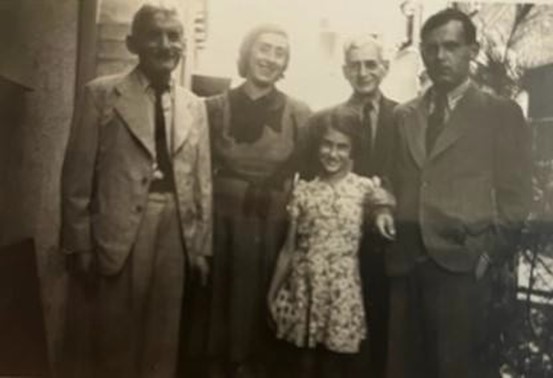
Left to right: Walter, Lieselotte, Helga, Samuel, and Heinz
Photo courtesy of Helga Silberberg
When Lieselotte was released from the hospital, the Meyers moved into an apartment in the rundown district in the northeastern part of Shanghai known as Hongkew. Helga describes their new residence:
The apartment was in a little house. The house was in a big lane…. The lanes in Shanghai…were long and sideways. The houses were usually tiny, and each house—like the one we lived in—there was [an] “apartment” down below. The apartment consisted of one big room, one little room. Cooking area outside…. The same scenario was on top. And then there was one little room, which was just for one person to live in…. We had a little bit of money, if we sold stuff we brought to be able to pay the rent. And the house belonged to a Jewish person from Austria, and for some reason he decided to sell it, but he didn’t tell my father about it, because, at that time, my father would still have been able to buy that house from him.[18]
The Austrian Jewish man had sold the house to a Russian lady. Samuel, Lieselotte, and Helga were able to keep the downstairs apartment, but a Russian couple moved into the upstairs apartment. The Russian man often got drunk and abusive. He beat up his wife and the landlady. He even tried to come down to the Meyers’ apartment, but Samuel was able to keep the man outside. The Meyers stayed in this apartment until early 1943.
Helga says her father was a remarkable man, who always was able to make do with very little. Samuel managed to see to it that the family had at least one meal a day. When they arrived in Shanghai, Samuel started to manufacture and sell screen doors and windows in the city.[19] When winter came around, however, Samuel saw his sales dry up. Thus, he decided to make and sell lard instead. Helga says he continued to sell lard, “for a couple or three years.” Meanwhile, Lieselotte worked as a seamstress in the apartment.
In February 1943, the Japanese—who had expanded their control of the city of Shanghai in December 1941 concurrent with the attack on Pearl Harbor—issued the Proclamation for the formation of a Designated Area within the Hongkew district. According to the Proclamation, all stateless persons who entered Shanghai after January 1, 1937, had to move into the Designated Area. The Meyers’ apartment was located within the Designated Area, so the Proclamation did not force them to move. Nevertheless, they were soon kicked out of their apartment. The Russian lady sold the house to a Japanese man, who proceeded to show up at the Meyers’ apartment, slap Samuel, and command, “Out next week!” Helga explains the reality at the time: “You had no rights whatsoever. The Japanese were the occupying force in Shanghai. And, by that time, there were no other living facilities but the camps. So, that’s when we moved to the camp.” By “camps” Helga means the various large Heime, which provided barracks-style lodgings for the most impoverished of the refugees. (Heim, literally “home,” is the singular form; Heime is the plural form.) The Meyer family moved into the Chaoufoong Road Heim. In the Heim, the Meyer family shared a room with twelve other people. Helga was the only child. For privacy, blankets and sheets were hung up, and Helga and the others got “dressed and undressed in bed because there was no other space.” This was the living arrangement for the family until Samuel became sick with colon cancer in 1944. He was then granted permission to leave the Designated Area to have a colectomy in the exclusive section of the city known as the French Concession. When Samuel returned, the family was given their own room in the Chaoufoong Road Heim for privacy. They lived in this tiny room until they left Shanghai after the Second World War ended.
When the family had had to move to the Chaoufoong Road Heim, Lieselotte had to find another place to work, because there was no space for her to sew in a room occupied by fifteen people. A friend let Lieselotte set up her sewing machine in her apartment. It turns out that on July 17, 1945—a date that remains forever etched in the memories of Shanghai refugees—Lieselotte’s life was saved by this friend’s lunch. On that day, American bombers—who were targeting nearby military installations—accidently hit the Designated Area. As the bombs exploded, some three dozen European refugees and hundreds of Chinese were killed. Helga recounts what happened to her mother that day:
You didn’t have electricity for irons. You had to warm them on a coal stove. And, that was that one day in July, that Mom had to iron the dress to deliver. And her friend had to cook her lunch. So, [the friend] said, “I’ve got to finish my lunch, then you can have the coal stove to do the ironing.” It saved her life. And so, she ironed, and she took off to the client’s house to deliver the dress. The bombardment started while she was going there, and a Chinese guy pulled her into his store and made her sit under his counter. When she came out, there were all kinds of dead and wounded on the sidewalk. She could not go to the lady’s house because that lady’s house had been bombarded. So, she came home.
My dad and I, we were standing watching people come and the stretchers come with the wounded, with the dead, we were waiting for her. She finally came. The lady that she was supposed to deliver to was okay. Both her husband and son had been wounded. And the lady was so grateful to have that dress that my mother had made for her [when my mother was finally able to give it to her] because it was such a hot day, she was in a slip having lunch, she had nothing to wear. That was the only thing she had.
While Samuel sold lard and Lieselotte sewed dresses, Helga attended school and grew skinny in Shanghai.
Helga’s earliest memories of Shanghai are of adjusting to the cultural norms in China.
She explains,
There were all the Chinese customs to get accustomed to. We were living amongst the Chinese, actually. Although there were lots of immigrants, but the Chinese lived there too. So, memories of going and buying boiled water—you weren’t allowed to drink the water. And you used to…buy little wooden sticks, and for each stick you got a bowl of water, and then I was told, “When you get the water, you be sure to make sure it’s boiling, that the Chinese guy doesn’t give it to you before it’s boiling!” And I wasn’t that tall at seven, eight years, so I had to really go over and see. [She laughs.]
For Helga one of the most positive aspects of Shanghai was the Shanghai Jewish Youth Association School, also known as the SJYA or Kadoorie School, after its main benefactor, the Sephardic Jewish philanthropist, Horace Kadoorie. At first, the school was in a building owned by the government, the Shanghai Municipal Council. The building was located on Kinchow Road. The Shanghai Municipal Council then took the building back. After this there were about four or five months without school, then, with the support of Horace Kadoorie, the school reopened in a U-shaped building at 627 East Yuhuang Road in 1942. Helga says that after the school reopened, “They really were set on wanting to make up for the time we lost; we never had more than two weeks of vacation at a time.”
She remembers what school was like before the Japanese took over the city in December 1941: “Well, in the beginning…some of the teachers were British. There was one teacher, Mrs. Beresford, she was really, really nice…. But…after Pearl Harbor, all the British subjects were interned in Shanghai, so then our teachers were either Russian Jews…and a lot of German Jewish teachers.” The Shanghai Jewish Youth Association School was located a few blocks outside of the Designated Area that the Japanese set up in spring 1943. “And we had to go to the well-known Ghoya and had to get little cards which we hung around our necks. That was the permission for us to go to school. But that didn’t mean we could wonder around anywhere else. It was just go to school and back home.” Helga refers here to the infamous Kanoh Ghoya, the Japanese official who oversaw the distribution of passes out of the Designated Area. Ghoya, who styled himself as the “King of Jews,” often mistreated the refugees who applied for the passes. Given his diminutive size, he often saved his most demeaning tactics for tall Jewish men. The refugees, in turn, viewed Ghoya as an unstable clown. Helga’s only interaction with Ghoya was when her family went to get the passes for her to go to school, and she too thought Ghoya ridiculous: “It was kind of funny. We had to stop myself from laughing because [Ghoya] had all these stamps and he went sticking them all over, and I was a kid, and I thought that was very funny.”
Helga did not particularly care for her Hebrew and Physical Education classes at the Shanghai Jewish Youth Association School. She remembers receiving a bad grade in the latter. She explains, “In school, sports really wasn’t my thing.” She had to participate though, and it did not go well. She explains, “I was quite skinny as a girl, because I grew pretty fast, but there wasn’t that much food, so I was skinny.” In gymnastics class, when someone would throw a heavy ball at her, she would just step aside. Her gym teacher was not very happy about this.[20] After she received a bad mark, her cousin, Heinz,[21] who also was a teacher, went to the gym teacher and said, “You know, your subject isn’t really important enough to ruin my cousin’s report card! [She laughs.]” Helga was clearly not athletic. She says she also has it in writing from her report card that she cannot sing. She laughs and says, “Dancing wasn’t my forte either!”
Despite unfortunate run-ins with Hebrew words, musical notes, dance steps, and gymnastics balls, Helga’s memories of attending the Shanghai Jewish Youth Association School are overwhelmingly positive. She says, “The school was really arranged to make us all feel at home there. It was a great part of the life in Shanghai, at least for me.” She says that they even received meals in school. She laughs and says, “It wasn’t very good stuff, but it was something to eat.” Thinking back on the eight years of instruction in the Shanghai Jewish Youth Association School—the only formal education she ever received—Helga says, “on the whole it was excellent.” She laughs as she says that her grandchildren still send things to her and ask, “‘Omi, will you spell check this for me?’ ‘Yes, I will spell check it for you because I can write!’” She particularly enjoyed her mathematics, history, and geography classes in the school, and she notes that the mathematics she learned in Shanghai served her well later during her career.
Although her experiences with the gym teacher were not so favorable, Helga has positive memories of the teachers on the whole. One teacher stands out above all others: Gunter Gassenheimer. Helga says, “My class teacher for many years was Mr. Gassenheimer…he was an excellent teacher, not just as a teacher, but as a [person].” Helga is far from alone among former Shanghai refugees in highlighting the good character of Mr. Gassenheimer. Mr.
Gassenheimer’s care for his students went beyond Shanghai. Helga explains that after Mr. Gassenheimer immigrated to the United States, he would look up the passenger lists for all the ships arriving in San Francisco so that he could greet his former students when they arrived. This Mr. Gassenheimer did when Helga arrived in 1947. Helga laughs and says, “That was quite an effort in those days!” In the United States, Gassenheimer changed his name to Gates and became a rabbi in Alameda, California.
Although the Shanghai Jewish Youth Association School provided much of the structure and substance in the lives of the refugee children, there was more to being a kid in Shanghai than books, gym, and arithmetic. Kids also enjoyed playing games, pursuing hobbies, and participating in clubs. Helga points out that she and the other refugee children in Shanghai often had to make do with very little when it came to toys and games. She says,
I had some dolls that we brought along from Germany. In later years, we made our own toys or board games, at least. We got quite inventive because there was nothing to buy. So, we made our own. And I remember us making something like a Monopoly game [this was known as Shanghai Millionaire] and we kids used to play with that.
She also remembers playing Ludo in Shanghai. She says that, in the Heim, “we always found stuff, games to play.” Helga particularly liked anything having to do with paper. When her maternal grandparents were still able to send post to Shanghai, they sent her a package of materials with which to play post office. Her grandfather, Richard Schlesinger, it should be remembered, was an office supplies salesman. He loved collecting stamps, and so, too, did his daughter, Lieselotte. Helga inherited her grandfather’s and mother’s philatelic passion; She explains,
So, I started with these [postal materials from my grandparents] and then it evolved. Shanghai had inflation, so I could go with my girlfriend to the post office to the philatelic section and buy stamps for practically nothing because, due to the inflation, these stamps were not worth anything. And a little bit, we fooled around. But now it has grown out of hand, I must say! [She laughs.]
By “out of hand,” Helga is referring to her continued passion for stamp collecting. Decades after having received in Shanghai the postal materials her grandparents had sent from Berlin, Helga is still playing post office.
Helga joined the Girl Guides in Shanghai; however, her membership in that organization was fleeting. One night the troop did not return from an outing until 10 p.m. Samuel Meyer would have none of that. Helga remembers, “My father and all the other parents were terribly worried. And my father said, ‘That’s the end of the Girl Guides, if they don’t have enough sense to bring you girls home at a decent time.’” More important to Helga than the Girl Guides was the Jewish organization known as Brith Noar Zioni. She explains,
I belonged to that group for many years. It was within the camp, and all the people in the group lived in the camp. So, we got together a lot. And it was all kinds of activities. We had a theater group. We performed theaters within the camp. And we met fairly often because it was our main thing to do there.
Although she was neither a singer nor a dancer, Helga was quite involved in theater. She says, “When it came to reciting stuff and learning things by heart, that I could do.” Helga still has newspaper articles from Shanghai about the theater plays in which she participated. She says that the Brith Noar Zioni group was very much interested in Zionism and Israel. Although Israel would not become a state until 1948, Helga explains, “It was very pertinent. Because at that time [while living in the camp in Shanghai], we all knew how important Israel would be to us Jews.”
Helga does not remember having much, if any, interaction with anyone but refugees in Shanghai. She explains that the refugees were basically an enclave onto themselves. She does not remember interacting with Sephardic Jews, Stateless Russian Jews, or children of other nationalities. She knows that other children interacted more with Chinese children than she did; however, she simply did not interact much with Chinese children, even when her family lived in the lane apartment. She adds, “Afterwards in camp, of course, there were no Chinese whatsoever.”
Helga remembers the end of the war well. She says, “There was a lot of jubilation, and some of the Jewish boys went out and smacked the Japanese up pretty good. There with their vent up anger.” Not too long afterwards, American sailors arrived in Shanghai. She remembers the city being full of them:
They used to come to our school. They used to attend our Friday night services even sometimes. I remember once, we were very daring; we were in a little boat, and we went around the war ships, and they threw chewing gum down on us. Of course, the city was full of American sailors at that time, and there were many Jewish sailors who came to the Jewish institutions.
Soon after the end of the war, jubilation was tempered by the grim news of what had happened in Europe. Lists of those who were killed in the Holocaust started to appear in Shanghai. Helga recalls, “Then, of course, the news started coming in, and one didn’t know what there was, you know. There were these long lists. People used to look at the list, looking for names.”
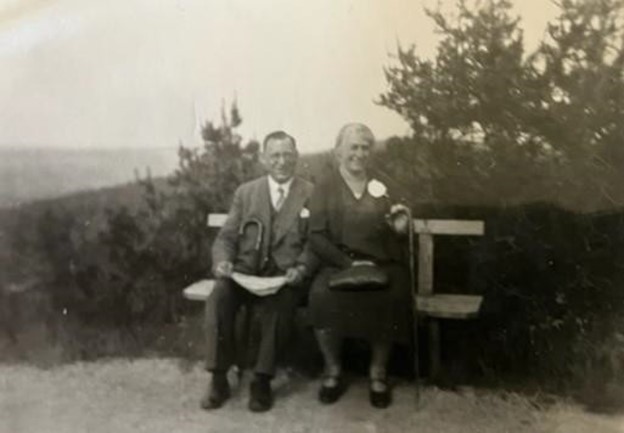
Photo courtesy of Helga Silberberg
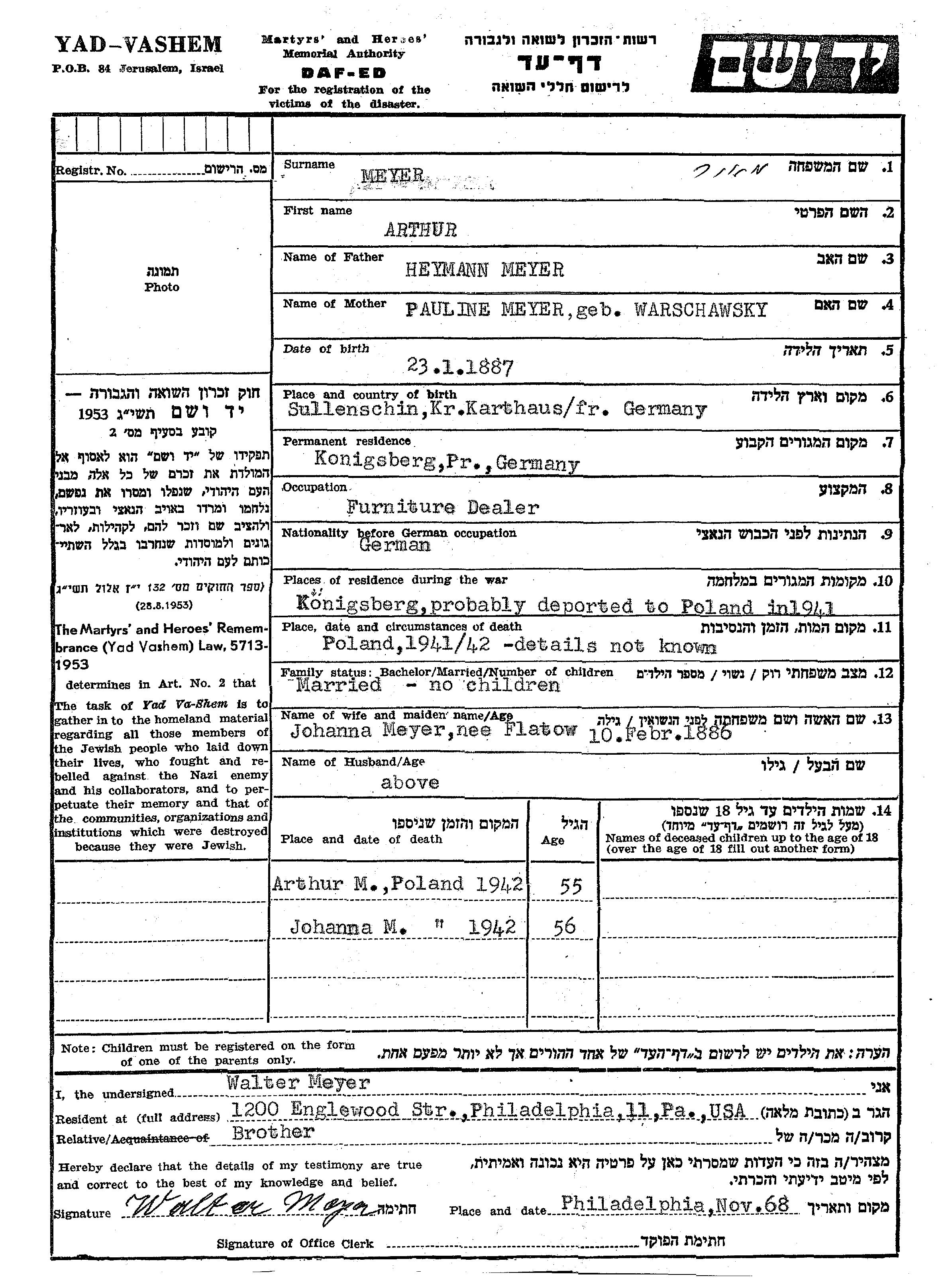
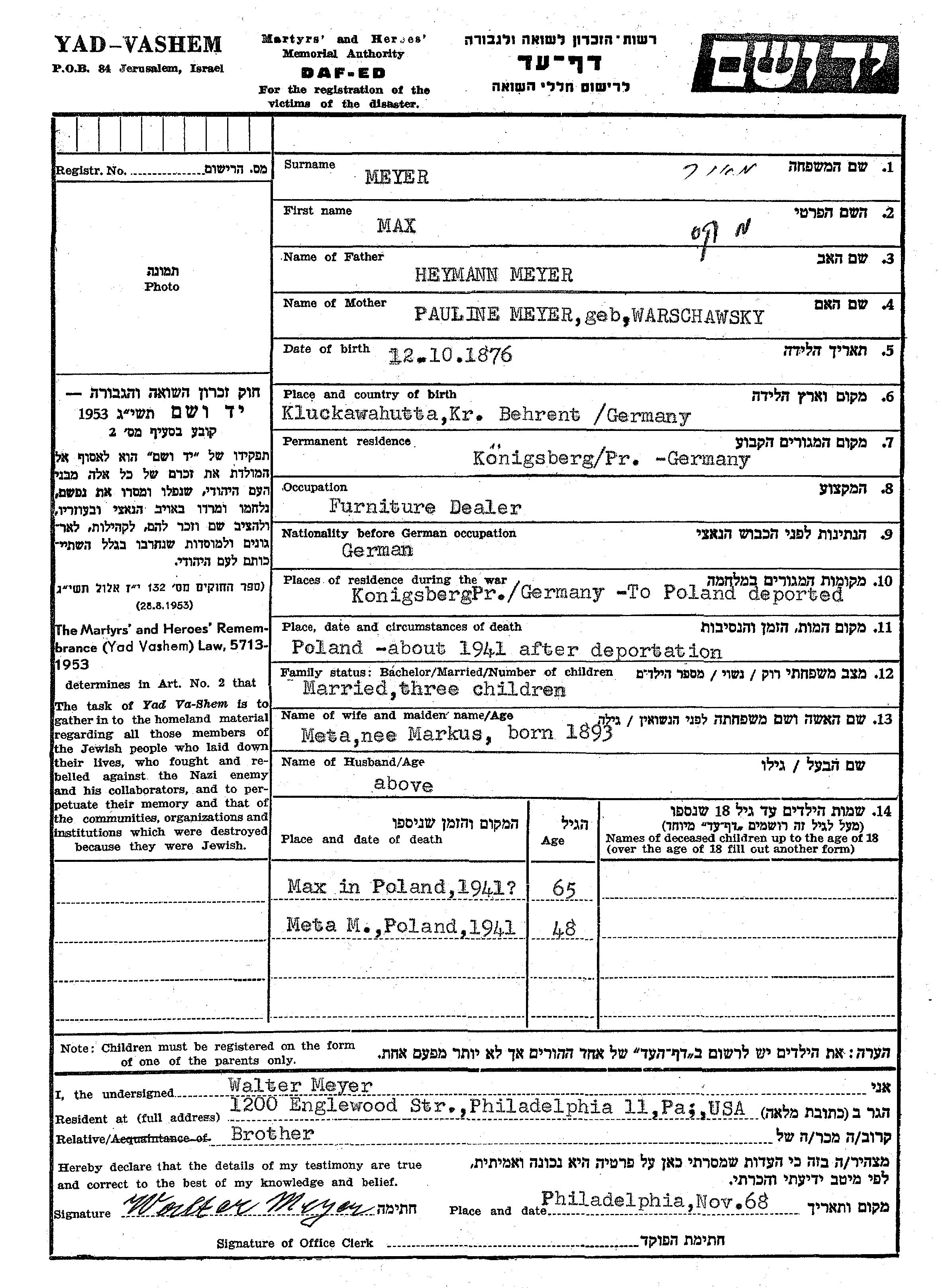
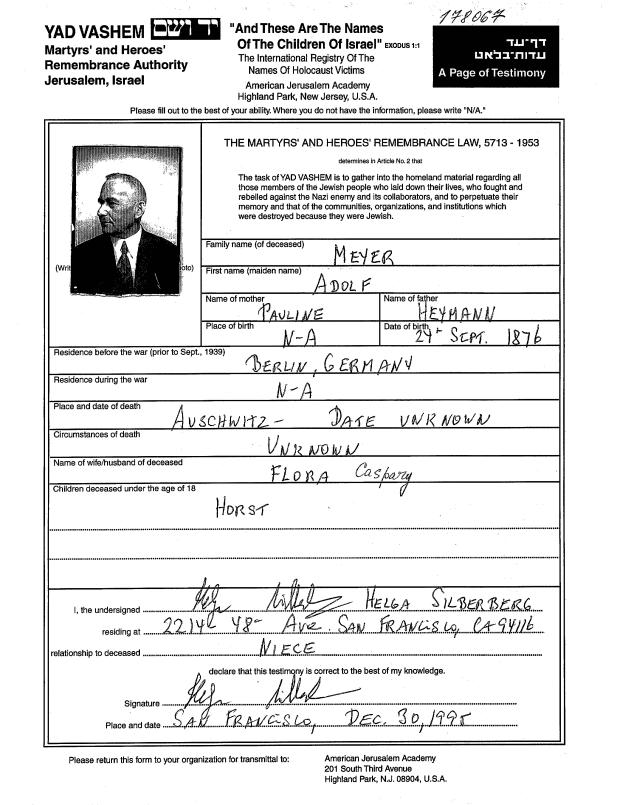
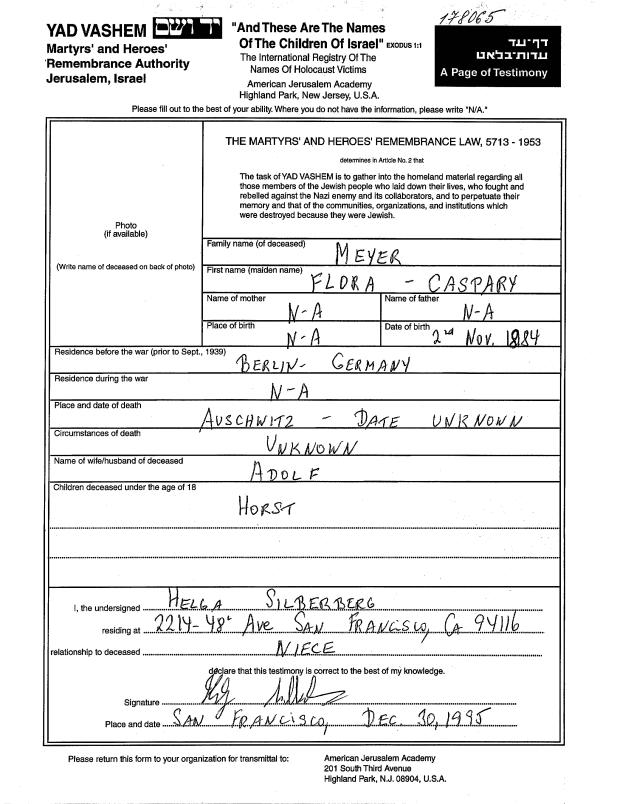
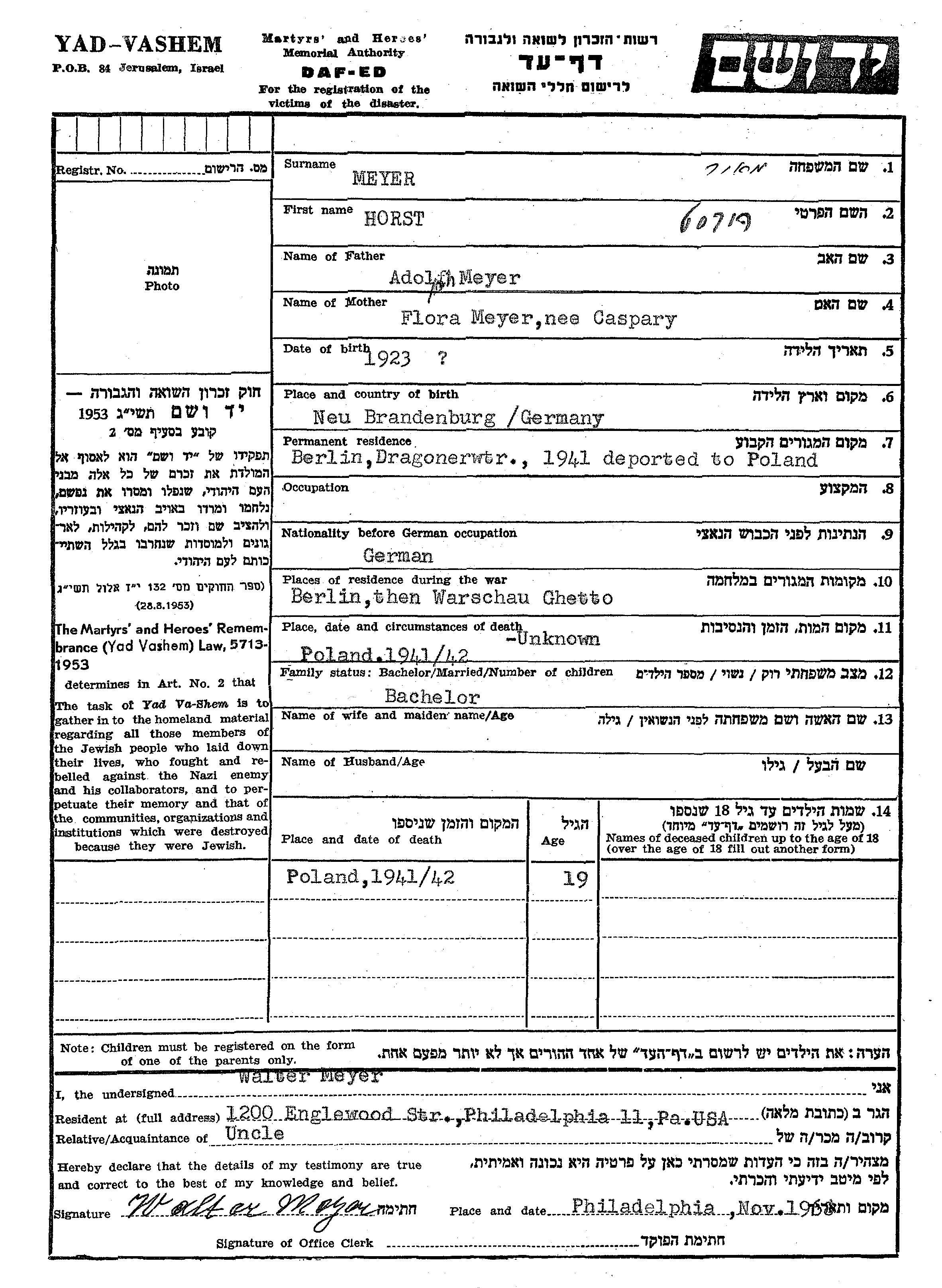
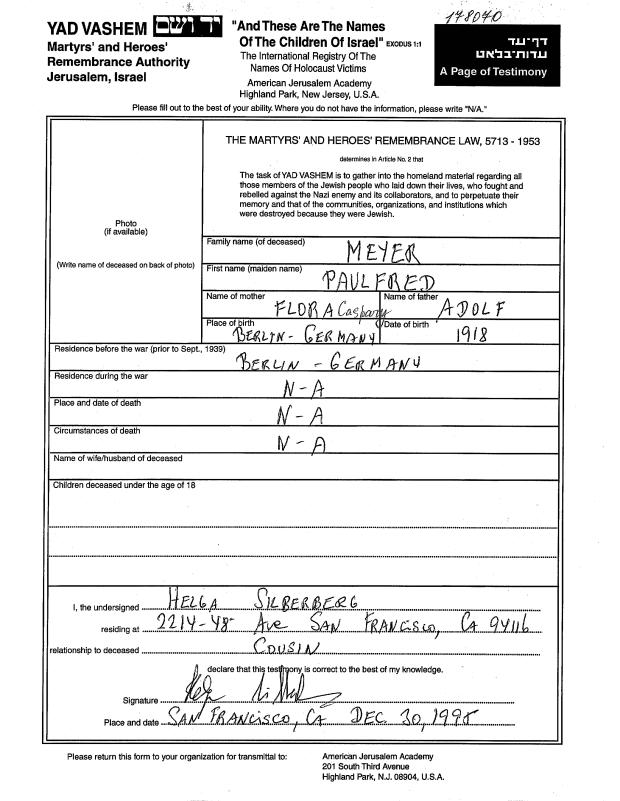
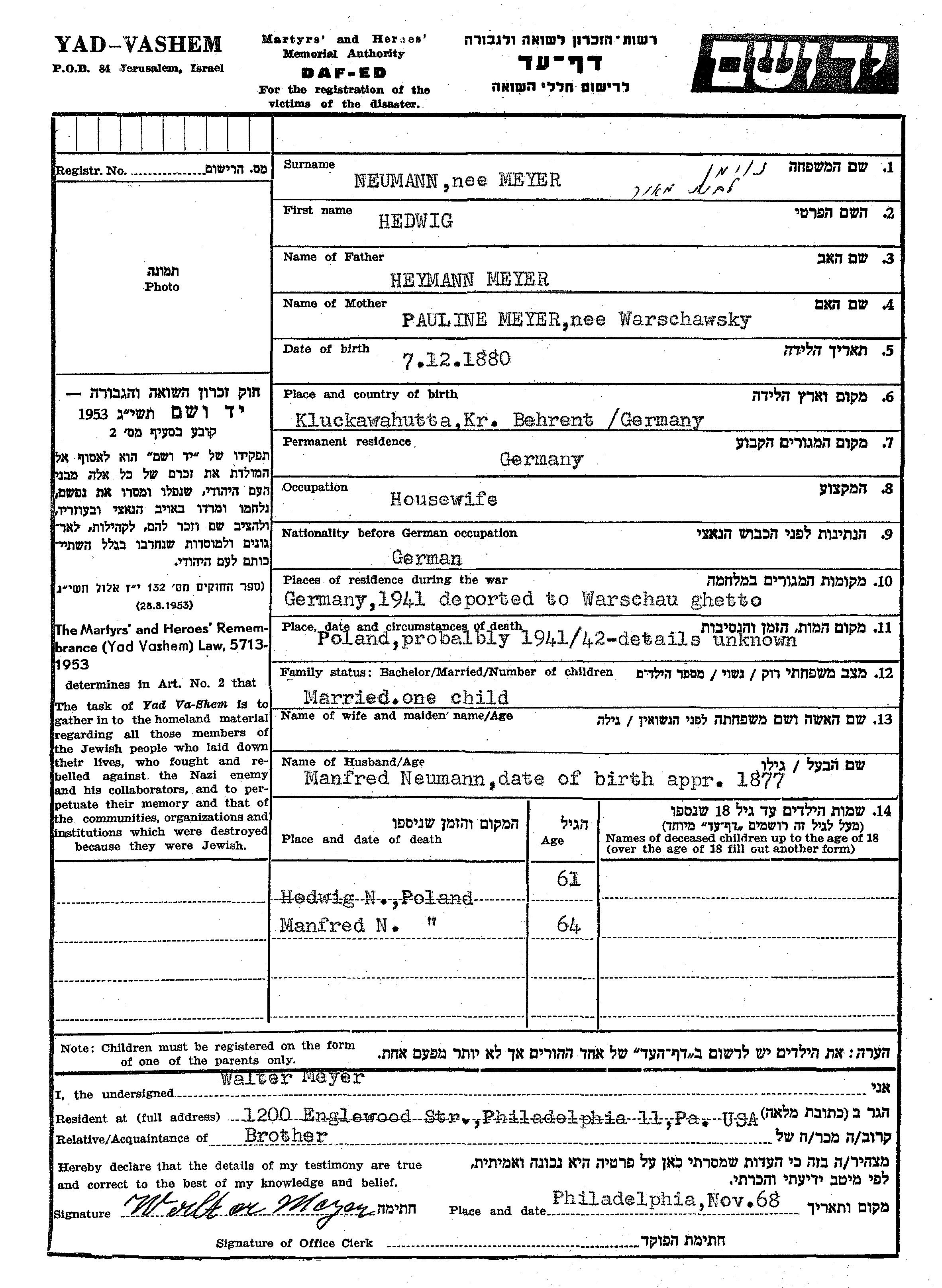
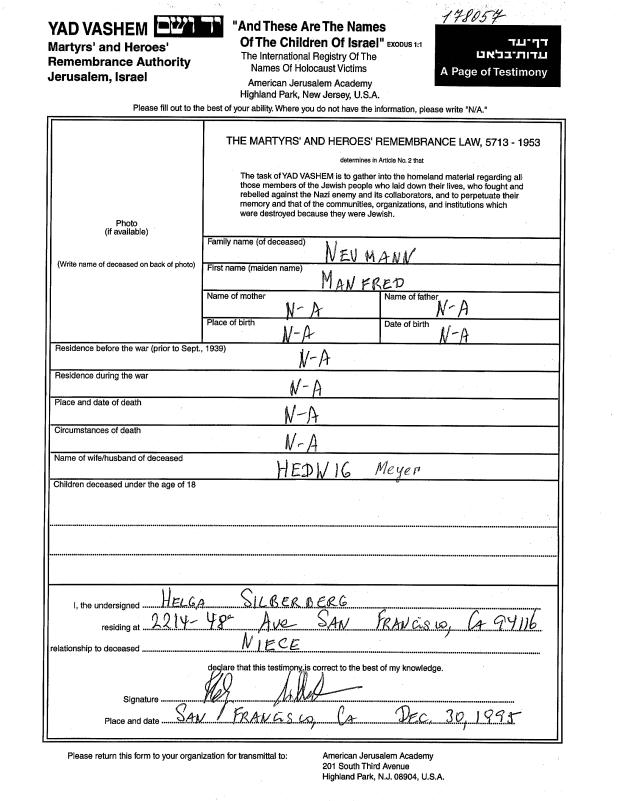
The news for the Meyer family was grim.[22] Eleven members of Samuel’s family were killed in the Holocaust: His brother, Max Meyer, and his wife, Meta;[23] his brother, Arthur Meyer, and his wife, Johanna;[24] his brother, Adolf Meyer, and his wife, Flora, and their sons, Paulfred and Horst;[25] and his sister, Hedwig, and her husband, Manfred Neumann, and their son, Meinhard.[26] All the members of Lieselotte’s family were killed in the Holocaust: Her parents, Richard and Martha Schlesinger; and her sister, Kaete, her husband Egon Sommerfeld, and their daughter, Inge.[27] Lieselotte had sent papers from Shanghai to her parents for them to immigrate to Shanghai; however, Richard had had either a heart attack or a stroke and, therefore, was not able to travel. On August 17, 1942, Richard and Martha were deported to the Theresienstadt ghetto. Richard was murdered there twelve days later, on August 29, 1942. On September 19, 1942, Martha was then sent to Treblinka, where she was murdered.[28] Today, Stolpersteine, small “stumbling stone” plaques, are located outside Fasanenstraße 59 in Berlin to commemorate the lives of Helga’s grandparents.[29] It had been in her grandparents’ apartment at Fasanenstraße 59 that Helga used to play hide-and-go-seek with her cousin, Inge Sommerfeld.[30]
The Polish Quota
Shortly after the conclusion of the war, Samuel and Lieselotte started looking for a way out of Shanghai. Helga explains that there were rumors that the Communists were making their way to the city. Moreover, Helga points out that Shanghai was never a place where the family wanted to stay. But where could they go?
So, then my parents looked at the options: United States was no! That was Polish quota, it didn’t work. Going back to Germany? Not really. Israel was not a state yet. So, [my father] had this sister in Bolivia, and after the war they got into contact again. And my cousin was able to get the papers so that we could come there and then the Jewish organizations…took care of the fare to get us there.
Samuel’s sister in Bolivia was Wally and the cousin who helped was Anni, the one who had called her Uncle Samuel back during the Nazi round-up in July 1938.
The Meyer family left Shanghai on the SS General Gordon in early June 1947 and stopped in San Francisco for two months on the way to Bolivia.[31] The family then flew by plane over a few days from San Francisco to Bolivia. They arrived in La Paz on September 11, 1947.[32] Helga says the transition for her family would have been somewhat easier had they not seen San Francisco. She explains,
It wouldn’t have been that bad if there hadn’t been two months in San Francisco while we went there. As a kid, I realized there was really something different than Shanghai! And then I come to Bolivia, and, like my dad said, “You come from one misery to the next.” He was adamant; he said to my mother the next day, “You go and register us for the United States. We’re not staying here.”
Lieselotte tried to do as Samuel instructed by registering at the American Consulate in La Paz.[33] Attempts to find a way to the United States were unsuccessful, however. Helga explains,
Mom and I, we got an affidavit from a cousin, but we didn’t have the money to pay the fare. And another cousin tried really, really hard, and he found a Jewish organization [that] was ready to lend us the fare to come, which was a week after the visa expired. So, I’m telling my children, “See, that was all meant for you. Because I wouldn’t have married your dad, if I would have left at that time!”
Helga stayed in Bolivia twenty-three years.
A little over a year after the family arrived in La Paz, Samuel Meyer succumbed to colon cancer on November 4, 1948.[34] Thus, at the age of fifteen, Helga lost the man she idolized and continues to idolize today. She says,
My father was somebody who really knew life. He was able to deal with any situation that came along. And he was a very wise person. In those days, I don’t think he went past fourteen years to school, because then you learned a trade, and in those days in Germany…it wasn’t a must to go to college unless you wanted to be a lawyer or a doctor. You learned a trade after you left school. And he really was able to deal with all the cards that were dealt him. And I thought he was a brilliant man, and he gave me a lot of good advice. And I often now think of his words; of course, in those days they didn’t sink in. But now I realize how right he was.
She says one piece of advice that her father gave her works particularly well, and she has tried to pass it down within her family: “Always look below you and not above you, and you’re going to be happy.”
It may not have seemed that there was much below Helga Meyer in her early years in La Paz, Bolivia. She had arrived with eight years of education, no knowledge of Spanish, and few, if any, skills. In fact, she was fired in quick succession from her first three jobs. She then found work looking after a boy for a family. Within a few years, Helga met a German Jewish immigrant named Erich Silberberg at the Jewish Zionist organization in La Paz. Erich had emigrated from the Rhineland in Germany. When he first arrived in Bolivia, “he drove trucks, then he drove his own cab.” Eventually, he opened a five-and-dime store. Helga and Erich got married in 1952, and together they ran the store. Helga describes her late husband—Erich passed away in April 2006—as having “a strong personality. [He] was always very involved in Jewish life in La Paz…and he was the kind of person who would give the shirt off his back for his family.” Neither Helga nor Erich became Bolivian citizens. Helga explains there are two reasons for this: “First of all, it was quite costly. The second thing, a Bolivian passport is not something you want to travel with, it just causes problems.” She says she was reinstated as a German citizen in the early 1950s while living in Bolivia and that this was a preferrable situation, given that the Bolivian political landscape was often unstable with revolutions and uprisings, and the German consulate gave assurances of protecting German citizens in the country. She says that when it became necessary for her to have a passport for travel, she took the German passport. She says, “It’s just a piece of identification for me.”
Lieselotte worked as a seamstress in Bolivia. When Samuel succumbed to colon cancer, she was distraught. Helga explains, “My mother…was the protected daughter, who went from Mommy and Daddy to a husband who took over. And when he passed away, she was at a big loss. She was stuck with a teenage daughter in a country where she barely knew the language. And it was not easy for her.” Lieselotte remarried in Bolivia approximately four years after Samuel passed away. A year after that, she and her husband immigrated to the United States.
Lieselotte lived with her husband in New York for many years and then moved to California. She became an American citizen and eventually sponsored Helga, Erich, and their children when they immigrated to the United States in January 1971. Helga remembers her mother—who passed away in 1989—as having been a “very caring” person.
Checks and I.D.
The move to San Francisco in January 1971 constituted a major change for Helga and Erich Silberberg. Gone was the five-and-dime store. Helga says that the adjustment to American life was more difficult for Erich, given that he did not speak English and had to leave the business he had built behind in Bolivia. Whereas he had been the boss back in Bolivia, in San Francisco he had to adjust to being an employee. For Helga, the mathematics she had learned in the Shanghai Jewish Youth Association School came back in a big way. She laughs as she recalls the ironic career path she took in San Francisco. She conveys this irony by telling the story of one of the jobs she had been fired from shortly after arriving in Bolivia decades before:
I worked for somebody who had a factory there. And he was a Polish Jew…and came there after the war, and he made sweaters. So, yeah, he said he was going to give me a try to work for him, and after a few days, he had to go and buy wool and took me along, and then he gave me his checkbook and [said], “Write this check out for me.” I hadn’t seen a check in my life! I had no idea what that was. So, I did it wrong, and then the guy there, he told me what to do, and I made it right. So, when my cousin went to him after a week and [asked], “Are you going to keep my cousin?” He said, “No, she can’t even write a check!” Well, he couldn’t write period, because he could only write Hebrew! The ironic part is that I wound up being a bank manager. [She laughs.]
Helga did not start out as a bank manager in the United States, of course. She had to work her way up the ladder over the years. She began as a part-time teller, then worked as a safety-deposit box custodian, and then took other positions on the way to bank manager. It is fair to say that when Helga retired as a bank manager, she knew how to write a check!
In the United States, Helga and Erich continued to converse with each other in German. Sometimes, however, they would switch to Spanish, or a “big mix-up” of German, Spanish, and a little English. She says since Erich passed away, “there is hardly anyone to talk German to anymore.” Neither Helga nor Erich became American citizens. Helga explains,
My husband had problems because his English wasn’t so good, so he never wanted to go through the process. And for me, it really doesn’t make any difference. I’m not a citizen of anywhere, I feel myself. So, I have a passport, that’s a piece of I.D. End of story. I’m a “citizen” of wherever I happen to live…I still have a German passport, now it’s a European passport though. Good document to travel with.
Helga adds, though, that both her children are U.S. citizens.
Helga and her mother started to receive reparations from Germany while they were living in Bolivia. She says most of the reparations went to her mother. Helga, herself, did not receive very much. She continues to receive a small pension from the German government. She says she never worked in Germany, of course, but explains, “Due to the fact that I had to leave…they gave some credit for that.”
Rosh Hashanah Gifts
Samuel and Lieselotte Meyer were “observant” but not devout Jews. They celebrated the main Jewish holidays in Shanghai but did not keep a Kosher household. When Helga thinks of Shanghai in terms of religion, she mentions the Friday night services that the students officiated in the Shanghai Jewish Youth Association School. She participated regularly in these services but never officiated. She says that whereas, her father’s family had been religious, she thinks her father’s long bachelorhood may have had a dampening effect on his religious observance.
Regarding the Schlesinger family, Helga laughs and says that they were “not religious at all!” She believes the term “Three-day Jew” best summed up how devout her maternal grandparents were. This term has been used—jokingly or derisively, depending on one’s point of view—to connote someone who attends synagogue on the High Holidays (i.e., on the two days of Rosh Hashanah and on Yom Kippur).
For Helga there is much more to being Jewish than attendance at synagogue, though. For her, it is very important to preserve the Jewish heritage of the family: “Not as religious. But being a Jew. Because that’s what my life was all about.” Helga wants to make sure that Jewish identity is preserved down the generations of her family:
What I believe in is to keep up the traditions. Because that’s what keeps people relevant to remembering they’re Jewish. Because, in Shanghai, not a problem, it was only Jews. In Bolivia, pretty much too, they were not very assimilated over there. The Jews kept together. Here in the States, that’s a different story. So, over here, of course, it is more necessary. And I make sure that holidays are kept as much as possible. [It is] getting more difficult with people all over the place, you know…And not because of religion, just because of remembering you’re a Jew. And Zionism was always very important to me.
For Helga, the Shanghai experience has always been a part of her identity as a Jew. During the 1980s, she attended three Rickshaw Reunions—the name given by Shanghailanders for their reunions—in San Francisco, the Catskills, and Israel. She decided to stop going to them, however, because she said there was too much bickering. Helga stresses that every refugee had a different experience in Shanghai. She explains, for example, the experience of a man in his late fifties who had to go to Shanghai and look after his family (i.e., the experience of her father) vastly differs from that of a six-year-old girl such as herself. She says that for some refugees who were able to find employment, love, and adventure in Shanghai, like her cousin, Paul, “Shanghai was a lark!”[35] Erich used to ask Helga when listening to various former Shanghai Jewish refugees talk about their experiences, “Are they all talking about the same place?” Helga would respond, “Yes, they are. But their experiences are different.” Helga has two life-long friends from Shanghai with whom she still shares those experiences or, as she says, reminisces “about days gone by.” One friend lives in Sacramento, and they still meet periodically. The other lives in Michigan, and they still talk regularly on the phone.
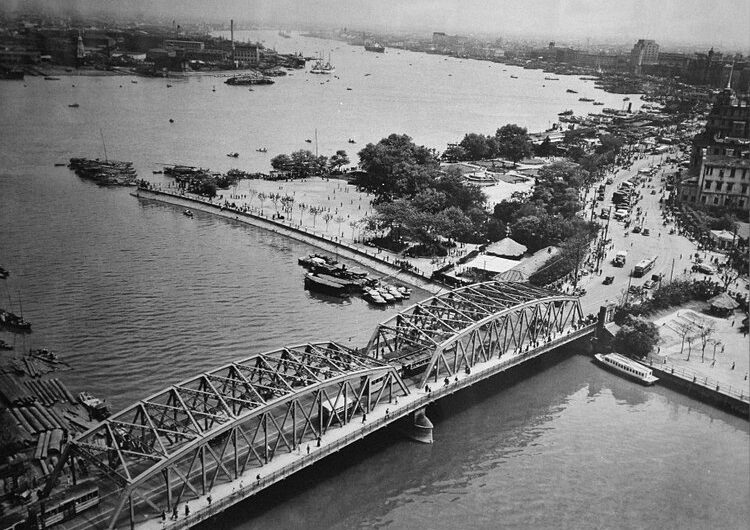
Helga returned to Shanghai with family members in 2010. She says, overall, the experience was somewhat strange. She was able to go into an apartment that was just like the one that she lived in until that Japanese man had come and kicked her and her parents out. Here she was able to show her family a little bit of what living in Shanghai had been like. But Shanghai had changed a great deal since the 1940s, and so had Helga. Returning to the place of her childhood as an adult changed her perspective regarding the scale of things. She laughs as she recalls how she asked, “Where is Big Garden Bridge?” And when it was finally pointed out to her, she realized that Garden Bridge is not so big after all. Things can look very different after decades of life experience.
Helga was asked to speak about her Shanghai experience for the PBS documentary Harbor from the Holocaust that was produced in 2020. She was also asked to participate in PBS events in conjunction with the release of the documentary. Other than that, she has not spoken a great deal about her experience to the public. She says not many people know about the history of the Shanghai refugees. She says many Jews she encounters do not know about it, and often when non-Jews hear that she is from Shanghai, they assume that her parents were Christian missionaries.
Shanghai was indeed a harbor from the Holocaust, so much so, in fact, that many Shanghai Jewish refugees, such as Helga, do not always feel comfortable being labelled Holocaust survivors. Helga spoke about this subject when interviewed in both September 2019 and August 2022. During the first interview she said, “In the beginning when they said to me, ‘You’re a Holocaust survivor,’ I somehow didn’t feel that was the right designation. I did not survive the Holocaust in Europe. No, Shanghai was no paradise, but it was nothing compared with what was going on in Europe. But, yeah, they still designate that as a Holocaust survivor.” When asked again in the August 2022 interview about her relationship to the Holocaust having participated in the PBS documentary, Helga said, “I’ve gotten more accustomed to the fact that I am considered a Holocaust survivor. But, as I said before [during the September 2019 interview], compared to what happened in Europe, the surviving in Shanghai was really nothing. It was no pleasure, but, by a longshot, it was nothing like what happened in Europe.”
Although Helga and the other Shanghai refugees did not survive the Holocaust in Europe, they did survive the Holocaust by getting out of Europe. Because they survived, Helga and other former refugees have been able to make sure that the traditions they hold dear are passed down the generations of their families. And in Helga’s case, her family has grown and grown. This despite being the only child of Samuel and Lieselotte Meyer. When interviewed in September 2019, Helga proudly noted, “I was just talking to my daughter yesterday. I said I had to get ready Rosh Hashanah gifts. I said, ‘It took me two days, it’s sixteen of you guys!’ She said, ‘Sixteen?’ And I said, ‘Yeah!’ So, for an only child, that’s pretty good! [She laughs.]”
Here Today and Gone Tomorrow
When Helga Silberberg situates the experience of being a refugee within her life’s journey, she points out that Shanghai provided her with an important life lesson. She revealed this lesson when interviewed in both September 2019 and in August 2022. In September 2019, she described it as follows:
To always be very alert about what’s going on around you and never take anything for granted, because it might be here today and gone tomorrow. And I’ve tried to instill that in my children, tried in my grandchildren. And great-grandchildren, they’re still too little to understand that. But I think that is what life in Shanghai taught me, and [I] will always be grateful for what I have. When I was in San Francisco the first time in 1947, when we were in transit to go to South America. If anyone would have told me then, “You’re going to live in the city. You’re going to own a house in the city.” I would have said “Nah, you’re nuts! Not going to happen!” [She smiles.]
In August 2022, Helga articulated the lesson as follows,
Well, the reason I believe that it gave us, especially me, and my friends think the same way, a good lesson for life is we learned you can do with very little and still make a go of things. And, no, our circumstances were not as bad as the Holocaust in Europe, as I think I mentioned before, but they were pretty primitive and pretty hard. We children didn’t have toys, we made our own. And that worked. So that was a way of learning to make do with what you have and not always want more and more. And I think that is the main life lesson I learned.
To underscore the point of the lesson, she added,
If you live in a room with fourteen people and all you own is a cot on which you sleep, then you get to appreciate everything else you have in life. And, whenever you are not so happy with it, then you think back on those days, and the present looks just wonderful!
When the Meyer family fled Germany in April 1939, they left with a wooden container full of possessions. When asked in August 2022 whether she still has the little gold ring that accompanied the family because her father had forgotten to list it among the family’s jewelry, Helga says, “No.” She does not know what happened to it. She surmises that the ring probably shared the same fate in Shanghai as the furniture and other items that had been sealed away in the wooden container in front of the policeman in their Berlin apartment: Her parents probably sold it to make ends meet. But Helga is not sad about this. She learned a long time ago in a place far away that there are much more important things in life than chairs, tables, and a little gold ring.
[1] The main sources for the chapter are interviews that were conducted with Helga Silberberg by Kevin Ostoyich in San Francisco on September 18, 2019, and via Zoom on August 4, 2022. Additional information was gleaned through email correspondence with Helga Silberberg. The interviews are treated in the chapter in the present tense except for when distinctions are being made between Helga’s comments in the two interviews.
[2] Birthdate supplied by Helga Silberberg in email correspondence with Kevin Ostoyich, September 9, 2022.
[3] It is present-day Sulęczyno, Poland.
[4] Helga does not know much about his service. She explains that he never talked about it. Given her father died when she was only fifteen years old, there was not much opportunity to discuss such things.
[5] The alternate spelling of Pauline’s maiden name as “Warschawsky” is supplied in the documentation Walter Meyer provided to Yad Vashem regarding the death of his brother Arthur Meyer.
[6] Richard Schlesinger was born on February 1, 1872. Email correspondence from Helga Silberberg to Kevin Ostoyich on August 29, 2022.
[7] Martha (née Salomon) Schlesinger was born on May 15, 1872. Email correspondence from Helga Silberberg to Kevin Ostoyich on August 29, 2022.
[8] Lieselotte’s and Kaete’s date of birth: “Stolpersteine Fasanenstrasse 59,” Bezirksamt Charlottenburg-Wilmersdorf. Text written by Karin Sievert with information provided by Helga Silberberg.
[9] Email Correspondence from Helga Silberberg to Kevin Ostoyich, August 23, 2022.
[10] Fine-tuning details for the July 1938 incarceration story were provided by Helga Silberberg in email correspondence to Kevin Ostoyich on August 23, 2022.
[11] Identification of Julius as the brother in the United States provided by Helga Silberberg in email correspondence to Kevin Ostoyich on August 29, 2022. According to Helga, Julius had nine children and lived most of his life in Buffalo, NY.
[12] Two years later—in May 1941—the SS Conte Rosso was sunk by a British submarine.
[13] Helga explains that her mother often suffered from seasonal spring fever allergies, and she thinks that the climate change may have exacerbated this problem when they were on the ship.
[14] Victor Sassoon was an extremely wealthy Sephardic Jewish businessman and philanthropist in Shanghai. He supported various efforts to assist the European refugees to Shanghai. Sassoon owned the iconic Embankment Building and converted parts of it to receive refugees in the late 1930s. For information about Sassoon as well as other Sephardic families, especially the Kadoories, see Jonathan Kaufman, The Last Kings of Shanghai: The Rival Dynasties That Helped Create Modern China (New York: Viking, 2020).
[15] Additional details about Paul Meyer were provided in email correspondence sent from Helga Silberberg to Kevin Ostoyich on August 23, 2022.
[16] Email correspondence from Helga Silberberg to Kevin Ostoyich on August 23, 2022.
[17] Information about Ruth and Hans Moses provided by Helga Silberberg in email correspondence with Kevin Ostoyich on August 29, 2022.
[18] The description of the living arrangements comes from the September 18, 2019, interview. In email correspondence to Kevin Ostoyich on September 9, 2022, Helga added that the toilet “facilities” consisted of a “Honey Bucket” that had to emptied out every morning into a big cart. The cart was drawn by a Chinese laborer. The waste was used as fertilizer on fields.
[19] Email correspondence from Helga Silberberg to Kevin Ostoyich, September 9, 2022.
[20] Helga’s gym teacher was Leo Meyer, and there was no relation. Email correspondence from Helga Silberberg to Kevin Ostoyich, September 6, 2022. Leo Meyer was an outstanding soccer player.
[21] Helga identified that it was her cousin, Heinz, in email correspondence from Helga Silberberg to Kevin Ostoyich, September 6, 2022.
[22] The Meyers did not learn of the fates of all sixteen family members who were killed in the Holocaust at this time. Information came piecemeal over the decades, and new information (such as the fate of Meinhard Neumann) has only been brought to Helga’s attention due to the research Kevin Ostoyich has done for the present article.
[23] According to the information provided by his brother, Walter Meyer, to Yad Vashem in 1968, Max was born on December 10, 1876, and was a furniture dealer. He resided in Königsberg and was most likely deported in 1941 and most likely killed in Poland that year. Max’s wife, Meta (née Markus) Meyer was born in 1893. Max and Metahadthreechildren.According to Helga, thetwodaughtersimmigrated to England andtheson immigrated to New Zealand.Thus, whereas the children survived the Holocaust, the parents did not.
Note: Kevin Ostoyich believes that the birthdate Walter Meyer provided for his brother, Max, is incorrect; the birthdate is too close to that of brother, Adolf. A Theresienstadt document confirms the September 24, 1876, birthdate for Adolf Meyer ( “LIST OF PERSONS INPRISONED IN TEREZIN /THERESIENSTADT/ [M],” United States Holocaust Memorial Museum record RG-48.012M). Helga knows that Max was the oldest of the Meyer children and Adolf was the second oldest. Email correspondence from Helga Silberberg to Kevin Ostoyich, September 9, 2022.
[24] According to the information provided by his brother, Walter Meyer, to Yad Vashem in 1968, Arthur was born on January 23, 1887, and was a furniture dealer. Arthur was most likely deported in 1941/2 and killed in Poland in 1942. Arthur’s wife, Johanna (née Flatow) Meyer was born February 10, 1886. The couple lived in Königsberg.
According to Walter Meyer, the Johanna suffered the same fate as her husband. Arthur is also listed as having been killed in the Holocaust in the “Victims of the Persecution of Jews under the National Socialist Tyranny in Germany 1933 – 1945” prepared by the German Federal Archives. The German Federal Archives file states that Arthur’s place of death is unknown. The German Federal Archives file states that Johanna’s place of death is unknown.
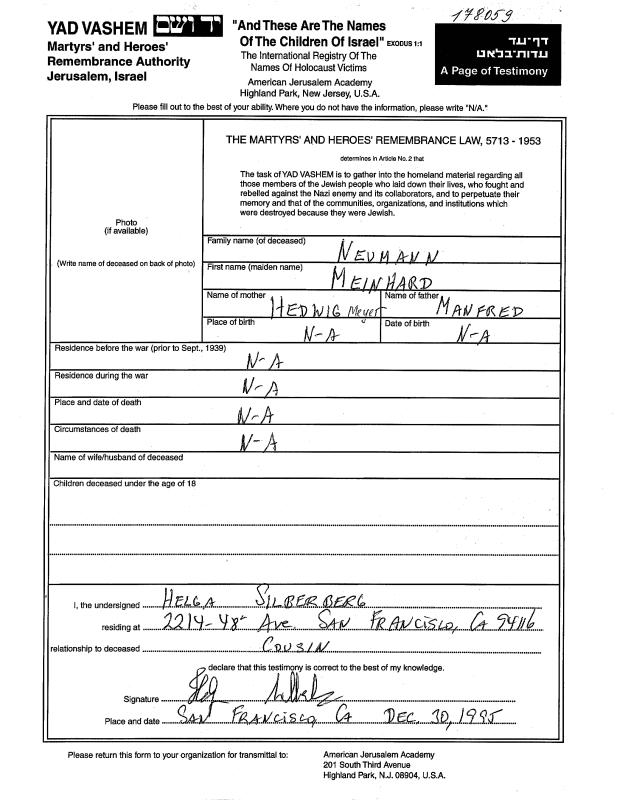
[25] Helga submitted the information to Yad Vashem in 1995 that Adolf Meyer (born September 24, 1876) and Flora (née Caspary) Meyer (born November 2, 1884) were killed in Auschwitz on an unknown date. (There is a discrepancy between the birthdate Helga provided and the birthdate listed by the Federal State Archives for Flora Meyer. See below.) The United States Holocaust Memorial Museum record RG-48.012M shows that Adolf Meyer was listed among inmates of Theresienstadt. The Memorial Book of the Federal State Archives states that Adolf was deported to Auschwitz on January 29, 1943, and he was murdered there. The Federal State Archives file has Flora suffering the same fate as her husband. (The Federal State Archives has February 11, 1886, as the birth date for Flora (née Caspary) Meyer.) Walter Meyer provided information to Yad Vashem in 1968 about Adolf’s and Flora’s youngest son, Horst. Horst was born ca. 1923 in Neu Brandenberg, Germany, lived in Berlin until being deported to the Warsaw Ghetto in 1941. Walter Meyer believed Horst was killed at some point in either 1941 or 1942. The Federal State Archives has record of Horst Meyer being born on March 2, 1925, being born in Neubrandenberg, having resided in Berlin, and being deported on January 29, 1943 (the same date as his parents) to Auschwitz, where he was killed. In 1995, Helga submitted information to Yad Vashem about Adolf’s and Flora’s eldest son, Paulfred, who was born in 1918. The Federal State Archives has Paulfred’s birth year as 1920 and has him listed as being deported to the Warsaw ghetto.
[26] Walter Meyer submitted information about his sister, Hedwig, to Yad Vashem in 1968. Hedwig was born on July 12, 1880, married Manfred Neumann, and was a housewife. Walter believed Hedwig was deported to the Warsaw ghetto in 1941 and most likely was murdered in 1941 or 1942. The Federal State Archives has Hedwig being born on December 7 (the discrepancy with Walter’s recording of the day and month is a flip between the European and American systems of dating: He gave July 12). The Federal State Archives provides 1879 as Hedwig’s year of birth, whereas Walter listed 1880. The Federal State Archives lists Hedwig’s date and place of death as unknown. Helga submitted forms about the deaths of Manfred and Meinhard Neumann to Yad Vashem in 1995, but she did not have much information on either her uncle or cousin. The Federal State Archives does not have any information on Manfred, but it does have a file for Meinhard Paul Neumann with birthdate June 27, 1921, and birthplace of Königsberg and having resided in Rosenberg. Meinhard Paul Neumann is recorded as having been an inmate of the Forsteinsatzlager at Booßen and then being deported to Auschwitz on April 19, 1943. Helga believes this Meinhard Paul Neumann to be her cousin. She writes, “The fact that the middle name is Paul is a clincher. My grandmother’s name was Pauline and most of the grandchildren got a derivative of this name. My own middle name is Paula (which I don’t use).” Email correspondence of Helga Silberberg to Kevin Ostoyich, September 6, 2022.
[27] Inge, with whom Helga would play hide-and-seek in their grandparents’ apartment, was born on January 20, 1926. According to the Memorial book “Victims of the Persecution of Jews under the National Socialist Tyranny in Germany 1933 – 1945” prepared by the German Federal Archives, Inge and her parents were deported to Auschwitz on February 26, 1943. For Inge, see https://apps.bundesarchiv.de/gedenkbuch/en1163845; for Kaete, see https://apps.bundesarchiv.de/gedenkbuch/en1163550; for Egon, see https://apps.bundesarchiv.de/gedenkbuch/en1163564.
[28] Information on Richard and Martha Schlesinger comes from the website devoted to their Stolpersteine and the Federal State Archives.
[29] The Stolpersteine commemorating Richard and Martha Schlesinger was laid before Fasanenstraße 59 on April 12, 2010.
[30] A photo of Inge is available on the Yad Vashem website.
[31] Ship name and date of departure provided by Helga Silberberg in email correspondence to Kevin Ostoyich on August 29, 2022.
[32] Email correspondence from Helga Silberberg to Kevin Ostoyich on August 29, 2022.
[33] Email correspondence from Helga Silberberg to Kevin Ostoyich on August 29, 2022.
[34] On the date of Samuel Meyer’s passing: email correspondence of Helga Silberberg to Kevin Ostoyich, August 29, 2022.
[35] Helga identifies her cousin, Paul, in email correspondence from Helga Silberberg to Kevin Ostoyich, September 6, 2022.