
DIE LINKE via Flickr
Shifting Partisan Trends among Young Germans

William Wolgemuth
Halle Foundation/AGI Intern
William Wolgemuth is a Summer 2026 Halle Foundation intern at the American-German Institute and a recent graduate from the University of Georgia, where he majored in International Affairs and minored in Chinese and Religious Studies. He has experience researching various regional dynamics throughout the globe, while holding a particular interest in the transatlantic partnership, due to its complex security and economic implications. William’s previous experience includes geoeconomic research throughout Asia, supply chain security analysis, and assisting in courses related to regional economic integration. William’s interest in the American-German partnership stems from a passion for intercultural understanding and enhancing bilateral relationships. His particular research interests include Germany’s history, domestic politics, and its regional cultural differences.
Rising Youth Polarization
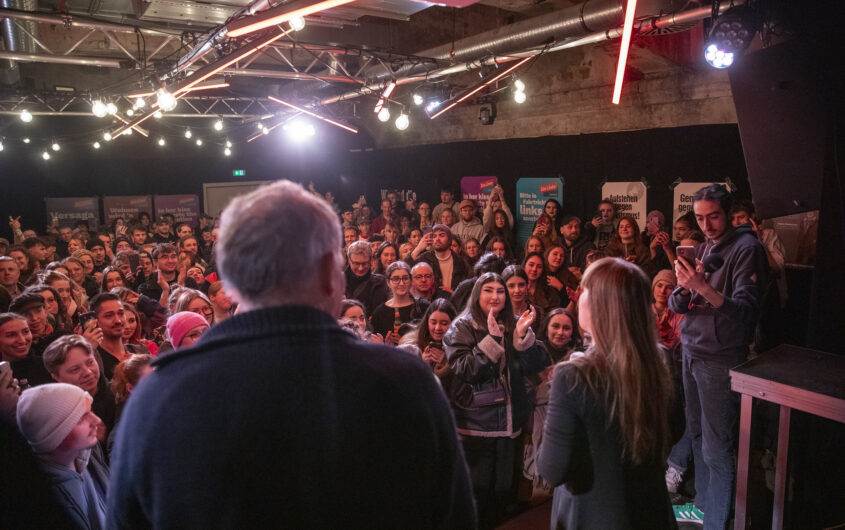
The 2025 Bundestag election revealed serious generational divides in German voting patterns. While the Christian Democrats (CDU) and Social Democrats (SPD) received solid support from older Germans, especially in the west, the traditional duopoly finished third and fourth, respectively, amongst voters in the 18-24-year-old demographic. These younger voters were swayed by the far-left Die Linke, which won a plurality of the demographic, and the far-right Alternative for Germany (AfD). The shocking underperformance of the CDU and SPD demonstrates serious dissatisfaction with the political status quo amongst German youth, with the success of non-mainstream parties indicating an appetite for radical solutions.
Electoral Analysis of the Youth Vote in 2025 Election
The 2025 Bundestag election resulted in an electoral regression for all members of the “traffic light coalition.” Then-Chancellor Olaf Scholz’s SPD had failed to maintain a functional balance between the liberal Free Democrats (FDP) and the progressivism of the Green Party, resulting in the government’s dramatic collapse. The coalition’s tenure was riddled with issues since its formation, with the war in Ukraine, severe budgetary issues, and a failure to cooperate resulting in all three parties being punished electorally. The CDU won a plurality; however, the size of their victory was muted by the growth of the far-right AfD. Similarly, the SPD’s woes were compounded by the strong performance of the socialist-oriented Die Linke. Furthermore, Germany’s traditional alternatives, the Greens and FDP, did not electorally improve, reflecting a widespread malaise regarding their role in the downfall of the previous government. Ultimately, Merz’s CDU was able to forge a pact with the SPD to gather enough support to form a new coalition government, despite the relative weakness of both parties.
These remarkable results reinforce the perception that the German political order is fundamentally changing, with the two major Volksparteien seemingly unable to reach young voters. The vote share that the CDU and SPD managed to receive was primarily due to older voters. The SPD earned 25 percent of the vote amongst voters over 70, while winning only 12 percent of under-24 voters. The CDU won 43 percent in the over-70 demographic but only won 13 percent of voters under 24. The statistics for Die Linke and AfD voters portray almost polar opposite results, with their vote share being inversely proportional to age. By winning a collective 46 percent of voters under 24, the once political fringes have captured the attention of the German youth.
Youth Appeal of the AfD and Die Linke
The success of the AfD and Die Linke is due to a combination of deliberate partisan strategy, youth discontent, and growing ideological polarization. Both parties have been able to foster large online support, using social media platforms like Instagram and TikTok, in ways that mainstream parties have failed to do. This approach allows the parties to reach younger people, who are overwhelmingly online, and directly promote their messaging without relying on traditional avenues. Social media algorithms act as amplifiers, which in effect isolate user attention and reinforce underlying political biases. These algorithms tend to promote highly sensational and emotional content, regardless of affiliation, which improves the reach of abrasive and uncompromising movements. Furthermore, online spaces are able to uniquely isolate various political perspectives from each other so that good-faith political viewpoints from opposing groups do not enter the echo chamber. AfD leader Alice Weidel has the largest TikTok presence of German politicians, boasting over 1 million followers and videos that regularly attract hundreds of thousands of views. Die Linke also proved able to capitalize on the internet, as Heidi Reichinnek’s scathing denouncement of CDU-AfD cooperation in January 2025 gained 30 million views on social media. Older voters are less likely to be active on social media and spend less time on the websites that they use. Additionally, 61 percent of Germans over 55 regularly consume local news, preventing algorithmic capture among older voters.
Without evidence that the coalition government is seriously addressing the concerns of young Germans, there is little reason to believe that these voters will return to the center in the state elections later this September.
Beyond outreach strategy, the political platforms of the AfD and Die Linke speak more to issues relevant to young voters’ interests. Whether due to social media or simply a reaction against the existing political and economic climate, younger Germans tend to be concerned with unemployment, housing, and security. During the campaign, Die Linke made affordability and rent control core issues, which paid off in Berlin, as young urbanites find the cost of living to be increasingly unaffordable. The AfD also focused much of their messaging around linking young people’s economic and safety concerns to increased migration and negligence from the elites. Younger German voters thus feel alienated by parties of the “status quo,” which are perceived as out of touch and more interested in appealing to the increasingly significant elderly electorate. By nature of their age, younger voters also have less experience engaging with electoral politics and therefore have little reason to maintain strong partisan loyalties. Additionally, older voters have more experience living through or in the wake of illiberal periods of German history and would have more context to be wary of political radicalism. When taken in conjunction, it is not incomprehensible that younger voters would find political alternatives appealing.
Gendered Politics
While young voters in Germany are collectively moving away from the center, young men are increasingly drawn to the right, while women are shifting further left. Historically, gender divides emerged from different fault lines, with women generally favoring the CDU, due to higher rates of religious observance, and men supporting the SPD, as they were more likely to be in the workforce. As these voting trends began to subside in the 2000s, new divisions became apparent, as the FDP gained an increasingly masculine base, whereas the Greens became popular among women. These divisions were not born out of religious or occupational differences; rather, they reflected a growing cultural divergence between the genders. The Greens’ emphasis on social liberalism and gender equality appealed to women, especially younger voters. Many men, conversely, were drawn to the FDP’s promise of strengthening entrepreneurship and digital advancement without the intervention of egalitarian policies, like gender-based quotas. This divide reached its zenith in the 2021 Bundestag elections, where the Greens and FDP won women and men under 24, respectively.
Due to the successful online campaign strategies of the AfD and Die Linke, in addition to an inability to deliver campaign promises while in government, the Greens and FDP lost a substantial portion of their young voting base. The 2025 federal election saw Die Linke win a remarkable 35 percent of women under 24, while AfD won 27 percent of their male counterparts. Despite both parties being firmly anti-establishment, their success mirrored the cultural gender divide seen in the 2021 election. Die Linke, which had received predominantly male support in previous election cycles, was able to portray the party as principled leftists unafraid to advocate for social justice, rather than out of touch and obsessed with Ostalgie. As the FDP’s support cratered, young men shifted in favor of the AfD’s image of traditional order.
Future Implications
Like Scholz, Chancellor Merz has struggled to garner widespread popularity, with the war in Iran (albeit beyond his control) and sluggish reforms dampening his support. Dissatisfaction with the current coalition’s inefficiency mirrors criticisms of the SPD. Throughout 2026, Die Linke and the AfD have continued to gain in the polls, whereas the SPD and CDU have further declined. These statistics indicate that the results of the 2025 Bundestag elections were not a one-time occurrence but rather part of a larger trend of youth-driven polarization. Germany is not alone in this anti-establishment shift, as populist parties have spent the last decade gaining prominence throughout Europe. It is difficult to tell how much staying power the AfD and Die Linke have, as the FDP and Greens performed similarly well with the younger demographic in the 2021 Bundestag election and young Germans have demonstrated less loyalty to specific parties.
This year’s Landtag elections paint an unclear picture. Baden-Württemberg’s results demonstrate that young voters respond to changing electoral dynamics, as the Greens performed solidly across all youth. Nevertheless, the AfD and Die Linke still performed disproportionately well amongst men and women under 29, respectively. In Rhineland-Palatinate’s election, Die Linke won a plurality of women under 29, and the AfD won their male counterparts. Baden-Württemberg and Rhineland-Palatinate saw both parties retain influence amongst younger voters, but nevertheless underperform their Bundestag results. In an interview with the Mitteldeutscher Rundfunk, Mette Golembek, an 18-year-old from Coswig, Saxony-Anhalt, voiced a common view among young Germans: “The realization: I’m afraid for the future, and the parties currently in power aren’t doing anything for me.” Without evidence that the coalition government is seriously addressing the concerns of young Germans, there is little reason to believe that these voters will return to the center in the Saxony-Anhalt, Berlin, or Mecklenburg-Vorpommern state elections later this September.