

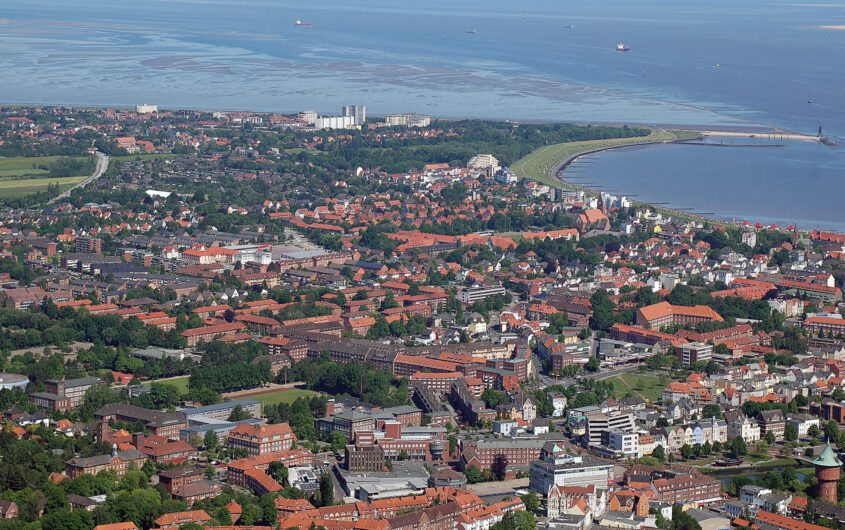
RaBoe via Wikimedia Commons
“Dear Occupants of Dohrmannstrasse 1”

Kevin Ostoyich
Valparaiso University
Prof. Kevin Ostoyich was a Visiting Fellow at AGI during the summers of 2017 and 2018. He is Professor of History at Valparaiso University, where he served as the chair of the history department from 2015 to 2019. He is also Guest Professor at the Center for Applied Policy Research at Ludwig Maximilian University of Munich and Historian for the Florence and Laurence Spungen Family Foundation. Prior to moving to Valparaiso, he taught at the University of Montana. He has served as a Guest Professor at the Institute of Bavarian History at Ludwig Maximilian University of Munich, Fellow at the Käte Hamburger Kolleg at Ludwig Maximilian University of Munich, Eadington Fellow at University of Nevada Las Vegas, Fellow at the Center for Advanced Studies at Ludwig Maximilian University of Munich, Distinguished Guest Professor at Shanghai University, Senior Fellow at the German Historical Institute Pacific Regional Office/University of California, Berkeley, Research Associate at the Harvard Business School, and Erasmus Fellow at the University of Notre Dame. He currently is an associate of the Center for East Asian Studies of the University of Chicago, a board member of the Sino-Judaic Institute, and an inaugural member of the Shanghai Jewish Refugees Museum International Advisory Board. He has published on German migration, German-American history, the Holocaust, and the history of the Shanghai Jews. He holds his BA from the University of Pennsylvania and his AM and PhD from Harvard University.
While at AGI, Prof. Ostoyich conducted research on his project, “The Wounds of History, the Wounds of Today: The Shanghai Jews and the Morality of Refugee Crises.” The Shanghai Jews were refugees from Nazi Europe who found haven in Shanghai and thus escaped the Holocaust. For this project Ostoyich interviewed many former Shanghai Jewish refugees and conducted research at the National Archives at College Park, MD, and United States Holocaust Memorial Museum. At Valparaiso University he co-teaches a course titled “Historical Theatre: The Shanghai Jews,” which fuses the disciplines of history and theatre. To date, he has written and produced four original plays with university students based on the history of the Shanghai Jewish refugee community: Knocking on the Doors of History: The Shanghai Jews (2016), Shanghai Carousel: What Tomorrow Will Be (2019), The Singer of Shanghai (2020), and Lyrics and Laughter from Shanghai: A Relevant Cabaret Evening with Historical Commentary (2025). He has been involved in the creation of two films: Gary’s Letter (2024) and Three Girls of Shanghai (2024).
Click here for an article by Ostoyich on the Shanghai Jews.
He is currently trying to interview as many former Shanghailanders as possible. If you would like to be interviewed or know someone who might want to be interviewed, please contact Professor Ostoyich at kevin.ostoyich@valpo.edu.
A House, a Stream, and Two Telephones
Looking back, Gary Sternberg could not believe he did it. He simply had been compelled to do so. On August 5, 2019, he sent a letter that began with the words, “Dear Occupants of Dohrmannstrasse 1.”[1] What had led him to write this letter? The Internet and human curiosity.
Gary had looked up “Dohrmannstrasse 1” of Cuxhaven, Germany on Map Quest and found an aerial view of his childhood home. As he looked at the picture, memories of playing in the backyard by the little stream known as the Wettern flooded his mind. Thoughts about his past flowed into the present, and he wondered who the current occupants in this house by the North Sea were. As he pressed the keys on his computer, Gary was surprised to see the names of his parents pop up on the screen. But both Hermann and Augusta Sternberg had died in the 1960s. They most definitely were not the current occupants of Dohrmannstrasse 1. But, sure enough, there Gary’s parents’ names were on a website titled, “Traces of War.”[2] As Gary poked around more on the Internet, he found out that his parents’ names came up because small memorial plaques called Stolpersteine had been laid in the ground in front of Dohrmannstrasse 1. Stolpersteine (literally, stumbling stones) are small commemorative plaques that are laid before locations of where victims of the Holocaust had lived in many cities throughout Germany. Gary had not heard of them before.
Gary was “compelled” to learn more, so he started to compose a letter to the current occupants of Dohrmannstrasse 1. Although Gary still spoke German, he was concerned with the level of his written German, so, using Google Translate, he translated his letter and included both the English and German versions of his letter in the envelope and sent it on its way to Cuxhaven:
Dear Occupants of Dohrmannstrasse 1,
My name is Gerd Sternberg, I am the son of Hermann and Augusta Sternberg. The reason for me writing to you is that I just became aware of the Stolpersteine that are placed in front of the house at Dohrmannstrasse 1, honoring my parents.
In spite of everything, I still hold very dear memories and often think and talk about beautiful Cuxhaven, the house we lived in and the good times we had growing up there. However, all that came to an end when the Nazis kidnapped my father in 1938 and shipped him off to Sachsenhausen.[3]
We lived on the lower floor where my father also had his orthopedic practice. He left Germany for Shanghai in 1938; however, my mother, sister Ruth and I were not able to leave until 1940.
We all then migrated to the United States in 1948. I have a son, Adam; my wife Noreen passed away 17 years ago, I have lived in Las Vegas and Henderson for the last 50 years. Henderson is a suburb of Las Vegas.
I am hoping that we could communicate and exchange stories about Cuxhaven and how the Stolpersteine came to be and who put them there.
Sincerely,
Gerd Sternberg[4]
A House and a Stream
Gary’s father, Hermann Sternberg, was born on September 2, 1893, in Wetzlar an der Lahn.[5] Gary’s mother, Augusta Piassek,[6] was born on November 24, 1894, in Lengoven, in present-day Poland. Hermann came from a wealthy family of cattle farmers and was considered somewhat of the black sheep and did not have much to do with his family. Augusta came from a modest family of Protestant Polish farmers. She had a younger sister, Annie, with whom she never got along well. They simply never saw eye-to-eye on anything. Their mother died of breast cancer while Augusta was still living in Lengoven. Augusta left Lengoven most likely after the First World War and found employment as a housekeeper for a wealthy orthodox Jewish family. In doing so, she became deeply knowledgeable in the religious practices of Judaism. Eventually she moved to Cuxhaven, where she met Hermann Sternberg. Augusta and Hermann got married in the city.
Hermann’s Jewish faith meant that Hermann and Augusta’s two children, Ruth (born February 1, 1930) and Gerd (born August 25, 1931), increasingly encountered discrimination in Nazi Germany even though the children were being raised in Augusta’s Protestant faith. Although born and raised as Gerd, Gary preferred to be referred to as “Gary” after he arrived in the United States; thus, he is addressed by this name throughout the present text. Gary claimed that religion was never a point of dissension or disagreement within the Sternberg family. They celebrated Easter, Passover, Chanukah, and Christmas. Gary fondly remembered the Christmas trees his father would bring home: “The tree is too big or it’s too small, all the branches are one side and over here it’s too bare, it’s crooked on the top, etc., etc.” But he noted that “when the tree was all decorated, it was just perfect.” Hermann was always in charge of setting up the candles for the tree, and buckets of sand and water were placed at the base in case of fire. As Gary recalled, “My father would light the candles and my mother would lead us in song, she had a beautiful voice. The flicker of the lighted candles in the darkened room, the singing and the anticipation of opening the presents was a memorable and festive event.”[7]
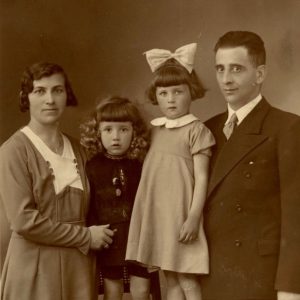
Gary remembered, “My mother was a very devout Christian, and she raised both me and my sister in the Christian faith, the Evangelical faith.” Despite Hermann not being very religious, Augusta saw to it that the Jewish High Holy Days were observed. She had only matzos in the house during Passover and made sure Hermann attended religious services. The family had to order their matzos because it was difficult to find in Cuxhaven. He claimed, “My mother probably knew more about Judaism than most Jews did even though she was Christian. […] My mother didn’t have a good school education, but I think she was one of the smartest women [Gary choked up] that I ever knew. She was just a hell of a lady.”
Hermann had been a medic during the First World War and had been awarded the Iron Cross for having crawled out of a foxhole to save the life of a wounded officer. In Cuxhaven, Hermann maintained an orthopedic practice that he ran out of the house. Gary vividly recalled his father’s workshop, where his father and an employee “would make arch supports, hernia trusses, artificial limbs, braces and a whole array of medical appliances. It was such a fun place; there were machines, tools and all kinds of materials to make all these things.”[8]
To Gary, Cuxhaven was paradise. The Sternbergs lived on the ground floor of the house at Dohrmannstrasse 1, which was just a block away from the dike on the North Sea.[9] The description of the property he provided in his memoir evinces the deep love he held for every square centimeter:
There was a big back yard and the side of the house had a flower garden and next to the garden there flowed a creek, it was called ‘Die Wettern,’ the water was usually shallow, very clear and cool, but the current was swift, we had so much fun there, wading bare-footed in the cool water with the mud squishing between the toes, a net in one hand and a tin can in the other we would catch little minnows…[10]
Often Gary and Ruth would walk to the beautiful beach along the North Sea and gaze at Cuxhaven’s famous Kugelbake (a tall structure used by seafarers for orientation). They also watched their step so as not to tread in “Kukake” left like “land mines” by the cows that grazed in the meadow.[11] Some of Gary’s fondest memories were those of the family dressing up and going out on beautiful Sunday afternoons, buying ice cream, and listening to bands play “Strauss waltzes and other popular dance music.”[12] He remembered a large sports complex was located right on the sea. This was a favorite place for the Sternbergs to go on those Sunday afternoons.
The Sternbergs rented the ground floor of the house at Dohrmannstrasse 1 from a customs official named Max Steffens. Steffens lived upstairs. Gary and Ruth were always afraid of Mr. Steffens because their hijinks often elicited his anger. As Gary recalled,
As kids we had one impression, because we always messed around with fish, a container or box that [Mr. Steffens] kept fish in. And my sister and I sometimes would play around with it and let the fish get loose. So, he was always mad at us. And to us he was always mean, he was a big, heavyset guy. He was always mean. His wife was very nice. And I always remember him in a green uniform, because he was a customs inspector…. But one of the nice things about [him] is that he always used to give us—he had a smoke house in the back—and he used to smoke eel and halibut and all kinds of fish. And I acquired a taste for smoked fish and still till today I love smoked fish—and he used to give us that.
Events would later reveal that Max Steffens’ generosity was not limited to smoked fish.
Cast Adrift
Storm clouds started to appear on the horizon as the 1930s progressed. Gary started to encounter problems in school as antisemitism increasingly spread throughout the curriculum. Particularly painful for him was being forced to watch films, which invariably depicted Jews as criminals and often contained scenes of violence. After one extremely explicit film that ended with townspeople beating up a Jew, Gary went home crying. When he explained the film to his father, Hermann said, “Don’t say anything about it.” One day, his school canceled all lessons so everyone could walk to the dike and salute Adolf Hitler as he sailed by Cuxhaven on a yacht:
I would guess that all the schools in town were on that dike. After a while the teachers were going around passing out paper swastika flags. It made quite a sight, the whole dike was bathed in a sea of red, black and white flags. It seemed like we were sitting there for a long time until Hitler’s ship finally appeared way off in the distance. Everybody was disappointed because they expected to at least get a glimpse of that German God. As the ship appeared, we were told that everybody jump to their feet waving their flags and arms and hollering ‘Heil Hitler,’ it was a typical Nazi propaganda spectacle.[13]
The storm finally hit for the Sternbergs on the early morning of June 14, 1938. The front door of the house had an oval glass inset that would rattle if there was a bang on the door. Gary remembered that
early in the morning, it must have been four or five o’clock maybe—that’s when the Nazis did their best—they banged on the door and this glass [rattled], I mean like crazy. And we ran to the front door just in time to see them yank my father out. No goodbye, no nothing [about] where he was going, anything. Totally, just yanked him out of the house, dumped him on a truck with some other people and off they went. And it took my mother the longest time—it took her a month before she found out whether he was alive or not, where he was, how he was. It was horrible.
Gary recalled, “My Mother was hysterical, and my sister and I were crying with all the commotion.”[14] Augusta frantically tried to figure out where Hermann was and what to do. Neither Hermann nor Augusta had family in Cuxhaven, so Augusta started to contact friends and Jewish organizations to try to figure out if anyone knew what had happened to Hermann and if anyone could help. After about a month, Augusta received a notice from the government that Hermann had been taken to Sachsenhausen concentration camp. Soon thereafter, she received a letter Hermann had sent from the camp.
Although Gary and Ruth were being raised Protestant, they were still viewed by others as racially Jewish. Technically, under the racist terminology of the National Socialist regime and its infamous Nuremberg Laws, Ruth and Gary were classified as “Mischlinge” (“mixed race”). Gary was shunned by the other children. He started to feel this acutely after Hermann was sent to Sachsenhausen: “In school not a lot of kids wanted to befriend me. Because they knew that my father was Jewish. Especially when he went to the concentration camp, that was ‘He’s a Jew. He’s horrible. He’s got horns growing out of his head.’ Yeah, that was hard.” Until then, in school he was considered half-Jewish, but after his father was sent to Sachsenhausen, “then the half didn’t count that much; I was just Jewish, and that’s it.”
In Sachsenhausen, Hermann was issued Prisoner Number 6137.[15] While Hermann was incarcerated in the concentration camp, men showed up at Dohrmannstrasse 1 and took all of Hermann’s orthopedic equipment, machines, and tools. They claimed they were not stealing the items, but merely “buying it from the Jew, Sternberg.” After loading everything on the truck, “the guy in charge put some papers on the table saying, ‘this is the inventory of all things we bought, sign here’ and with that he threw a few Marks […] on the table and left.”[16] While Augusta was looking after Gary and Ruth, she started to get pressure from government officials to divorce Hermann since she was Christian. But as Gary explained, “She was a stout, devoted mother and wife, and she wouldn’t even hear of it.” He added, “that part alone makes her like a saint. Her loyalty to her husband was unrivaled.”
A wealthy woman named Mrs. Reinecke, who was a client of Hermann and a family friend, provided money to Augusta to use to get Hermann out of the concentration camp. Hermann had always been a personal hero to Mrs. Reinecke because she had acute problems with her feet and Hermann was the only person who could help her. Eventually, with the money supplied by Mrs. Reinecke, Augusta was able to get Hermann out of Sachsenhausen a little over seven months after he had been yanked out of the Sternberg home.
Hermann was released from Sachsenhausen on January 28, 1939.[17] He and Augusta then tried to figure out what to do. Hermann said the family would have to leave Germany. As he thought back to when his father made that painful decision, Gary was reminded of the similarities of his family to that of Anne Frank. He pointed out how Hermann Sternberg, like Otto Frank, was a World War I hero, and how both men had to tell their families that they had to leave Germany in search of a haven. Gary saw in both cases, “Families being uprooted from beautiful towns and familiar places, leaving friends and possessions behind and becoming refugees overnight. These scenes like the Franks’ and the Sternbergs’ were played out thousands and thousands of times, all for the same reason, yet each a completely different story.”[18]
Augusta was terrified and was convinced that the Gestapo was spying on the family. Gary explained, “My mother always thought that if you talked about anything against the government that they had people going around reading lips and that she’d be persecuted for talking against the government or even the kids talking against the government.” Gary recalled that one time when they were sitting around the kitchen table after Hermann returned from Sachsenhausen: “My father started talking about the concentration camp, not in detail but generalities, [and] she quickly drew the curtains and said, ‘Hermann, you have to be careful because there are people out there, the Gestapo’s out there reading your lips!’”
Hermann and Augusta realized that they needed to get out of Germany. They went to the ship lines and found that there was only one passage available on the ship to Shanghai. Thus, they had the dilemma of deciding who would go. Hermann insisted that Augusta go. But Augusta insisted that Hermann go because she felt that if Hermann stayed in Germany, he would be killed. Gary explained, “So my mother won the argument, as usual, and he went on the Italian luxury liner.” Somehow Hermann and Augusta scrounged up the money for the expensive ticket, as well as for new clothes that would be suitable for Hermann in first-class passage. During the months in Sachsenhausen, Hermann had lost a tremendous amount of weight, and none of his clothes fit him anymore.
Hermann left Germany for Shanghai in spring 1939.[19] While en route to Shanghai, Hermann took out the Iron Cross medal he had been awarded during the First World War and threw it overboard. The Iron Cross had always been his father’s “prized possession.”
With Hermann already there, Augusta “worked like crazy to get passage” for the rest of the family to Shanghai. She received help from the Jewish Joint Distribution Committee. Meanwhile she looked for a job but had difficulty finding one because everyone knew that she was married to a Jew. The family’s funds started to dwindle.
Eventually, someone notified her to report to an upscale restaurant in a pavilion that overlooked the North Sea. It was a beautiful establishment. She went to the restaurant to apply for the job. The manager offered her the job without even asking for her qualifications. Augusta wondered how this was possible. She eventually found out that Mrs. Reinecke, the lady who had provided the money to get Hermann out of the concentration camp, owned the restaurant. Mrs. Reinecke had found out that Augusta needed a job and had set up the whole thing.
In September 1939, the Germans invaded Poland, thus starting the Second World War. During the next year, Augusta, Ruth, and Gary experienced British bombing raids of Cuxhaven. As Gary recalled:
Air raid wardens who never had a shred of authority in their lives were now going up and down the streets knocking on doors and shouting orders and telling people what to do, like to tape up the window glass, it had to be done in a crisscross pattern to prevent glass from shattering from bomb blasts, also making sure that drapes were completely closed to black out any light at night. If any light did show through during an air raid you were fined or jailed. Anti-aircraft gun installations and listening posts were popping up all over the place. Military personnel (mostly Navy) was increasing by the day. Officers were strutting around like peacocks.[20]
Gary remembered spending nights in the bomb shelter. “It was scary as hell for a little kid. The bomb shelter was a cement thing and was cold and damp. It was not good […]. Sometimes the bombs got so close that it broke out the windows in the house.” Gary explained, “The favorite thing for all the kids after an air raid was to go around and find bomb fragments and anti-aircraft artillery fragments. Whoever collected the most, of course, was the hero. We used to do that. I had a whole collection of those things.”
As Augusta worked at the restaurant, she managed to provide sustenance for Ruth and Gary. Gary recalled that money and food were in short supply at the time.[21] As Christmas approached, something remarkable happened at Dohrmannstrasse 1. Gary explained,
It was a couple of days before Christmas, Mrs. Reinecke’s limousine pulls up to the front door, her chauffeur comes in with his arms full of packages, after his second trip he tells us that Mrs. Reinecke and her staff wish us a Merry Christmas while Ruth and I are standing around open mouthed. My mother hugged and thanked him all over the place and [said] also to thank Mrs. Reinecke.
Others also helped the Sternberg family. Gary remembered that a baker gave Gary a small green wreath along with Christmas wishes for Augusta and Ruth.[22] Help also came to the family from someone whom Gary and Ruth did not expect it: Max Steffens. Given their run-ins with the large customs official over letting his fish loose, Gary and Ruth always thought the worst of the landlord who lived upstairs. But their assessment proved to be wrong. Gary explained that with Hermann away in Shanghai and Augusta struggling to makes ends meet, Mr. Steffens forgave “part of the rent or all of the rent—I don’t remember exactly how—but he gave us some breaks on that. So, he was very nice in that respect.” Recalling the generosity the Sternbergs encountered at the time, Gary explained, “This is how people worked […] Not all Germans were Nazis. There were some good people. [Mrs. Reinecke] could have jeopardized her reputation by helping a woman who was married to a Jew.”
Augusta continued to work on getting Ruth, Gary, and herself to Shanghai. This proved difficult in Cuxhaven. Augusta wrote a letter to her sister, Annie Kasulke, who lived in Berlin, about her predicament but did not expect her sister to respond given that they had never gotten along and had fallen out of communication. To Augusta’s surprise, Annie wrote back, offering to put Augusta, Gary, and Ruth up in her apartment in Berlin for as long as needed.[23] In September 1940, they set out for Berlin. They stayed in the German capital for approximately two weeks. Gary recalled that his Aunt Annie “took wonderful care of us.” Annie had a Schrebergarten, a state-sponsored little garden outside the city with fruits, vegetables, rabbits, and three chickens. The chickens were her prized possessions, especially given the rationing of the war. Meanwhile, Augusta worked on making the arrangements for the family to leave for Shanghai.
Around the time Augusta, Ruth, and Gary arrived in Berlin, the city was subjected to British aerial bombing.[24] The family often had to go down to the basement bomb shelter of the apartment building. Gary remembered that in the shelter people often told jokes that were critical of the Nazi regime. The Minister of Propaganda and Enlightenment and governing official (Gauleiter) of Berlin, Joseph Goebbels, was particularly singled out for ridicule: Gary remembered people calling Goebbels “Halb Sieben”—indicating the hands of a clock at six-thirty—to mock the Minister’s clubfoot. Augusta was shocked at such brazen displays of criticism of the Nazis, but Annie assured her that no one was going to say anything because they were all of like mind.[25] Eventually, in Berlin, and with the help of the Jewish Joint Distribution Committee, Augusta was able to finalize the arrangements for the trip to Shanghai.
After Augusta finalized the arrangements for the journey, they prepared to go to the train. As the two sisters made their farewells, Annie handed Augusta a bag, and said, “Here, this is for if you get hungry on the trip.” Augusta did not look in the bag. Later, on the train, when they got hungry, Augusta finally opened the bag. In it was a roasted chicken. As Gary explained, “So [Aunt Annie] took one of her prized possessions, one of her chickens, and gave it to us.” Gary choked up as he recalled this and said, “I’ll never forget that.”
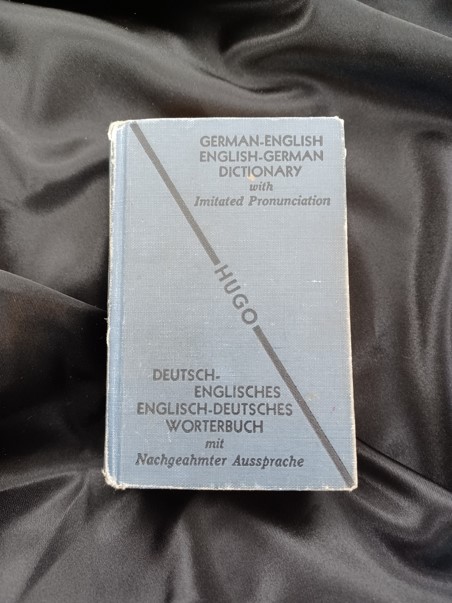
Augusta, Ruth, and Gary traveled by train through Poland and the Soviet Union. They stopped in Moscow, where they stayed in the luxurious Metropol Hotel, and they saw all the sights of the city. They then boarded the Trans-Siberian Railroad and continued their long journey. According to Gary, the train was very comfortable and had amazing food in beautiful dining cars. His breath was taken away by the scenery of Lake Baikal as the train curved around the lake: “My pastime was to count all the tunnels [that were dug through the mountains], and I counted 53 of them!” His memory of Siberia: “Trees and trees and trees.” When they crossed the border from Russia to Manchuria (at the time, the Japanese puppet state of Manchukuo), Japanese soldiers boarded the train, and two soldiers stood guard with fixed bayonets in each car. Gary was frightened and thought they would be arrested. All the shades were drawn, and an announcement was made that no one was to look out the windows. Gary recalled that “We figured that there were a bunch of Japanese military installations that they didn’t want us to see.” The train took them to Harbin, which Gary recalled being called “Little Israel,” given its large Jewish population. In Harbin they boarded a Chinese train. The conditions on board were dirty and the smell overwhelming. Sanitation conditions were deplorable, and there were people infested with lice. Gary remembered that being a “total switch” from the conditions they had experienced up to this point on their journey. On the Chinese train, Augusta, Gary, and Ruth first realized what their new lives were going to be like in China. Gary remembered his mother, whom he described as “a neat freak” being “in total horror.” Gary also remembered that on the train all the signs were in Chinese and English, “which of course we couldn’t read but Muttie [Mommy] had the foresight to bring a little pocket dictionary from German to English and English to German.”[26] The train took them to a port on the Yellow Sea. At the port they boarded a dirty Japanese steamer. They spent three days on this “rusted out rust bucket” to journey to Shanghai.
Fish out of Water
Upon arriving in Shanghai after a long journey through Poland, the Soviet Union, and Manchuria and over the Yellow Sea, Augusta expected her husband to take them to a place to stay; instead, Hermann took the family to a restaurant where he and Augusta proceeded to have an argument because Hermann had neglected to find a place for them to live. Fortunately, they were soon able to secure a one-bedroom apartment. The apartment was in the depressed and bombed-out district of Hongkew in the northeastern part of the city. Gary explained, “Shanghai for the most part—pardon the expression—is a shithole, and Hongkew is the shithole of Shanghai.” The Sternbergs’ apartment was luxurious for the area because it had a W.C.—something rare in Shanghai and almost unheard of in Hongkew. They had not been able to bring much of anything with them to Shanghai, so they had to build up from scratch. Hermann set up a little orthopedic workshop in a corner of the room and was able to make a meagre living for the family.
The apartment was on the second floor of the building and had a balcony that overlooked a Japanese garrison. From the balcony they could watch the Japanese soldiers doing their exercises with bamboo sticks.[27] According to Gary, their relations with the Japanese were favorable, and there was a Japanese soldier who sometimes brought fruit and meat to the family.
Given that Gary and Ruth were Christian, they attended a Christian missionary school. Gary claimed that the missionary school placed too much emphasis on religious instruction at the expense of secular subjects, and thus, when he and his sister later attended the Shanghai Jewish Youth Association School, they were very far behind the other children in their respective grades.
In 1943, the Japanese set up a “Designated Area” in Hongkew. All “stateless refugees” who entered the city after January 1, 1937, had to move into the Designated Area by May 18, 1943. From that point on, their movement was restricted, and those who wished to leave the Designated Area needed to apply for a pass. The Sternbergs had to move from their one-room apartment into a camp within the Designated Area. The camp they moved into was the Chaoufoong Road Camp, which had been a Chinese university. Gary and Hermann slept in bunks in the men’s dormitory and Augusta and Ruth in a large hall. Gary recalled the effect this had on his mother: “My mother went hysterical. There were bedbugs and lice, and it stunk. She went crazy.” A few weeks later, Hermann was able to find a space in a building that was called the “hospital building.” They moved to the third floor of the building. There they lived with four other families in a large room that was only separated with bunk beds and sheets. They only had recourse to communal toilets and cooking facilities. Gary remembered it not being pleasant, given that families bickered and kids screamed all the time.
Gary fell in love with football (American “soccer”) and ping-pong in Shanghai. If a kid had a football or a ping-pong ball, that kid was popular: “When the ball broke, his popularity waned. So, that was the culture of the camp. [He laughed.]” The children put picnic tables together and put bricks on them to serve as the ping-pong “net.” It did not matter to them that the planks of the tables were all warped. They played football on the field of the former university and had organized teams. The football league was actually quite large. Gary’s team was called Barcelona. He noted that “Barcelona was not a good team. We were always along the bottom end of it. We lost every damn game […] and I couldn’t handle that.” Then Gary was asked to play for the Alte Herren Verein (A.H.V.), the top team for all the different divisions, from men’s down through the boys. “Just to be on that team—whether you ever played or not—was a great honor.” So, now Gary found out that to play on the team, he needed proper football shoes. The question was how he was going to get them. Gary recalled, “I was in tears because I knew I was going to be dumped from the team because I didn’t have football shoes.” Hermann was able to scrounge up a pair of shoes, but he thought the shoes were too small, but Gary said, “Oh, no, no. They’re fine! They’re fine!” In reality, Gary could hardly walk in the shoes because they were so small:
When they took me off the bench, I could barely walk in those shoes, let alone run or kick the ball. But I still played on the team. [He laughs.] And I was still on the team. It was such an honor even though I couldn’t play worth a damn. With those shoes it was impossible. I was in pain every time we got done with the play. That was my experience playing football.
Gary’s face always lit up whenever he reminisced about the first-place medal his A.H.V. team won.
The kids improvised when it came to toys and games. They played a game called “Packs,” which was like marbles but with cigarette packs. After the war, Gary added marbles to their repertoire of games. (He explained that he simply could not afford the marbles during the war.) The children often made footballs out of rags because actual balls were rare. They would play on a back lot where there were open sewers. Sometimes the ball would go into the open sewers, and they had to go get the ball and wash it off. The children were not to drink the water in Shanghai. Nevertheless, one time when Gary was playing, he got very thirsty and drank from a tap. He got extremely sick afterward with dysentery: “I was so sick. It was unbelievable!” He had to go through many different treatments before getting better.
Augusta took the children to church in Shanghai, and it was in Shanghai that Gary was confirmed, even though he was never really religious. He remembered there being a lot of mixed marriages among the refugees, as well as many Christians who had established themselves in Shanghai well before the refugees arrived. Gary recalled that the church did not look like a church but was just a regular building where religious services were held. Given that he was not very religious, Gary only liked to go to the church because he could get cookies there.
Gary had friends in Shanghai who had Jewish fathers and Christian mothers. One such friend was Henry Litmanovitz. Although their friendship began in Shanghai, Gary and Henry did not become best friends until their families reunited in the United States after the war.
Gary was bullied by the Jewish children in the camp. He explained that “in Germany I was persecuted for being a Jew, and in Shanghai I’m being persecuted for being a Christian.” He was singled out and called “Jesus Christ.” Thinking back, Gary said, “Kids are kids.”
After the war, Hermann rented a little storefront on Chushan Road, and the family moved out of the camp into a room in a house on Tongshan Road. The lanes stunk and were strewn with garbage, but Gary pointed out, “that, by comparison, was luxury.” They applied to come to the United States, and “it took us three years total from the time we applied.” In June 1948, the family received visas to go to the United States. One memory stood out prominently for Gary about this process: When it was time for them to go to the American Consulate General to pick up the final documents to travel to the United States, they went by taxi. Gary explained that this had become somewhat of a tradition for families to do in celebration of finally getting to leave for the United States. When it was time for the Sternbergs to do this; however, Hermann wavered, saying it was simply too expensive. But Ruth begged and begged until Hermann finally relented. Gary laughed when he recalled that the taxi did not come to them; but rather, they had to walk to the taxi and then take it the few blocks to the American Consulate General. “But that was one of those things,” Gary added with a chuckle, “I still think of that today and think it’s funny!”
New Shores
The Sternberg family then embarked on their journey to the United States. They first set foot on American soil in Honolulu, Hawaii, and the Jewish Community Center there treated them like kings. Gary beamed as he recalled,
We couldn’t believe just how they treated us, we felt so important, here little refugees from Shanghai, and they made us feel so important. And they sent each one of us off with a great big bag full of little Hawaiian oranges. Real thin-skinned oranges. And they were like sugar. […] The amount of fruit that we had had was almost non-existent. And here I am, I’m half way through this bag of oranges. I can’t stop eating them. So, when the ship left the harbor, we hit really rough seas. And the ship we were on was an 18,000-ton troop transport and when it hit rough sea the front of the ship would get under the water and then lift up the ocean and then it would rattle […]. I was never so sick in my life. I heaved up all the oranges. And my sister was laughing at me that I got seasick. I might have gotten seasick, but mostly because I was loaded down with those oranges.
Gary vividly remembered going through Pearl Harbor and seeing the masts of the American ships that had been sunk during the Japanese attack sticking up out of the water: “It was an eerie sight.” Gary claimed that the trip on the “slow boat to the United States,” took about two or three weeks. As he recalled their arrival in San Francisco, Gary choked up and said, “That was such a transformation. It’s like coming from Hell into Heaven.” He remembered his thoughts as the ship approached the Golden Gate Bridge: “It’s enormous. And I’m looking around, I’m asking everybody. And one of the crew from the ship comes up and I asked, ‘Where’s the Statue of Liberty?’ And he starts laughing, and I felt like an idiot. He says, ‘You’re in the wrong place. You’re on the opposite side of the country.’ I didn’t know! [Gary laughed.]”
The Sternbergs were admitted into the United States on July 22, 1948. They stayed in San Francisco for about three months. They had two rooms in a hotel: Hermann and Gary in one, Augusta and Ruth in the other. The family then moved on to Cleveland, Ohio. For Gary, “‘Ohio’ meant ‘good morning’ in Japanese. But it was Cleveland, Ohio, never heard of it.” With a loan of $300 from the Jewish Joint Distribution Committee, they were put up in a spacious apartment. “We had two bedrooms, with a dining room, and a living room with a fireplace. Living it up! [Gary laughed.]” They then went to the Salvation Army to pick out furniture. Gary recalled, “My mother was in her glory! She had a kitchen stove.” Initially, they had an ice box, but they eventually made their first major acquisition: a Westinghouse refrigerator from Mandel’s store. Gary explained that the refrigerator became “our prized possession.” The Sternbergs particularly enjoyed opening and closing the door because a light would come on.
On their block, the Sternbergs were surrounded by other families of Shanghai refugees. He recalled, “It was like little Jewish Germany.” Everybody knew everybody else and were generally friendly to one another. One day, Gary ran into Henry Litmanovitz, whose family had Anglicized their name to Littman. The Littmans moved in just two doors down from the Sternbergs. From this point on, Gary and Henry were inseparable. They double-dated and went to parties together. Gary noted that Henry was handsome, and “the girls just flocked around him.” Gary and Henry were determined to lose their German accents and become Americans.
Hermann was unable to resume his orthopedic practice. To have done so, he would have had to go to school to become licensed, and this would have been impossible for him, especially because he did not really speak English. So, Hermann got a job in the Hildebrand Sausage Factory meatpacking plant. Hermann worked very hard, and Gary remembered how beat up his father’s fingers and hands became.
Meanwhile, Ruth moved to Benton Harbor, Michigan, because she had become engaged to an American sailor, whom she had met in Shanghai at one of the dances at the YMCA. Despite Hermann and Augusta’s opposition, Ruth married the sailor.
Gary had always been good with his hands, so he got a job in a storer run by a locksmith and an electrician. Under their tutelage, Gary learned about electricity, radio, locks, and more. Then Gary took a job at a factory that made aircraft parts. There he performed backbreaking work carrying long, heavy sheets of steel. He eventually moved into the inspection division of the factory and started to take trade school courses on the side.
In 1952, Gary was drafted into the service. Given his electrical experience, he was assigned to perform anti-aircraft radar duty. After basic training, he was shipped to Korea. Initially, he figured this would be fine, because there were no enemy planes in Korea. Nevertheless, when he arrived in Korea, he was assigned to the First Field Artillery Observation Battalion and soon found that this was “not a fun job. […] Your life expectancy [was] not very good.” Gary explained, “We had a big radar stand sitting right behind the front lines with everyone looking down our throat and shooting mortars at us and we had nothing to shoot back with.” His unit’s job was to figure out the trajectory of mortar and artillery shells, plot them out on the map, and then call that information back to an artillery unit, which would then fire on the area. Gary’s unit was sent wherever there was the most artillery fire on the Main Line of Resistance (MLR) that stretched all the way from the west coast to the east coast of the country. The unit was often exposed to the enemy for long stretches of time. One time they were made particularly vulnerable due to the Korean soil. He explained that the ground in Korea was mostly clay. During the summer the clay turned into a powder that would produce a huge cloud if a vehicle went over it, but, during winter, it would turn into a hard rubber substance into which one could hardly dig. One winter, his unit was sent up a mountain in central Korea. They could not dig in, so they were completely exposed to the enemy. A group of engineers was sent up to them to try to dig into the ground using dynamite and land mines. After many futile attempts, the engineers simply gave up, and Gary and his unit were left to fend for themselves.
Upon the conclusion of his service in Korea, Gary reflected on how miraculous it was that he had survived bombing raids in Germany and China and his deployment in a “four-point zone” (the most dangerous) in Korea. Through it all, the worst injury he sustained was a cut on his leg from running into barbed-wire when he and his friends fled a mortar attack that broke out while they were returning from watching a film at Battery Headquarters.
Unfortunately, Henry Littman did not have Gary’s luck. Littman had also been sent to Korea and served as a combat medic. One day, Gary visited Henry’s unit and was informed that Henry had been killed a couple days before. Gary was devastated: “I thought I’d sink into the ground.” When he returned home, Mrs. Littman could not even look at Gary because he reminded her of her son. Gary recalled, “It was a horrible, horrible thing. He got killed by small arms fire.” It was not until Gary got married in 1957 that the Littman family was ready to interact with Gary and the Sternbergs again.
Gary met Noreen Gottlieb on a blind date. He later converted to Judaism. He laughed as he explained that “Her grandmother didn’t want her to marry a Goy.” At the time, Gary was working as a foreman for a spot-welding plant making aircraft parts. Not too long after getting married, Gary and a partner went into business together servicing washing machines and dryers. The partnership eventually broke down, and Gary returned to working at the aircraft parts manufacturer. In 1964, Gary, Noreen, and their daughter, Pammy, moved to Los Angeles with Gary’s parents.[28]
Not too long after the move to Los Angeles, Hermann passed away from lung cancer. Gary took care of the arrangements to have his father buried in Mount Sinai cemetery in the foothills outside of Los Angeles. Augusta had been taking care of Hermann, and Gary believed that the strain ultimately was too much for his mother, for just a year after Hermann passed, Augusta died of a heart attack. Gary faced some resistance as he made the arrangements to have Augusta buried next to Hermann in the cemetery. A rabbi led the funeral service for Augusta, and Gary claimed that during the service the rabbi noted how there had been some objections to a Christian woman being buried in a Jewish cemetery. Gary choked up as he recalled what the rabbi said next: “This woman is no less a Jew than anybody here.” Gary added, “That was the truth. […] That was quite a statement.” Due to Gary’s perseverance, Hermann and Augusta lay in rest together.
Gary started to sell washing machines and stoves for a Sears Roebuck store in Hollywood. As a result, he sold appliances to many stars, including Liberace and Dan Blocker (aka Eric “Hoss” Cartwright on Bonanza). Gary claimed that one of the greatest incentives of working with Sears was the profit-sharing arrangement for its employees.
Dealing in the Desert
After working for Sears for a while, Gary and Noreen decided to open a decorating business called “Driftwood Décor and other Delights.” Despite its catchy name, Gary conceded that “business didn’t really warm.”[29] After closing the store, and experiencing too many California earthquakes, Gary and Noreen decided to move to Las Vegas in 1969. The following year, Noreen and Gary welcomed their second child into the world, Adam. In Las Vegas, Gary opened his own appliance service business. Not too long thereafter, Gary enrolled in Michael Gaughan’s card-dealing school. During the day, Gary ran the business; at night, he learned the art of the deal.
At the time, to become a dealer at a major casino, one first had to break in downtown, where one did not make much money. Usually, to get a job at Caesars Palace—the greatest casino in the world at the time—one had to work first for about four years downtown. “Obviously, I wasn’t going to go that route,” Gary explained. Instead, Gary played his Ace card: ping-pong. During his childhood in Shanghai, Gary had fallen in love with the game, despite the warped boards, brick “nets,” and unreliable balls. In Las Vegas he pursued this passion by starting a table tennis club with students at UNLV. It just so happened that an executive at Caesars Palace named Neil Smyth also had a passion for table tennis. According to Gary, nobody wanted to play with Neil because he had a weird style, but Gary did. Gary asked Neil about working at Caesars Palace, and Neil said that if Gary got a little bit of experience dealing, he could have a job at Caesars Palace. Gary proceeded to go from casino to casino downtown looking for a job but only found rejection. Next thing he knew, he received a call from a man by the name of Dick Nee regarding a broken washing machine. It turned out Dick also had a hot-water heater emergency. Gary fixed both the washing machine and the hot-water heater (despite having little experience working on the latter). Dick was a dealer. Gary asked Dick if he could help him break in downtown. Dick made a phone call to his friend Marv, who was a pit boss at the Bonanza Casino. Marv, in turn, took Gary to see his friend, a casino manager at the El Cortez Casino, and this friend gave Gary an audition. Gary passed the audition and was hired. Gary explained that Vegas works on “Juice,” in other words, connections. After Gary worked at the El Cortez for seven months, Neal Smyth carried through on his promise and Gary was granted an audition at Caesars Palace. He passed this audition as well. He laughed as he reflected on his meteoric rise: “So, now I’m a big shot dealer at Caesars Palace!”
Gary’s first day on the job at Caesars Palace was very stressful: “I’m on the game for about two seconds, a guy [sits] down [at my table and says] ‘Let me have a ten-thousand-dollar marker.’ While recounting the story, Gary laughed hysterically and started to shake to show how nervous he was at the time. Gary’s boss came up to him and said, “Gary, if you can’t handle that action, I’ll put someone else on.” Gary responded, “No, sir, I can do it,” and he dealt away. For the next 31 years and one month, Gary handled all the action. Only in 2005, at 74 years of age, did Gary finally lay down his dealer’s apron.
Gary was very proud of having worked at Caesars Palace. He explained, “To some people this may seem like a very minor thing, but to me, a little Jewish boy from China—a little refugee boy—this was a big thing […] to get the best job in a town like Las Vegas.”
In 1983, while Gary was working at Caesars Palace, he and Noreen began an import business. As he reflected on this endeavor, Gary laughed and quipped, “What do I know about the import business? Not a damn thing!” Gary and Noreen sold sequin and beaded appliques. Initially, business boomed. Gary recalled, “We made good money at it. But then, like anything else, the trend changed—because it’s a fashion item—the trend changed, and we tried different things and invested money in a lot of other things that didn’t work out, and then we finally closed up the business.” Then Gary invented Peeps. Peeps solved the age-old problem of how to protect one’s glasses while having one’s hair dyed at a beauty parlor. Although Gary was proud of his invention, he conceded that Peeps turned into a disaster: “That was the project from Hell,” he noted with a laugh.
No matter what you can think of that can go wrong with a project. It’s like: You drive your car on the interstate, and you get one flat tire; it’s bad luck, and you pull over to change the tire. But if you drive down the interstate and get four flat tires; that’s how bad, that’s how unlucky this project went!
The manufacturer sent 50,000 boxes of Peeps—a whole warehouse full—from China, and “half of them were no good, but you didn’t know which half until you tore them apart.” But even with this poor hand, Gary did not bust. A couple years after the shipment fiasco, Gary’s patent attorney called and said that a Danish company had come up with a similar invention and wanted to lease Gary’s patent in order to distribute it in the United States. “I said, ‘No way! They’re going to buy it or they’re not going to get it at all!’” Gary sold the patent to the Danes and kept thousands of boxes of Peeps for himself, half of them defective. He just didn’t know which half!
Peeps was by no means Gary’s only invention. For example, Gary came up with an efficient and economical transport system for an electric scooter in a vehicle. The inspiration for this was the fact that in the last years leading up to her death in 2002, Noreen was physically impaired, and the available systems for transporting scooters tended to be very complex and expensive.
Gary always tinkered with new ideas for inventions. One invention that dated from late in his life was a plexiglass napkin holder. The novelty of his holder is that a single napkin can be drawn from the holder with ease. It is not hard to see how the invention sprung from the mind of a man who spent a great deal of his life pulling out one card at a time.
Although Gary cleanly distributed cards in Las Vegas for close to thirty-two years, he spent his whole life as a dealer. He was always shuffling the cards, going from Cuxhaven to Berlin to Moscow to Harbin to Shanghai to Honolulu to San Francisco to Cleveland to Los Angeles to Las Vegas. With his trained hands he has shuffled employers countless times: ranging from an aircraft manufacturer, Sears Roebuck, El Cortez, Caesars Palace, and several others. He dabbled in the worlds of washing machine repair, interior design, and fashion accessories. He endured bombing attacks in Germany, China, and Korea. He saw just about every hand imaginable in Las Vegas. Much more could be written about Gary’s Vegas exploits; for example, his brushes with Frank Sinatra, Telly Savalas, David Hasselhoff, and many others over the decades. In fact, the transcript of Gary’s interview for an oral history project conducted by UNLV for the history of Las Vegas spans several hundred pages.
As Garry reflected on all the hands he dealt and had been dealt, he offered two bits of advice for new players to the table: First: “If you would take religion out of the human equation there would be a lot less death, a lot less killing, a lot less dissension. But this is how things are, so you have to make the best of it.” Second: “The moral of the story of me and so many like me, is, that if you are dealt a bad hand you don’t have to play it, you certainly don’t double down on it or keep on whining about it, you fold or pass and go on till [you] get a good hand and then double down or raise.”[30] As for Gary, in 2004, after going on many dates and feeling like he had finally lost all his chips, he met Mary Lou Burbine. With Mary Lou in his life, Gary was as happy as could be: “I hit the jackpot, and the lottery, I doubled down and raised the limit and became very wealthy. I am not talking about money…I met Mary Lou: A dealer’s ultimate reward.”[31]
Casting a Line from the Desert
The dealer’s letter arrived at Dohrmannstrasse 1 in the summer of 2019. Dörthe and Hans-Jürgen Lindemann returned from vacation and found the envelope among their other mail. Dörthe and Hans-Jürgen first thought it was just another piece of unwanted Werbung (advertisement). They were about to throw the letter into the trash, but then they saw that there was a return address to Nevada with a name above it. They were intrigued. This did not seem to be a piece of Werbung after all. They opened the envelope and read Gary’s letter. They decided to compose a letter of their own and sent it off to Gary:
Dear Mr. Sternberg,
First of all, thank you very much for your letter.
We read it with pleasure and were very impressed you have found your way back to your old home.[32]
Our names are:
Dörthe Lindemann b. Döscher
Hans-Jürgen Lindemann,
We are the current owners of the house Dohrmannstrasse 1.
My parents inherited the house in [1961][33] from the then owner, Mr. Steffens. My father owned a small boatyard in Captain Alexander Strasse and met Mr. Steffens about an order for a small Heligoland boat. Soon a certain friendship developed, because Mr. Steffens was childless and we had three children. He went fishing with my brothers and felt very well in our family.
We were still living in the shipyard and when Mr. Steffens fell ill, he had our family inherit the house.
Unbelievable for my family!!!
Unfortunately, my father did not enjoy life in this house for much longer. In 1969 he died of lung cancer at the age of 52.
In 1983, my husband and I took over the house in Dohrmannstrasse and rebuilt it so that we could live happily here together with my mother for 27 years.
My mother died at the age of 80 in 2004 and we now use her flat as a home Guest apartment.
Until the action “stumbling block” we did not know that your parents in our house lived and had an orthopedic practice there.
For the action “Stumbling Stones” we enclose an information note and hope that you can see how important it is not to forget this dark time.
It is a great pleasure to have contact with you and to stay
Yours sincerely,
Dörthe Lindemann (Dörthe Lindemann signature)
Hans-Jürgen Lindemann (Hans-Jürgen Lindemann signature)
Dohrmannstrasse 1[34]
A Boat and a House
Dörthe (née Döscher) Lindemann was born in 1948, the first of three children, to Curt and Lieselotte (née Eggers) Döscher. Curt had been born on October 10, 1916, in Cuxhaven, and Lieselotte had been born on August 25, 1924, in Dithmarschen in Schleswig-Holstein. Dörthe’s birth was followed one-and-a-half years later by the birth of a brother and one-and-a-half years after that by the birth of another brother. The Döscher children were born and raised in Cuxhaven. Dörthe’s memory of Cuxhaven during her childhood is that it was under British occupation and that many of the city’s inhabitants, including her family, were poor. British soldiers controlled the harbor, and the Cuxhavener often resorted to smuggling food. She particularly remembers people trading fish for other food items. In the postwar years, the city gradually rebounded through the growth of its fishing industry.
Curt was a builder of Börteboote (Börteboats). Börteboats are used for lobster fishing and for transporting passengers from large ships to the island of Heligoland, located in the North Sea approximately forty miles from Cuxhaven. The Döschers had a small shipyard in which Dörthe’s parents worked and the Döscher children played. Although the family was extremely poor, Dörthe has fond memories of her childhood in the shipyard. She attributes this to the great love that her parents showed each other and their children. Dörthe explains that her parents had complementary personalities. Curt was a very “vivacious person” who was often impulsive with his emotions. He was “extremely loving to us children” and he would do anything for his family. Lieselotte was “very quiet.” Whereas Curt would often explode, Lieselotte was unflappable and tranquil. Dörthe remembers that Curt could go off on a tirade, and Lieselotte would just sit by, let him finish, and then calm the situation with her tranquil demeanor. Together, Curt and Lieselotte fostered a loving environment for their family. Dörthe says it was not out of the ordinary for her parents to spontaneously show signs of affection for each other. She says that, for example, when music would come on the radio, they would start to dance or hug. As she reflects back on her childhood, Dörthe believes her parents’ love “was a great gift for us children.”
One day a customs official who was approaching retirement by the name of Max Steffens asked Curt if he would build a small Börteboat for him. Curt agreed to do so. Given that the Döscher family was so poor, Steffens offered to pay for the boat as Curt built it rather than wait until it was finished. As Curt constructed the boat, Steffens often paid visits to the shipyard. Given that Lieselotte was always ready to welcome guests, she often invited Steffens to join the family for breakfast. As the visits continued, Steffens became closer to the family, and the Döscher children started to refer to him as “Uncle Max.”
One day Steffens asked Curt if he could come to his house at Dohrmannstrasse 1 because a door needed repair. Curt gathered his tools and rode his bicycle to the house. As he was there, Steffens asked him if he could imagine he and his family living in the house. Curt responded that he could not afford to provide anything more for his family than what they already had. Steffens then clarified that his question had not been about purchasing the house; he wanted to know whether Curt could imagine the family living in the house. He added that, for this question, there was only a “Yes” or “No” answer. Curt answered, “Yes.”
In February 1961, “Uncle Max” paid another visit to the shipyard and invited Curt and Lieselotte to coffee. When they arrived, there was much more than coffee in store for them. Steffens had arranged for them to be met by a notary public, who had prepared a testament stating that the Döscher family was to inherit the house at Dohrmannstrasse 1 upon Steffens’ death.[35] Curt and Lieselotte were shocked. Dörthe says not a word was spoken to the Döscher children about the arrangement.
At some point later, Steffens became ill. Lieselotte offered to take care of him, but Steffens refused. He explained he had not sought the Döscher family out to be cared for by them; rather, he had sought them out because he wanted children to live in the house at Dohrmannstrasse 1. He explained that he had been married, but his wife had died in the house while giving birth. The baby, too, had not survived.[36] Although Steffens had a brother, he did not want to leave the house to him. It was his wish that the Döscher children live there.
Later that year, “Uncle Max” passed away, and Dörthe and her family moved into the house most likely in December 1961.[37] Dörthe remembers being overwhelmed by how beautiful and well-made the house was. To her and her family, the house at Dohrmannstrasse 1 was “more than a castle” given that, up to this time, they had lived under barracks-style conditions in an apartment directly in front of the shipyard on the water.
When the Döschers moved into the house at Dohrmannstrasse 1, they were not alone; they were to share the house with a Frau Münzinger.[38] Frau Münzinger had served as the caretaker of the house while Steffens lived in it, and she had been granted the legal right to stay there for the remainder of her life. Frau Münzinger was far from welcoming to the Döschers. Dörthe explains that Frau Münzinger viewed them as legacy hunters and thought that Curt had worked Mr. Steffens over to get him to bequeath the house to the family. Thus, Frau Münzinger avoided the Döschers at all costs. Nevertheless, Lieselotte was determined to thaw relations. She invited Frau Münzinger to eat with the family, but Frau Münzinger refused. Lieselotte proceeded to leave the food for Frau Münzinger on the stairs to her apartment. Eventually, Frau Münzinger took the food. Lieselotte then told Frau Münzinger that if she was going to take the food, she might as well come eat upstairs with the family because that would be nicer than eating alone. Frau Münzinger agreed, and the iciness soon turned to friendship. To show her gratitude, Frau Münzinger bought the family a washing machine. The Döschers had never owned one, and the children found it fascinating. They loved to sit and watch the machine work its magic through its porthole. To Dörthe, the story of Frau Münzinger and the washing machine perfectly encapsulates the power of her mother’s tranquil and patient personality. The Döschers shared the house with Frau Münzinger for about four years; Dörthe believes she passed away in 1965.[39]
Frau Münzinger had not been alone in giving the Döschers an icy welcome to Dohrmannstrasse. Two female cousins of Mr. Steffens also lived on the street, and, like Frau Münzinger, they viewed the Döschers as legacy hunters. They went so far as to try to set the other neighbors against the family. But, as had been the case with Frau Münzinger, the cousins’ hostility was no match for Lieselotte’s kindness and patience. After seeing the error of their ways, the cousins apologized and returned various household items they had taken to “save” them from the “legacy hunters.” Dörthe points out that, although it took some time for the adults to come around, the kids in the neighborhood got along with the Döscher children from the very start.
Mr. Steffens had not told the Döschers about the Sternbergs. Dörthe says that her family heard about the Sternbergs from their neighbors (including Steffens’ cousins). They were informed that a Jewish family had lived in the house and that the father had made prosthetics, etc. for people with leg and feet problems. They were also told that the family had two children and they all had to flee the Nazis. At the time, Dörthe did not know much about what had happened in Cuxhaven and Germany during the 1930s and 1940s. She says that she and the other children of Cuxhaven learned very little about the Second World War in school. She recalls that school children were taught that there were two world wars in the twentieth century, but they were offered no explanation as to why or how these wars occurred. Regarding the Holocaust, there was complete silence. Dörthe says this silence extended to the home as well. She does not remember ever speaking about the wars or the Holocaust with her parents. Aside from hearing that the Sternberg family had lived in the house, Dörthe learned nothing about the Jews in Cuxhaven for the first several decades of her life.
In 1968, Dörthe married the seaman, Hans-Jürgen Lindemann. As would be the case for many years of their marriage, Hans-Jürgen’s job took him immediately off to sea. Married, but alone, Dörthe moved into the downstairs apartment at Dohrmannstrasse 1. In 1969, Dörthe gave birth to a son. She had to stay a long time in a hospital. When she and her son finally came home, they crossed paths with Curt in the hallway. Curt was on the way to the hospital, himself. As they passed, Curt briefly greeted his grandson. It would be their only encounter. Curt passed away from cancer in the hospital at the age of 52. In the autumn of the following year, while Hans-Jürgen was again away at sea, Dörthe suffered a miscarriage in the house at Dohrmannstrasse 1. She dealt with the death of her daughter alone.
Although widowed at the age of 44, Lieselotte never remarried. She took a job in a bakery and resolved to stay in the house at Dohrmannstrasse 1. Dörthe explains that for her mother to be able to keep the house, she often had to rent parts of it to spa guests. In the early 1980s, Lieselotte was laid off from her job just nine months away from qualifying for a pension. By this time, Dörthe and Hans-Jürgen had moved out of Dohrmannstrasse 1 and had been living in their own house for many years. They decided to sell their home and purchase the house at Dohrmannstrasse 1 from Lieselotte and buy out Dörthe’s brother. Dörthe and Hans-Jürgen arranged for Lieselotte to have the legal right to live in the house for the remainder of her life. Dörthe, Hans-Jürgen, and their son moved into the upstairs, and Lieselotte moved into the downstairs apartment. For the next two years, Dörthe and Hans-Jürgen made extensive renovations to the house, including the installation of a second entranceway to Lieselotte’s apartment.
A Return
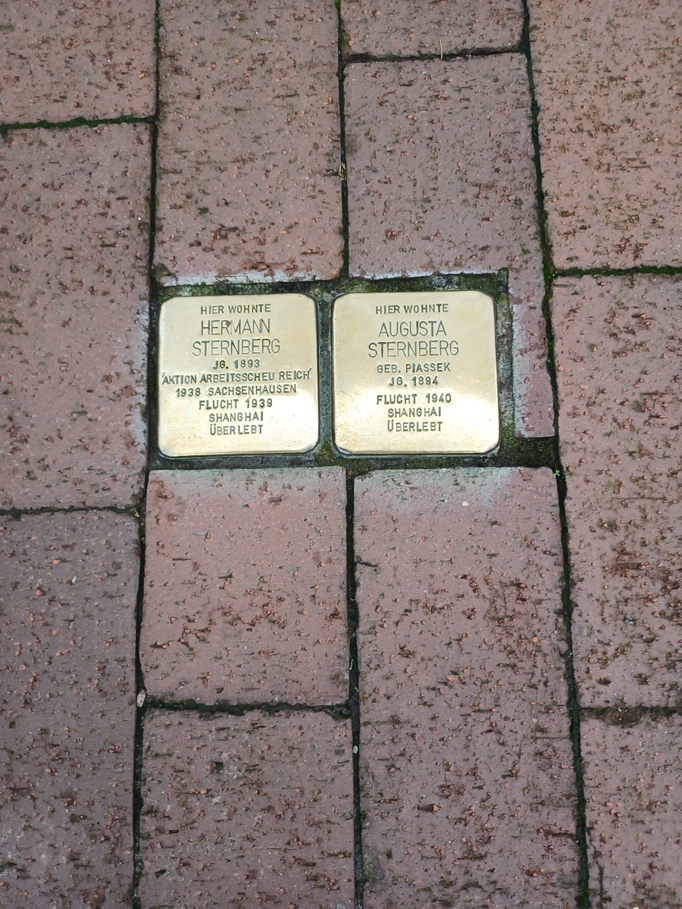
In 2012 Hermann and Augusta Sternberg returned to Dohrmannstrasse 1. As part of an initiative to commemorate the history of the Holocaust, schoolchildren of Cuxhaven conducted research on those who were discriminated against, killed, and/or forced to flee the city during the time of the National Socialist regime. Stolpersteine devoted to those individuals were laid in the ground before their former places of residence. Stolpersteine dedicated to Hermann and Augusta Sternberg were laid in the sidewalk at Dohrmannstrasse 1. With this event, Dörthe says her real education of the Holocaust began.
Of course, she had become much more familiar with the history of the Holocaust in the decades after the silence at school and home during the 1950s and 1960s. Although she had learned absolutely nothing about these subjects from her parents or grandparents, Dörthe did inform herself about the Second World War and the Holocaust as she set out on her career as an educator. But she says, “to be quite honest,” she was not “intensely” interested in learning about the subject at the time. She started to learn more about this history when she changed jobs and worked as a social worker in an old persons’ home. There she was confronted with the stories the elderly patients told her about the past. Dörthe says she organized discussion circles where people could talk about their life experiences, and she learned a great deal from these conversations. She remembers encountering a woman named Mrs. Reinecke, who explained that she and her mother had helped a Jewish family during the Nazi years. There was still much more for Dörthe to learn, though, including which family Mrs. Reinecke and her mother had helped.
Dörthe’s education about the Holocaust and Cuxhaven’s Jews began in earnest when the Stolpersteine to Hermann and Augusta Sternberg were laid before the house at Dohrmannstrasse 1. Having the Stolpersteine in front of her house caused Dörthe to reflect on this history on a regular basis. She is grateful for this. She thinks the Stolpersteine initiative to be “exceptionally good” (“ausgesprochen gut”) because she believes this history needs to be remembered. She took her duty of caring for the Stolpersteine very seriously and says she even took a certain pride in cleaning them on a regular basis. Nevertheless, for many years, Dörthe knew nothing about Hermann and Augusta Sternberg beyond the scant information provided in the publications about the Stolpersteine of Cuxhaven.
That would all change when she and Hans-Jürgen read Gary’s letter upon returning from vacation in the summer of 2019.
Two Telephones
When Dörthe responded to Gary’s letter to the “Occupants of Dohrmannstrasse 1,” she provided the Lindemann’s phone number. Little did she and Hans-Jürgen know what awaited them. Gary called, and, since then, there have been countless phone calls between Henderson, U.S.A., and Cuxhaven, Germany. Both Gary and Dörthe were interviewed about their telephonic friendship. The following is a collection of their views on various themes related to their conversations.
On Their Conversations
Gary explained:
Like once a week or once every other week I call Dörthe and sometimes we speak for an hour [or] an hour and a half on the phone. And we speak about everything and anything, anything from politics, to Cuxhaven, and die Wettern, which is the creek that runs next to the house. We talk about the dike, we talk about the sea, the North Sea, we talk about the things that were there then and aren’t there anymore. And, it’s really something! And the problems she’s having with her house, and the storms that they’ve had, and stuff like that.
Dörthe said that what stood out most about their conversations was Gary’s boundless curiosity. She laughed as she explained that she often does not get to ask many questions during their conversations because Gary has a seemingly endless supply of questions and they come at a rapid pace. She noted that Gary’s capacity to learn was simply “uncanny.” For many years, she has spent countless hours talking with elderly people and says that often elderly people tend to narrow their focus onto one topic. Not so with Gary. She could not get over how interested he was in everything!
Gary on Speaking German
Gary and Dörthe conversed in German. For Gary it was a rare treat to be able to speak German with someone. He did not get to do so otherwise. And he was proud that he could still speak the language after so many years being away from Germany:
We talk for a long time. And it’s just delightful, because I can’t believe, and she can’t believe, how well my German sounds. And she says I sound like a regular native without any kind of accent. But, however, many times I have to think of words, and she helps me out with it. And we have this conversation going. It’s just delightful. It’s just like, like we’ve known each other all our lives.
Dörthe on Gary’s German
Dörthe laughed as she revealed how relieved she was when she heard Gary speaking German on the phone. She had been afraid that he could only speak English, because she said, “My fluency in English is not really good, actually, to be quite honest, it does not exist at all!” Not only was she relieved when she heard Gary speak German, she was consistently astounded by how well he spoke the language despite the fact that he had not been back to Germany since having to flee the country in 1940.
Gary on the Past
Gary enjoyed reminiscing about the Cuxhaven of his youth, but he was just as interested to talk about issues of the present, not just about the house and Cuxhaven, but of current events in the world.
Dörthe on Gary’s Memory
Dörthe was flabbergasted by the accuracy of Gary’s memory with respect to Cuxhaven and the house at Dohrmannstrasse 1 even though he had been forced to flee the house eight years before she was even born! She explained that during their conversations, Gary frequently described with precise accuracy such things as the number of steps that lead down to the Wettern and exactly how thick the walls are in the basement. She noted that many things about Cuxhaven are exactly how they had been when Gary lived there. She pointed out, for example, the rose bush in the backyard dates to Gary’s time in the house. Not everything has survived, however. In fact, much of Cuxhaven was destroyed during the war. Gary experienced the beginning stages of the aerial bombings while still in the city. Those bombings became more devastating as the war progressed. When Gary asked about the complex where he and his family used to go on Sunday afternoons and get ice cream and listen to Strauss waltzes, Dörthe had to report that, unfortunately, that part of Gary’s past did not survive into the present.
Gary on the Friendship
Gary explained that after contacting Dörthe, “We’ve been friends ever since.” After years of talking on the phone, Gary wanted nothing more than to meet Dörthe in person. Unfortunately, health problems did not allow for him to travel to Germany. He noted, “I’d love to have her come out, but I don’t think she will because again traveling restrictions now and so on. [Gary made the statement during the Covid epidemic.] And I would be very happy to pay for her trip out here. I would love to meet her.”
Dörthe on the Friendship
Dörthe knew of no other person like Gary. Furthermore, she explained that her life has been enriched immensely by becoming his friend. The friendship with Gary also enriched the life of her late husband. Gary and Hans-Jürgen would talk endlessly on the phone. Primarily about the sea. She said Gary always wanted to talk with Hans-Jürgen about the latter’s various sea voyages as well as the boat Hans-Jürgen and Dörthe sailed to many ports around the globe. They would talk endlessly about the boat’s measurements and specifications. Dörthe said the conversations with Gary were of particular importance to both her and Hans-Jürgen as Hans-Jürgen was battling cancer. The conversations with Gary during that difficult time were invaluable, and Dörthe said she would always be grateful for the comfort Gary provided to her late husband.
Gary on Meaning
The letter that Gary sent and the friendship that ensued made Gary reflect on how wrong one’s assumptions of other people can be:
And…the incredible thing was what made or prompted me to write that letter, and I question myself why I did it or how I did it. It’s just weird about how it came about, and the lesson I learned from it that, everybody’s asking me, “Have you gone back to Germany?” No, I’ve nothing lost over there…. I don’t want to go there because I’m afraid, again with all the antisemitism all the hate and stuff, I’m going to start a fight over there. Plus, the fact that old memories—the bad memories—would kind of interfere with the whole thing. But the lesson I’ve learned from it: that how wrong you can be, and how nice people can be, and how accommodating, and having made a new friendship that was the most unlikely thing that could have ever happened.
He expounded on the theme:
We’re all one family. Even though the most horrific things happened over there, the people are still good people, kind people, like the people that we met when we stayed with my aunt in Berlin, in the bomb shelter every night during air raids. In spite of…having hang over their heads the dangers of speaking against the regime and Hitler, they still did it.
Gary never expected to reorient his thoughts so drastically so late in life:
I still can’t believe what I did and how I did it and how the whole thing came about, plus the fact that my mind was made up about the people that lived in the house, and I was completely wrong. And that is the main thing. I was so wrong about the people in the town. I found out a lot of things, the fact that my parents were helped, my mother was helped financially for traveling and that sometimes you’re just wrong, you know, my whole feeling about the people in the town was just wrong. Had I known that, had I made that friendship earlier when I was still physically able…I would have gone there in a minute.
He added, “In retrospect now, if I would have made this friendship earlier, Mary Lou and I would have gone down there two or three times already either by ship or by plane.”
Dörthe on Meaning
Although her conversations with Gary tended to focus on her life—Gary simply had such an active curiosity that it was hard to keep up with all his questions—their conversations inspired Dörthe to learn more about the history of the 1930s and 1940s. For example, she became acquainted with two women who were schoolmates of Gary’s sister, Ruth. She learned a great deal about the Sternberg family and the history of Cuxhaven at the time that the Sternbergs lived there from these two women. Both women have since passed away. Nevertheless, by talking with these women and conversing with Gary on a regular basis, Dörthe became more knowledgeable about a history that had remained unknown to her for so long. She laughed as she explained that she finds herself talking about her friendship and this history to just about everyone and anyone regardless of whether they care to listen.
Dörthe came to realize that the history of the Shanghai refugees is a special one, and she noted that “it is a great gift” to have befriended by someone who experienced it.
Revelations of Things They Share
Gary and Dörthe’s telephone conversations revealed that they shared many things in common. Not only did they grow up in the same house, they even occupied the same level of the house (Gary for the duration of his time there and Dörthe immediately following her marriage to Hans-Jürgen). They both had loving parents who did everything they could to provide for their children. They both benefitted from the generosity of Max Steffens. They both had enriching encounters with a Mrs. Reinecke (Gary with the mother, Dörthe with the daughter).
Some of the things they shared were quite coincidental and trivial: Gary shared a birthday with Dörthe’s mother, Lieselotte. And Dörthe’s son conducted his professional training in Hermann Sternberg’s hometown of Wetzlar an der Lahn. Some of the things they shared were humorous. They both remembered their fascination with modern marvels that have since become mundane: a refrigerator for Gary and a washing machine for Dörthe. Some of the things they shared were tragic: They both lost loved ones to cancer.
Some of the same spaces in the house at Dohrmannstrasse 1 triggered great emotional memories for Gary and Dörthe. The entrance hallway, for example, is the place where Gary witnessed his father being taken away by the Nazis; it is also where Dörthe witnessed the only encounter between her father and her son shortly before her father’s death.[40] The steps that lead down to the Wettern reminded Gary and continue to remind Dörthe of how wonderful it was for them to spend their respective childhoods near water. Ultimately, Gary and Dörthe shared not only a love for the house at Dohrmassstraße 1 but also an appreciation that that house brought them together in a wonderful and unexpected friendship.
A Stream’s Current
Neither Gary Sternberg nor Dörthe Lindemann live in the house at Dohrmannstrasse 1 anymore. Gary passed away on January 1, 2024, after a long battle with cancer. In 2022, realizing she could no longer manage the house alone after Hans-Jürgen passed away, Dörthe made the difficult decision to part with it. Although she sold the house, she made sure to stipulate in the contract that the house would stand “as long as I am on the face of this earth.” She has no real worries about the beautiful house that was “more than a castle” to her and her family. She explains that—like Max Steffens before her—she made sure that the house went to a young family. Like Steffens, Dörthe wants the house to be graced by the laughter and joy of children.

Dörthe has a friendly relationship with the current occupants of Dohrmannstrasse 1. She has begun to tell the young family about the house’s rich history—about Max Steffens, the Sternberg family, Mrs. Reinecke, Mrs. Münzingen, Mr. Steffens’s two cousins, her parents, Hans-Jürgen, her son, and so much more. She believes the history of Dohrnmannstrasse 1 needs to be told.
Gary Sternberg and Dörthe Lindemann are now each part of the history of the house. Although somewhat saddened by the fact that she no longer lives there, Dörthe is heartened by the thought that its present and future stories will be experienced by children. Perhaps, like those who came before them, the present and future occupants of the house at Dohrmannstrasse 1 will descend the steps into the cool waters of the Wettern barefooted and play with the minnows that swim by.
Note: A draft of the present article served as the guiding text for the film, Gary’s Letter (directed by Charlotte Krüger, 2024). Part of this article draws upon and updates “The Dealer’s Cards: How Gary Sternberg Has Made the Best of Them,” published on April 4, 2019.
[1] Details about the process that led to Gary writing the letter come from the interview of Gary Sternberg conducted by Kevin Ostoyich, May 31, 2022, Henderson, Nevada.
[2] Stumbling Stones Dohrmannstraße 1, Traces of War, https://www.tracesofwar.com/sights/63661/Stolpersteine-Dohrmannstra%C3%9Fe-1.htm.
[3] Soft edits of the addition of a semicolon and a comma before and after “however” have been applied to the original.
[4] A copy of the letter was sent electronically to Kevin Ostoyich on March 11, 2022.
[5] The narrative details for the chapter are based on four interviews conducted of Gary Sternberg by Kevin Ostoyich (October 28, 2017, in Henderson, Nevada; October 28, 2018, phone interview with Sternberg in Henderson, Nevada and Ostoyich in Valparaiso, Indiana; March 10, 2019, in Henderson, Nevada; and May 31, 2022, in Henderson, Nevada); additional phone calls; e-mail exchanges; items Gary Sternberg has donated to the Florence and Laurence Spungen Family Foundation, Gary Sternberg’s unpublished memoir, “The Kid from Cuxhaven: An Autobiography of Gerd (Gary) Sternberg: A Holocaust Survivor’s Story;” an interview of Dörthe Lindemann by Kevin Ostoyich on September 18, 2022, in Cuxhaven, Germany; and other in-person and phone conversations with Dörthe Lindemann. To keep notes to a minimum, when either Gary Sternberg or Dörthe Lindemann is the source for information, only quotations from “The Kid from Cuxhaven,” e-mails with Gary Sternberg, and non-interview conversations with Dörthe Lindemann are cited.
[6] Augusta’s name appears variably as Auguste and Augusta. Augusta is used consistently in this chapter.
[7] Gary Sternberg, Unpublished memoir, “The Kid from Cuxhaven: An Autobiography of Gerd (Gary) Sternberg: A Holocaust Survivor’s Story,” September 20, 2014, 5.
[8] Sternberg, “The Kid from Cuxhaven,” 5. A soft edit has been applied here to change “Hernia” to “hernia.”
[9] Sternberg, “The Kid from Cuxhaven,” 2.
[10] Sternberg, “The Kid from Cuxhaven,” 2-3. A soft edit of italics for “Die Wettern” has been applied to the original here.
[11] Sternberg, “The Kid from Cuxhaven,” 3.
[12] Sternberg, “The Kid from Cuxhaven,” 4.
[13] Sternberg, “The Kid from Cuxhaven,” 9.
[14] Sternberg, “The Kid from Cuxhaven,” 10-11.
[15] Hermann Sternberg is listed in the Sachsenhausen “Strength Reports” of June 23, 1938. His prisoner number is included in this document: https://www.ushmm.org/online/hsv/person_view.php?PersonId=8516618. The original document from Sachsenhausen is in RG-11.001M in the archival holdings of the United States Holocaust Memorial Museum. (Hermann Sternberg is identified as Jewish and appears on line 1374 of the list.)
[16] Sternberg, “The Kid from Cuxhaven,” 12.
[17] Sternberg, “The Kid from Cuxhaven,” 15. Gary noted that later he talked to his father about the latter’s experience in Sachsenhausen. After recounting some of the stories that his father had told him about Sachsenhausen, Gary teared up and said, “It’s unbelievable. Normal, civilized people turned into absolute savages. Savages. Unbelievable.” (Ostoyich interview of Sternberg, March 10, 2019).
[18] Sternberg, “The Kid from Cuxhaven,” 17.
[19] Two sources provide different dates for when Hermann left Germany. According to the German Towns Project, Hermann emigrated to Shanghai on April 17, 1939. In his memoir, Gary writes that his father left on May 15, 1939. Perhaps the date Gary provides is when Hermann arrived in Shanghai. Sternberg, “The Kid from Cuxhaven,” 18.
[20] Sternberg, “The Kid from Cuxhaven,” 19. For a list of British bombing raids of Cuxhaven, see Bomben auf Cuxhaven – cuxpedia.
[21] Sternberg, “The Kid from Cuxhaven,” 11.
[22] Sternberg, “The Kid from Cuxhaven,” 14. The soft edit of “Reineke” to “Reinecke” has been applied to Gary’s account here.
[23] Records at the USHMM show that Augusta, Ruth, and Gary arrived in Berlin Kaiserstrasse 93 on September 2, 1940.
[24] For a list of British bombings of Berlin including those of September 1940, see https://en.wikipedia.org/wiki/Bombing_of_Berlin_in_World_War_II.
[25] The description of the bomb shelter experience and criticism of Goebbels is based on the interviews as well as Sternberg, “The Kid from Cuxhaven,” 24.
[26] Sternberg, “The Kid from Cuxhaven,” 35. Until recently, Gary kept the little blue dictionary in his desk drawer, and he wrote in his memoir, “whenever I open the drawer I can see Muttie leafing through it struggling to construct a sentence.” Sternberg, “The Kid from Cuxhaven,” 36. Gary has since gifted the dictionary to Kevin Ostoyich. Ostoyich plans to show the dictionary to students when teaching them about the history of refugees in Shanghai.
[27] Gary explained, “We would watch the Japanese soldiers in competitive judo-like sword combat sport. It is one on one, a bamboo stick would simulate a sword, wearing total bamboo body armor and a baseball catcher’s mask for protection. It was very noisy as they attacked each other with yelling and screaming like a Bonsai charge.” E-mail from Gary Sternberg to Kevin Ostoyich, March 23, 2019.
[28] Pammy was born in 1958.
[29] The name was a riff on Herb Albert’s album, Whipped Cream & Other Delights. Gary attributed the failure of the store to its poor location.
[30] E-mail from Gary Sternberg to Kevin Ostoyich, March 17, 2019.
[31] E-mail from Gary Sternberg to Kevin Ostoyich, March 23, 2019.
[32] The original reads “…that you still once you have found your way to…” Dörthe explains that, at first, she and Hans-Jürgen thought that Gary had come to the house while they were away on vacation.
[33] Dörthe erroneously wrote 1960 in the original letter. In a telephone conversation with Kevin Ostoyich on October 15, 2022, Dörthe confirmed that her family inherited the house in 1961.
[34] Copy of the letter was sent electronically by Gary Sternberg to Kevin Ostoyich on March 11, 2022. The text of the letter has been lightly edited for grammar.
[35] Precise date of the testament provided by Dörthe Lindemann in telephone conversation with Kevin Ostoyich on October 15, 2022.
[36] Dörthe says Max Steffens’s wife and child died in 1949. Telephone conversation of Dörthe Lindemann and Kevin Ostoyich on October 15, 2022.
[37] Dates provided by Dörthe Lindemann in telephone conversation with Kevin Ostoyich on October 15, 2022, to clarify details provided in the September 18, 2022, interview.
[38] In the September 18, 2022, Dörthe erroneously remembered the name as Münzenberger. She provided the correction in a telephone call with Kevin Ostoyich on October 15, 2022.
[39] Telephone conversation between Dörthe Lindemann and Kevin Ostoyich on October 15, 2022.
[40] The topic of their son’s connection to Wetzlar an der Lahn was conveyed to Kevin Ostoyich by Dörthe and Hans-Jürgen when he visited them in Cuxhaven in January 2020.