
Sandro Halank via Wikimedia Commons
AGI Profiles: Kai Wegner
Zara Khan
Halle Foundation/AGI Intern
Zara Khan is a Summer 2026 Halle Foundation intern and a rising third-year at the University of Southern California, where she studies International Relations and Global Economics with a minor in Finance. At USC, she serves as communications director and programming lead for the Global Policy Institute, the University’s student-run foreign policy think tank. Prior to university, Zara lived, studied, and worked in Vienna and Lunz am See, learning about Austria’s history, politics, and regional dialects. Zara’s research interests include election dynamics pertaining to the rise of Alternative for Germany (AfD) and the evolving relationship between other political parties; the changing nature of Germany’s economic and fiscal priorities, and the evolving role of private markets in international relations more broadly.
Mayor of Berlin
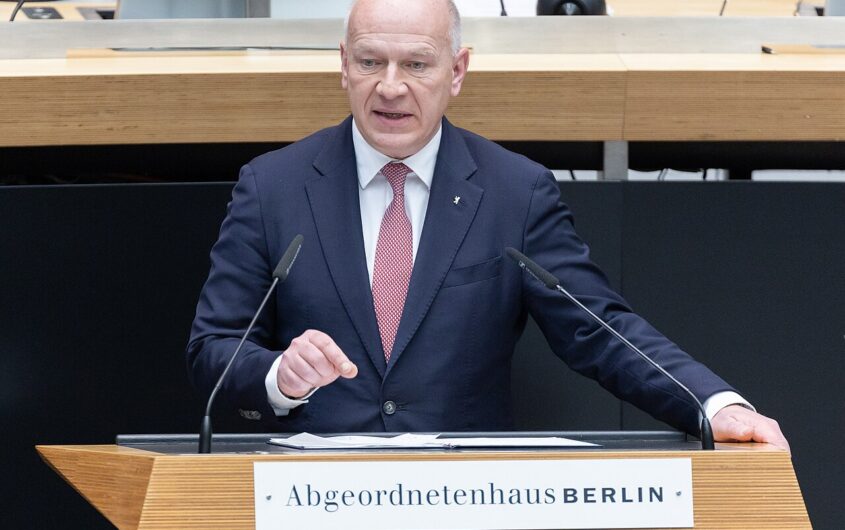
Kai Wegner, Berlin’s first conservative mayor in twenty-two years, initially emerged as the figure who could restore the Christian Democratic Union’s (CDU) position in Berlin. Yet after months of declining poll numbers and a career-altering controversy regarding January’s blackout, Wegner announced in July that he would resign from the race as the leading candidate for the September 20, 2026, elections. Wegner’s rise and rapid fall in his political career raise a warning flag for the CDU and its future.
Lifelong Commitment to the CDU
Wegner’s political involvement began early. Born in 1972 to two working-class parents in the district of Spandau, he joined the CDU’s youth wing, the Junge Union, at just sixteen years old. From 2000 to 2003, he was chair of the youth organization in Berlin. Wegner’s youth involvement launched the trajectory of his political career, a steady ascent up a ladder until he reached his place in the Rotes Rathaus as mayor of Berlin.
After completing two years in the air force, he was elected to the Spandau Borough Assembly while completing vocational training as an insurance salesman. He then worked for three years at a construction company before becoming a business consultant. During this time, he also served in the Berlin House of Representatives (Berlin’s state parliament) from 1999 to 2005, where he served as deputy chair and economic policy spokesperson for the CDU. His time working for a construction company established him as an expert in housing and urban development, which he made central to his campaign on increasing housing in Berlin. In 2005, he was elected to the Bundestag, fifth on the party’s list after losing the direct mandate to Social Democrat (SPD) member Swen Schulz. In 2009 and 2013, he successfully won his constituency of Berlin-Spandau-Charlottenburg, becoming directly elected to the Bundestag. However, in 2017, he once again lost his constituency to Swen Schulz, entering the Bundestag second on the state list. In the Bundestag, he was the spokesperson for the Committee on Building, Housing, Urban Development, and Local Government from 2018 to 2021.
In 2019, Wegner shifted his focus to local politics, running to be the head of the Berlin CDU. While relinquishing a Bundestag position could be perceived as a poor political move, for Wegner, it was the opposite. He held a long-term ambition to become mayor. His experience in the Bundestag, Berlin CDU, and the district and city-state government deepened Wegner’s connections within the party, especially with members from west Berlin. The incumbent chair Monika Grütters was repeatedly criticized for an insufficient presence in Berlin state politics and failing to set her own distinct policy stamp. The party was divided. Wegner’s campaign as chair was centered around the end of the red-green-red (Social Democratic-Green-Left) coalition and a united CDU with the motto “CDU Gemeinsamstark” (CDU Strong Together). Wegner secured his position as Berlin Chairman with a healthy 76.9 percent of the vote.
In October 2020, he announced his intention to run for mayor in the 2021 state election. Wegner called upon his experience in housing and urban development to create a central campaign pitch and image. He emphasized his working-class parents, drawing from an experience where a rent increase notice pushed his family to move: “I know what it’s like for people whose rents are rising, who fear they can no longer afford it.” He vowed to tackle the ever-pressing issue of Berlin’s high cost of living. However, in 2021, with the looming uncertainty around the CDU after the retirement of Angela Merkel, Wegner secured a meager 18 percent. When the election was re-run in 2023, the CDU surged to 28.2 percent, and he became mayor.
Law, Order, and Migration (and Controversy)
The unprecedented success of the conservative party in 2023 emerged from a variety of factors. The election itself was unusual; the 2021 results were deemed invalid due to ballot mix-ups and long wait times, exacerbated by the date coinciding with the massive Berlin marathon. The chaos of the extraordinary election, coupled with an increase in violence during the voting period, where men threw fireworks at emergency workers, gave the CDU, a party campaigning on security and order, a natural advantage. Furthermore, Wegner provoked a media debate, demanding the names of the criminals to determine whether they were immigrants. This rhetoric capitalized on the then-budding xenophobic sentiment in Berlin that has only grown since.
Despite the CDU gaining 10.2 percentage points in 2023, Wegner did not have an easy time assuming the mayoral office. Wegner required eighty votes out of 159 to become mayor; yet even with the grand coalition formed between the CDU and SPD totaling eighty-six seats, it took three ballots to confirm his position. More leftist members of the SPD were dissatisfied with the choice of Wegner and the coalition with the conservatives, resulting in the prolonged process. This was the first time in Berlin’s history that the mayoral election required three rounds to elect a governing mayor.
Following the election, the Alternative for Germany party (AfD) released a statement alleging that some members cast ballots in favor of Wegner, implying that it was not votes from coalition partners that led him to win but the far-right. Ultimately, the vote was conducted by secret ballot, making it impossible to verify these claims. Nevertheless, the announcement, along with the historical precedent of requiring three ballots, painted an image of disunity and a fractured Landtag, leaving Wegner to start his mayoral term on precarious political footing.
Berlin: Ready for More
Throughout Wegner and the CDU’s 2023 campaign, the slogan “Berlin: bereit für mehr” was seen around the city, a message for revitalizing the city’s economy and infrastructure. Yet, after Wegner’s term in Berlin, it seems that Berliners are “ready for more” than the CDU.
Once elected, Wegner named Berlin’s housing crisis as a top priority. He underlined that the cost of living and deficiency of affordable housing were barriers to the city’s growth. According to Berlin’s Senate Department for Urban Development, Building, and Housing, 272,000 new apartments are needed by 2040 to ease the overheated market. By reducing construction taxes, subsidizing manufacturing, shortening planning deadlines, and overall decreasing bureaucracy for construction in the Faster Construction Act, Berlin successfully approved 13,750 apartment units to be built in 2025, up by 40.7 percent from 2024. However, this is far below the demand threshold. Prices remain high, and discontent grows. As his administration is reluctant to approve social housing separate from private enterprise, dissatisfaction from SPD and Green voices increases.
Another of Wegner’s largest emphases during his campaign was administrative reform, highlighting how government failures and inefficiencies were systemic and synonymous with Berlin. On January 1, 2026, he successfully passed a reform plan supported by opposing Greens and Left parties, ringing in the new year united in a desire for improved efficiency. However, this reform was overshadowed by a January 3 power outage, during which 45,000 households and 2,200 businesses remained without power amid freezing conditions. Icy conditions froze streets and created overcrowded emergency rooms. It was revealed that the power outage was caused by an arson attack. Wegner was heavily criticized for playing tennis amidst the blackout, facing calls to resign. Repeated revisions to Wegner’s account of his actions during the blackout and growing criticism from his own party transformed a week of political controversy into a months-long conversation about Wegner’s credibility as a politician. Wegner’s 2026 continued to dampen as Berlin’s culture minister resigned in April after misallocating funds. One month later, his pick for chief digital officer also stepped down after lying on his CV and a scandal involving insolvency proceedings with his company. As Wegner continued to campaign on administrative efficiency, the dark cloud of 2026’s failures cast a shadow of distrust over his words. By July 10, Wegner, at the prompting of his party, announced that he would no longer be running for reelection.
September 2026 Outlook
The CDU now enters the September election under circumstances few anticipated. Berlin was expected to be one of the CDU’s strongest opportunities to regain lost ground after its loss to the Greens in Baden-Württemberg in March. An unparalleled rise of the AfD in Mecklenburg-Vorpommern and Saxony-Anhalt all but guarantees losses in those states this coming September. There is also symbolic significance in more moderate parties losing their hold on the nation’s capital: if polarized views permeate even the most urban and cosmopolitan place in the country, the future of the CDU is rocky.
In the upcoming election, the CDU is once again trying to position itself as a unifier: a centrist force that pledges not to ally with overly radical parties. However, its own party now stands divided. In June 2026, Wegner had been nominated as the party’s leading candidate. Less than one month later, he was pushed to resign, with Berlin’s finance minister Stefan Evers, a man obscure outside the local CDU bubble, taking his place, thrusting the CDU into a leadership transition two short months before the election. Further, regional elections have historically served as opportunities to express discontent with the national government. As Merz himself also sees declining support, the outlook for the CDU in September dims. The CDU continues to target issues Berliners care about—security, housing, education, and traffic policies. However, whether the transition to another candidate is enough accountability to quell the discontent of the citizens with the previous administration stands to be seen in September.