
European People's Party via Flickr
The Unloved Chancellor

Stephen F. Szabo
Senior Fellow
Dr. Stephen F. Szabo is a Senior Fellow at AICGS, where he focuses on German foreign and security policies and the new German role in Europe and beyond. Until 2017, he was the Executive Director of the Transatlantic Academy, a Washington, DC, based forum for research and dialogue between scholars, policy experts, and authors from both sides of the Atlantic. Prior to joining the German Marshall Fund in 2007, Dr. Szabo was Interim Dean and Associate Dean for Academic Affairs and taught European Studies at The Paul H. Nitze School of Advanced International Studies, Johns Hopkins University. He served as Professor of National Security Affairs at the National War College, National Defense University (1982-1990). He received his PhD in Political Science from Georgetown University and has been a fellow with the Alexander von Humboldt Stiftung, the Woodrow Wilson International Center for Scholars, and the American Academy in Berlin, as well as serving as Research Director at AICGS. In addition to SAIS, he has taught at the Hertie School of Governance, Georgetown University, George Washington University, and the University of Virginia. He has published widely on European and German politics and foreign policies, including. The Successor Generation: International Perspectives of Postwar Europeans, The Diplomacy of German Unification, Parting Ways: The Crisis in the German-American Relationship, and Germany, Russia and the Rise of Geo-Economics.
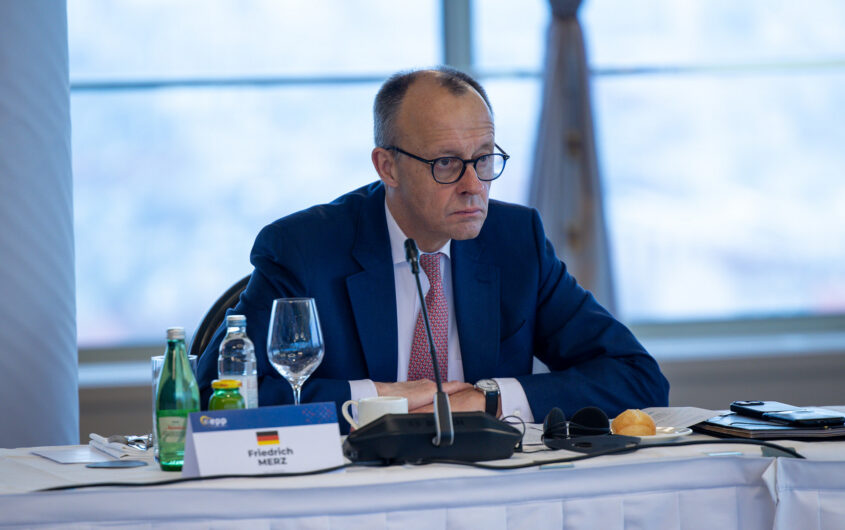
Following the results of the recent Landtag elections in Saxony-Anhalt, the press is already preparing Friedrich Merz’s political obituary. While he may be responsible for some of the discontent and his personal style seems not to resonate very widely among Germans, to paraphrase what Mark Twain said about Wagner’s music, it is not as bad as it sounds. It is ironic that the German public has warm memories for Angela Merkel but little understanding of the task she left for her successor. The Merkel years have proved to be a disaster for Germany. Under her coalition governments, German infrastructure became sadly depleted, and the country found itself too reliant on cheap Russian energy, exports to the Chinese market, and the American security guarantee—while ending conscription and deeply neglecting defense spending. Her policy opening the doors to Syrian and other refugees in 2015, while morally laudable, opened the doors rather for the Alternative for Germany (AfD) in 2026.
Since coming to power, Merz has tried to revive the German economy by investing in infrastructure and has reinvigorated German defense and intelligence capabilities, including a major increase in defense spending begun under his predecessor, the Social Democrat Olaf Scholz. He has introduced reforms in taxes, pensions, health insurance, labor markets, and other areas that, in one assessment, “represent the kind of grinding overhauls previous governments have avoided because they involve unpopular measures like increasing the retirement age and cutting some health insurance benefits, and in that sense, they are arguably the stuff of mundane, responsible governance.” He has had to do this while working within a coalition with the Social Democrats, and while his defense minister, Boris Pistorius, has been an invaluable partner, the party has proved to be reluctant on many of these issues and watered down many of his efforts. He is also leading a Christian Democratic Union that polled at 35 percent with its sister party the Christian Social Union when Merkel took office and stood at 28.5 percent when he took office. His coalition partner only polled at 16.5 percent, down from the 34.2 percent it polled in Gerhard Schroeder’s defeat in 2005. The two parties’ seats in the Bundestag fell from 448 in 2005 to 328 today; the coalition holds a majority of twelve seats. If Merz were to be replaced by Hendrik Wust, the minister president of North Rhine-Westphalia and the current favorite, Wust would face the same limits.
Merz has taken on a necessary but deeply unpopular task of reforming a country that is now facing serious challenges from the neglect of the years of Merkelism.
The German public and the domestic and international media have overreacted to the elections in a small state in eastern Germany. The results may be a bellwether for parts of eastern Germany but not for the entire country. Saxony-Anhalt, like much of the rest of the former GDR, has seen an out-migration of the best and the brightest since German unification in 1989. Saxony-Anhalt has lost a quarter of its population since reunification, leaving only 2.2 million people today. The state has the third-lowest population density in Germany, behind two other eastern German states. As a result, Saxony-Anhalt now has the oldest population of any state in Germany, with an average age of 47.9. It has one of the highest unemployment rates in Germany at 8 percent. About 192,000 foreigners live in the state, about 8 percent of the population. This population—older and disgruntled, who never really experienced a diverse population or immigration—is now declared to speak for the future of Germany. In a nation that supports Ukraine in its defense against Russian aggression and has little sympathy for the Putin regime, the leaders of the AfD in Saxony-Anhalt want to reintroduce Russian language classes and end support for Ukraine.
While Friedrich Merz may not be the kind of person many Germans would like to have a beer with, he has taken on a necessary but deeply unpopular task of reforming a country that is now facing serious challenges from the neglect of the years of Merkelism. Analysts should be more concerned about what’s happening at Volkswagen and what it says about the broader German economy and less about the victory of malcontents in a small, unrepresentative state. Media and political analysts risk amplifying the importance of dangerous and bizarre politicians while undermining and criticizing those who are trying to deal with real problems facing Germany’s future.