
Jason Hayes via Flickr
The Language of Eastern Resentment
Tim Eydelnant
Non-Resident Fellow
Tim Eydelnant is a former senior U.S. Foreign Service Officer with more than two decades of experience in transatlantic affairs, diplomacy, humanitarian response, and public policy.
Most recently, he served as Executive Director of the Shalom Hartman Institute’s Washington, DC, Center for Judaism, Israel, and Public Policy, where he helped build a new platform for engagement with policymakers, think tanks, and international organizations around questions of democratic resilience, antisemitism, pluralism, and the future of the transatlantic relationship.
Previously, he was a Senior Diplomatic Fellow at the Wilson Center, where his research focused on the rise of antisemitism and extremism in eastern Germany following October 7, as well as broader societal fragmentation in Central and Eastern Europe.
During his Foreign Service career, Tim served as Principal Officer (Consul-General) at the U.S. Consulate General in Leipzig, Germany, where he directed U.S. engagement in Saxony, Saxony-Anhalt, and Thuringia, worked closely with Jewish communities and civil society partners, and led initiatives related to Holocaust remembrance, democratic resilience, and U.S.-German relations in eastern Germany. His diplomatic assignments also included Jerusalem, Iraq, Austria, Brazil, Russia, and Finland, as well as senior Washington roles in the Bureau of Energy Resources, the Bureau of Population, Refugees, and Migration during the Syrian refugee crisis, Consular Affairs, and the State Department Operations Center.
He is a graduate of Georgetown University’s School of Foreign Service and the National Defense University’s Eisenhower School.
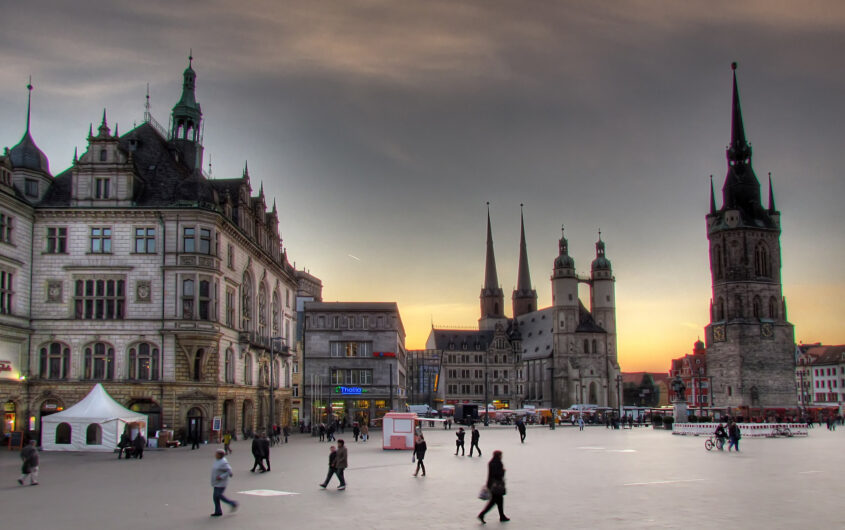
Of the three eastern German states I was responsible for as U.S. Consul General in Leipzig, Saxony-Anhalt always struck me as perhaps the most distinctly eastern. It was also a place I particularly enjoyed visiting. My memories range from the extraordinary rose gardens of the Europa-Rosarium in Sangerhausen and the medieval streets of Stolberg to more personal connections: exploring Halberstadt’s Jewish past, cheering on the basketball team in Weißenfels, or discovering excellent white wines around Naumburg. Saxony-Anhalt was never simply a political jurisdiction on my consular map. I came to know it with considerable affection.
Perhaps that is why my first reaction to Sunday’s election is to resist the easiest headline, that of another far-right surge. There is no reason to minimize what happened. The Alternative for Germany (AfD), whose Saxony-Anhalt organization has been classified as right-wing extremist by the state’s domestic intelligence service, won 43.8 percent, more than twice its 2021 result. The Christian Democratic Union (CDU) collapsed from 37.1 to 17.2 percent.
But describing the winner does not necessarily explain the voters. What happened looks increasingly like a regional political realignment. Dissatisfaction with Berlin certainly helped drive it. But that alone cannot explain why voters chose the AfD rather than another opposition party.
If Germany’s democratic center wants to win these voters back, it first has to understand why so many concluded that the established political order no longer speaks for them.
Migration and economic insecurity matter. So do energy costs and frustration with a federal government many voters see as distant. Regional pride matters too. In my years traveling through eastern Germany, I encountered that pride alongside a persistent feeling that eastern experience was too often explained by others rather than listened to. Reunification brought extraordinary freedoms and opportunities, but also dislocation, demographic decline, and the disappearance of institutions and certainties that had structured people’s lives.
The AfD has been more successful than its competitors at turning those individual grievances into a collective identity. Its message is not simply that Berlin’s policies are wrong. It is that we understand who you are, and they do not. That message now crosses generations. I recently wrote about the AfD’s appeal to young eastern Germans, a generation that inherited the freedoms of 1989 rather than fought for them. Sunday’s result forces me to broaden that argument. The AfD led among younger and older voters, men and women, in an election with 77.8 percent turnout. This was not a highly motivated fringe capturing a low-turnout election.
And now comes the paradox in Magdeburg. The AfD won 39 of 83 seats but cannot govern alone. The left-populist Bündnis Sahra Wagenknecht (BSW), with just five seats, could now play an outsized role in determining what government emerges, a remarkable consequence of the fragmentation of the old political order. That arithmetic will occupy Berlin. The larger problem should occupy it longer.
The Saxony-Anhalt I knew was proud, complicated, hospitable, sometimes frustrated, and unmistakably eastern. Listening seriously to what its voters are saying does not mean accepting the AfD’s extremist answers. Quite the opposite. If Germany’s democratic center wants to win these voters back, it first has to understand why so many concluded that the established political order no longer speaks for them.