

After Kohl and Merkel
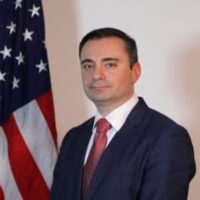
Tim Eydelnant
Non-Resident Fellow
Tim Eydelnant is a former senior U.S. Foreign Service Officer with more than two decades of experience in transatlantic affairs, diplomacy, humanitarian response, and public policy.
Most recently, he served as Executive Director of the Shalom Hartman Institute’s Washington, DC, Center for Judaism, Israel, and Public Policy, where he helped build a new platform for engagement with policymakers, think tanks, and international organizations around questions of democratic resilience, antisemitism, pluralism, and the future of the transatlantic relationship.
Previously, he was a Senior Diplomatic Fellow at the Wilson Center, where his research focused on the rise of antisemitism and extremism in eastern Germany following October 7, as well as broader societal fragmentation in Central and Eastern Europe.
During his Foreign Service career, Tim served as Principal Officer (Consul-General) at the U.S. Consulate General in Leipzig, Germany, where he directed U.S. engagement in Saxony, Saxony-Anhalt, and Thuringia, worked closely with Jewish communities and civil society partners, and led initiatives related to Holocaust remembrance, democratic resilience, and U.S.-German relations in eastern Germany. His diplomatic assignments also included Jerusalem, Iraq, Austria, Brazil, Russia, and Finland, as well as senior Washington roles in the Bureau of Energy Resources, the Bureau of Population, Refugees, and Migration during the Syrian refugee crisis, Consular Affairs, and the State Department Operations Center.
He is a graduate of Georgetown University’s School of Foreign Service and the National Defense University’s Eisenhower School.
Why the CDU Is Collapsing
In September, the party of Adenauer, Kohl, and Merkel failed to win even five percent of the vote in Merkel’s own home state. It was the worst result in the Christian Democratic Union’s history, and it will not be the last unless the party understands why it happened.
My first memories of Helmut Kohl are from Minsk.
It was 1986. I was thirteen, and my father and I would watch Mezhdunarodnaya Panorama, Soviet television’s weekly review of international affairs. Its commentators offered one of our few windows onto Western politics. Even through the ideological filters of Soviet television, I remember Kohl being treated with a certain respect. He was the chancellor of an adversarial NATO country but also a serious political figure. A statesman.
Three years later, my family was in Rome, awaiting immigration to the United States, when the Berlin Wall fell. Suddenly, the chancellor I remembered from Soviet television stood at the center of something that had seemed unimaginable in Minsk: German reunification and the collapse of the European order in which I had grown up.
Nearly four decades later, the party Kohl led is collapsing in the very region his reunification promised to transform. In Mecklenburg-Vorpommern, its share of the vote fell from 38.3 percent in 1990 to 4.9 percent. In Saxony-Anhalt, it received 17.2 percent against the Alternative for Germany’s 43.8 percent. In Berlin, it finished behind Die Linke.
The most common explanation is migration. It is the right place to start, but it is not the whole story. The CDU did not collapse because of migration alone. It collapsed because it lost credibility on migration twice, in opposite directions, and because nothing else it once offered eastern voters was strong enough to hold them.
The first loss came in 2015, when Merkel kept Germany’s borders open to roughly a million asylum seekers. Whatever one thinks of that decision morally, politically, it split the CDU’s electorate. Many conservative voters, particularly in the east, concluded that the party no longer represented them. The AfD, founded two years earlier to oppose eurozone bailouts, remade itself as an anti-immigration party and found its constituency. Merkel’s personal popularity concealed the damage for years. Her electoral success postponed, rather than resolved, the question of what the CDU stood for on the issue that had reshaped German politics.
The second loss came when Friedrich Merz set out to win those voters back. In January 2025, as CDU leader, he pushed a migration motion through the Bundestag with AfD votes, drawing a rare public rebuke from Merkel. As chancellor, he has made border control a signature issue.
It has not worked. If migration alone explained the CDU’s decline, a harder line should have reversed it. Instead, the AfD has continued to grow in popularity. Voters who want the hardest possible line on migration already have the original; the CDU is offering a copy. And every step toward the AfD’s agenda costs the CDU voters in the center, who conclude that its boundaries are negotiable.
Where the CDU still holds, it is because someone earned trust in person rather than relying on the party’s name.
Heidenau shows what this looks like on the ground. In this Saxony town, CDU council members co-sponsored a motion with the AfD to stop the installation of new Stolpersteine, the small brass plaques commemorating individual victims of Nazi persecution. CDU Federal Education Minister Karin Prien called the decision a scandal. The party’s own 2018 congress resolution rules out cooperation with the AfD, and in 2024, it adopted a new statement of principles. The CDU’s problem is not a lack of written positions. It is a lack of credibility in holding to them. The episode had nothing to do with migration, but it revealed the same pattern: a party that allows its competitor to set the agenda no longer controls its own identity.
Migration also cannot explain everything. Before the Saxony-Anhalt election, voters named the economy, jobs, and wages as their most pressing problem more often than any other issue. Many eastern regions with the strongest AfD support have relatively few migrants. Eastern skepticism toward Germany’s hard line on Russia, which Merz embodies, matters as well. Migration became the symbol of a broader conviction that decisions about the east are made elsewhere.
The CDU’s eastern roots were also always shallower than its western ones. The party governed on the authority of Kohl’s reunification and Merkel’s biography rather than through dense local networks. Younger eastern Germans remember neither. Among voters aged 18 to 24 in Saxony-Anhalt, the CDU received just 5 percent.
Saxony is the exception that proves the point. Despite a May 2026 Institut für neue soziale Antworten (INSA) survey placing the AfD at 42 percent and the CDU at 21 percent, Minister-President Michael Kretschmer’s CDU still leads the state government. During my years as U.S. Consul-General in Leipzig, I came to appreciate his political method. I have disagreed with some of his positions, especially on Russia, and occasionally strongly. But he understood the importance of showing up. He visited communities, engaged dissatisfied citizens, and made himself accessible even when conversations became uncomfortable. Where the CDU still holds, it is because someone earned trust in person rather than relying on the party’s name.
In Leadership, Henry Kissinger titled his chapter on Konrad Adenauer “The Strategy of Humility.” Adenauer restored Germany’s legitimacy by starting the process of confronting the country’s past and anchoring its future in the democratic West. That founding inheritance is why Heidenau matters and why a CDU that borrows its agenda from the AfD loses more than it gains.
When I watched Kohl on Soviet television, he represented a conception of Germany’s future that ultimately transformed Europe.
The CDU’s collapse is not simply a story about migration. It is the story of a party that lived on inherited credibility until migration revealed how little was left. It cannot win back the east by imitating its rival. If it wants to produce another generation of statesmen, it must stop relying on the legitimacy of its predecessors and begin earning its own.