

Thomas Wolf via Wikimedia Commons
Merz’s Economic Challenge

Alexander Privitera
AGI Non-Resident Senior Fellow
Alexander Privitera a Geoeconomics Non-Resident Senior Fellow at AGI. He is a columnist at BRINK news and professor at Marconi University. He was previously Senior Policy Advisor at the European Banking Federation and was the head of European affairs at Commerzbank AG. He focuses primarily on Germany’s European policies and their impact on relations between the United States and Europe. Previously, Mr. Privitera was the Washington-based correspondent for the leading German news channel, N24. As a journalist, over the past two decades he has been posted to Berlin, Bonn, Brussels, and Rome. Mr. Privitera was born in Rome, Italy, and holds a degree in Political Science (International Relations and Economics) from La Sapienza University in Rome.
The AfD’s Pressures on Domestic and European Policy
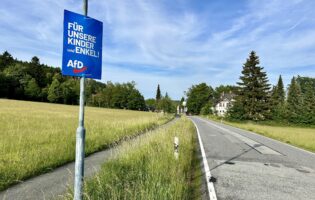
The rise of the far-right Alternative for Germany (AfD) in Germany is having an impact on the economic agenda of the German government led by Friedrich Merz. The chancellor wants to prevent populist forces from gaining power at the federal level. The goal is, in his words, to protect Germany’s democracy. In practice, this means that the ruling coalition will look for ways to reduce the negative impact of global turbulence on Germany and change those policies, domestic and European, that typically only pay off in the medium to long term but are often painful in the short term.
On the domestic front, despite assurances that he will stay the course, there are signs Merz will look for ways to soften the impact of planned welfare reforms, especially on pensions. His maneuvering room is limited by the worsening state of Germany’s retirement system. According to the Bundesrechnungshof—Germany’s version of the U.S. Congressional Budget Office and the Government Accountability Office—pensions could eat up more than 40 percent of the government budget by 2040 unless the system is reformed. 30 percent of German government spending already goes to fill up depleted retirement coffers. These shortfalls reduce the government’s ability to tackle other priorities, such as the need to lessen the tax burden on its citizens and Germany’s struggling companies.
Another area in which short-term measures risk trumping long-term solutions is energy as the government scrambles to reduce prices at the gas pump. In this area confusion reigns supreme. Recent measures taken to increase and diversify foreign energy supply and reduce the adverse impact of the decarbonization of Germany’s economy have increased dependencies on fossil fuel providers that are now involved in the military conflict in the Middle East.
Corporate Germany warns that the industry faces a dire future if the energy crisis is not addressed promptly. Since the recent supply shocks are mainly caused by outside factors, such as the wars in Ukraine and Iran, this is easier said than done. The AfD suggests that to reduce energy prices, Russian gas and oil should resume flowing toward Germany freely. In other words, Germany should stop supporting Kiev. If the AfD continues to collect electoral victories, the domestic debate about energy could soon have a dramatic impact on Germany’s foreign policy priorities. For now, any quick fix to address the energy problem will require greater fiscal support from Berlin to reduce or cap energy prices for consumers and corporates.
Of course, the energy challenge has a European dimension. Under pressure from populists and Germany’s manufacturing industry, in particular its automotive sector, the German government is pushing hard to soften EU rules governing the so-called green transition. Berlin asked the EU Commission to find ways to avoid the mandated end of combustion engines by 2035. Europe’s executive tabled a proposal that softens the regulation but has since faced stiff resistance from a group of member states headed by France, which want to stick by the original rules. More recently, contours of a possible bargain have suddenly emerged. In return for France’s willingness to give up its resistance, Germany is apparently more open to embracing more stringent “Made in Europe” rules for public procurement and public support schemes, which it had, until now, resisted.
If the AfD continues to collect electoral victories, the domestic debate about energy could soon have a dramatic impact on Germany’s foreign policy priorities.
This is all part of a larger story of European and national retrenchment, and energy is not the only area in which France and Germany are finally converging toward common solutions. The most notable breakthrough, one that is potentially a watershed moment for Germany and Europe, is trade.
In a new common paper, Berlin and Paris now openly call out systemic and persistent market distortions in the global trade system, caused by practices such as dumping, excessive subsidies, and other unfair industrial policy measures. The paper even highlights restrictions of currency convertibility and currency manipulation. In strong wording, Germany and France stress that derisking must be pursued in sectors where dependencies are already being weaponized. The list is comprehensive. It includes areas such as AI, semiconductors, quantum, critical raw materials, lithium-ion battery supply chains, clean energy components, biotech, and financial services. What is notable about the common position is that it asks the Commission to strengthen its toolkit of trade defense instruments. Moreover, it supports its faster deployment.
The paper represents a hardening of Germany’s position on trade. Once a champion of globalization, Berlin has chosen to side with the traditionally more protectionist France. By highlighting a presumed asymmetry in market openness, the new Franco-German position even vaguely echoes Donald Trump. Potentially, this is another step toward partial deglobalization, toward a system in which the search for ever-greater market efficiencies is replaced by a greater emphasis on resilience and in which openness is only granted to like-minded partners, think of Canada or the UK. Against such a backdrop, even the European objective to preserve and expand the European manufacturing base should not be solely seen as an attempt to regain Europe’s eroded competitiveness but also as a necessary step to ensure Europe would be able to better withstand potential military conflict with its own means in the future.
The main addressee of the Franco-German paper is clearly China. The government in Beijing will no doubt register that Paris and Berlin are trying to strengthen the Commission’s negotiating hand. Whether or not this will help to find a compromise between Brussels and Beijing is unclear. Some Franco-German inconsistencies, such as the demand for some of the Chinese sectors to export less to Europe while others should do the opposite, are hard to reconcile.
But overall, what really matters is that Berlin is no longer shy to state that China is not an opportunity for Germany’s export-oriented economy anymore and should mainly be treated as a threat. This pivot is in large part due to lobbying from the German automotive sector, which has dramatically changed its once-open attitude toward the Chinese market. It has the added benefit that it signals to the U.S. administration that Europe’s and Washington’s positions on China are similar.
Oddly, this newfound convergence of Paris and Berlin has not affected the uncompromising German position on the European MFF (Multiannual Financial Framework). Here, Berlin continues to insist on drastic cuts to the common budget proposal under discussion, in spite of the fact that some of its funds could also be used to cushion the economic shocks and help strengthen Europe’s industrial base. The failure to link the new trade stance to the need to unlock more common resources is a problematic omission. Perhaps it stems from the fact that the German change of heart on trade is recent and not entirely thought through.
But perhaps, more simply, the truth is that agreeing to any increase in the spending capacity of the European Commission is bound to be criticized by a public opinion in Germany that faces domestic spending cuts and is increasingly leaning toward national, populist solutions. And that, too, is part of the impact the AfD is already having on the work of Germany’s government.