



Tobias Koch via Wikimedia Commons
On the Decline of Germany’s Major Political Parties

Jörn Quitzau
Bergos AG
Joern Quitzau is a Geoeconomics Non-Resident Senior Fellow at AGI. He is Chief Economist at Bergos, a private bank based in Switzerland. He specializes in economic trend research and economic policy. Joern Quitzau hosts two Economics podcasts.
Prior to his position at Bergos, Joern Quitzau worked for Berenberg in Hamburg (2007-2024) and Deutsche Bank Research in Frankfurt (2000-2006) with a special focus on tax and fiscal policy.
Dr. Quitzau (PhD, University of Hamburg) was a Visiting Fellow at AGI in April 2014 and September 2022 and an American-German Situation Room Fellow in April 2018.
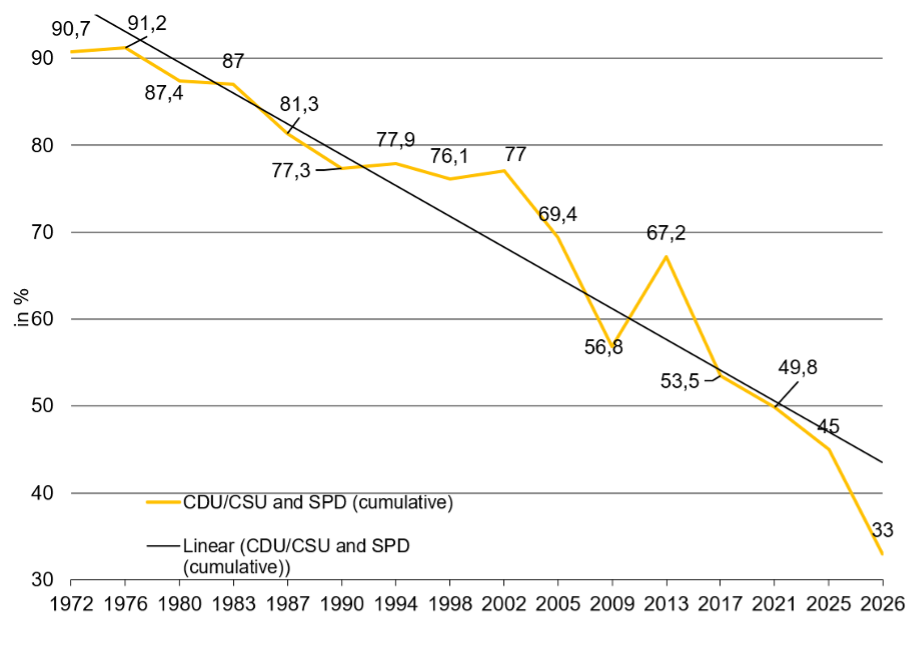
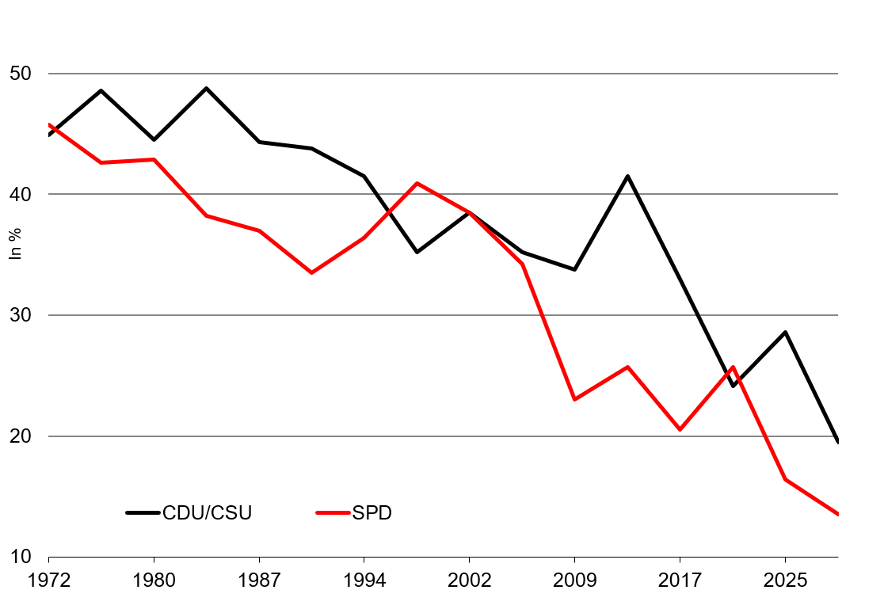
The decline of Germany’s major political parties, the Christian Democratic and Christian Social Union (CDU/CSU) and the Social Democrats (SPD), can be vividly illustrated in a single image (Figure 1). In the 1970s, the two rival parties together accounted for about 90 percent of the vote; according to the latest poll, that figure would now be only 33 percent. However, the fact that the conservative CDU/CSU now polls at only 19.5 percent and the social democratic SPD at 13.5 percent at the federal level is not merely a snapshot in time, but rather the (provisional) culmination of a decades-long downward trend (Figure 2).
Figure 1: Long-Term Downward Trend
The reasons for the decline in the popularity of the mainstream parties have long been the subject of intense debate. Party-political calculations, a focus on retaining power rather than substantive policy, a lack of quality and credibility among political figures, the role of social media, and targeted influence by foreign powers through fake news have all been discussed at length as factors contributing to the loss of votes. All of these factors do, in fact, go some way toward explaining the situation.
However, little attention has been paid so far to the fact that the decline in the influence of the mainstream parties—which began gradually years ago and has since accelerated—goes hand in hand with an increasingly individualized and diverse society. Values, lifestyles, and political attitudes have become more differentiated. Pluralism and diversity have become increasingly important as guiding principles for social coexistence. In such an environment, it would be downright surprising if political preferences had not also become more diverse. Why should members of a society that is becoming increasingly diverse—and that enjoys the greatest possible variety of products when it comes to consumption—be satisfied with practically only two or three options when it comes to political issues? In this respect, the trend of declining voter turnout could be interpreted quite unspectacularly as a political reflection of societal developments.
Figure 2: Drastic Decline in Significance
A Broader Spectrum of Political Parties
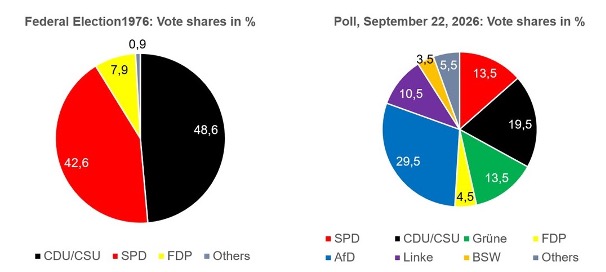
In the 1970s, aside from the two major mainstream parties, the only alternative was the liberal Free Democratic Party (FDP). At the time, it was regarded as a “majority-maker,” since, as the only possible coalition partner, it enabled either the CDU/CSU or the SPD to secure the necessary majority of seats in the Bundestag to form the federal government.
Over the decades, for various reasons, the number of parties with sufficient potential to clear the 5 percent threshold for entering the Bundestag has increased. Five parties are currently represented in the Bundestag: the CDU/CSU, the SPD, the Alternative for Germany (AfD), the Greens, and The Left. Recent polls also suggest that the FDP and the Sahra Wagenknecht Alliance (BSW) have a chance of entering the Bundestag (Figure 3). Compared to the 1970s, the number of serious options for voters has increased significantly, from three to the current seven.
Figure 3: German Political Landscape 1976 vs. 2026
Dissatisfaction Despite a Broader Range of Political Options
One could argue that a more diverse party landscape would better address the diverse wishes of the people and thus contribute to higher voter satisfaction. In that case, the decline in the influence of the mainstream parties would not actually be something to lament, but rather something to welcome. However, this would be a fallacy, because while citizens have more choices, in the end they are still offered only “one-size-fits-all” solutions by politicians. This makes voter dissatisfaction inevitable. The more citizens’ preferences diverge on political issues such as migration, environmental and climate protection, income redistribution, domestic security, military buildup, data protection, transportation, or digitalization, the greater the potential for dissatisfaction. After all, ultimately, all voters receive only a one-size-fits-all solution from the government, even when there is a coalition of two or more parties.
This is all the more significant because, in their private lives, citizens can make their (consumer) decisions entirely according to their own wishes. Thanks to the overwhelmingly vast range of products and services available—the market can fulfill even the most unusual desires—citizens can have all their wishes fulfilled in a tailor-made way (within their budgetary limits). In the wake of digitalization, the personalization of services even became all the rage. Companies advertised that their customers no longer had to make any compromises. Individual desires were prioritized above everything else.
Viewed in this light, the efficiency of the market economy is a curse for politics and for the provision of public goods to citizens. While the supply of private goods is tailored to individual needs, politicians can only offer a one-size-fits-all solution when it comes to public goods. No politician or political party can change this situation. Public goods are collective goods—no matter which party is in power, it will never be able to satisfy all citizens at the same time. A certain degree of voter frustration is, so to speak, built into the system.
On top of that, political parties often make different decisions after the election than they promised during the campaign. One example of this is the debt brake. Chancellor Friedrich Merz had spent his entire campaign advocating for sound public finances and the preservation of the debt brake. After the election, Merz allowed the debt brake to be watered down and paved the way for higher levels of debt. Breaking campaign promises is particularly likely when parties that are ideologically incompatible must form a coalition. Due to the so-called “firewall” against the AfD—which attracts a significant portion of the vote—this has almost become the norm in Germany. The CDU/CSU can now form coalitions almost exclusively with parties that are political opponents, given their very different worldviews and platforms.
Possible Solutions
What options are there to counter public dissatisfaction and thereby give the mainstream parties a new boost?
A widely held belief is that greater economic growth could alleviate social tensions—in line with the motto: “It’s the economy, stupid.” Yet this approach will be of only very limited help. These tensions and the decline in the mainstream parties’ influence were already present when Germany was still Europe’s engine of growth in the past decade. Economic success and political satisfaction have become somewhat decoupled. Further evidence comes from various poll results showing that citizens are satisfied with their personal situations, while they are dissatisfied with the state of society.
The efficiency of the market economy is a curse for politics and for the provision of public goods to citizens.
What is needed is a new balance between individualism and a sense of community. This would result in a greater willingness to compromise among the population. Without a willingness to defer to the majority opinion when it comes to the provision of public goods, severe social conflicts will arise—just as we are currently experiencing. But the path to greater willingness to compromise is long and arduous. A short-term solution is unlikely.
One option would be to embrace more direct democracy—that is, to allow referendums on specific policy measures. This would enable citizens to express their preferences directly, without having to go through the process of voting for political parties. A common argument against referendums is that citizens lack the knowledge needed to decide on complex issues. However, this argument holds only to a limited extent. First, only less complex issues—those involving ideological rather than highly technical matters—could be decided through direct democracy. Second, the claim that politicians possess greater expertise and therefore achieve better results rests on shaky ground: political parties have similarly qualified advisory bodies. Nevertheless, the parties’ responses to many political questions vary widely. This shows that even when making decisions with far-reaching political implications, consulting highly qualified experts often does not lead to a clear recommendation for action. Switzerland has had positive experiences with referendums, in part because citizens inform themselves better about the issues being voted on than if they were to delegate all decisions to politicians.






.jpg)