

European Parliament via Flickr
Canada, the EU, and a Fragmenting Global Economy

Peter S. Rashish
Vice President; Director, Geoeconomics Program
Peter S. Rashish, who counts over 30 years of experience counseling corporations, think tanks, foundations, and international organizations on transatlantic trade and economic strategy, is Vice President and Director of the Geoeconomics Program at AICGS. He also writes The Wider Atlantic blog.
Mr. Rashish has served as Vice President for Europe and Eurasia at the U.S. Chamber of Commerce, where he spearheaded the Chamber’s advocacy ahead of the launch of the Transatlantic Trade and Investment Partnership. Previously, Mr. Rashish was a Senior Advisor for Europe at McLarty Associates, Executive Vice President of the European Institute, and a staff member and consultant at the International Energy Agency, the World Bank, UN Trade and Development, the Atlantic Council, the Bertelsmann Foundation, and the German Marshall Fund.
Mr. Rashish has testified before the House Financial Services Subcommittee on International Monetary Policy and Trade and the House Foreign Affairs Subcommittee on Europe and Eurasia and has advised three U.S. presidential campaigns. He has been a featured speaker at the Munich Security Conference, the Aspen Ideas Festival, and the European Forum Alpbach and is a member of the Board of Directors of the Jean Monnet Institute in Paris and a Senior Advisor to the European Policy Centre in Brussels. His commentaries have been published in The New York Times, the Financial Times, The Wall Street Journal, Foreign Policy, and The National Interest, and he has appeared on PBS, CNBC, CNN, NPR, and the BBC.
He earned a BA from Harvard College and an MPhil in international relations from Oxford University. He speaks French, German, Italian, and Spanish.
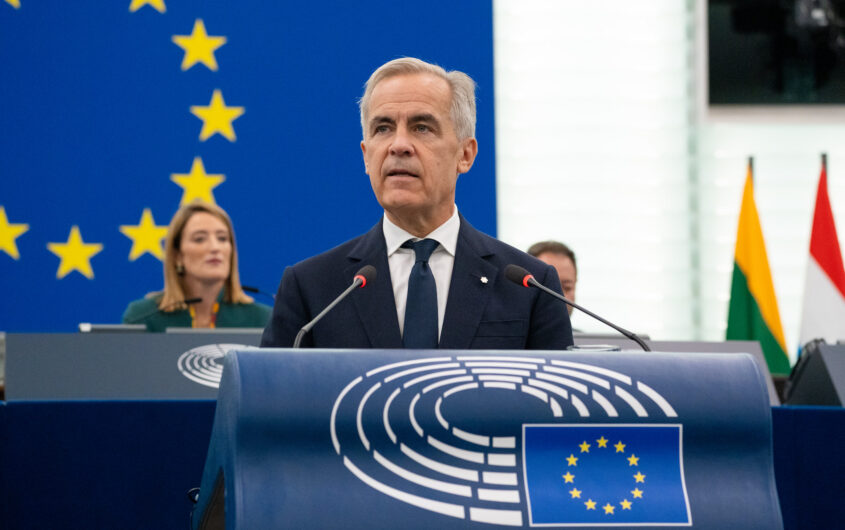
Last week, European Commission President Ursula von der Leyen and Canadian Prime Minister Mark Carney spoke on successive days before the European Parliament in Strasbourg. During her annual State of the European Union (SOTEU) address, von der Leyen proposed that Canada become the EU’s first “Associate Member,” which Carney endorsed (albeit cautiously) as part of an “alliance for the future.”
Although neither leader mentioned the United States in their speeches, the U.S. administration’s nationalistic approach to relations with allies—including ongoing trade tensions with both the EU and Canada—was clearly a backdrop for both. Indeed, President Trump raised concerns that such a tie-up could be a “hostile act” toward the United States and threatened tariffs against the EU (although not Canada) if it turned out that way.
The United States is a disruptive lone superpower, but viewing this move by Brussels and Ottawa solely through the lens of their deteriorated relations with Washington is unnecessarily zero-sum. Beyond creating a new channel for asserting their joint interests in the face of an uncooperative U.S. partner, the EU-Canada rapprochement can also be seen as one response to accelerating disorder and fragmentation in the global economy, something that has multiple causes.
While the EU has maintained several “association agreements,” especially with countries that are candidates for membership of the bloc, the category of “associate member” is nowhere to be found in the EU treaties. Canada and the EU do have a deep commercial partnership through the Comprehensive Economic and Trade Agreement signed in 2016, but such trade deals do not include the benefits and obligations of membership.
Beyond creating a new channel for asserting their joint interests in the face of an uncooperative U.S. partner, the EU-Canada rapprochement can also be seen as one response to accelerating disorder and fragmentation in the global economy.
But what von der Leyen and Carney said such a relationship would entail is revealing. They highlighted critical minerals, intelligent manufacturing, the defense industry, energy, AI, space, and cyber, among others. These are all areas of potential win-win cooperation that would serve the broader interests of democratic, market economies faced with China’s mercantilist challenge, Russia’s aggressive geopolitical posture, and weaker multilateral cooperation. Neither von der Leyen nor Carney spoke of ideals like reform of the World Trade Organization or, for that matter, of coercive measures like export or import controls, tariffs, or sanctions.
Whatever expression the EU and Canada give to their stepped-up, building block strategy for cooperation, it is likely there will be more such efforts in the coming years—irrespective of the party or person in power in the United States. In fact, the pragmatic, middle ground of policy—rather than sweeping calls for a return to the alliance of the past—can be expected to be the starting point for how a Democrat in the White House would approach transatlantic relations if the party won the 2028 presidential elections.
Universal and institutional approaches will often come up short if the current age endures where economic security is a paramount concern. More functional, ad hoc tools among shifting rosters of countries could become the norm. Depending on what it involves, Canadian associate membership in the EU should primarily be assessed in that light.