



Olivier Cleynen via Wikimedia Commons
Watching Ceuta, Thinking About Magdeburg
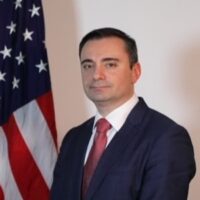
Tim Eydelnant
Tim Eydelnant is a former senior U.S. Foreign Service Officer with more than two decades of experience in transatlantic affairs, diplomacy, humanitarian response, and public policy.
Most recently, he served as Executive Director of the Shalom Hartman Institute’s Washington, DC, Center for Judaism, Israel, and Public Policy, where he helped build a new platform for engagement with policymakers, think tanks, and international organizations around questions of democratic resilience, antisemitism, pluralism, and the future of the transatlantic relationship.
Previously, he was a Senior Diplomatic Fellow at the Wilson Center, where his research focused on the rise of antisemitism and extremism in eastern Germany following October 7, as well as broader societal fragmentation in Central and Eastern Europe.
During his Foreign Service career, Tim served as Principal Officer (Consul-General) at the U.S. Consulate General in Leipzig, Germany, where he directed U.S. engagement in Saxony, Saxony-Anhalt, and Thuringia, worked closely with Jewish communities and civil society partners, and led initiatives related to Holocaust remembrance, democratic resilience, and U.S.-German relations in eastern Germany. His diplomatic assignments also included Jerusalem, Iraq, Austria, Brazil, Russia, and Finland, as well as senior Washington roles in the Bureau of Energy Resources, the Bureau of Population, Refugees, and Migration during the Syrian refugee crisis, Consular Affairs, and the State Department Operations Center.
He is a graduate of Georgetown University’s School of Foreign Service and the National Defense University’s Eisenhower School.
What Spain’s Border Tells Us About Eastern Germany
In the last week of July, tens of thousands of people crossed from Morocco into the Spanish enclave of Ceuta. Spain’s Interior Ministry counted close to 50,000 arrivals in little more than a day. More than 100 died. Some drowned. Others were crushed against the fence. Within forty-eight hours, most of those who had made it were back in Morocco.

That same week in Magdeburg, the two leading candidates in Saxony-Anhalt’s state election spent much of their time arguing about immigration. Almost no one who crossed at Ceuta will ever reach Magdeburg. What travels instead is the image of a border that no government was able to hold.
European governments have learned to ask whether such movements are being manipulated. Migration has been used as leverage against Europe before, by Belarus at the Polish and Lithuanian borders, by Turkey when it opened the Evros crossing in 2020, and by Morocco itself during its 2021 dispute with Spain. This time, economic desperation and online rumors may have been enough, although questions remain about Morocco’s enforcement of the border. European capitals responded by blaming one another. Italy temporarily introduced checks on arrivals from Spain. Twenty-two EU governments demanded coordinated action to strengthen Europe’s external borders, while several also blamed Spain’s regularization program. What none of them disputed was the premise beneath the quarrel. Europe’s external border had been overwhelmed within hours, and responsibility for holding it was immediately disputed. Voters did not need that explained to them. Is the government still in control?
That question will hover over Saxony-Anhalt’s state election on September 6, where the Alternative for Germany (AfD) is trying to convert years of protest into something more consequential. As I wrote after returning to Saxony earlier this summer, a protest sustained over election after election eventually stops being a protest and starts to resemble a claim to power. Where the AfD polls well ahead of the governing Christian Democrats (CDU), that transformation is no longer theoretical.
As Consul-General in Leipzig, I traveled often through Saxony-Anhalt, to Magdeburg and Halle but also to Dessau, Wittenberg, Sangerhausen, and towns that rarely attract the attention of Berlin, much less Washington. In an early interview with the Magdeburger Volksstimme in 2017, I said I wanted to see a Saxony-Anhalt beyond its two largest cities, and I reminded readers that democracies depend on citizens recognizing the state as their own even when they dislike its leaders. When that recognition weakens, every administrative failure confirms a larger suspicion. Over years of conversations, worries about migration were interwoven with demographic decline, shortages of doctors, energy costs, bureaucracy, and the sense that decisions about the region were made elsewhere by people who neither knew it nor much respected it. Migration gave all of it a single name.
The Magdeburg campaign forum in late July reflected exactly that. Minister-President Sven Schulze and his AfD challenger Ulrich Siegmund argued about asylum, deportations, and the need for foreign workers, but beneath the policy lay a contest over credibility. Which of them could plausibly claim to enforce the rules, and which represented a government able to do what it said it would? The AfD, which Saxony-Anhalt’s own domestic intelligence service classifies as confirmed right-wing extremist, understands that this question is more potent than any asylum law. Its language about migration plays on prejudice and deepens it. But the party also draws strength from failures nobody can call imaginary. German authorities have struggled to process claims, to deport people whose applications were rejected, and to act on warnings.
Compassion without administrative competence exhausts public confidence. Control without compassion corrodes the values border policy exists to protect.
No event shows both the reality of those failures and the danger of simplifying them more clearly than the attack on the Magdeburg Christmas market on December 20, 2024, when a driver plowed through a crowd, killing six and injuring hundreds. The accused was a Saudi-born physician who had lived in Germany since 2006 and been recognized as a refugee, and authorities had received multiple warnings about him. Yet his history resisted the narrative the attack was immediately given. He was not an Islamist but a vehement opponent of Islam, sympathetic to the AfD, and increasingly conspiratorial about the German state.
Most voters do not sort a failure into categories. They draw the conclusion that connects them. The state had the information and the authority, and people died anyway. The AfD exploits that ruthlessly, redirecting grief toward migrants who had nothing to do with it. The democratic center cannot answer by minimizing the failures, because refusing to name an institutional mistake leaves it to those who will describe it dishonestly.
My own relationship with Magdeburg makes it impossible to see the city only through that attack. In 2019, I was Schirmherr of the Christopher Street Day (CSD) Magdeburg, in the year of Stonewall’s fiftieth anniversary. The week opened with five rainbow flags raised in front of the Rathaus, and that August we flew one at the Consulate in Leipzig as well. The motto that year was a pun, “Deine Rechte Wa(h)ren?!”—turning on whether your rights are being kept or whether they merely were. In my message to the community, I wrote that rights are never self-evident, and I asked for solidarity with people still prosecuted, jailed, or executed over their sexual orientation in more than seventy countries.
That was not an abstraction in Magdeburg. Among the demands the CSD published that year was that staff in refugee accommodation be trained for the situation of LGBTQ+ asylum seekers, and that the city open a counseling center for them. The people marching for their own rights were already arguing about how Germany receives those fleeing for theirs. An asylum system worthy of Germany’s constitutional values must protect them. It must also be run by people able to tell the difference between those entitled to protection and those who are not. Compassion without administrative competence exhausts public confidence. Control without compassion corrodes the values border policy exists to protect.
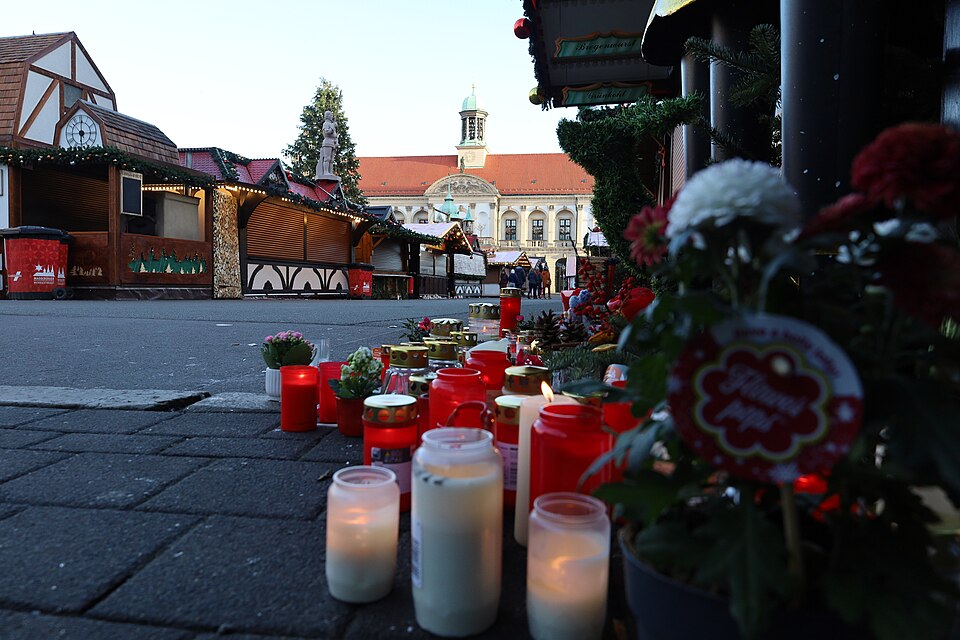
When I think about Magdeburg, the flags and the mourning belong to the same argument. Protecting people and being able to deliver on that promise are not competing demands. They are the same demand, and the AfD’s advantage is its insistence that the two cannot be reconciled. In September, Saxony-Anhalt will not be choosing between compassion and control. It will be deciding whether its voters still believe a government can manage both.
Ceuta is far from Magdeburg, but the questions raised at Ceuta’s fences have already arrived in Saxony-Anhalt. If Germany’s democratic parties can answer them with honesty, competence, and respect for the public they serve, migration may again become one difficult policy question among many. If they cannot, it will keep functioning as something larger: a referendum on whether the democratic state still knows how to govern.






_Christmas_Eve_Magdeburg_mourning_01.jpg)