
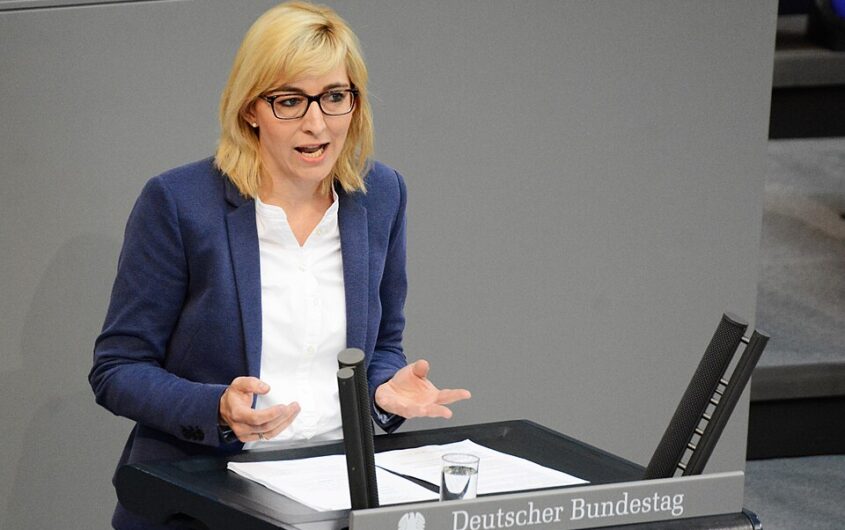
Katharina Böcker via Wikimedia Commons
AGI Profiles: Nina Warken

Rebecca Bohn
Halle Foundation/AGI Intern
Rebecca Bohn is a Summer 2026 Halle Foundation Intern at the American-German Institute and a fourth-year undergraduate student in the School of Public and International Affairs at the University of Georgia. Majoring in Political Science and International Affairs with a minor in German, Rebecca has developed an interest in the unique transnational relationship between the United States and Germany. Previously, she presented work on implementing German sustainability initiatives in the United States at the Young Economic Summit (YES!) in Hamburg in 2022. During summer 2025, she studied sustainable urban infrastructure and the German language at the Goethe-Institut in Freiburg before traveling to Munich to immerse herself in German language and culture. Rebecca’s research interests include Germany's role in securing sustainable energy sources, the relationship between far-right German parties and vaccine hesitancy, German migration policy, and Germany’s role in European security policy.
Head of the Federal Chancellery
Following the resignation of Jen Spahn, Chancellor Friedrich Merz’s cabinet has been shaken up. Nina Warken was selected as Merz’s head of the Federal Chancellery, a role equivalent to chief of staff, not even a week after her predecessor Thorsten Frei succeeded Jen Spahn as CDU/CSU parliamentary leader in late July 2026. Warken, a lifelong member of the Christian Democratic Union (CDU), had previously assumed office as Germany’s federal health minister in May of 2025. She inherited a financially unstable healthcare system with rising costs and a compounding budget deficit. During her time in office as health minister, she focused on ambitious cost-cutting reforms of the healthcare budget. Now the controversial former health minister must shift gears to serve as the central bridge between Merz and his ministers.
Personal Background and Education
Warken’s involvement with the CDU began as a young adult. She was born Nina Bender on May 15, 1979, in Bad Mergentheim, Baden-Württemberg, and joined the CDU at twenty. She earned her Abitur from Matthias-Grünewald-Gymnasium in Tauberbischofsheim in 1998 and attended Heidelberg University to study law. After completing her education, Warken became a licensed attorney in 2006 and has continued to practice law since then, including joining her father-in-law’s legal firm in 2012. Warken’s continued work as a lawyer complemented her growth in her political career and deepened her legal knowledge.
Warken portrays herself as a devoted wife to her husband Sebastian Warken, mother of her three boys, and an avid amateur tennis player when she is not working. However, the newly appointed head of the Chancellery presents an alternate side to her coworkers: a tough negotiator and staunch party loyalist who can muscle through complicated policy reforms despite fierce opposition.
Career in Government
Following her long-term membership in the CDU’s youth wing, the Junge Union, starting in 1999, Warken served as the deputy federal chair of the Junge Union from 2006 to 2014. Her time as a member of the Junge Union sparked a passion for politics in Warken, and she related to the core values of personal responsibility and support for families when she joined the party. She was elected district chairwoman of the Main-Tauber district in 2001. Later, she would attribute her success in politics to her involvement in the Junge Union, which taught her how to build valuable relationships, negotiate majorities, and reach compromises.
Nina Warken was elected to the Bundestag in 2013 in fourteenth position on the state party list. Fellow CDU party members expected the young mother at the time of her election to work on the Family Affairs Committee. Instead, she chose to broaden her horizons, and she served on the Interior Committee. From there, the young politician went on to become the party’s rapporteur on asylum law, with specializations in migration, integration, and refugees. Warken was also the first woman to serve as president of the Baden-Württemberg state association of the Federal Agency for Technical Relief (THW) when she took up the position in 2015.
As she continued to enhance her expertise in the Bundestag, Warken steadily built up a standing internally in her party. During her career, she served on the district executive committee for CDU Main-Tauber from 2014 to 2019, the municipal council of the city of Tauberbischofsheim from 2004 to 2024, and the District Council of the Main-Tauber District from 2014 to 2019. Warken later expanded on the skills gained on the Bundestag’s interior committee as the Chairwoman of the CDU federal committee for internal security. In 2023, Warken became Secretary General of the CDU in Baden-Württemberg.
During the early years of her career, Nina Warken impressed senior members of her party, including Thomas Strobl. He praised her work on the interior committee and her ability “to combine family, mandate, and local engagement as a young mother.” He gave her the party support to diverge from traditional “women’s issues” in politics. While Warken’s expertise may lie in fields not dominated by female politicians, she has not shied away from calling herself a feminist. In 2025, she became the chairwoman of the Women’s Union for the CDU/CSU and has consistently advocated for gender-conscious policy throughout her career. Notably, Warken, during her year-long stint as health minister, worked to implement “gelebte Frauenpolitik” (women’s policy in practice) through cuts to co-spousal insurance included in her major healthcare reform. Co-spousal insurance allows one working individual in a marriage or civil union to extend their healthcare coverage to their spouse, so long as the spouse’s income does not exceed 565 euros. The reform package will create a surcharge of 2.5 percent of the working spouse’s monthly income. Exceptions will exist for families with children under twelve in the household, unemployed spouses acting as caregivers, and other special circumstances. The then-health minister claimed that her reform “promotes independence and self-reliance—especially regarding pensions,” framing it as a feminist issue that would overall benefit the women of Germany by encouraging them to pursue employment.
After her selection as federal health minister in May 2025, Warken was responsible for a major healthcare reform effort. Outside of interweaving feminist politics with health policy, the then health minister tackled an ambitious plan to rein in healthcare costs. Notably, Warken stated that Germany could no longer “spend more than we take in” at a press conference in Berlin when introducing the austerity package. Included are limitations on co-spousal insurance, raising mandatory rebates for drugmakers, and coverage for homeopathic medications. However, despite the widespread unpopularity of Warken’s reform package, that is not the most controversial decision she made in her role as health minister. Nina Warken came under heavy criticism for refusing to release and then redacting parts of the report on the mask scandal after it was leaked to the press. The report detailed Jens Spahn’s ill-advised “open house” procedure used during the pandemic to procure masks, costing the government billions by bidding on masks above market price. Warken’s protection of Spahn was deeply unpopular, especially as the press continued to unearth financial scandals, implicating Spahn in quid pro quo contracts with companies he had personal ties to during and after the pandemic.
Throughout her career, Warken has trended toward the mainstream conservative views of her party. Notably, she voted in 2017 against the legalization of same-sex marriage in Germany and has maintained her stance against medicinal cannabis abuse and recreational use. Warken has demonstrated loyalty to the core conservatism that unites CDU/CSU politicians and has helped her develop strong party allies.
Political Allies and Influence
Friedrich Merz has praised Nina Warken as having “sound judgment, honesty, and empathy” with a successful “reform that serves as a model” for the rest of the reforms being pushed by the government. During the announcement that Nina Warken would be the next head of the Chancellery, he described her as “assertive” and “well-versed in security policy issues.” He stated that her new role is one of the most important pillars of his government. In a time of political upheaval among those working at the top of the German government, Nina Warken has earned a powerful position as one of Merz’s most essential advisors.
Despite Merz’s public support, Warken received criticism from fellow parliamentarians and coalition members during her time as the health minister. Notably, there were reports from anonymous CDU/CSU and SPD coalition members that felt Warken was unprepared to be federal health minister and that she had made promises about the reform package that she could not fulfill. The public, like politicians, has not made up its mind about Warken. Of Germans polled about Warken’s reform by ZDF, 79 percent believe that her reform package will not solve the financial problems in the healthcare system. While she has generated some controversy and scorn, Warken also backed away from the spotlight during her term as health minister, preferring instead for her parliamentary state secretaries Tino Sorge and Georg Kippels to speak for her. Warken’s reserved approach to her political career and ministerial position has left public opinion confused and largely undecided about her as a politician.
Taking Control in an Unsteady Environment
Nina Warken is the first woman to step into the role of the head of the Federal Chancellery. Along with the position comes the official rank of Federal Minister of Special Affairs, a joint position since 2005. Her selection follows enduring criticisms of Chancellor Merz’s lack of female advisor and women in positions of authority in his government. Warken will be expected to run the Federal Chancellery and operate as the principal assistant to Merz. Being the right-hand woman to Merz will require Warken to coordinate disputes and policy between federal ministers, oversee the Federal Intelligence Service, and run the Federal Chancellery. Warken’s experience as the health minister may help to guide her approach as the gatekeeper of the chancellor’s time and attention.
Opinion polls have the Merz government reaching historically low approval ratings. As of July 28, 2026, only 15 percent of German voters polled by RTL/ntv were satisfied with Merz’s performance as chancellor. Critics have pointed out continued tensions within the government and Merz’s offhand polarizing comments as critical issues preventing the administration’s success in addressing major economic reforms. In this political context, Warken’s promotion to head of the Chancellery reads as a strategic move. Warken describes herself as impatient for results and highly communicative, which suits her new role well. Frank-Walter Steinmeier also praised her for her expertise and common sense in her reform. Beyond her personality, she received praise for being the first federal minister of the Merz administration to push through reform with her austerity package in the healthcare system. The newly anointed head of the Chancellery may bring stability and groundedness to Merz’s administration that has been so clearly lacking for the last year.