
Public Domain via National Guard
He Inherited Freedom. Does He Believe It Is His?

Tim Eydelnant
Non-Resident Fellow
Tim Eydelnant is a former senior U.S. Foreign Service Officer with more than two decades of experience in transatlantic affairs, diplomacy, humanitarian response, and public policy.
Most recently, he served as Executive Director of the Shalom Hartman Institute’s Washington, DC, Center for Judaism, Israel, and Public Policy, where he helped build a new platform for engagement with policymakers, think tanks, and international organizations around questions of democratic resilience, antisemitism, pluralism, and the future of the transatlantic relationship.
Previously, he was a Senior Diplomatic Fellow at the Wilson Center, where his research focused on the rise of antisemitism and extremism in eastern Germany following October 7, as well as broader societal fragmentation in Central and Eastern Europe.
During his Foreign Service career, Tim served as Principal Officer (Consul-General) at the U.S. Consulate General in Leipzig, Germany, where he directed U.S. engagement in Saxony, Saxony-Anhalt, and Thuringia, worked closely with Jewish communities and civil society partners, and led initiatives related to Holocaust remembrance, democratic resilience, and U.S.-German relations in eastern Germany. His diplomatic assignments also included Jerusalem, Iraq, Austria, Brazil, Russia, and Finland, as well as senior Washington roles in the Bureau of Energy Resources, the Bureau of Population, Refugees, and Migration during the Syrian refugee crisis, Consular Affairs, and the State Department Operations Center.
He is a graduate of Georgetown University’s School of Foreign Service and the National Defense University’s Eisenhower School.
At the risk of dating myself, I remember a very different mood among young people in post-communist Europe.
I was a student in Prague in 1994, five years after the Velvet Revolution. The city seemed to improvise its future in real time with bookstores like The Globe, where Czech students and newly arrived Americans crowded around tables over coffee and books, and jazz clubs like Reduta, where Bill Clinton famously picked up a saxophone during his visit that year. Prague was inexpensive, chaotic, and enormously fun. More importantly, it felt open.
Four years later, as a young American diplomat in Moscow, I found something similar on a larger, less stable stage: clubs like Kitayskiy Letchik and Propaganda crowded with young Russians eager to experience everything that suddenly seemed possible, in a country unsettled and precarious but charged with the sense that the future might be better than the past.
Czechia and Russia would travel in radically different directions. One democratic transition succeeded, the other catastrophically failed, but neither felt inevitable then. What I remember most is the curiosity: young Czechs and Russians wanted to talk to Americans, and argue with us, about freedom and democracy. The United States was hardly beyond criticism, but it was interesting. Democracy was interesting. The future was interesting.
More than thirty years later, I wonder where that sense of possibility went. The question feels particularly urgent in eastern Germany.
Consider a hypothetical 20-year-old in Quedlinburg today, a UNESCO World Heritage town of half-timbered houses set against the Harz Mountains, the Germany tourists come to admire as ancient, prosperous, and intact.
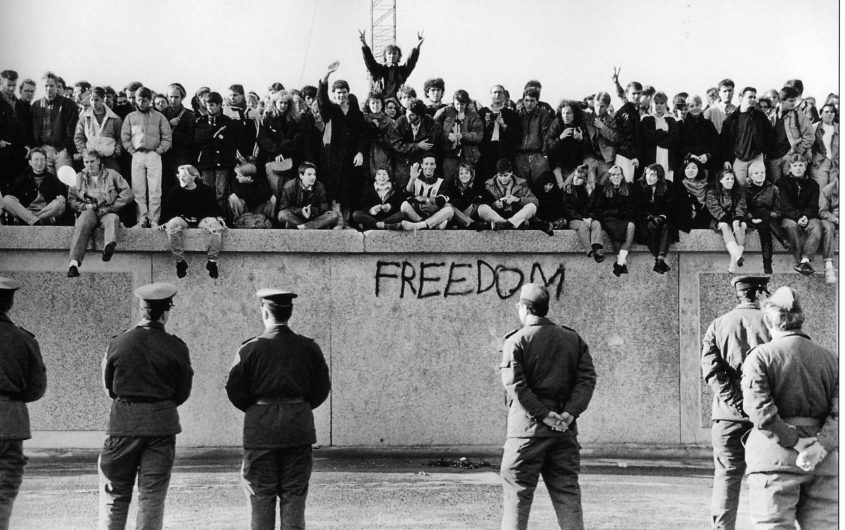
He was born around 2006, sixteen years after reunification. The GDR belongs to his history books, not his childhood; the Berlin Wall is almost as distant to him as the Vietnam War was to me as a student.
He has always lived in a democratic Germany, inside the European Union, with freedoms his grandparents could scarcely imagine. He can study in Paris or Prague, criticize his government, demonstrate against it, and vote it out of office.
In theory, freedom abounds. But what does freedom mean when you have never known anything else? And what does “East Germany” mean to someone born long after it ceased to exist?
We should be careful here: the pull of younger voters toward political extremes is not exclusively eastern. In the 2025 federal election, 21 percent of Germans aged 18 to 24 voted for the far-right Alternative for Germany (AfD); even more, 25 percent, voted Left Party. Migration, economic insecurity, and distrust of institutions cross the old inner-German border.
But there is an eastern intensity to it: in the 2024 Thuringia election, the AfD won 38 percent among voters 18 to 24 and 36 percent among those 25 to 34, with similarly strong showings in Saxony and Brandenburg. The fuel may be national. In the east, it burns with a distinctive texture.
Identity can survive memory and perhaps become more useful once freed from the contradictions of lived experience.
Our young Quedlinburger has no memories of the GDR, no recollection of reunification, no experience of the 1990s transformation. Yet he has grown up amid the memories of people who do: factories that disappeared, towns that emptied, qualifications that suddenly counted for less, and also the other GDR, of surveillance, restricted travel, and a state that built a wall to keep its own citizens from leaving.
Both memories can be true. Perhaps this is where we misunderstood the generation that came afterward: we assumed the political meaning of “the east” would fade along with living memory of the GDR. Instead, memory has become inheritance.
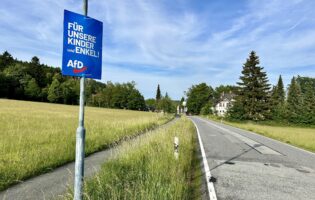
The recent AfD rally in Quedlinburg, built around the iconic East German Simson motorcycle, is an almost perfect illustration. Nearly 5,000 people attended, combining electoral politics with a motorcade around a beloved symbol of eastern German life. AfD politicians associated Simson with freedom, solidarity, and remembered social cohesion.
For a 20-year-old rider, this cannot really be Ostalgie in the traditional sense. You cannot be nostalgic for a country that disappeared sixteen years before you were born.
Something else is being transmitted here, less nostalgia for socialism than a question of dignity.
Tell a young Simson rider the GDR was a dictatorship, and he may readily agree; tell him reunification gave his family freedoms his grandparents never had, and he may agree with that, too. Neither answers the question he may consider more immediate: Do people like me matter in the Germany that emerged afterward?
The AfD has learned how to answer that question and reach the people asking it, through social media personalities, a youth wing called Generation Deutschland, and rallies like Quedlinburg’s that move politics into familiar cultural spaces.
The party did not invent the grievances. It built machinery for turning them into identity. A shrinking hometown becomes evidence of neglect; your grandparents’ experiences become shared history rather than collateral damage; skepticism toward Berlin or Brussels becomes proof you will not be lectured by people who do not understand where you come from. Being “eastern” becomes meaningful again precisely as living memory of East Germany disappears, and Simson makes that tangible: craftsmanship, community, independence, something authentically ours.
Its history is more complicated. Simson was founded by a Jewish family dispossessed under the Nazis, and descendants in the United States have objected to the AfD’s use of the name, a German Jewish history predating both the GDR and reunification. The contradiction is striking, but it does not diminish the emotional power of a symbol. Identity answers different questions: Who are we? Who respects us? Where do we belong?
For decades, Americans, including American diplomats, engaged with eastern Germany as a transition story: support institutions, encourage investment, let generational change narrow the gap between east and west. Much of that happened. One assumption did not.
We expected eastern political identity would fade along with memory of the GDR. Instead, identity can survive memory and perhaps become more useful once freed from the contradictions of lived experience.
That does not mean younger eastern Germans are uniquely alienated; their concerns about migration, economic security, and institutions are shared across Germany. But in the east, those anxieties attach to something more: an inherited story about place, dignity, and belonging.
Back in Prague in 1994 and Moscow in 1998, I wondered whether societies emerging from communism could learn the institutions and habits of freedom. The 20-year-old in Quedlinburg never had to learn them. He inherited them. The harder question is whether he believes they belong to him.