
Dirk Vorderstraße via Flickr
The Bundeswehr as the Center of Europe’s Conventional Forces

Dieter Dettke
Georgetown University
Dr. Dieter Dettke is a Non-Resident Fellow at AICGS and Adjunct Professor at Georgetown University.
Dr. Dettke served as the U.S. Representative and Executive Director of the Friedrich Ebert Foundation in Washington from 1985 until 2006 managing a comprehensive program of transatlantic cooperation. In 2006, he joined the German Marshall Fund of the United States as a Transatlantic Fellow and from September 2006 to June 2007, he was a Fellow at the Woodrow Wilson International Center for Scholars. His most recent book is “Germany Says ‘No’: The Iraq War and the Future of German Foreign and Security Policy,” published by theWoodrow Wilson Center Press and The Johns Hopkins University Press, Washington, DC, and Baltimore, 2009.
Dr. Dettke is a foreign and security policy specialist, author and editor of numerous publications on German, European, and U.S. foreign and security issues.
He studied Law and Political Science in Bonn and Berlin, Germany, and Strasbourg, France and was a Fulbright Scholar at the University of Washington in Seattle in 1967/68.
Germany’s new military strategy unveiled in a paper of the Federal Ministry of Defense dated April 2026 is an answer to Trump’s challenge of NATO and America’s more fundamental cultural distancing from Europe as well as a long-term planning document for Germany’s armed forces in the next decade and beyond. The answer to these two issues, in short, is a plan to build up the Bundeswehr to become the strongest army in Europe as a matter of German “responsibility for Europe”.
Based on Trump’s criticism of NATO as a one-sided burden for America and America’s misadventure in Iran, Germany had to conclude that this new Middle East war with an uncertain outcome will most likely usher in a decline of the American empire. The reason for such a decline is the fact that the only beneficiaries of the economic and military quagmire in Iran would be China and Russia. Therefore, a crucial impact of the U.S. war in Iran for Europe will be the strengthening of Russia’s position in its war in Ukraine. Even before Russia’s invasion of Ukraine, Russia’s neo-imperial behavior annexing Crimea and creating satellite territories in parts of Georgia foreshadowed the looming threat for Europe that then materialized in the invasion of Ukraine. For Germany and its neighbors in Eastern Europe, the invasion was a watershed moment in Europe’s relationship with Russia. The German “Zeitenwende” (turning point in history) away from seeking potential accommodation with Russia and shifting instead to a major military buildup of its armed forces was the initial reaction to the invasion of Ukraine on February 22, 2024.
Germany’s new military strategy must be seen as an effort to respond to the dual challenge of an increasing Russian military threat to the security of Europe at a time of weakening transatlantic relations. The American president doubled down on his threat to NATO by announcing the withdrawal of 5,000 American troops from Germany when the German chancellor dared to criticize America’s lack of strategy in the war against Iran. The perceived message in Germany was that America’s commitment to NATO is not a firm guarantee. An even more important sign of a weakening American commitment to NATO is the fact that the Trump administration will no longer follow through with the stationing of American long-range missiles in Germany to counter the superior Russian capabilities in this area of weapon systems. Germany is not only a recipient of America’s security guarantee. The U.S. military bases in Germany are crucial for American military operations in the Middle East, and the United States was able to use these bases also in the current war in Iran. It is the fickle American behavior in its relationship with friends and foes that forces Germany now to hedge against a long-term U.S. retrenchment from Europe. As former German Foreign Minister Joschka Fischer pointed out recently, Germany and other allies of the United States cannot discount that even after Trump, elements of his foreign policy could continue.
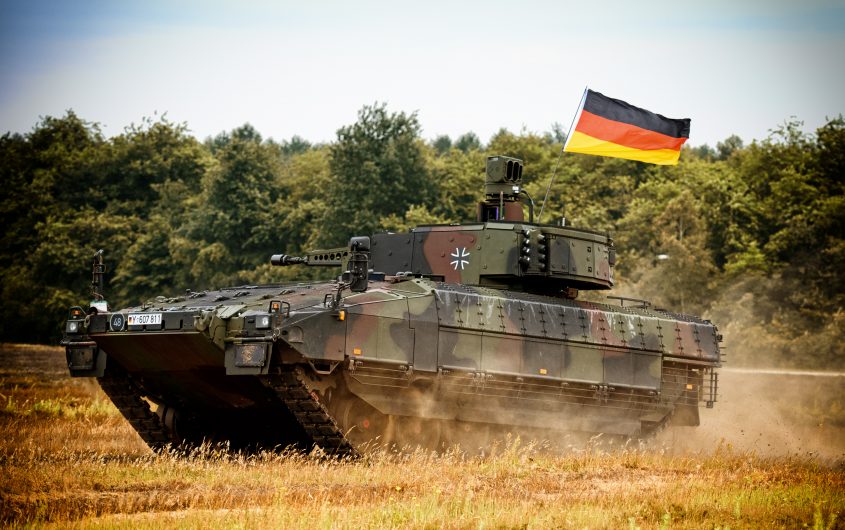
The only realistic military strategy for Germany must be the empowerment of Europe as a military actor even without the United States on its side in a possible military conflict with Russia. One could call such a development an emerging European NATO built on the defense arrangements of European treaty commitments. In this respect, the new German military strategy based on Germany’s economic and political weight takes on “responsibility for Europe” by strengthening the Bundeswehr to become Europe’s strongest conventional army by 2039.
Considering that the current level of forces is an army of just 185,420 active duty soldiers, the buildup will have to be achieved in several stages over the next decade, first to 260,000 by the mid-2030s and then to a combined level of 460,000 combat-ready troops, including reserves, by 2039. The plan is to reach this goal in three phases: “a rapid buildup through 2029, a capability-focused expansion through 2035, and a longer-term technology-driven phase through 2039 and beyond.” Given the current outdated equipment as well as its low level of personnel strength, the Bundeswehr has a steep hill to climb politically as well as financially. Domestic support for stronger military forces in Germany is difficult. Decades of believing in Germany as a “civilian power” cannot be transformed easily. But the dual challenge of a serious Russian threat at a time of weakening transatlantic relations created a rendezvous with the hard realities of power politics for German public opinion. There is a strong sense in Germany now that standing firm on the side of Ukraine is an existential task given Putin’s attempt to recreate a Russian empire that would dominate Eastern Europe if Russia succeeded in controlling Ukraine militarily and politically. Putin’s experience in East Germany as a KGB agent during the Cold War seems to have created a sense in him that Germany must be on Russia’s side one way or the other, and, unfortunately, there are some reciprocal inclinations in German left and right political circles that might help Putin achieve his objectives.
Germany’s new military strategy must be seen as an effort to respond to the dual challenge of an increasing Russian military threat to the security of Europe at a time of weakening transatlantic relations.
A major problem for Germany is that its armed forces—unlike Ukraine’s army—have hardly any battle experience. Germany said “no” to the war against Iraq, and in Afghanistan the Bundeswehr focused on stabilization and reconstruction, primarily emphasizing a non-combat role by training, advising, and assisting Afghan National Defense and Security forces. There were only a few minor combat operations executed by German forces alone.
In addition, Germany is a non-nuclear power faced with a nuclear-armed Russia. In the past, the United States provided the nuclear umbrella in a nuclear sharing arrangement that deliberately left the ultimate decision-making to the president of the United States. There is now uncertainty, too, whether the U.S. nuclear umbrella is still as reliable as it used to be under previous administrations. Here too, Germany must hedge and seek an arrangement with France and possibly also with Great Britain to build up a European nuclear backup.
Creating a European nuclear umbrella for Germany and its neighbors compatible with the Treaty on the Non-Proliferation of Nuclear Weapons (NPT) is the most complicated issue Europe is facing today. The only open avenue left for a nuclear Germany as a member of the NPT is a sovereign European nuclear force. When Germany signed the NPT, it committed the country to non-nuclear status but left open the possibility of being part of a sovereign nuclear-armed Europe. That being a faraway possibility excludes a national German nuclear capability as long as Germany continues to be a member of the NPT. An argument could be made, however, that attacks of nuclear powers against non-nuclear states that are member states of the NPT violate the spirit of the NPT. Non-nuclear countries should not be exposed to nuclear threats and, more importantly, nuclear warfare. A legitimate question is whether, because of the war in Ukraine and the war in Iran, the NPT lost legitimacy with uncertain consequences for its members. A new nuclear arms race cannot be excluded.
Under these circumstances, Germany, as the biggest EU member state, must not only build up Europe’s strongest conventional capabilities. A European nuclear arrangement between the two European nuclear powers and Europe’s non-nuclear countries is necessary, too. Germany and France are already on a trajectory to integrate French nuclear deterrence into European defense strategy. A better solution would be if the nuclear potential of Great Britain could be part of a European nuclear umbrella.
Concerns about a new German hegemony, including an “involuntary hegemony,” because of the new military strategy aiming at a Bundeswehr as the strongest conventional military are overstated. Germany learned from its past behavior and is committed to being integrated into a larger community of European nations. Differences in size of the armed forces within Europe and differences in economic weight have always been part of the European integration process without fears of hegemonic behavior. The two European nuclear powers have not caused concerns about hegemonic aspirations because of their nuclear status. If the past is a recipe for the future, hegemony should not be a cause for concern today. The more important concern is the preservation of Europe’s security and independence.