
The White House via Flickr
One Year Later, Can the Turnberry Agreement Hold?

Peter S. Rashish
Vice President; Director, Geoeconomics Program
Peter S. Rashish, who counts over 30 years of experience counseling corporations, think tanks, foundations, and international organizations on transatlantic trade and economic strategy, is Vice President and Director of the Geoeconomics Program at AICGS. He also writes The Wider Atlantic blog.
Mr. Rashish has served as Vice President for Europe and Eurasia at the U.S. Chamber of Commerce, where he spearheaded the Chamber’s advocacy ahead of the launch of the Transatlantic Trade and Investment Partnership. Previously, Mr. Rashish was a Senior Advisor for Europe at McLarty Associates, Executive Vice President of the European Institute, and a staff member and consultant at the International Energy Agency, the World Bank, UN Trade and Development, the Atlantic Council, the Bertelsmann Foundation, and the German Marshall Fund.
Mr. Rashish has testified before the House Financial Services Subcommittee on International Monetary Policy and Trade and the House Foreign Affairs Subcommittee on Europe and Eurasia and has advised three U.S. presidential campaigns. He has been a featured speaker at the Munich Security Conference, the Aspen Ideas Festival, and the European Forum Alpbach and is a member of the Board of Directors of the Jean Monnet Institute in Paris and a Senior Advisor to the European Policy Centre in Brussels. His commentaries have been published in The New York Times, the Financial Times, The Wall Street Journal, Foreign Policy, and The National Interest, and he has appeared on PBS, CNBC, CNN, NPR, and the BBC.
He earned a BA from Harvard College and an MPhil in international relations from Oxford University. He speaks French, German, Italian, and Spanish.
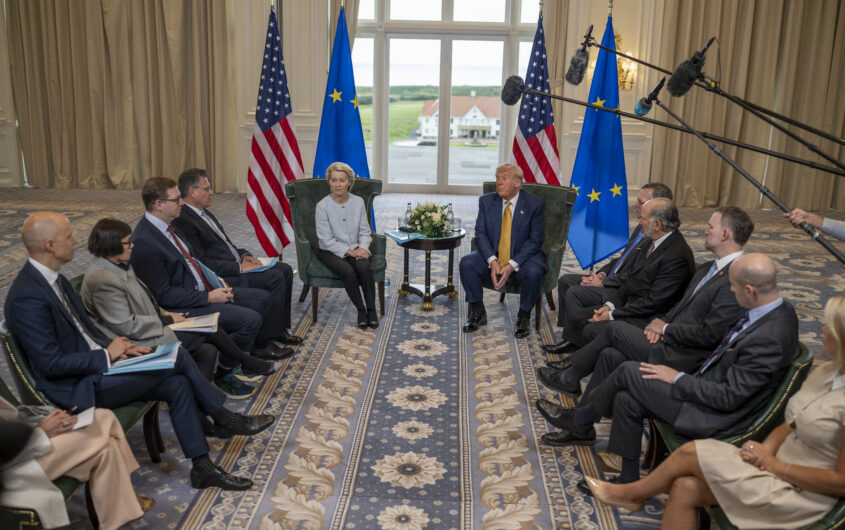
Just shy of a year ago, on August 21, 2025, the United States and the European Union announced their Framework on an Agreement on Reciprocal, Fair, and Balanced Trade that is sometimes known as the “Turnberry Agreement” for the town in Scotland where President Trump and European Commission President von der Leyen met a month earlier to work out the contours of a deal. The European Union was prompted to seek this arrangement after the steep tariff increases on U.S. trading partners—including 20 percent on the EU—that the president announced in April of last year.
How has this deal fared since it was signed a year ago and what does it augur for the future of the transatlantic economic relationship?
First of all, it took a long time for the deal to come into effect. The EU only approved it on June 25, 2026, nearly a year after the handshake between Presidents Trump and von der Leyen in Scotland. In part, that reflects a natural adjustment process in the EU to such a radical change in the dynamics with its largest commercial partner.
But the time frame was also the product of internal debates among EU member states about how to respond: retaliation, leverage, or negotiations. The EU mainly chose the third course, aided by the second in the form of a better understanding on both sides of the transatlantic balance of economic power.
The final deal reduced the headline tariff rate to 15 percent and, with a push by the European Parliament, imposed conditions including a sunset clause ending the agreement in December 2029 and a suspension mechanism allowing the EU to pull back its concessions in the face of U.S. non-compliance or a surge in imports. Beyond the official numbers, the effective tariff rate on EU exports to the United States dropped over time, to around 8 percent, because of the impact of sectoral exemptions from the 15 percent rate.
Depending on how several trade investigations play out, there is a risk that the 15 percent tariff cap on U.S. imports from the EU under the Turnberry accord could be breached.
A recent survey of the transatlantic business community showed a majority of firms expressing confidence in the stability of the U.S.-EU trade and investment relationship for the first time since January 2025. That makes sense, as the February 2026 Supreme Court ruling striking down the administration’s use of the International Emergency Economic Powers Act has obliged the administration to rely on more predictable and slower-moving trade authorities, mainly Section 301 of the 1974 trade act.
But even if the White House is now pursuing trade policy in a more familiar way, there are hazards ahead.
Although the recently concluded Section 301 investigation into the use of forced labor by U.S. trading partners will not affect the terms of the U.S.-EU deal, the administration is also looking at global manufacturing overcapacity, Germany’s pharmaceutical policies, and potentially the EU’s recent decision to fine Google for anti-competitive practices. Depending on how these play out, there is a risk that the 15 percent tariff cap on U.S. imports from the EU under the Turnberry accord could be breached.
Turnberry is a throwback to trade deals of old—all tariffs, no joint strategy. The latter approach has mainly been left to a separate arrangement on critical minerals, where the U.S. and the EU signed an action plan in April that aims to reduce their dependence on China, as well as some work on the tech stack through the State Department’s Pax Silica initiative.
So far, the two sides have been able to pursue this incipient geoeconomic cooperation even as the U.S. administration has raised tariffs on the EU. But breaking the Turnberry agreement could undermine the European consensus that has allowed this compartmentalization to work and incentivize European moves to rely less on U.S. firms for their prosperity and security.
Although the White House thinks it can go it alone, the fact is that China has become so powerful that the United States and the European Union need each other. It is time to focus on the essential: ensuring that transatlantic interests continue to set the terms of the global economy.