
AGI News
The 2026 State Elections: AGI Expert Analysis in the Media
Olaf2 via Wikimedia Commons

Eric Langenbacher
Senior Fellow; Director, Society, Culture & Politics Program
Dr. Eric Langenbacher is a Senior Fellow and Director of the Society, Culture & Politics Program at AGI.
Dr. Langenbacher studied in Canada before completing his PhD in Georgetown University’s Government Department in 2002. His research interests include collective memory, political culture, and electoral politics in Germany and Europe. Recent publications include Comparative Politics: Mapping Institutions, Power, and Legitimacy (2025), Shifting Paradigms in Contemporary German Politics and Policy (edited volume, 2024), The German Polity, 12th ed. (2021), and Twilight of the Merkel Era: Power and Politics in Germany after the 2017 Bundestag Election (edited volume, 2019).
Dr. Langenbacher remains affiliated with Georgetown University as Teaching Professor and Director of the Honors Program in the Department of Government, as well as the Director of the Master in European Studies Program in the School of Foreign Service. He has also taught at George Washington University, Washington College, The University of Navarre, and the Universidad Nacional de General San Martin in Buenos Aires, Argentina, and has given talks across the world. He was selected Faculty Member of the Year by the School of Foreign Service in 2009 and was awarded a Fulbright grant in 1999-2000 and the Hopper Memorial Fellowship at Georgetown in 2000-2001. Since 2005, he has also been Managing Editor of German Politics and Society, which is housed in Georgetown’s BMW Center for German and European Studies. Dr. Langenbacher has also planned and run dozens of short programs for groups from abroad, as well as for the U.S. Departments of State and Defense on a variety of topics pertaining to American and comparative politics, business, culture, and public policy.

Jeff Rathke
President of AGI
Jeffrey Rathke is the President of the American-German Institute in Washington, DC.
Prior to joining AGI, Jeff was a senior fellow and deputy director of the Europe Program at CSIS, where his work focused on transatlantic relations and U.S. security and defense policy. Jeff joined CSIS in 2015 from the State Department, after a 24-year career as a Foreign Service Officer, dedicated primarily to U.S. relations with Europe. He was director of the State Department Press Office from 2014 to 2015, briefing the State Department press corps and managing the Department's engagement with U.S. print and electronic media. Jeff led the political section of the U.S. Embassy in Kuala Lumpur from 2011 to 2014. Prior to that, he was deputy chief of staff to the NATO Secretary General in Brussels. He also served in Berlin as minister-counselor for political affairs (2006–2009), his second tour of duty in Germany. His Washington assignments have included deputy director of the Office of European Security and Political Affairs and duty officer in the White House Situation Room and State Department Operations Center.
Mr. Rathke was a Weinberg Fellow at Princeton University (2003–2004), winning the Master’s in Public Policy Prize. He also served at U.S. Embassies in Dublin, Moscow, and Riga, which he helped open after the collapse of the Soviet Union. Mr. Rathke has been awarded national honors by Estonia, Latvia, and Lithuania, as well as several State Department awards. He holds an MPP degree from Princeton University and BA and BS degrees from Cornell University. He speaks German, Russian, and Latvian.
__
Tereza Novotná
DAAD/AGI Research Fellow
Dr. Tereza Novotná is a DAAD/AGI Research Fellow in fall 2026. She is a Senior Affiliate Researcher at the Center for European Integration at Freie Universität Berlin, a Senior Associate Research Fellow at EUROPEUM Prague, a Non-Resident Kelly Fellow at Pacific Forum, and a Korea Associate at 9DASHLINE. She received her PhD from Boston University and holds further degrees from Charles University Prague. Prior to joining AGI, she was a Senior Eisenhower Fellow at the NATO Defense College in Rome. Her previous fellowships and academic appointments include Seoul National University, Fudan University, and LUISS University Rome. She has also worked at the EEAS in Brussels, the EU Delegation to the United States in Washington, DC, and the Czech Permanent Representation to the EU. Her research focuses on European foreign and security policy, transatlantic relations, the Indo-Pacific, and the Korean Peninsula. She has published widely in academic and policy outlets and frequently comments on these issues in international media in English, German, and Czech.
Dr. Novotná’s research at AGI examines the prospects for renewed U.S.–North Korean diplomacy and the roles that South Korea and Europe can play in shaping it. The project considers how Seoul can preserve its agency and ensure alliance consultation in potential U.S.–North Korea negotiations, how Germany and the EU could support South Korean and U.S. diplomatic efforts, and how North Korea’s growing cooperation with Russia and strategic alignment with China affect prospects for diplomacy. The project will develop policy recommendations on how Germany, the EU, and South Korea can contribute to a more coordinated transatlantic and Indo-Pacific approach toward the Korean Peninsula.
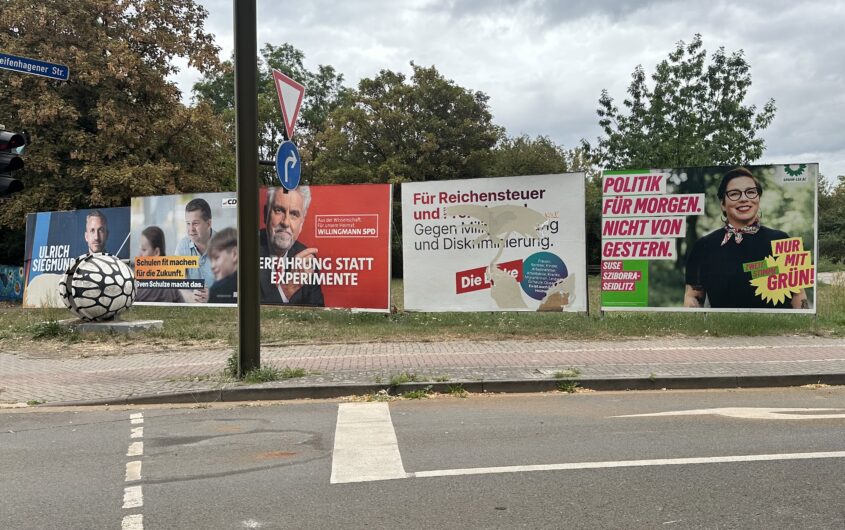
In fall 2026, first-place finishes for the far-right and far-left in state elections in Saxony-Anhalt, Mecklenburg-Vorpommern, and Berlin shook up German politics. The Alternative for Germany (AfD) will likely form the government in Saxony-Anhalt, the first time in the history of the Federal Republic that a far-right party will lead a state government. The AfD’s first-place finish in Mecklenburg-Vorpommern came at the expense of the chancellor’s Christian Democrats, who did not meet the 5 percent threshold to enter the Landtag—also a first in Germany’s postwar history. In Berlin, the Left Party, the successor party to the East German PDS, won a plurality of votes and their best-ever result. The success of these parties and underperformance of the political mainstream in these elections have had outsized consequences for German politics.
AGI experts have analyzed the regional, national, and international implications of these state elections to the media.
Washington Post: German nationalists’ big win sounds alarm for mainstream politicians in Europe
DW News: Global ripples from a small German election
CBC: Germany’s far-right AfD party is taking pages out of Trump’s playbook
Foreign Policy: Germany Is Officially Adrift
TN.cz: AfD also appealed to non-voters in the elections. The result is a final warning for the CDU, says expert (in Czech)