
Die Linke via Flickr
Berlin Voted for Change
Tereza Novotná
DAAD/AGI Research Fellow
Dr. Tereza Novotná is a DAAD/AGI Research Fellow in fall 2026. She is a Senior Affiliate Researcher at the Center for European Integration at Freie Universität Berlin, a Senior Associate Research Fellow at EUROPEUM Prague, a Non-Resident Kelly Fellow at Pacific Forum, and a Korea Associate at 9DASHLINE. She received her PhD from Boston University and holds further degrees from Charles University Prague. Prior to joining AGI, she was a Senior Eisenhower Fellow at the NATO Defense College in Rome. Her previous fellowships and academic appointments include Seoul National University, Fudan University, and LUISS University Rome. She has also worked at the EEAS in Brussels, the EU Delegation to the United States in Washington, DC, and the Czech Permanent Representation to the EU. Her research focuses on European foreign and security policy, transatlantic relations, the Indo-Pacific, and the Korean Peninsula. She has published widely in academic and policy outlets and frequently comments on these issues in international media in English, German, and Czech.
Dr. Novotná’s research at AGI examines the prospects for renewed U.S.–North Korean diplomacy and the roles that South Korea and Europe can play in shaping it. The project considers how Seoul can preserve its agency and ensure alliance consultation in potential U.S.–North Korea negotiations, how Germany and the EU could support South Korean and U.S. diplomatic efforts, and how North Korea’s growing cooperation with Russia and strategic alignment with China affect prospects for diplomacy. The project will develop policy recommendations on how Germany, the EU, and South Korea can contribute to a more coordinated transatlantic and Indo-Pacific approach toward the Korean Peninsula.
Will Germany’s Political Center Listen?
The most striking result of Berlin’s state election may also be its greatest paradox. Die Linke, a party long considered firmly anchored in Germany’s past, has suddenly emerged as one of the parties most successful at appealing to the country’s future.
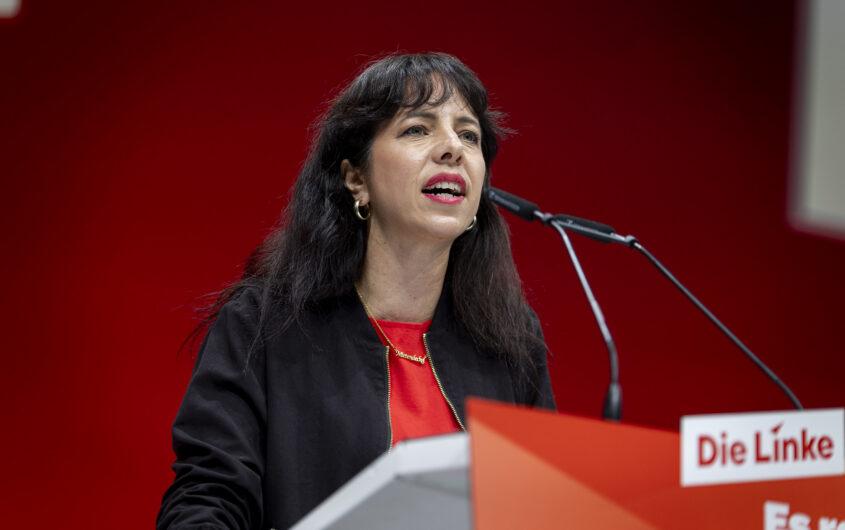
For the first time, the party that grew out of East Germany’s former ruling communist party has won an election in the German capital. Its lead candidate, Elif Eralp, could become Berlin’s first mayor from Die Linke. Yet the voters behind this victory increasingly look unlike the electorate traditionally associated with the party. Die Linke was particularly successful among young Berliners under thirty-five, suggesting that a party once associated with an aging eastern German constituency can win a new generation of voters by moving beyond nostalgia and connecting progressive themes to everyday concerns.
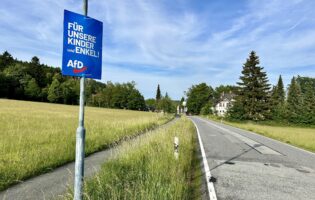
It would be tempting, but misleading, to interpret Die Linke’s victory simply as another sign of political radicalization in Germany, particularly when set alongside the far-right Alternative for Germany’s (AfD) victory in Mecklenburg-Vorpommern on the same day. Instead, the two results reveal different transformations of German politics—and carry an important warning for the country’s established centrist parties.
The Paradox of a New Die Linke
Die Linke is historically rooted in the former East German communist party. Its predecessor, the PDS, survived reunification largely by representing eastern Germans who felt that their experiences and interests were insufficiently recognized in unified Germany.[1] For decades, this history was both the party’s electoral foundation and the baggage preventing it from expanding much beyond it. This is no longer the case.
Die Linke is undergoing a generational and ideological rebirth. Nearly three years ago in October 2023, Sahra Wagenknecht and her supporters split from the party to form the BSW, a party combining left-wing economic policies with radical positions on migration and a Russia-friendly foreign policy. At the same time, parts of its ‘ostalgic’ eastern electorate gradually moved in a very different direction—toward the AfD.
Paradoxically, shedding large parts of its old constituency and leadership helped Die Linke present itself as younger, more diverse, and building on modern progressive themes. Eralp personifies that transformation. The daughter of Turkish political refugees, she hardly fits the stereotypical image of an East German post-communist politician. Her campaign drew inspiration—and advice—from New York Mayor Zohran Mamdani, focusing on affordability, grassroots organizing, and effective social media mobilization.
Housing was a particularly important campaign topic. Once famous for cheap apartments, Berlin has become a city where average rents have risen dramatically, and affordable housing is increasingly hard to come by. Die Linke offered the most radical solution: implementing the result of Berlin’s 2021 referendum, in which 57.6 percent of participants supported the socialization of the housing stock of large private property companies.
Whether this would solve Berlin’s housing problems is far from clear. The measure could be enormously expensive, its constitutionality remains contested, and transferring existing housing into public ownership would not itself build the new apartments Berlin desperately needs. Recent polling also suggests that support for the proposal has fallen since the 2021 referendum. Nonetheless, Die Linke succeeded politically because it convinced many voters that it recognized this major problem and was prepared to do something about it.
Where Did the Center Go?
Die Linke’s rise also reflects the weaknesses of its competitors; it gained voters from the SPD, the Greens, and Christian Democrats (CDU), as well as previous non-voters. The Social Democrats historically occupied much of the political space into which Die Linke is now advancing but entered the election burdened by participation in CDU-led governments at both the state and federal levels. Instead of representing an alternative to the status quo, the SPD had become part of it.
The Greens retained a substantial urban constituency but failed to dominate the kitchen-table debate in the way Die Linke did. That left Eralp with space to promote her party as the clearest vehicle for voters who wanted a change of direction but were alarmed by the AfD.
This is why describing the two elections in Berlin and Mecklenburg-Vorpommern simply as simultaneous victories of the “far left” and “far right” misses what happened. Die Linke and the AfD benefited from dissatisfaction with established parties but mobilized different electorates and offered very different responses.
The chancellor risks reinforcing the perception that established parties are more interested in ruling out alternatives than in understanding why voters are turning to them.
There is nevertheless an important historical connection. After reunification, many eastern Germans felt that although they had brought down the Berlin Wall, they had little influence over the terms on which reunification proceeded. Massive financial transfers transformed the eastern states materially but did not necessarily eliminate feelings of political and social inequality.[2]
For years, the PDS and later Die Linke captured much of this disillusionment. Over time, parts of that electorate shifted toward the AfD. Yet the AfD’s strength in east German Länder is no longer simply a protest vote. Alongside a stable base of supporters out of conviction, it continues to mobilize large sections of non-voters and attract voters disappointed with other parties, including those who see no other political home on the right.
A Double Warning for the CDU
The two elections therefore carry a double warning for Friedrich Merz and the CDU—one from the right in Mecklenburg-Vorpommern and another from the left in Berlin.
In Mecklenburg-Vorpommern, the CDU failed even to cross the five-percent threshold to enter the state parliament, while the AfD won more than 38 percent of the vote. Merz and his party have increasingly responded to the AfD’s rise by toughening their rhetoric on migration. But the experience of center-right parties elsewhere in Europe[3] suggests that adopting far-right language can prove counterproductive. It can normalize extremist framing by embedding it in mainstream political discourse and signaling that such views have become acceptable. The CDU may eventually lose moderate voters without winning AfD supporters. Why choose the copy if the original is available?
Berlin provides the other side of the warning. Merz has announced plans for federal legislation that could prevent the socialization of large housing companies. There are legitimate economic, political, and legal reasons to challenge Die Linke’s proposal, just as there are legitimate concerns about antisemitism within parts of Berlin’s Die Linke that Eralp and any prospective coalition partners will have to address.
But opposing Die Linke is not the same as understanding why voters chose it. Economic insecurity, demographic change, inadequate political representation, and the perception that government is detached from daily concerns all matter.
If Merz’s grand coalition blocks Die Linke’s signature housing proposal, it may win the immediate political battle—and perhaps even outmaneuver Eralp from forming a government in Berlin. Yet the chancellor risks reinforcing the perception that established parties are more interested in ruling out alternatives than in understanding why voters are turning to them.
A Center That Listens
None of this means that Germany’s centrist parties should adopt Die Linke’s policies—or the AfD’s. Electoral success does not make the solutions offered by either party workable—or desirable. The lesson is instead about political representation.
Die Linke’s Berlin victory shows that even a party burdened by its past can reinvent and successfully portray itself as a party of change. Mecklenburg-Vorpommern elections, meanwhile, illustrate the limits of responding to AfD by imitating its rhetoric: doing so neither addresses the sources of discontent nor necessarily weakens the CDU’s competitor on the right.
This lesson extends beyond Germany. Across Europe—and across the Atlantic—established parties face challengers offering sometimes radical answers to genuine voter concerns. They need not embrace those answers. But dismissing the challengers without addressing the problems that made voters turn away from the political center is unlikely to rebuild trust in it.
Thirty-six years after unification, the results in Berlin and Mecklenburg-Vorpommern are not mirror images; they tell very different stories. Together, however, they point to the same lesson: Germany’s established parties need to listen more closely to why voters are looking elsewhere.
[1] See Dan Hough, The Fall and Rise of the PDS in Eastern Germany (Bloomsbury Academic, 2002); David F. Patton, Out of the East: From PDS to Left Party in Unified Germany (Albany, NY: State University of New York Press, 2011).
[2] Tereza Novotná, How Germany Unified and the EU Enlarged: Negotiating the Accession through Transplantation and Adaptation (Basingstoke, UK: Palgrave Macmillan, 2015).
[3] Tim Bale and Cristóbal Rovira Kaltwasser, eds., Riding the Populist Wave: Europe’s Mainstream Right in Crisis (Cambridge, UK: Cambridge University Press, 2021).