
Stephan Röhl/Heinrich-Böll-Stiftung via Flickr
Whither the Greens?

Thomas Protzman
Thomas Protzman is a Halle Foundation research intern at AGI in fall 2024. He is pursuing a master's degree in International Affairs with a concentration in Human Rights and Global Governance at the Hertie School in Berlin and is currently on academic exchange at the Elliott School of International Affairs at George Washington University. He spent three years in Vienna, completing a teaching fellowship with Fulbright Austria. He earned his undergraduate degree in History from Denison University and studied for a semester at the Ruprecht-Karls Universität in Heidelberg, Germany. Additionally, he brings experience from his time as an intern for U.S. Senator Sherrod Brown. Thomas is committed to strengthening institutional ties and fostering collaborative leadership in the transatlantic sphere. He has a wide range of research interests, including climate change, populism, and institutional trust.
Özdemir’s unexpected triumph and the future of the party
The Green Party, led by talismanic candidate Cem Özdemir, finished first on March 8 in the Baden-Württemberg state elections with 30.2 percent of the vote, a 2.4 percent drop from their previous high in 2021. Although they finished with the same number of seats in the state parliament as the center-right Christian Democrats (CDU), the composition tells a different story: the CDU won fifty-six of seventy constituency seats through direct mandates, while the majority of Green seats came through Zweitstimmen (second-votes), a proportional mechanism only introduced by electoral reform in 2022. Under the old single-vote system, which did not fully compensate for overhang mandates at the state level, the CDU’s dominance in constituency seats would likely have translated into a clear seat advantage. Instead, Özdemir is set to become the first minister-president in Germany with a Turkish background.
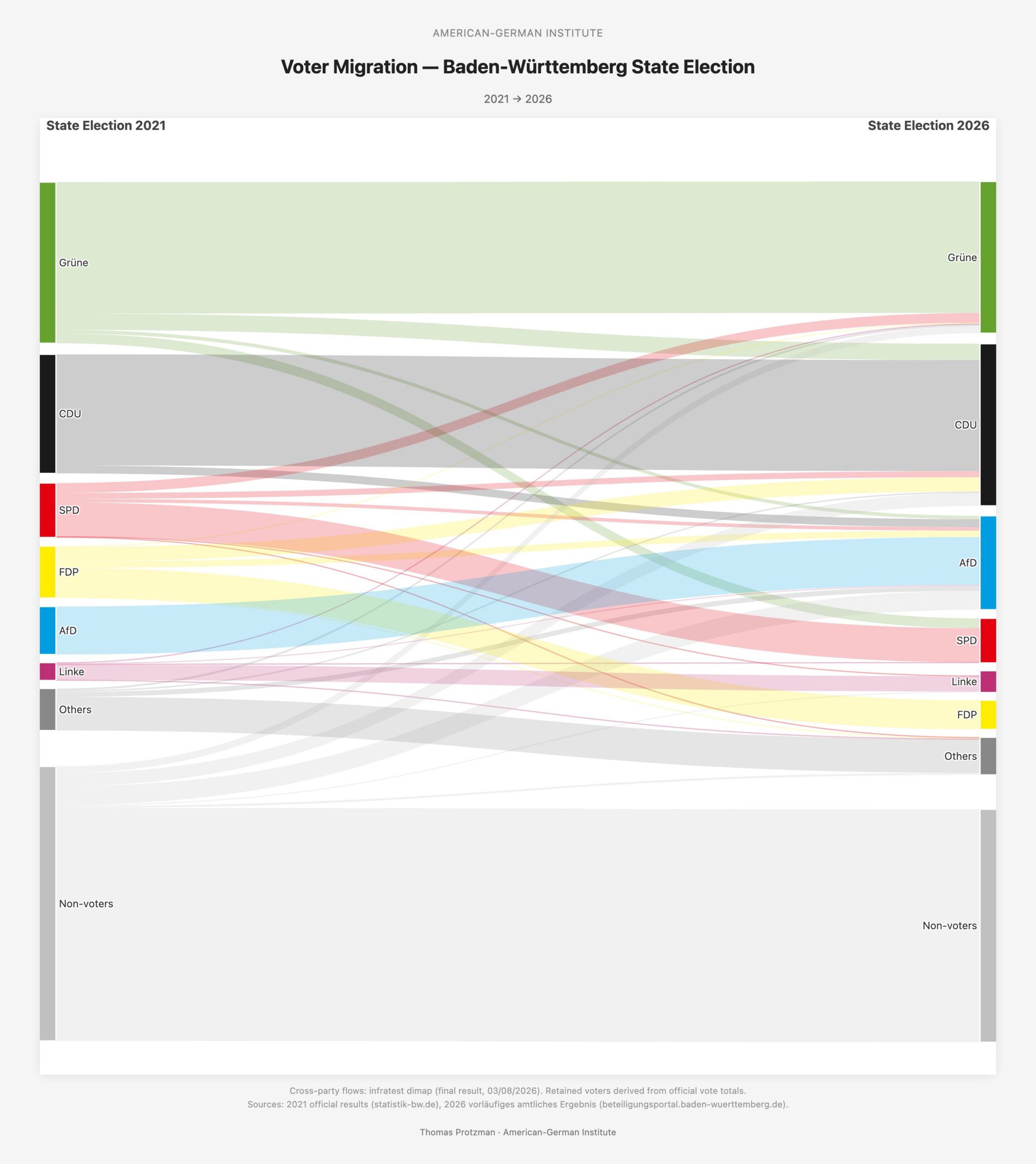
He will succeed fellow Green Winfried Kretschmann, who led Baden-Württemberg for fifteen years. Having trailed in most polls, Özdemir’s Greens appear to have been saved by a late video leak in which CDU rival Manuel Hagel commented on a schoolgirl’s “fawn-brown eyes,” a remark widely characterized as sexist. On election night, the victory was hailed by both Özdemir and the press as an Aufholjagd (comeback). Nevertheless, the Baden-Württemberg Greens lost 165,000 voters to the CDU and an additional 35,000 to the far-right Alternative für Deutschland (AfD), for whom 190,000 previous non-voters mobilized. The CDU and Free Democrats (FDP) also lost voters (80,000 and 65,000, respectively) to the AfD, who recorded their highest-ever vote share in a western German state election until it was surpassed on March 22 in Rhineland-Palatinate. The center-left Social Democrats (SPD) shrank by half, losing 100,000 voters to the Greens, 60,000 to the CDU, and 35,000 to the AfD. The AfD performed better with voters under 44 than the CDU, whose strongest demographic was voters over the age of 70.
The Baden-Württemberg Model
The German media has framed this as a “personality election,” and a word that followed Özdemir throughout the campaign was Entgrünung (de-greening), the deliberate distancing of a Green candidate from the party’s federal platform to win in conservative territory. Indeed, political scientist Karl-Rudolf Korte told ZDF that Özdemir “maximally de-greened himself.” Yet de-greening is not something that Özdemir invented. Baden-Württemberg has always been a conservative state; when Kretschmann took over in 2011, it was on the back of fifty-eight consecutive years of CDU-led government. Kretschmann’s victory owed less to Green ideology than to circumstance. The Fukushima nuclear disaster in Japan had handed the anti-nuclear Greens a late surge. Meanwhile, the CDU coalition government with the liberal Free Democrats (FDP) had badly mishandled Stuttgart 21, a controversial long-term railway development project whose forced construction—including the use of water cannons and tear gas against protesters—alienated much of the Stuttgart public. Even so, the Greens placed second with 24.2 percent to the CDU’s 39 percent; indeed, it was a coalition with the SPD, not a Green mandate, that put Kretschmann in office.
Once there, the “de-greening” began almost immediately. Kretschmann let Stuttgart 21 proceed through a referendum, then spent the next decade governing as a self-described “green conservative.” In 2014, he pushed through the expansion of “safe countries of origin” in the Bundesrat, despite a Green party conference declaring the concept “wrong” just months earlier. He switched coalition partners from the SPD to the CDU in 2016 and governed with them for ten years, with the automotive industry at the center of his agenda. “A New Idea of Conservative” was the subtitle of his 2018 book. That year, he told regional newspapers that groups of criminal refugees should be sent “in die Pampa” (roughly, to the boondocks) and called young male migrants “the most dangerous thing human evolution has produced.” During COVID, he joined the center-right premiers of Bavaria and Lower Saxony in proposing purchase subsidies for petrol and diesel cars. It was a position no one in the federal Green Party supported.
Yet the federal Greens tolerated all of it. Why? Because it worked—Kretschmann kept winning. In this regard, “de-greening” has been the Baden-Württemberg model for fifteen years, and by most measures, Baden-Württemberg has been well-governed. It is economically productive, fiscally stable, and consistently ranked among Germany’s strongest states.
What Özdemir Changed
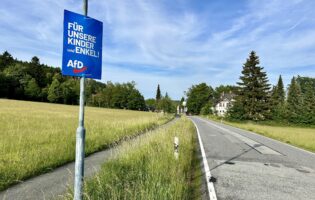
On the surface, Özdemir’s “de-greening” was visual. His campaign posters, designed by Jung von Matt, featured his face and the slogan “Er kann es” (“He can do it”) with, as the Tagesspiegel noted, a party name so small it was barely visible. The FAZ’s Jasper von Altenbockum added that “on the posters: no indication that he’s a Green.” Kretschmann’s 2021 campaign ran on “Grün wählen für Kretschmann” (“Vote Green for Kretschmann”).
The deeper shift was substantive. Unlike Kretschmann, Özdemir made the immigration issue one of the focal points of his campaign. In an interview with Welt am Sonntag a week before the election, Özdemir said “immigration must be much more strictly controlled” and told his own party, “whoever wants humanitarianism must not be silent about order and control.” This was a departure from the federal party’s own platform, which defines Green migration policy as “human-rights-oriented,” centered on the individual right to asylum.
Then there was Boris Palmer. The former Tübingen mayor had quit the Greens in 2023 after repeatedly using a racial slur at a public event in 2021 and comparing his critics’ response to the Star of David. At the time, Kretschmann called Palmer’s behavior ‘unworthy of a mayor,’ and Özdemir himself told the same party congress he was “a bit tired of doing Palmer exegesis.” Five years later, just weeks before the election, Özdemir chose Palmer to officiate his wedding in a move the NZZ called a logical stunt. The day after the election, rumors surfaced of a cabinet role. Palmer was a signal to conservative voters that Özdemir’s de-greening was not just rhetorical.
Climate policy, meanwhile, was absent from the campaign. The Konrad-Adenauer-Stiftung’s election analysis found the economy was voters’ top concern at 29 percent, with crime and internal security rising sharply to 15 percent. Climate ranked among a cluster of secondary issues alongside education and social security. In 2026, elections are decided by the economy, industry, and jobs, not through detailed climate policy ambitions, said ZDF. So Özdemir sidelined the issue that defined a generation of Green membership.
Appropriating Özdemir’s strategy means a rightward shift on immigration and no more talking about climate.
His economic framing told a similar story. The federal Greens treat climate and prosperity as inseparable. Özdemir said climate protection works “only with people, not against them.” Correctiv noted he sounded like his CDU rival Hagel. “At times, Özdemir seemed to want to be the better conservative,” wrote NZZ. On trade, Özdemir went further still: in January, he called his own party’s vote against the EU-Mercosur agreement in the European Parliament “a mistake” and demanded the deal be implemented, siding with German industry against the Green delegation that had voted alongside the far right to block it.
One might say Özdemir’s de-greening is just a continuation of Kretschmann’s smart regional politics. But Kretschmann was long viewed as a “personifizierter Sonderfall,” an exceptional personality in his conservative state, a local anomaly. Özdemir is a national figure. As a former federal party co-chair and cabinet minister, his words and positions carry greater implications for the national party.
Furthermore, being a conservative or a centrist means something different in 2026 because the center itself has shifted. In January 2025, when running for the chancellorship, Friedrich Merz broke with decades of precedent by passing an immigration motion in the Bundestag with AfD votes. As ZDF documented, the five-point plan appeared in near-identical wording in an AfD motion from 2017 that the CDU had voted against: permanent border controls, blanket rejection of irregular entry regardless of asylum claims, mandatory detention of all deportable persons, federal enforcement support for deportations, and indefinite detention for criminal offenders. The AfD’s Alice Weidel called it “a historic day for Germany, a victory for democracy.” That was when the CDU moved into AfD territory on immigration. Now, Özdemir has moved into the space the CDU vacated. His statements about order and management echo the rhetoric that the CDU used before it switched to detention and deportation. The CDU recognized the positions as its own, with board member Christian Bäumler telling the Staatsanzeiger that coalition negotiations would be based not on the Green platform, but on Özdemir’s campaign statements, to be adopted “without discussion.” Even with a rightward shift on migration, Özdemir still lost 165,000 voters to the CDU and 35,000 to the AfD.
The Greens’ largest inflow of roughly 100,000 former SPD voters came as the SPD collapsed to 5.5 percent. Whether those voters were drawn to Özdemir’s immigration stance or moved despite it, the result is the same. With the FDP falling below the 5 percent threshold, the last center-right alternative to the CDU has disappeared from the state parliament. It is important to remember that a combined 95,000 votes went from the SPD to the CDU and AfD. What remained of the center-left tactical vote consolidated around a Green Party candidate who had campaigned on stricter immigration controls that the federal party opposed, abandoned the party platform on economic competitiveness, and publicly rehabilitated a figure who had left the party in disgrace.
Özdemir is now caught between two demands. Merz congratulated Özdemir on “his personal victory,” commenting that he won by distancing himself from the federal Greens. The CDU, empowered by the parliamentary stalemate, has made it clear it will not give him a coalition without a fight. Hagel has said there is “no automatism to forming a state government—and no automatism to agreement with the Greens.” At the same time, Green Youth co-chair Luis Bobga asked on election night, “What good is someone with a migration background as minister-president if their policies are very often directed against migrants?” The Green Youth published a formal demands paper calling for Palmer’s exclusion from government and a guarantee that no asylum-tightening measures pass the Bundesrat with Green votes.
The Center Moves Right
Former Green Party leader Omid Nouripour called Özdemir’s campaign a “blueprint [for] … winning a broad majority nationwide” and said that the Greens’ place is in the “center of society.” The Economist said the result shows “that centrism can win even in polarised times.” Some analysts have heralded it as a bellwether for a future Green-Black coalition in Berlin. If it is indeed a bellwether, then the assumption is that the national Green Party will appropriate Özdemir’s strategy. That means a rightward shift on immigration and no more talking about climate. The youth revolt is happening now because Özdemir’s win forces a choice that Kretschmann’s tenure never did. The state party has never been more distant from the national party. If the Baden-Württemberg Greens are just a quirk, the “Green CSU,” the federal youth wing might live with it. If it becomes a template, they certainly will not, because the template requires abandoning the positions that define Green politics for a generation that joined the party in the Fridays for Future era. Climate was absent from the campaign. Migration became a tool of differentiation from the federal Green Party. Social policy receded behind economic competitiveness. Three issues that brought a generation into the Greens were three issues the Özdemir campaign set aside to win.
Because the data shows that the center has moved to the right. The CDU gained votes. The AfD doubled to its highest-ever western finish. The SPD gave about as many votes to CDU and AfD as it did to the Greens. FDP voters poured to the right as the party crashed out of parliament. Two weeks later, in Rhineland-Palatinate, the pattern repeated. The AfD set another western record at 19.5 percent and the FDP is out of a second state parliament, but the Greens, running without an Özdemir, finished at 7.9 percent. Without de-greening, the Greens are a single-digit party. The only party member who has found a way to win has done so by abandoning the positions that, for so many, were supposed to make the party worth voting for.