

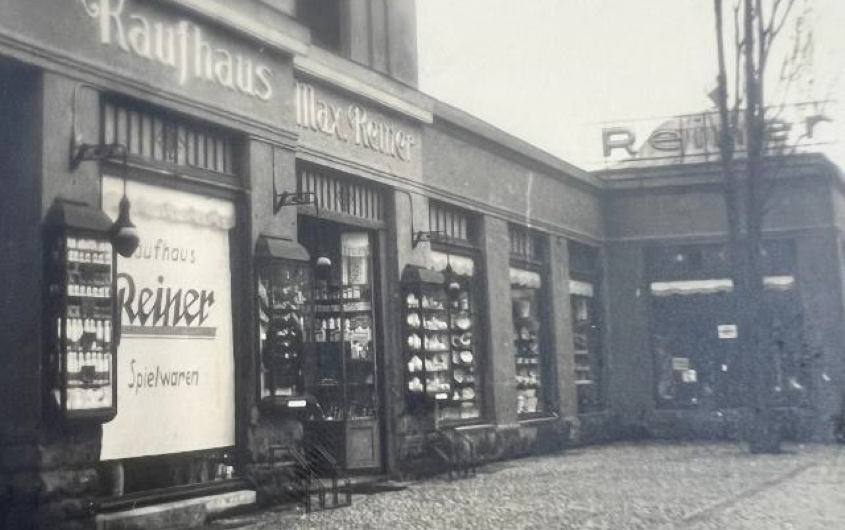
Photo courtesy of Bert Reiner
Toy Maker 2: Journeys
Kevin Ostoyich
Valparaiso University
Prof. Kevin Ostoyich was a Visiting Fellow at AGI during the summers of 2017 and 2018. He is Professor of History at Valparaiso University, where he served as the chair of the history department from 2015 to 2019. He is also Guest Professor at the Center for Applied Policy Research at Ludwig Maximilian University of Munich and Historian for the Florence and Laurence Spungen Family Foundation. Prior to moving to Valparaiso, he taught at the University of Montana. He has served as a Guest Professor at the Institute of Bavarian History at Ludwig Maximilian University of Munich, Fellow at the Käte Hamburger Kolleg at Ludwig Maximilian University of Munich, Eadington Fellow at University of Nevada Las Vegas, Fellow at the Center for Advanced Studies at Ludwig Maximilian University of Munich, Distinguished Guest Professor at Shanghai University, Senior Fellow at the German Historical Institute Pacific Regional Office/University of California, Berkeley, Research Associate at the Harvard Business School, and Erasmus Fellow at the University of Notre Dame. He currently is an associate of the Center for East Asian Studies of the University of Chicago, a board member of the Sino-Judaic Institute, and an inaugural member of the Shanghai Jewish Refugees Museum International Advisory Board. He has published on German migration, German-American history, the Holocaust, and the history of the Shanghai Jews. He holds his BA from the University of Pennsylvania and his AM and PhD from Harvard University.
While at AGI, Prof. Ostoyich conducted research on his project, “The Wounds of History, the Wounds of Today: The Shanghai Jews and the Morality of Refugee Crises.” The Shanghai Jews were refugees from Nazi Europe who found haven in Shanghai and thus escaped the Holocaust. For this project Ostoyich interviewed many former Shanghai Jewish refugees and conducted research at the National Archives at College Park, MD, and United States Holocaust Memorial Museum. At Valparaiso University he co-teaches a course titled “Historical Theatre: The Shanghai Jews,” which fuses the disciplines of history and theatre. To date, he has written and produced four original plays with university students based on the history of the Shanghai Jewish refugee community: Knocking on the Doors of History: The Shanghai Jews (2016), Shanghai Carousel: What Tomorrow Will Be (2019), The Singer of Shanghai (2020), and Lyrics and Laughter from Shanghai: A Relevant Cabaret Evening with Historical Commentary (2025). He has been involved in the creation of two films: Gary’s Letter (2024) and Three Girls of Shanghai (2024).
Click here for an article by Ostoyich on the Shanghai Jews.
He is currently trying to interview as many former Shanghailanders as possible. If you would like to be interviewed or know someone who might want to be interviewed, please contact Professor Ostoyich at kevin.ostoyich@valpo.edu.
On June 20, 2018, the article “The Story of Bert Reiner, the Toy Maker, or: An Appreciation for the Individual Experiences of Former Shanghai Jewish Refugees” was published by the American-German Institute. Since the time “The Story of Bert Reiner, the Toy Maker” was published, both Bert and one of his toys, named “Anna,” have gone on long, separate journeys. The recent journeys of Bert and Anna have stimulated more research and reflection regarding a family deeply connected to toys.
Maximilian Reiner’s Journey to Theresienstadt
Friday, 7th of January 1944
All my dear ones!!
A new roundup! All divorcees were evacuated. They also came looking for me to pick me up, but given I am working, they will come back soon. I am using the brief time I have to write this farewell letter. It is perhaps the last sign of life that you all will receive from me. I am glad and happy that we were able to see each other one more time. I thank you all deeply for all the love that you all have bestowed upon me. Think of me well. I do not know what will happen to my things that are still here. In any case, contact Mr. Oskar Kurban, whom I am entrusting with all the keys as well as Miss L.’s[1] things. Live well and be warmly kissed from your
F[ather].
Greetings to your parents and Mother.[2]
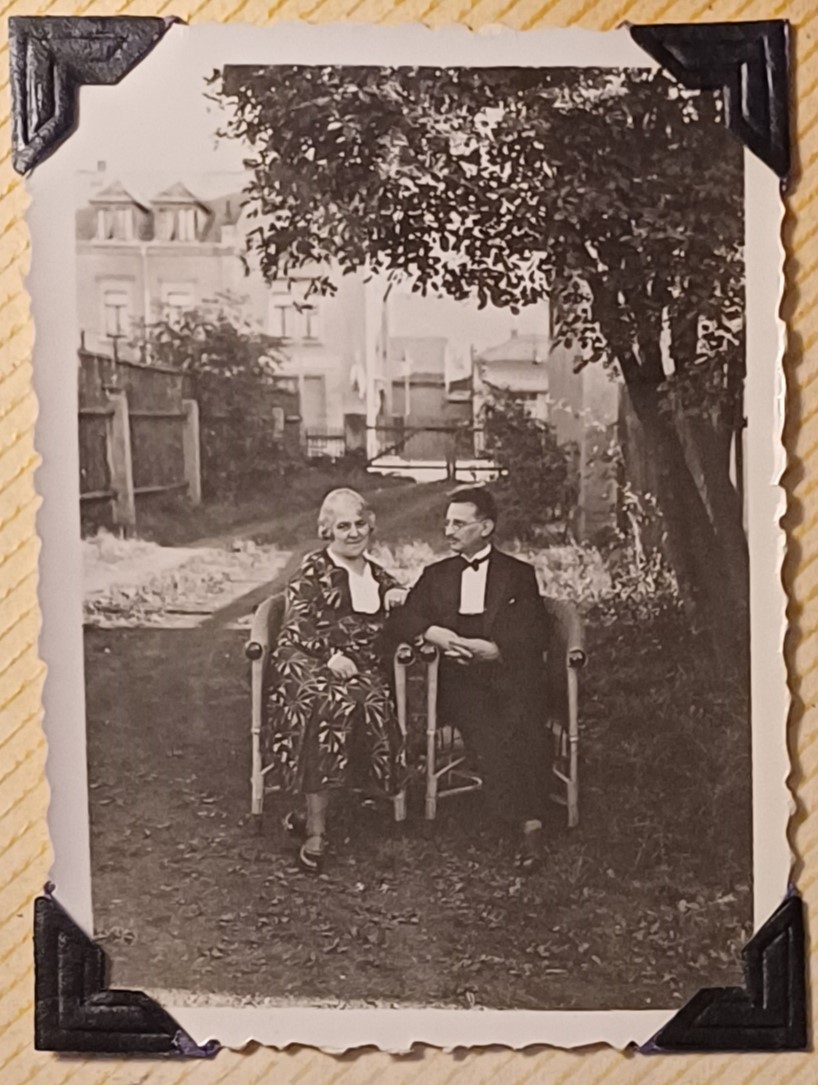
Maximilian Reiner had been in a “privileged mixed marriage.” But then his “Aryan” wife, Elsa, divorced him. Stripped of the protection, he was going to be transported to Theresienstadt in the former Czechoslovakia and within the Nazi-created Protectorate of Bohemia and Moravia. He was not alone. As he noted, other Jewish divorcees were going to be transported along with him.
On January 10, 1944, Transport I/105 left Berlin. Maximilian Reiner was among the 352 Jews on the transport.[3]
Maximilian Reiner and the others of the transport arrived at Theresienstadt the next day.[4] According to the Yad Vashem website, the transport had taken the following route:
The train’s route took the deportees from Berlin to Dresden and along the river Elbe to Decin (Tetschen), Usti nad Labem (Aussig), Bohusovice (Bauschowitz) and finally to Theresienstadt. From 1 June 1943 on the trains went directly into the ghetto, as the prisoners had built a connecting railway line from Bauschowitz station to Theresienstadt.[5]
Maximilian Reiner was born on September 22, 1877, in Olszany.[6] Olszany is in Galicia, which is the part of Poland that was incorporated into the Austrian Habsburg Empire when Poland was carved up among Prussia, Russia, and the Habsburg Empire during the latter part of the eighteenth century. On November 6, 1906, Maximilian married Elsa Rössler (born on December 4, 1877) in Dresden.[7] Maximilian and Elsa had two children, Horst and Käthe. Horst and Käthe were both born in Dresden, Horst on January 1, 1907, and Käthe on June 25, 1909.[8]
According to the late history teacher and local historian, Hugo Jensch (June 20, 1927 – September 15, 2022),[9] the Reiner family moved from Dresden to Heidenau in 1913, and Maximilan opened a department store in Heidenau-Nord (Heidenau-North) in 1914.[10] Given that Maximilian Reiner was a citizen of the Habsburg monarchy, he served in the Austro-Hungarian army during the First World War. Käthe ran the department store while Maximilian was away at war. Maximilian had been a Socialist since 1896 and joined the Social Democratic Party (SPD) after the war. In 1921, Maxmilian became a German citizen.[11]
After the Nazis came to power in Germany, the pressure mounted on Maximilian with respect to his department store. The store was targeted during the boycott of Jewish businesses on April 1, 1933. An SA man was stationed outside the store, and patrons were photographed going into the store and were warned not to return. In 1938, the windows of his store were repeatedly burned with hydrofluoric acid. During the Kristallnacht pogrom, Maximilian was arrested and taken to Dresden. He was spared having to go to a concentration camp because of his marriage to Elsa. Whereas Maximilian was Jewish, Elsa had been Lutheran. Although she had converted to Judaism upon marrying Maximilian, she was still deemed racially “Aryan” by the Nazi regime. Although Maximilian was spared going to a concentration camp at the time, he was, nevertheless, forced to sell his department store.[12]
The details of Maximilian Reiner’s life between the end of November 1938 and January 1944 are not always clear. There are two main accounts of his life, but the accounts differ in some respects. One account is by the late Hugo Jensch, a local historian in Saxony. The other account is published in the collection titled, Buch der Erinnerung: Juden in Dresden deportiert, ermordert, verschollen (1933 – 1945), henceforth referred to as Buch der Erinnerung.[13] According to Jensch, after losing the department store, Maximilian and Elsa went to Berlin, where Maximilian had to register regularly with the police, and, starting in 1939, Maximilian was compelled to do forced labor in garbage collection, railway construction, and battery recycling. The work with the batteries led to his suffering from lead poisoning. Due to state (and perhaps family) pressure, Elsa divorced Maximilian. Consequently, Maximilian lost his semi-privileged “mixed marriage” status. He was then forced to live in a so-called Judenhaus or “Jew house” in Berlin.[14] The Nazis instituted strict regulations regarding where Jews could live and from whom they could rent. “Jew houses” were residences in German cities that were designated solely for Jews.[15] In February 1943, all Maximilians’s remaining assets were confiscated or “Aryanized.” During his time of great hardship in Berlin, Maximilian was visited and assisted by his daughter, Käthe, and son-in-law, Günther, on a regular basis.[16]
According to the Buch der Erinnerung account, Maximilian and Elsa had already been living separately since 1934 and finally divorced on July 18, 1941. The account states that “one source notes” (“Eine Quelle gibt an”) that Maximilian was detained in the Sachsenhausen concentration camp from January 10, 1941, to March 7, 1943. The present author believes that, of this information, only the date of the divorce is correct.
Bert Reiner, the grandson of Maximilian and Elsa Reiner, does not believe that his grandparents were separated as far back as 1934. He thinks that his grandparents got divorced in 1941 due to the pressures of living in a mixed marriage within the Third Reich. His understanding has been that his grandfather was in Sachsenhausen concentration camp at some point and says he believes that his grandfather met a woman named Lizzie Lilienthal while in the camp.[17] This is the “Miss L” Maximilian mentioned in his letter of January 1944. Bert says that his Aunt Käthe became friendly with this woman and even visited her in San Francisco after the war. The present author has conducted multiple searches of Sachsenhausen records through the Arolsen Archives website but has not been able to locate any documentation pertaining to Maximilian Reiner in Sachsenhausen. It is possible that at least some of the forced labor that Maximiliian Reiner was compelled to do while in Berlin overlapped in some way with the Sachsenhausen satellite camp system or that, given the proximity of Sachsenhausen to Berlin, his work as a forced laborer in the city simply became associated with the notorious camp in the family narrative. It is plausible that Maximilian met Lizzie in connection with forced labor duties. (More information about Lizzie Lilienthal and her friendship with Maximilian Reiner is provided below. In the interview testimony she gave in 1996, she mentioned having to conduct forced labor in Berlin but did not mention ever having been incarcerated in Sachsenhausen.) Jensch had consulted a personal narrative written by Maximilian Reiner (and other individuals) in 1945 while drafting his account of Maximilian’s life. The fact that Jensch did not mention Maximilian having been incarcerated in Sachsenhausen would mean Jensch either overlooked this in Maximilian Reiner’s account (which seems highly unlikely) or that Maximilian did not state that he had been Sachsenhausen. If the latter is the case, it would seem extremely unlikely that Maximilian would have neglected to include such a fact, especially if he had been incarcerated in Sachsenhausen between January 10, 1941, to March 7, 1943, as per the Buch der Erinnerung account. Unfortunately, Jensch did not provide information about the whereabouts of Maximilian Reiner’s personal account. Hopefully, future research will uncover the whereabouts of Maximilian’s account as well as documentation that provides more clarity about where Maximilian Reiner was from November 1938 to January 1944. According to Lizzie, when she stayed with Maximilian in Berlin, he was living in an apartment in a building that was only for Jews.
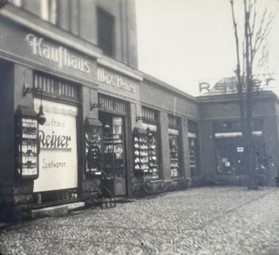
If one looks closely at the large white sign on the store front of Kaufhaus Reiner—the department store Maximilian Reiner had run in Heidenau and eventually was Aryanized after Kristallnacht—one sees the word “Spielwaren” prominently displayed. “Spielwaren” is German for “toys.”
Bert Reiner: The Toy Maker
Maximilian Reiner’s grandson, Bert Reiner, lives in Las Vegas. The license plate on his SUV reads “TOY MKR.” How did this come to be? How did Bert Reiner become the Toy Maker? It turns out it all started with plastics. Bert explains:
My first job [after] graduating was with Sikorski Aircraft as an electromechanical engineer, but I wasn’t too happy at Sikorski, and I left after a couple of years and then worked for an electronic company [SoundScriber] that made dictating equipment, similar to Dictaphone. And we were heavily involved in plastics. And I had no experience or knowledge in dealing with plastics. So, I took a plastics course, and I asked the instructor one night how I could get more hands-on experience, and he suggested my joining a toy company. The unique thing about the toy industry is that you’re changing product lines continuously. If you look at any one catalogue, you’ll find that seventy percent of those toys were developed over the last twelve months. As opposed to working for a refrigerator company—that’s all they make is refrigerators. And that’s what got me into the toy industry. I like the industry. And I’ve been in it ever since.[18]
Bert left SoundScriber and began making toys first with AC Gilbert and then Ideal. One of the major projects at AC Gilbert was an oven in which children could bake cakes. Bert developed a thermostatically controlled door for the oven that prevented children from touching the hot light bulb that did the baking. Bert’s experience with the AC Gilbert ovens would serve him well later when he took a job at Coleco.[19]
In 1969, Bert became the first engineer to be hired by Coleco. Although he had worked at two toy companies (AC Gilbert and Ideal) prior to being hired, Bert was not initially involved in manufacturing toys at Coleco. When Bert joined the company, Coleco primarily manufactured above-ground swimming pools. Thus, his first major project with the company was to design a pool filter. Approximately a year after Bert was hired, Coleco acquired a Canadian toy company called Eagle Toys. Although Bert initially continued to work on swimming pools, he eventually started to get involved in the manufacture of toys again.[20]
One of the toys that Bert was involved with at Coleco was the Pizza Hut baking oven. Bert had already been involved in designing such oven-based toys at AC Gilbert. But the oven at AC Gilbert was primarily for the baking of cakes. At Coleco, the challenge was to create a safe oven that would allow children to bake pizzas. For the cake ovens, the door would not open until the oven had cooled down, which, as Bert notes, “was fine for baking a cake.” But this would not work for a pizza. For Coleco, Bert needed to figure out a safe way for the pizza to be extracted while it was still warm. While eating pizza at Pepe’s Restaurant in New Haven, Connecticut, Bert came up with the idea. He realized that he needed to eliminate the thermostatic door and instead use a small slot and wooden paddle. The pizzas would thus be extracted from Bert’s oven like they are in ovens in pizza restaurants. For the idea to work, he needed to make sure the slot was wide enough for the pizza and paddle but too narrow for children to insert their fingers into the oven. The idea worked, and Coleco was able to manufacture the Pizza Hut oven.[21]
Coleco eventually got involved in the video game industry, becoming a major competitor to Atari. The company’s first foray into the field was the creation of a product called Telstar. Regarding Telstar, Bert says,
And that was a simple video game. An improved version of Pong, which was made by Atari. Now what happened was that I was asked. We had never made any electronics prior to this. The president of my company said we’ve got to come up with a product similar to Pong. But, hopefully, [one] that would be better. So, I found an electronic engineering firm [Alpex] located in Danbury, Connecticut. And I hired them to design a product, which became Telstar. And while they were working on the development, they said that what we need is a long lead time because we need a custom chip, and they take a long time to program and to manufacture. And I said, you know who makes these chips? And they were all in the West Coast, but there was one company in the East Coast in New York. That company was called General Instrument. So, I said, I really don’t know anything about chips. I’d like to find out a little bit about it. So, I went to GI with the people from the company. […] And we explained what we were after, and I had to go to the bathroom. And when I came back, sitting in front of me was a multi-page specification for a chip. Developed by GI in their plants in Scotland. And that was way, way ahead of any development that we would have done. […]
So, we worked out an exclusivity contract. And we bought 950,000 chips, almost 1,000,000. And it became exclusive for us. And we had the exclusivity for six months. Unfortunately, the day the six months was over, they offered that same chip to the rest of the world, and we got knocked off. But that’s how we first came into the video game business. We continued working with GI, General Instrument. And we developed several other electronic games, and we had eventually came up with an improved version, which was ColecoVision.
What was unique about the ColecoVision was that it was programmable. So, you inserted a cartridge, similar to what Atari had done. And so, you could include several different games. I was not involved in the [game development], but I was involved in the hardware rather than in the software. And that was my responsibility.[22]
ColecoVision was released in August 1982 and quickly became very popular as a major competitor to Atari. Sales of the console passed one million in early 1983. Nevertheless, the gaming industry crashed that year, and Coleco shifted to another toy that would take United States households by storm by the end of 1983: The Cabbage Patch Kid.[23]
As the head engineer of the Cabbage Patch Kid at Coleco, Bert oversaw the production of one of the most successful toys of all time. Bert explains,
Well, I should start a little bit first about the Cabbage Patch Kids. The concept was conceived by a guy. His name is Xavier Roberts in Cleveland, Georgia […], and […] he rented or bought a hospital that was defunct and had the factory manufacture 25-inch versions of the Cabbage Patch Kids. And he dressed the employees up as doctors and nurses so that it would look like a hospital and that these dolls were actually born there. Coleco, the company I worked for, decided to market the Cabbage Patch Kids in a smaller and less expensive version. The doll was only 16 inches tall and would retail for $25 as opposed to $125. And my involvement was to handle the design, development, and manufacturing. And I flew to Hong Kong. This was prior to manufacturing in China. I presented the concept of the dolls being different to two manufacturers [Kader and Perfekta] that I had worked with previously. These were the largest doll manufacturers probably in the world. And when I explained that every doll had to be different, they laughed at me. They said this couldn’t be done. So, I thought, “How am I going to go back to my office and explain to management and to marketing that this doll, which seemed to have been successful, couldn’t be manufactured?” So, I came up with a matrix of how to do that, of how we could have every doll differently, and yet within a manufacturing environment. And I then presented that concept to the two manufacturers. They thought it was doable. And, lo and behold, we started manufacturing the Cabbage Patch.[24]
Bert helped create some of the most significant and popular toys ever made, has spent decades as a toy maker, and continues to provide expert testimony in lawsuits pertaining to toy safety. It may come as a surprise that he did not grow up with toys. Bert’s family fled Nazi Germany before his second birthday, and he spent the next ten years of his childhood as a refugee in Shanghai, China.

Bert did not have toys in Shanghai. Rather, he remembers playing marbles and a game called packs that was played with cigarette packs. Regarding those games, Bert remarks, “Neither of them [was] very sophisticated; nothing compared to what’s available today or even in my later youth.”[25]
Bert loves toys and being a toy maker. He thinks a toy is such an important thing because it is what “gratifies children.” Bert believes his appreciation for toys stems from his refugee childhood:
You know, we had marbles and we had that matchbook game [packs]. We played soccer, but as far as toys are concerned, we grew up without any of those that you see in the [United States]. So, I think I appreciate the toys more than the average kid. You know, kids of today take the toys for granted. I grew up until I was 12 years old, not having played with any of these toys. Or toys, period.[26]
In 2024, Bert Reiner decided to send one of the toys he had made to the city of his toyless childhood, Shanghai. The idea had been presented to Bert by Danny Spungen of the Florence and Laurence Spungen Family Foundation. Danny came up with the idea after he visited the newly expanded and reopened Shanghai Jewish Refugees Museum in March 2024. Danny had seen how the museum highlights certain Jewish refugees who later became very successful. He thought that Bert’s story needed to be integrated into the museum’s narrative. Thinking of the Flat Stanley concept, he wondered if Bert would be willing to donate one of the Cabbage Patch Kids that he had made in the early 1980s to the museum. Danny FaceTimed Bert from the museum and said that Bert’s story needed to be told at the museum.[27]
When Danny got back to the United States, he called Bert, and Bert agreed to send a Cabbage Patch Kid to the museum. Later Bert informed Danny that he had a Kid ready but needed to know where to mail it.[28]
Bert had been trying up to that point to mail his autobiography, My Journey From Shanghai to Las Vegas, to the Shanghai Jewish Refugees Museum, but, due to postal restrictions in China, he was not having any success. Danny decided that instead of having Bert mail the Cabbage Patch Kid to Shanghai, Danny would fly to Las Vegas and personally take the Cabbage Patch Kid to Shanghai. Bert realized he could have Danny also bring along a copy of his book with the Cabbage Patch Kid. He explains, “When Danny Spungen was going to visit the Shanghai [Jewish Refugees] Museum […] I thought, ‘Lo and behold, I’ll give him the book and a doll,’ and said, ‘Goodbye’ to Anna.”[29]
Anna’s Journey
Anna is one of approximately twelve Asian Cabbage Patch Kid prototypes that Bert made for Coleco. Bert thinks that he made the prototypes in 1984, the year after Coleco had introduced the Cabbage Patch Kids. Bert came up with the idea for the Asian Kids, and the inspiration for the idea was his childhood refugee experience in Shanghai. It was not really Bert’s job at Coleco to come up with a new product line like this. Such ideas usually came from the marketing department.[30] Despite the effort Bert made on the prototypes, Coleco did not run with the Asian Cabbage Patch Kid concept. Thus, the twelve prototypes were the only Asian Cabbage Patch Kids Bert made. Bert explains,
[We] sampled a dozen of those [Kids] in my factory. And we presented the [Kids] to marketing, and they decided not to proceed with it that year. It was probably because the concept of the regular Cabbage Patch [Kids] was so, so successful that to come up with another facial version may not make sense. I don’t really know.[31]
Bert kept three of the Asian prototype Kids. One was subsequently stolen from him. Anna was one of the two that remained in his possession. Bert decided Anna was ready to go on a long journey.[32]
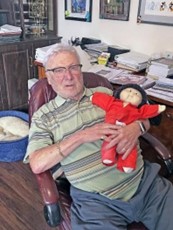
There were many stops on Anna’s journey to her new home. Her first stop was to go on a tour of the PEER Chain Company in Waukegan, Illinois, on October 15, 2024. That day, she also did a Zoom call with Troy Fears and Megan Wallace, the executive director and chair of board of directors, respectively, of CANDLES Holocaust Museum and Education Center. On October 17, 2024, Anna was put on a plane to Phoenix, Arizona, to make an appearance at a Mexican coin show. The next day she paid a visit to a friend of Bert and fellow Shanghailander, Evelyn Goldstein. She then flew back to Chicago and made a repeat appearance at PEER Chain, this time attending a scalability meeting of the company. She then flew from Chicago to San Francisco. On October 29, she boarded United Airlines flight 888 from San Francisco to Beijing. On November 1, she attended the Beijing Coin Show. That evening she attended a dinner event with coin designers. The next day she went to a shopping mall in Beijing. On November 3, Anna boarded Air China CA 1521 at 2:30 pm and arrived in Shanghai (PVG) at 4:55 pm. In Shanghai, she stayed at the Courtyard Shanghai Central at 338 Heng Feng Road. On the morning of November 4, Anna met with employees of the PEER Shanghai MCT Office and FaceTimed with Bert.[33]
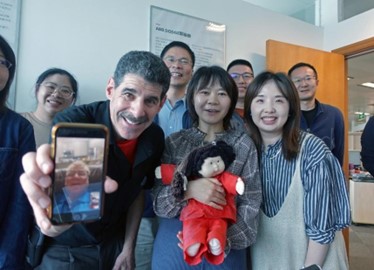
On the afternoon of November 4, 2024, Anna arrived at the destination of her journey and new home: the Shanghai Jewish Refugees Museum.[34] Danny presented Anna and the copy of Bert Reiner’s autobiography to the director of the Museum, Chen Jian. Anna, Chen, and Danny then Facetimed with Bert. Bert recalls speaking a few words in Shanghainese with Chen and says that although the conversation was brief, it was very positive.
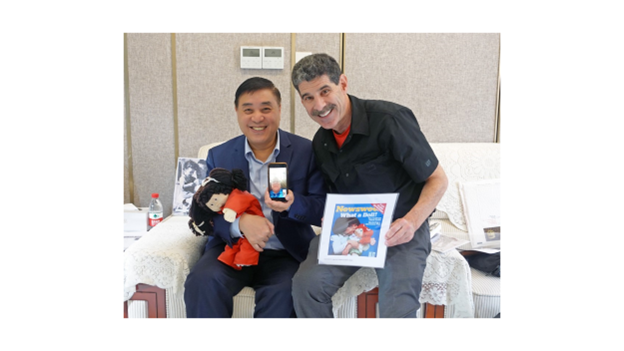
Danny Spungen, Anna’s companion on the journey, thinks children need a variety of learning tools and believes artefacts such as Anna can help young people connect with the humanity of history. Danny struggled through school with a learning disability and eventually realized that he could learn best about the world around him through the tactile world of stamp collecting. He thus knows firsthand how effective material objects can be as pedagogical tools. He thinks that Holocaust education should not only focus on the 6,000,000 Jews who were murdered but should also highlight the achievements of those who survived, such as Bert Reiner. Regarding Bert’s history, Danny thinks of the countless children who have played with the toys Bert has made throughout his life. Although the Cabbage Patch Kid Christmas craze of 1983 infamously sparked fights between “crazy parents who went nuts over this thing,” Danny notes that, overall, the “Kids” Bert made brought peace and joy to children.[35]
The mission of the Florence and Laurence Spungen Family Foundation—of which Danny Spungen is a trustee—is to bring artefacts to life and make them accessible; furthermore, it is the mission of the Foundation to connect survivors and their families to institutions such as the Shanghai Jewish Refugees Museum. Without such connectors, many survivors and families do not realize how priceless the artefacts they have are in terms of preserving and telling the story of Holocaust. Consequently, many of the artefacts are simply discarded. Thus, Danny thinks the most important role the Foundation plays is to foster a large network that connects survivors, their families, and their artefacts to the institutions that can best preserve and convey the stories. He believes such institutions will help educate the public about the stories through artefacts such as Anna when survivors such as Bert are no longer around to tell the stories themselves. Danny notes that often the next generations of the survivors—the children, grandchildren, etc.—do not immediately appreciate the importance of the survivors’ stories and artefacts; thus, he feels the Florence and Laurence Spungen Family Foundation can step in and help preserve the artefacts until the time when those family members want to take a more active role with respect to those items and that history. He likens the Foundation’s function to planting seeds for the children and grandchildren, whom Danny refers to as “future messengers.”[36]
The Toy Maker’s Journey into the Past
As Anna was on her journey to Shanghai, Bert went on a journey of his own. On October 15, 2024—the day Anna arrived at the PEER Chain Company in Waukegan, Illinois, as the first stop on her journey—Bert arrived in Dresden, Germany. He, along with a group of other survivors and family members of survivors, had been invited by the city of his birth to make a return visit. Bert met the mayor of Dresden, toured various cultural sites, attended a concert of the Dresden Philharmonic, spoke with high school students, and screened the documentary he made about his life. Bert was thoroughly impressed by the fact that the trip was sponsored entirely by the Dresden government.[37]
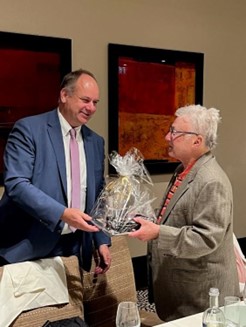
During his trip he conducted genealogical research and was taken to various sites pertaining to the journeys his family members had taken during the time of Nazi persecution.[38]
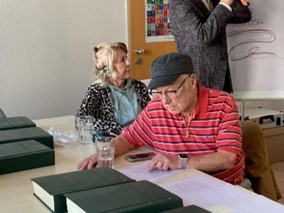
As part of the official itinerary, the group was brought to the Jewish cemetery. A local rabbi had conducted research and located gravesites of family members of group participants. Bert was taken totally by surprise when he found out that the rabbi had prepared for him to see the grave of his brother, Egon Manfred Reiner. Egon had been born before Bert and had only lived a few months.


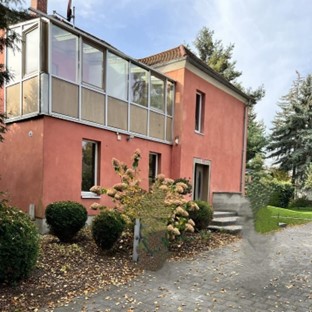
Although the official itinerary of the trip was packed with events, the group was allotted free time to see sites of more individual interest. Bert used his free time to see a house in which he had lived, search for the graves of his grandmother and aunt, and see the building where his grandfather had his department store and his grandparents, father, and aunt had lived.
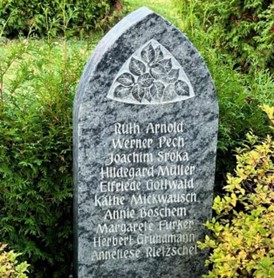
Bert visited a Lutheran cemetery hoping to find the graves of his grandmother and aunt. Although he was unable to find a grave for his grandmother, he did locate the grave of his aunt, Käthe (née Reiner) Mickwausch.
Bert went to the address Bahnhofstrasse 10 in Heidenau to see his grandfather’s department store and the apartment where his grandparents, father, and aunt had lived. A sign above the door notes that the building was built in 1913.
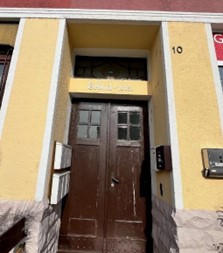
The building no longer is a department store. Rather, it has been converted into a Vietnamese restaurant.
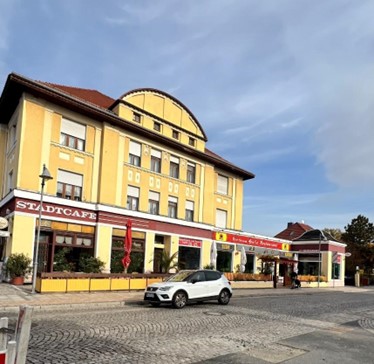
There are four small Stolpersteine “stumbling stones” in front of the building as reminders that the Reiners—Maximilian Reiner, Elsa Emmy Reiner, Horst Wilhelm Reiner, and Käthe Reiner—lived there.
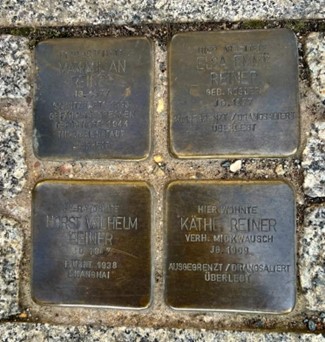
Each Stolperstein possesses information pertaining to the fate of the individual commemorated. Although the notes on the Stolpersteine are brief, the journeys the Reiners took were not.
The Journey of a Graphic Artist: Käthe (née Reiner) Mickwausch
Käthe (née Reiner) Mickwausch was born on June 25, 1909, in Dresden. The family moved to Heidenau-Nord in 1914. From 1915 to 1918, Käthe attended public school in Mügeln, and then from 1918 to 1925 she went to an all-girls’ school in Pirna. She then attended art and drawing lessons.[39] Starting in 1931, she took advanced classes at the Staatlichen Akademie für Kunstgewerbe (State Academy for Arts and Crafts) in Dresden, where she met fellow graphic art student, Günther Mickwausch. Upon their engagement in March 1933, Käthe converted to Protestantism. Käthe and Günther got married on May 20, 1933, in Chemnitz. According to historian Jensch, Käthe did not register as being racially Jewish and was able to hide this until her mother divorced her father in the early 1940s.[40]
According to an account by Andreas Hechler, Käthe did not pursue her career as an artist from 1933 to 1945.[41] During the Third Reich, the arts were administered by the Reich Chamber of Culture (Reichskulturkammer), which was subordinate to Joseph Goebbels’ Reich Ministry of Public Enlightenment and Propaganda. The Reich Chamber of Culture was comprised of seven chambers, of which the Reich Chamber of Fine Arts had control over graphic art and painting. To continue her career as a graphic artist and painter, Käthe Mickwausch would have had to be a member of the Reich Chamber of Fine Arts. Membership was limited to “Aryans.” If Jensch’s assertion that Käthe hid her Jewish past is correct, it is possible that the reason she did not pursue a career as an artist is that this would have required that she apply for membership the Reich Chamber of Fine Arts, and such action could have led to the revelation of her “non-Aryan” identity (as defined by the Nazis).
According to Jensch, after Elsa Reiner divorced Maximilian Reiner and Käthe’s “non-Aryan” identity became known, Käthe henceforth had to register regularly with the police.[42] She worked as a technical assistant in the construction office of the machine factory C.G. Haubold in Chemnitz until 1944.[43] She was then assigned to do forced labor in the spinning factory Spinnerei Witt in Chemnitz.[44] Günther petitioned to have Käthe released from this duty, but his plea was rejected by the authorities.[45]
According to Jensch, Käthe was due to be transported to a concentration camp by the Nazis in March 1945. This did not happen, however, because the Allies bombed Chemnitz. The war ended approximately two months after the bombing.[46] Thus, Käthe was ironically saved by the destruction of the city.
After the war, Günther and Käthe initially lived in Chemnitz, but in 1947 they moved to Heidenau. The couple opened a graphic design business called Mickwausch Entwürfe (Mickwausch Designs).[47]
Günther passed away on June 1, 1990, in Heidenau.[48] Käthe remained in Heidenau for the rest of her life and passed away at 102 years old.
A Journey to Shanghai: Horst Reiner, Gertrude Reiner, and Bert Reiner

While on his trip to Dresden, Bert saw several sites regarding his past. He already knew a great deal about this history, because it had been presented to him in a very special scrapbook that had been given to him on May 27, 1950, the date of his Bar Mitzvah. For the occasion, Horst and Getrude gave Bert a scrapbook that Horst had crafted with much love and care. In the scrapbook, Horst documented and narrated the journey Horst, Gertrude, and Bert had made from Dresden to Shanghai and then on to the United States. Excerpts of Horst’s text along with some of the photographs he pasted into the scrapbook are used here to narrate the family’s journey as refugees. Only occasional edits have been made to the original text in the interest of readability. Horst’s text appears in italics.
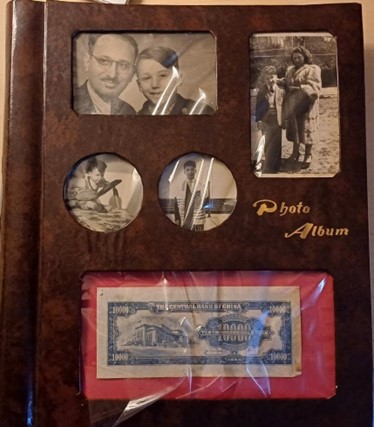
Horst began the narrative in a similar fashion to most photo albums, (i.e., with photographs of Bert’s parents and grandparents). Horst then included photographs of Bert as well as a lock of Bert’s hair.
Horst wrote:
You were growing normally as a child should grow, but, not as fast as the photos make you believe it, my son, and in between, there were times, when we were worried—just in the way as all the parents are doing all the world over. The photos are the best proof that you were a healthy child.
Actually our worries concentrated on our future as life became unbearable in Germany during 1938 and we contemplated our immigration.
We left Germany in February 1939 for China, and the following pictures were taken on the SS Potsdam which brought us to the FAR EAST, namely to SHANGHAI.

Along with the many photographs from the voyage, Horst reminded Bert why the family was on the SS Potsdam and included a note from the ship’s captain that underscored the reason.
Do you know by now why we left Germany—and together with us thousands of Jews?
In order to save our naked lives from destruction!
The following notice which was handed to us on board the SS Potsdam speaks a language for itself:
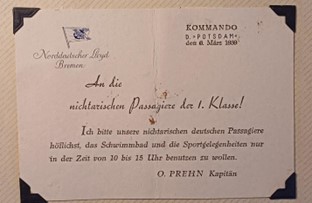
Horst then began to chronicle the family’s time as refugees in Shanghai.
Now you see the first pictures taken in Shanghai. We were living in North Szechuen Road, just across the Hongkew Park, where you went every day with your little “Amah.” We stayed there only for about 4 months and moved then to the French Concession, namely 255 Route Cohen. Quickly you made friends with all the neighbours and spoke quite fluently English and Chinese.
Life in Shanghai was by far not easy for the newcomers from Europe and all the refugees struggled hard to make a living in Shanghai.
Your father started in August 1939 the UNITED IMPEX COMPANY and in April 1941, this firm was merged with the firm of Mr. M. Fleishmann of Harbin into FLEISHMANN IMPEX COMPANY […].
The economical chaos in China found a vivid expression in the manifold issues of money for which [I] give your 2 samples, Chinese and Japanese “small money” which co-existed at the same time.
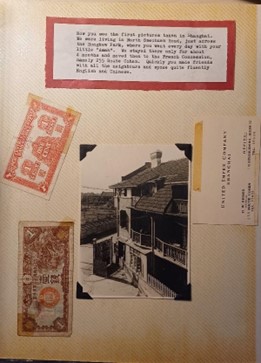
During the nineteenth century, Shanghai was forcibly opened to Western traders through the Opium Wars between the Chinese and the British. The city was divided into districts with different administrations. The International Settlement was governed by the Shanghai Municipal Council, which was primarily controlled by the British. The most exclusive section of the city was known as the French Concession, which was administered essentially as a French colony even though there were few French who lived in the city. Four months after arriving in Shanghai, the Reiners moved into the French Concession. Soon, Bert started to attend Kindergarten. In the scrapbook, Horst wrote of this time,
In the meantime, you grew up more and more, my son. You went to the Kindergarten Peter Pan for a couple of weeks, which was closed at the outbreak of the Pacific War and from then on you went to the “Wonderland”-Kindergarten, the owner of which, Mrs. Annemarie Schwarz, became a good friend of ours.
Now look at your surroundings at the Kindergarten:
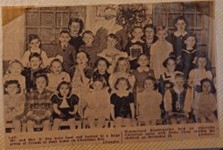
The dynamics in Shanghai altered drastically in December 1941. Concurrent to the attack on Pearl Harbor, the Japanese forcibly took over the International Settlement. British and American citizens in Shanghai became enemy combatants of the Japanese overnight and were subsequently placed into internment camps in and around the city. The actions by the Japanese created a general atmosphere of unease among the refugees. The Japanese did not occupy the French Concession, and for the time being, the Reiners were able to remain there.
Horst wrote about the “clouds of war” that appeared in 1941:
The year 1941 brought us much excitement as the clouds of war drew nearer and nearer to the Pacific. Of course, you did not know anything about this. You went to school and enjoyed life, your friends, and parties. But your parents worried much, especially for your grandfathers (Mamy’s and Papy’s fathers) who wanted to leave Germany but were unable to do so as the WAR had already started in September 1939.
And then…..suddenly we were again in the midst of war as the Japanese started their sneak attack on Pearl Harbor on December 8, 1941.
Hectic days followed. Proclamations were posted everywhere. Many things were prohibited as for instance hearing radio over the shortwave. Sometime later, we even had to surrender to the Japanese authorities our beautiful radio set which we had brought over from Germany.
The thousands of Jewish refugees suffered most as they were cut off the main source of their financing. Prices went skyhigh, especially for foodstuffs. Another Chinese currency was created by the Japanese and introduced by force—the so called Central Reserve Bank notes, in brief CRB Dollars.
For you, my son, life went smoothly on, as your parents did everything in their power to give you a happy childhood in spite of war and hardships.
For over a year after the Japanese forcibly took over the International Settlement, the Japanese left the refugees largely untouched. In 1943, this would change dramatically. From May 1943 until the middle of August 1945, the vast majority of the refugees—including the Reiners—were forced by the Japanese to live in a “designated area,” where they were only allowed to leave if they were issued an official pass.
Horst wrote about the fateful years 1943, 1944, and 1945:
1943
On the 18th February, the Japanese authorities issued the so-called Proclamation which affected very much the life of all the refugees in Shanghai, the essence of which was that of depriving them of their livelihood, robbing them of their possessions, their apartments, houses, factories and shops. Within the brief span of 3 months, all those refugees who arrived in Shanghai after 1937, which comprises the bulk of the Jewish refugees who fled Nazi Germany, were compelled to move to a “designated area” and if not…….well, as usual….prison and death. After all, it was a military law and so we moved to this “designated area” in Hongkew, where we lived until the end of the war meant liberty for us.
In Hongkew you went to the “Kadoorie School”.
1944
For a child of your age in the year 1944, school plays the most important part. It might be interesting for you to have a look at one of your own reports in later years. I am glad that I can produce one of the earlier reports of your school activities.
Your “hard” work was interrupted from time to time by childrens parties like the one you see on this page.
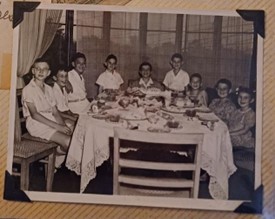
1945
This year brought us the climax of our sufferings but also the end. Daily bombardments of Shanghai were no pleasure! Prices for foodstuffs soared from day to day. A compulsory watch system was introduced by the Japanese and the refugees, too, had to participate. Very often your father had to stand on nightwatch in the wee hours, whether hot or cold and even when it was pouring.
On the 17th July, 1945, our district was bombed [by American B-52s] and many casualties resulted—many hundreds of Chinese and more than twenty of our own people.
All this and many other hardships were forgotten, when I got a telephone call from a Portugese friend in the middle of the night on August 9 (in fact it was a little bit too early) – anyway the preliminaries of a Japanese surrender had started and this meant the end of the war.
PEACE! PEACE! PEACE!
Although the war was over, the Shanghai sojourn was by no means over for the Reiners. As with the other refugees, the family sought a new place to live. Nevertheless, as had been the case before the war, the refugees were met with immigration quotas and bureaucratic mazes.
Horst described the years the Reiners stayed in Shanghai after the conclusion of the war:
1946 and 1947
These were most happy years for you and for your parents, too. First of all, we moved back to the former French Concession—we were so glad to get out of this “designated area”—we took a beautiful apartment in one of the finest buildings, namely in the Willow Court at 34 Route Boissezon. You had to change the school, of course, but you did not mind either. You went to the Shanghai Jewish School, one of the best schools in Shanghai with a very fine record. In this school you started working with interest and were always among the best of your class—see the report of June 1947. You joined the BETAR / Brith Trumpeldor and were always a devoted member. In sports you were quite good—you were rollerskating, you learnt to ride a bike and you learnt swimming, too. But the most exciting of all the sports were boxing at which you showed a good fighting spirit, a lot of courage and a good fist.
1948
And on 29th February 1948 you had your first fight and…..victory against Charlie Chang, a very courageous boxer, but you were still a bit better than him and the referees declared you victor. You even got a little silver cup.
Yes, 1948 was a happy year for all of us as the following photos are the best proof of. We spent a nice time in Shanghai and as your parents were members of the Jewish Club and the International Sporting Club, there were a lot of social obligations in which you did not join us.
But…….many of our friends made preparations for leaving Shanghai. In fact, the community of Jewish refugees had already started its process of liquidation and many had left as early as beginning of 1946, when the first boats were available for those who were in possession of a valid visa.
The Civil War of China which for the most part was fought in Northern China came suddenly nearer and nearer to Shanghai and more foreigners contemplated leaving China. We registered with the American Consulate in November 1948.
1949 was a very eventful year for Horst, Gertrude, and Bert. Horst wrote:
1949
This was a rather turbulent year, I might say, although you will not remember the details, my son. On February 6,[49] my father died suddenly in New York. This was a great shock to all of us. Your grandfather was looking eagerly forward to see you, his only grandchild, again, and his and our hope of a happy reunion of the family after these terrible years of separation could not be realized.
A few weeks later, one of your father’s partners in the Fleischmann Impex Co. who happens to be a good friend of us—and of you, too—left for France together with his wife.
Conditions in Shanghai became chaotic. Especially with the fall of Nanking and the siege of Shanghai by the Communists. End of May, Shanghai was “liberated” by the Communists and, at least Shanghai was spared the fate of a “second Stalingrad” as the heroic defenders of Shanghai predicted. Normal conditions returned, but business came to a complete standstill as the port of Shanghai was blockaded by the Nationalists.
We received our Visa for the USA, but, we had to wait until a steamer was available. In the meantime, we sold our home at a ridiculous low price and made ourselves ready for a quick departure. End of September, we left on the SS General Gordon via Hong Kong – Yokohama – Honolulu for the USA, land of liberty, heaven of the oppressed—and arrived in San Francisco on October 13.
When we left Shanghai, photos had to be taken for the U.S. Consulate—here is one: It shows you how you looked, when we were still in Shanghai. In the meantime, you have grown considerably, you gained weight, have grown stronger and even a moustache is visible. Don’t be ashamed of this sign of your manhood—it was the same with your father who had to shave also rather early.
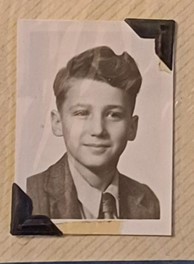
When Bert celebrated his Bar Mitzvah, his parents presented him with the scrapbook that Horst had so painstakingly assembled in secret over many months. Horst and Gertrude informed Bert that a bicycle that had been ordered for him had not yet arrived. Bert remembers his disappointment. He says that at that age a promise of a bicycle and a scrapbook dedicated to the past were not quite what he wanted.
The bicycle eventually arrived. But, as the years passed, especially after Horst died when Bert was in his second year at university in 1957, the scrapbook started to gain more meaning to Bert. Now, Bert has come to think of the scrapbook as one of his most prized possessions. It reminds him of the journey he and his parents took to survive the Holocaust.[50]
Bert continues to journey into the past, but he often thinks about the future. He is very concerned about Holocaust awareness among future generations. He thinks often about his own family:
Well, first of all, it goes back to again with my father… We spent a lot of time talking about my history, about what took place in China and in Germany, things that took place before I was born and in my early years. And, even though, a lot of stuff in Shanghai I didn’t remember, but through my father and our relationship, I remember it like it was yesterday. After my father passed and I started to grow a family, I felt that it was important that my kids know about my heritage and their kids and who knows after that.[51]
Bert regularly visits the graves of his parents[52] and of his grandfather, Maximilian Reiner. He hopes his children will do the same when he is gone.[53]
Journeys of Liberation: Maximilan Reiner and Lizzie Lilienthal
Theresienstadt was liberated by the Russians in May 1945. Maximilan Reiner was alive.[54]
Due to the quarantine that had been mandated after liberation, Maxmilian was still living in Theresienstadt a month after the camp had been liberated. On June 5, 1945, he wrote to Käthe and Günther Mickwausch:
Theresienstadt Concentration Camp
Parkstraße 6
5th of June, 1945
Despite the postal ban, I keep trying to send you news, hopefully this letter will reach you, my loved ones. The most important thing is that I am still alive, feeling relatively well, and am finally happy after such a long time. The greatest concern is now what you all are doing, whether you have withstood all these battles that have continued until recently. What I have heard on the radio up to now is hardly pleasant, unfortunately; according to these reports both Chemnitz and Dresden are said to have been terribly destroyed. What will become of us now? What form will our future take? I do not know where I am to return. The repatriation of the German citizens [Reichsdeutschen] will (should) begin next week. Despite the quarantine, transports of single passengers leave from here daily. They are people who have a home and know where they are going, though. What can I do? In Heidenau, I have no abode and no one to whom I could turn as well. I do not know how things look for you all, and I cannot come randomly. Thus, for me there is no other option than Berlin. And it is also doubtful that I will meet any of my former friends. Presently, of all the people who were sent to the East, approximately 90 percent were killed by these criminals in the gas chambers in Auschwitz or other extermination camps. If I were to report on all the suffering, your hair would stand on end. It is possible though that we will go into a reception camp to endure a quarantine. It will still take a very long time before I can get to Horst, there [in Shanghai] things are still in hot water and the war can still last a very long time. What I am going to do until then, completely destitute and at my age, and, after what I have experienced and endured up to now, I do not feel that I am capable anymore of working hard. Just now new guidelines have come out, and I will write and enclose a second letter to you.
Whole-heartedly,
Dad
I have just learned that it is now possible to return home as long as one can obtain a ride. Now I request that you, dear Günther [Günther Mickwausch, Käthe’s husband, Maximilian’s son-in-law], make an effort, perhaps with the assistance of the Worker’s Council to procure a covered truck that can accommodate around 10 to 12 individuals and about 40 to 50 pieces of luggage and take us to Chemnitz and Berlin. You need to obtain a pass from the present municipal government that authorizes to transport people back home from the concentration camp. A special identification card from the public health service that certifies that we are healthy and free of infection has been obtained. The luggage will be disinfected impeccably. You need only bring enough provisions to get yourself here. We will all be sufficiently provisioned for the return journey. Thanks to the occupation administration we will now be splendidly and richly fed. We will be ready to depart around the 15th of June, thus you have enough time to manage all your preparations. If, contrary to expectations, you are unable to do this, let me know. Namely, there are coaches that travel very frequently from or through Chemnitz to Theresienstadt, which you can give a letter addressed to us. In any case, however, I request that you inform the Jewish Community or other circles that are interested in the return of their relatives, so they take care to pick up their relatives. It would be particularly pressing to inform the Berlin Jewish Reich Representation that they seize this opportunity very soon. With many heartfelt greetings also to your parents.
Dad[55]
A little over two weeks later, Maximilian wrote another letter from Theresienstadt. He addressed it to “Alle meine Lieben!”—“All My Loved Ones!” It is not clear to whom he sent the letter. Given he signed the letter “Max” and mentions having sent a letter to Günther, it does not appear to have been sent to Käthe and Günther Mickwausch.
Dear all my loved ones!
A Dresden bus, which will bring all Dresden prisoners back home, will take along this letter. I do not want to let this opportunity pass to provide you, my dears, with news about me. The main thing is that I am still alive. It is only by a hair’s width that we were spared being gassed as well. In any event, I am doing well with the occupation—now we have good and rich provisions and what is most important—I am free—also things are improving for me, healthwise. Unfortunately, I do not know where I will find a home now. All my friends and acquaintances are either dead or murdered. Regardless, I would like to first go to Berlin, where I will more easily find suitable activity. For I do not know where else to turn. With this, however, I must expect that I will be housed in a camp until I find an abode. But I am already used to the like. Nevertheless, it is very sad for me that at my old age, I must set out into the unknown. How are things for you all, my dears? As far as I have heard, your section of the city was spared. By contrast, Chemnitz supposedly suffered terribly, and that concerns me greatly. I have written to the children repeatedly; I have given the letters to people who travel to Ch[emnitz] to take them with them. In one letter I have requested that Günther pick me up with a truck. But it will not be so easy here—and it is possible that the letter did not reach him at all. In the meantime, the conditions here have changed. I am required to stay at my post until the end of the month and help with the liquidation of Theresienstadt. By the same token, Th[eresienstadt] must be cleared of its inmates by the end of the month. What are the children up to? I worry a great deal that I have not heard from them in almost eight months. Try Frietz to show me some sign of life. There will now be cars dispatched to Th[eresienstadt] daily. Address is as before, Theresienstadt, Parkstrasse 6. That is the only chance to convey news. From the 1st of July, I will remain ready to travel to Berlin. Now be well all my dear loved ones and be abundantly warmly greeted and may we see each other very soon and healthy,
Your Max.[56]
In his letter to Käthe and Günther Mickwausch of June 5, 1945, Maximilian noted his concern for Horst and his family in Shanghai. Although the war had ended in Europe the previous month, the war continued to be waged in Asia. At the time that Maximilian wrote about his concern for Horst and his family, the conditions in Shanghai were worsening considerably for the refugees in the Designated Area. Food was becoming scarce, and the refugees were increasingly becoming sick. On July 17, 1945, matters became even worse as the Designated Area was mistakenly bombed by American planes. Approximately three dozen refugees were killed and many more were injured. Hundreds of Chinese were killed, but, as many refugees have later noted, no one bothered to count the Chinese casualties.
Just weeks after the Designated Area in Shanghai was bombed, the Americans dropped atomic bombs on Hiroshima and Nagasaki and the Japanese surrendered. The Japanese left Shanghai, American soldiers arrived, and the refugees started the process of securing visas to new homes.
In the spring of 1946, Horst Reiner sent a message to his father to let him know that he, Gertrude, and Bert had survived the war in Shanghai. The message was first sent from Shanghai to the Jewish Joint Distribution Committee in Paris.[57] It was then sent by the Jewish Joint Distribution Committee in Paris on March 6, 1946, to arrive at the Jewish Joint Distribution Committee in Berlin on March 15, 1946. It was then conveyed to Maximilian at the address where he was living: Salzburgerstrasse 11, Berlin-Schoeneberg.
Maximilian had survived the war, but he was officially a displaced person. He did not want to stay in Germany. His hope was to immigrate to the United States and eventually be reunited with Horst, Gertrude, and his only grandchild, Bert.
Eventually, Maximilian Reiner moved from Berlin to Dresden.[58] In 1947, he was photographed with his daughter, Käthe Mickwausch.[59] On May 6, 1947, a designated person card was filled out for Maximilian Reiner.[60] The following month he left Germany for the United States on board the SS Ernie Pyle.[61]
Maximilian was not alone when he immigrated to the United States. Although it is not clear exactly when and how they met, Maximilian had befriended Lizzie Lilienthal, and she accompanied him on the journey.
Bert says that it has been his understanding that Lizzie and his grandfather met in Sachsenhausen concentration camp. The present author does not think that Maximilian Reiner was detained in Sachsenhausen concentration camp. Moreover, in the testimony she gave in 1996, Lizzie did not mention having been incarcerated in Sachsenhausen. Given her description of being confined in Auschwitz and Ravensbrück, this is not a detail she would have omitted in her testimony. Lizzie did mention that she was compelled to do forced labor in Berlin for approximately two years. Maximilian Reiner was also compelled to perform forced labor in Berlin. Perhaps Maximilian and Lizzie met at some point while they conducted their respective forced labor details.
Lizzie Lilienthal was born in Berlin on June 1, 1904, to Moritz and Chana (née Ehrlich) Lilienthal.[62] She had a sister, Käthe, who was one year older. Moritz was the owner of a famous bookstore in Berlin. He specialized in foreign languages, especially French and Russian. After serving in the First World War, life became more difficult; the bookstore was no more.
Lizzie’s sister became a registered nurse. Lizzie went to business school and became a secretary. She worked as a legal secretary in the film industry at Ufa (Universum Film AG) in Berlin from 1925 until Hitler came to power in 1933. Afterwards, she was no longer able to work in the film industry. Lizzie found work as a legal secretary in Jewish law offices, including the law office of the father of the future composer and conductor, André Previn.[63] She lived with her parents until they were transported to Theresienstadt in August 1942.[64] She stayed in the apartment but had to do forced labor. In her testimony, Lizzie said her forced labor in Berlin began in 1940 and lasted for two years. The dates she provided in her testimony are somewhat imprecise, however. For example, she notes in the testimony that the Second World War began in 1938 and that her parents were transported to Theresienstadt in 1941. Her parents were actually transported on August 31, 1942. According to Lizzie, she was forced to work in a factory.
One day the custodian of the building where Lizzie was living tipped her off that she was going to be picked up either that evening or night. She went to work, told her supervisor she was not coming back, and did not return home. Instead, she went to friends of hers in the neighborhood. The next day they went and checked and found out that “true enough, people in the same building were taken away.” About a week later, she went to the apartment at night and took things from the apartment. She no longer went to work. Lizzie went into hiding in Berlin, staying in one place or another based on what was available to her. She always went to people she knew, and no one turned her down. One place she stayed was eventually bombed out. She then turned to Maximilan:[65]
Then I stayed with a very, very nice person. We used to walk[66] together. He lived in a mixed marriage, and he was kind of protected. But his wife left him, so he lived alone. […][67] So, I stayed with him for a while. But that was quite an arrangement. […] All Jews lived in so-called Jewish apartments—Jewish houses—Jewish apartments—so, the police knew exactly where to go to find you. The whole apartment was sealed off except for one room where he lived. And there I stayed some nights.
Lizzie noted that it was a very difficult time, especially given that there were air raids and she could not go to safety because she was hiding and should not be seen by anyone.
Eventually, she was introduced to an elderly lady who ran a boarding house for ten elderly women. The woman knew about Lizzie’s situation and took her in as a cook in the boarding house. At the time, Lizzie was living under the false name of Lise Linde. She was not safe, though, because she did not have any documentation to back up her false identity.
In May 1944, she was caught. While on her way to a place to get false papers to go along with her new identity, she was approached by two young Jewish men. They asked her who she was. They did not believe her story. It turned out the two men were informants for the Gestapo, and they took her immediately to a former Jewish hospital, which the Gestapo was using as a collecting place for Jews who were to be transported. She had to stay in the holding center without being allowed to retrieve any of her belongings. She later recalled staying in the holding center for weeks until she was transported to Auschwitz. It is not clear on what day she arrived and precisely how long she stayed. Documentation shows that on May 19, 1944, Lizzie was put on the “53. Ost Transport” to Auschwitz.[68] She was one of twenty-four deportees on the transport, of whom only three are known to have survived the Holocaust.[69]
In Auschwitz, Lizzie was tattooed with the number A-5083. She revealed the tattoo during her 1996 interview. Lizzie remained in Auschwitz-Birkenau until being forced to march out of the camp by the Germans because the Russians were advancing toward the area. After a combination of death march and freight train transport, Lizzie arrived in Ravensbrück, which she described as being worse than Auschwitz, given how overcrowded and chaotic it was. Eventually, Lizzie was forced onto another death march to a smaller camp in Mecklenburg, where she stayed until liberation. She stayed with a German family in Mecklenburg immediately after the war. She then returned to Berlin, where she found the elderly woman who had hidden her. Lizzie stayed with the lady for approximately half a year. In Berlin, she was reunited with Maximilian. The two of them moved into an apartment in Dresden to be close to Käthe and Günther Mickwausch. Maximilian and Lizzie waited in Dresden for their visas to the United States to arrive. Lizzie said this was a wonderful time, and they had a very nice apartment.
Documents pertaining to Lizzie’s journey to the United States match those of Maximilian, also leaving for New York on the SS Ernie Pyle in 1947.[70] Maximilian and Lizzie were sponsored by the Hebrew Immigrant Aid Society (HIAS) and the permanent address 101 Sherman Ave., New York, NY, was listed for them both.[71] This was the address of Gertrude Reiner’s sister Hertha and her husband. They had acted as sponsors for Maximilian (and presumably for Lizzie as well).[72]
In New York Lizzie worked. In her 1996 interview, she spoke of her time in New York in glowing terms: “We were a group of immigrants. We all went to English classes together. We tried to get some jobs. We worked. I think we enjoyed ourselves. I think we were very, very happy to be here. That was the crowning glory of the whole trip, the whole thing.”[73]
Maximilian waited for Horst, Gertrude, and Bert to get their U.S. visas and come to New York as well. Bert remembers that he and his family contacted his grandfather frequently on the phone while his grandfather was living in New York.[74] They all hoped to be reunited someday soon. Unfortunately, this was not to be. Maximilian Reiner died of a heart attack on February 5, 1949, in New York.[75] Horst, Gertrude, and Bert arrived in San Francisco eight months later, on October 13, 1949.[76] Horst, Getrude, and Bert eventually made it to New York, where they went to the apartment at 101 Sherman Ave.[77] The family then started their lives anew as immigrants in America.
After about a year living in New York, Lizzie Lilienthal went with a friend to San Francisco. There, she met Robert Weiss. Like Horst, Gertrude, and Bert, Robert Weiss had survived the Holocaust in Shanghai.[78] Lizzie was married to Weiss for about fifteen years. He died of a heart attack in 1967. She then was alone for about ten years, but then had a life partner, who had previously been married to one of her cousins who had since passed away. Lizzie had a relationship with this man for fifteen years until he, too, passed away. Lizzie worked for many years for the San Francisco Port Authority and retired in 1969 when she turned sixty-five years old.
Lizzie and Käthe Mickwausch remained best friends. In her interview, Lizzie noted that she and Käthe would get together every year with either she visiting Käthe or vice versa. When asked if she had ever spoken with Käthe about her thoughts regarding her mother having divorced Maximilian, Lizzie responded: “We talked about it once. I don’t think she made a comment about it. I think she’s on the side of her father. I don’t think she can quite understand it—why her mother did it. She thinks her mother was influenced by her family. That’s where you have Nazism again.”
When asked whether Maximilian had been a boyfriend or simply a friend, Lizzie responded: “A friend. A friend. He was much older than I.”
As she thought about her life’s journey during the interview, Lizzie said, “Now I have enough men and enough life, and I’m ready to go. To join the others.”
Lizzie passed away on July 21, 1999, in Oakland, CA.[79]
Two Toys for Peace and Joy
In 1972, Tom Jones released a single titled, “The Young New Mexican Puppeteer.”[80] The song, which was written by Earl Shuman and Leon Carr, tells the story of a boy who, seeing people living in fear, thinks that perhaps puppets could teach them peace and tolerance. In a similar vein, Bert Reiner and Danny Spungen hope that people living in fear today can learn from Cabbage Patch kids.
When Bert informed his children that he had donated Anna to the Shanghai Jewish Refugees Museum, they reacted positively to his decision. He says, “They thought it was a nice contribution.” He laughs, and adds, “They thought I had too many dolls anyway!”[81]
Sure enough, Bert still has many dolls. In fact, he still has an Asian prototype Cabbage Patch Kid.
From December 4, 2024, to March 15, 2025, this Cabbage Patch Kid was on display at the Governor’s office in Las Vegas. Bert is contemplating sending this second Cabbage Patch Kid on a journey like that of Anna before her. But instead of going to China, this Cabbage Patch Kid may be sent to Germany. If this were to happen, then an Asian doll made by a former child refugee would help teach peace and joy where the Reiners’ journeys began.
In recent times, Dresden has become the epicenter of the anti-immigrant and anti-refugee movement known as Pegida. Moreover, Heidenau—where Maximilian Reiner had set up his warehouse and had sold toys to children—made the news in 2015 for riots that broke out during demonstrations against asylum seekers.[82]
Bert Reiner—the Toy Maker and grandson of the Toy Salesman Maximilian Reiner—believes in the power of toys. Powerful, he says, because they gratify children. Perhaps this power can be tapped and channeled. Perhaps two Cabbage Patch Kids can help spread a message of tolerance and understanding when so many people live in fear.

This article was written for the Florence and Laurence Spungen Family Foundation.
[1] Miss L. is a reference to Lizzie Lilienthal. See explanation below.
[2] A German transcription of the letter and photos of the Reiner family appear on the Beiträge zur Geschichte Pirnas website from the late Hugo Jensch. Translation by Kevin Ostoyich.
[3] Wave 62 – “Transport of the Elderly” 99-101 to Theresienstadt, 01/10/1944 – 02/09/1944, 1.2.1.1/127213191/ITS Digital Archive, Arolsen Archives. On the top right the following is written: “II. Betr. Wohnsitzverlegung von nicht mehr bestehenden privilegierten Mischeehen.” “2. Concerning transfer of residence of no longer existing privileged mixed-marriages.”
[4] Documents with names from REILING, FLORA, 1.1.42.2/5112045/ITS Digital Archives, Arolsen Archives.
[5] “Transport I/105 from Berlin, Berlin (Berlin), City of Berlin, Germany to Theresienstadt, Ghetto, Czechoslovakia on 10/01/1944,” Yad Vashem.
[6] Folder DP3327, names from REJNAT, ALEKSANDER to REINEN, Wilhelmine (2), 3.1.1.1/68768930/ITS Digital Archive, Arolsen Archives.
[7] “Elsa Emma Rossler,” MyHeritage. Note: MyHeritage lists Elsa as having been born in Dresden. In his biographical sketch of Maximilian Reiner, Hugo Jensch wrote that Elsa Rössler came from Berlin.
[8] “Horst William Reiner,” MyHeritage and “Kathe Reiner,” MyHeritage.
[9] Beiträge zur Geschichte Pirnas, a website with Hugo Jensch’s research on the history of Pirna with an emphasis on the Jews of Pirna can be accessed at http://geschichte-pirna.de/. Jensch’s biographical sketch of Maximilian Reiner and collection of photographs and letters pertaining to Reiner have been drawn upon extensively in the present work.
[10] The building has a sign on it to the effect that it was built in 1913.
[11] All the information from this paragraph comes from Hugo Jensch, “Familie Reiner, Heidenau – Maximililan Reiner.”
[12] All the information from this paragraph comes from Hugo Jensch, “Familie Reiner, Heidenau – Maximililan Reiner.”
[13] Buch der Erinnerung: Juden in Dresden deportiert, ermordet, verschollen (1933 – 1945), Gesellschaft für Christlich-Jüdische Zusammenarbeit Dresden e.V. Archiv Gedenkbuch in der Jüdischen Gemeinde zu Dresden, (Hentrich & Hentrich, 2025), 431.
[14] Hugo Jensch, “Familie Reiner, Heidenau – Maximililan Reiner,” Beiträge zur Geschichte Pirnas.
[15] Joachim Hennig, “Was waren das eigentlich: „Judenhäuser“?” Mahnmal Koblenz.
[16] Hugo Jensch, “Familie Reiner, Heidenau – Maximililan Reiner,” Beiträge zur Geschichte Pirnas.
[17] The name Lizzie Weiss was provided to Kevin Ostoyich by Bert Reiner via an e-mail dated July 16, 2025. She was Lizzie Lilienthal when Maximilian Reiner knew her.
[18] Interview of Bert Reiner by Kevin Ostoyich, Las Vegas, June 4, 2022.
[19] Phone interview of Bert Reiner by Kevin Ostoyich, Las Vegas, July 16, 2025.
[20] Phone interview of Bert Reiner by Kevin Ostoyich, Las Vegas, July 16, 2025.
[21] Phone interview of Bert Reiner by Kevin Ostoyich, Las Vegas, July 16, 2025. The description of the slot being too small for children’s fingers comes from a non-recorded conversation between Bert Reiner and Kevin Ostoyich in April 2025 in Las Vegas. A photo of the Pizza Hut pizza oven is available at https://preview.redd.it/h5b5pwvwp4481.jpg?width=1080&crop=smart&auto=webp&s=a31bdb3d130b54eea250c1e1fe75ccd010b9b717.
[22] Phone interview of Bert Reiner by Kevin Ostoyich, Las Vegas, July 16, 2025. Note: The text has been updated with additional information and corrections provided by Bert Reiner in September 2025.
[23] Damien McFerran, “Feature: How ColecoVision Became the King of Kong: How a Trip to the Toilet Resulted in Video Gaming’s Greatest Coup,” nitendolife, September 18, 2010.
[24] Zoom interview of Bert Reiner by Kevin Ostoyich, Las Vegas, December 10, 2024. Note: The text has been updated with additional information and corrections provided by Bert Reiner in September 2025.
[25] Interview of Bert Reiner by Kevin Ostoyich, Las Vegas, June 4, 2022.
[26] Phone interview of Bert Reiner by Kevin Ostoyich, Las Vegas, July 16, 2025.
[27] Zoom interview of Danny Spungen by Kevin Ostoyich, Waukegan, IL, December 24, 2024.
[28] Zoom interview of Danny Spungen by Kevin Ostoyich, Waukegan, IL, December 24, 2024.
[29] Zoom interview of Bert Reiner by Kevin Ostoyich, Las Vegas, December 10, 2024.
[30] Telephone interview of Bert Reiner by Kevin Ostoyich, Las Vegas, August 4, 2025.
[31] Zoom interview of Bert Reiner by Kevin Ostoyich, Las Vegas, December 10, 2024. Note: The text has been updated with corrections provided by Bert Reiner in September 2025.
[32] Zoom interview of Bert Reiner by Kevin Ostoyich, Las Vegas, December 10, 2024.
[33] Trip itinerary provided in e-mail from Danny Spungen to Kevin Ostoyich, December 25, 2024.
[34] Trip itinerary provided in e-mail from Danny Spungen to Kevin Ostoyich, December 25, 2024.
[35] Zoom interview with Danny Spungen conducted by Kevin Ostoyich, Waukegan, IL, December 24, 2024.
[36] Zoom interview with Danny Spungen by Kevin Ostoyich, Waukegan, IL, December 24, 2024.
[37] Interview of Bert Reiner by Kevin Ostoyich, Las Vegas, April 4, 2025.
[38] Interview of Bert Reiner by Kevin Ostoyich, Las Vegas, April 4, 2025.
[39] Andreas Hechler, “Wer fehlt? – Voids in Reinhardtsdorf-Schöna,” in Ein Dorf voller Narren. Karneval – Idylle – Rechtsextremismus, Berliner Blätter, Sonderheft 43, ed. Falk Blask (Münster/Hamburg/Berlin/London: Lit Verlag, 2007), 186.
[40] Hugo Jensch, “Familie Reiner, Heidenau – Maximililan Reiner,” Beiträge zur Geschichte Pirnas.
[41] Andreas Hechler, “Wer fehlt? – Voids in Reinhardtsdorf-Schöna,” in Ein Dorf voller Narren. Karneval – Idylle – Rechtsextremismus, Berliner Blätter, Sonderheft 43, ed. Falk Blask (Münster/Hamburg/Berlin/London: Lit Verlag, 2007), 186.
[42] Hugo Jensch, “Familie Reiner, Heidenau – Maximililan Reiner,” Beiträge zur Geschichte Pirnas.
[43] According to Hechler, Käthe worked at C.G. Haubold from 1940 to 1944. This means that she started working there before her mother divorced her father and continued to work there after the divorce.
[44] Andreas Hechler, “Wer fehlt? – Voids in Reinhardtsdorf-Schöna,” in Ein Dorf voller Narren. Karneval – Idylle – Rechtsextremismus, Berliner Blätter, Sonderheft 43, ed. Falk Blask (Münster/Hamburg/Berlin/London: Lit Verlag, 2007), 186.
[45] Hugo Jensch, “Familie Reiner, Heidenau – Maximililan Reiner,” Beiträge zur Geschichte Pirnas.
[46] Hugo Jensch, “Familie Reiner, Heidenau – Maximililan Reiner,” Beiträge zur Geschichte Pirnas.
[47] Insula Rugia, “Günther Mikwausch.” A photo of the business card is available at https://akubiz.de/images/austellungen/km_5.webp.
[48] Insula Rugia, “Günther Mikwausch.”
[49] Horst was most likely using the date based on the Shanghai time zone. Maximilian is listed as having died on February 5, 1949, in the United States.
[50] This paragraph and the one above it are based on multiple conversations between Bert Reiner and Kevin Ostoyich.
[51] Interview of Bert Reiner by Kevin Ostoyich, Las Vegas, June 4, 2022.
[52] Horst Reiner changed his name to Horace Reiner in the United States. He is buried in Cedar Park Cemetery in Paramus, New Jersey.
[53] Interview of Bert Reiner by Kevin Ostoyich, Las Vegas, June 4, 2022.
[54] Maximilian Reiner’s name appears on a list of those liberated at Theresienstadt. Bulletin no. 15. July – August 1945: Names of 15,000 persons who were liberated in Ghetto Theresienstadt (Terezin) at the beginning of May 1945, 1.1.42.1/4956224/ITS Digital Archive, Arolsen Archives.
[55] A German transcription of the letter appears on Beiträge zur Geschichte Pirnas. Translation by Kevin Ostoyich.
[56] A German transcription of the letter appears on Beiträge zur Geschichte Pirnas. Translation by Kevin Ostoyich.
[57] Tracing request concerning REINER MAX, 6.3.3.1/106712806/ITS Digital Archive, Arolsen Archives.
[58] The information about the move from Berlin to Dresden is provided in Lizzie Weiss’ oral testimony: Weiss, Lizzie. Interview 52767. Interview by Ellen Szakal. Visual History Archive, JFCS Holocaust Center, May 3, 1996.
[59] The photo of Maximilian and Käthe can be found on page 7 of Hugo Jensch’s biographical sketch of the Reiner family.
[60] Folder DP3327, names from REJNAT, ALEKSANDER to REINEN, Wilhelmine (2), 3.1.1.1/68768930/ITS Digital Archive, Arolsen Archives.
[61] Folder DP3327, names from REJNAT, ALEKSANDER to REINEN, Wilhelmine (2), 3.1.1.1/68768929/ITS Digital Archive, Arolsen Archives.
[62] Unless indicated by specific footnotes, the information about Lizzie Lilienthal in this section comes from the oral testimony she gave in 1996. Weiss, Lizzie. Interview 52767. Interview by Ellen Szakal. Visual History Archive, JFCS Holocaust Center, May 3, 1996.
[63] Previn’s original name was Andreas Ludwig Priwin, and his father was the Berlin attorney, Jakob Priwin.
[64] Lizzie Weiss said 1941 in her testimony. Moritz and Chana Lilienthal were, in fact, transported to Theresienstadt on August 31, 1942. A month later, on September 29, 1942, they were transported to Treblinka.
[65] Lizzie did not mention Maximilian Reiner specifically by name in the interview. Nevertheless, given the details she did provide and the documents that are displayed below, it is clear that she was referring to Maximilian Reiner in the interview.
[66] It is not clear which word she used here in her interview. It sounds like she said either “walk” or “talk.”
[67] When the interviewer, Ellen Szakal, , asked why the wife [Elsa Reiner] left him [Maximilian Reiner], Lizzie responded, “Because he was Jewish.”
[68] Wave 64 – 53rd-54th Osttransport to CC Auschwitz; Correspondence regarding individual prisoners, 05/19/1944 – 06/16/1944, 1.2.1.1/127213242/ITS Digital Archive, Arolsen Archives.
[69] The Yad Vashem website provides detailed information about the transport.
[70] Folder DP2400, names from LILLAK, Ants to LIMANAUSKAS, Jonas (2), 3.1.1.1/68058531/ITS Digital Archive, Arolsen Archives.
[71] Correspondence and nominal roles, done at Bremen: transport by ship (ERNIE PYLE, MARINE MARLIN); transit countries and final destinations: USA.
Maximilian Reiner: 3.1.3.2/81651054/ITS Digital Archive, Arolsen Archives.
Lizzie Lilienthal: 3.1.3.2/81651044/ITS Digital Archive, Arolsen Archives.
[72] Phone interview of Bert Reiner by Kevin Ostoyich, Las Vegas, July 16, 2025.
[73] Weiss, Lizzie. Interview 52767. Interview by Ellen Szakal. Visual History Archive, JFCS Holocaust Center, May 03, 1996.
[74] Phone interview of Bert Reiner by Kevin Ostoyich, Las Vegas, July 16, 2025.
[75] “Maximilian Reiner,” MyHeritage. The information regarding the cause of Maximilian Reiner’s death has been provided by Bert Reiner.
[76] Ship manifest of the SS. General W. H. Gordon showing arrival of Horst, Gertrude, and Bert in San Francisco on October 13, 1949, MyHeritage.
[77] Phone interview of Bert Reiner by Kevin Ostoyich, Las Vegas, July 16, 2025.
[78] Based on a document trail that traces through Lizzie Weiss’ step-granddaughter (who is named in Lizzie’s testimony) and information in the obituary of Robert Weiss’ daughter, Marianne, the present author believes that the man Lizzie married was Robert Weiss. Robert Weiss was born on April 19, 1893. He was previously married and divorced in Vienna. His daughter, Marianne, who was born on October 10, 1920, was able to immigrate to the United States. Robert Weiss went to Shanghai. Questionnaires pertaining to Robert and Marianne Weiss that were filled out in Vienna can be accessed via the National Library of Israel. Robert Weiss (with birthdate listed as April 19, 1893) appears on a list of refugees from Austria in China and Manila who were requesting repatriation. The page of the list with his name can be requested from the USHMM.
[79] “Lizzie Weiss,” MyHeritage.
[80] “The Young New Mexican Puppeteer.”
[81] Zoom interview of Bert Reiner by Kevin Ostoyich, Las Vegas, December 10, 2024.
[82] For media coverage of the riots, see, for example, “Clashes at Germany’s Heidenau asylum centre alarm government,” BBC, August 24, 2015, and Matthias Meisner, “Der braune Mob von Heidenau,” Die Zeit, August 22, 2015.