
Peer Grimm via Bundesarchiv in cooperation with Wikimedia Commons
Time for a Change?

Jacobsen Gamble
Halle Foundation/AGI Intern
Jake Gamble is a Spring 2026 Halle Foundation Intern at the American-German Institute and a first-year graduate student in the Master of Arts in European Studies (MAES) program at Georgetown University’s Walsh School of Foreign Service. Prior to Georgetown, he earned a Bachelor of Arts in International Relations and Security Studies from the University of Lynchburg, with minors in German, History, and Political Science. While there, he partook in a semester abroad at Freie Universität Berlin to enhance his understanding of German language, politics, history, and culture.
Jake’s research interests include Germany’s role in matters of foreign and security policy, especially pertaining to the Russo-Ukrainian War; the growing influence of the Alternative für Deutschland on German political culture; transatlantic relations, and democracy and authoritarianism more broadly. During his internship at the American-German Institute, he hopes to focus on the increasing intersection of security and culture in Germany.
Thoughts on the National Anthem of Germany
The story of the Deutschlandlied (song of Germany) is one of turbulence and shifting perceptions. It was written in 1841 by August Heinrich Hoffmann von Fallersleben on the small island of Helgoland, a former British territory, and set to the melody of Joseph Haydn’s 1797 Austrian imperial anthem. The aim of this song, with its liberal lyrics, was to promote the unification of the countless German states through “unity and justice and freedom.” However, leaders of the unification movement were reluctant to adopt the tune, perhaps due to its liberal nature or the melody, which was used by the Austro-Hungarian Empire until its collapse in 1918.
Throughout the Kaiserreich years, from 1871 to 1918, “Heil Dir im Siegerkranz” (“Hail to Thee in the Victor’s Crown”) served as the unofficial anthem of the German Empire. The song was written in 1790 by Heinrich Harries, a German from Schleswig, for King Christian VII of Denmark and set to the melody of the British national anthem, “God Save the King/Queen.” In 1795, it was adopted as the Prussian imperial anthem and, following the founding of the Kaiserreich in 1871, was rewritten to espouse the love of the fatherland. It was reworded to hail Kaiser Wilhelm I and his successors Friedrich III and Wilhelm II. Despite its usage at official events, it was never considered the official anthem.
Following the end of World War I and the defeat of the German Empire and the Central Powers in 1918, the Weimar Republic was established. In August 1922, on the third anniversary of the adoption of the Weimar Constitution, Reich President Friedrich Ebert declared the Hoffmann-Haydn song to be the official Deutschlandlied. He felt that by doing so, Germany would be able to heal during the tumultuous interwar period. This did not come to be. Although the lyrics, “Germany, Germany above all, above all in the world,” were meant to unite rather than divide, these words were permanently stained by Adolf Hitler.
The Third Reich adopted the Horst-Wessel-Lied (Horst Wessel Song), which was sung by Hitler’s Sturmabteilung (stormtroopers), but retained the first stanza of the Deutschlandlied due to its many nationalistic undertones and expressions. After World War II ended, the Allies declared the Deutschlandlied and the Horst-Wessel-Lied illegal. This remained so until 1952, when Chancellor Konrad Adenauer appealed to President Theodor Heuss to declare the official anthem to be the third stanza of the Hoffmann-Haydn song:
Unity and justice and freedom
For the German fatherland!
Towards these let us all strive
Brotherly with heart and hand!
Unity and justice and freedom
Are the safeguards of fortune;
Flourish in the radiance of this fortune,
Flourish, German fatherland!
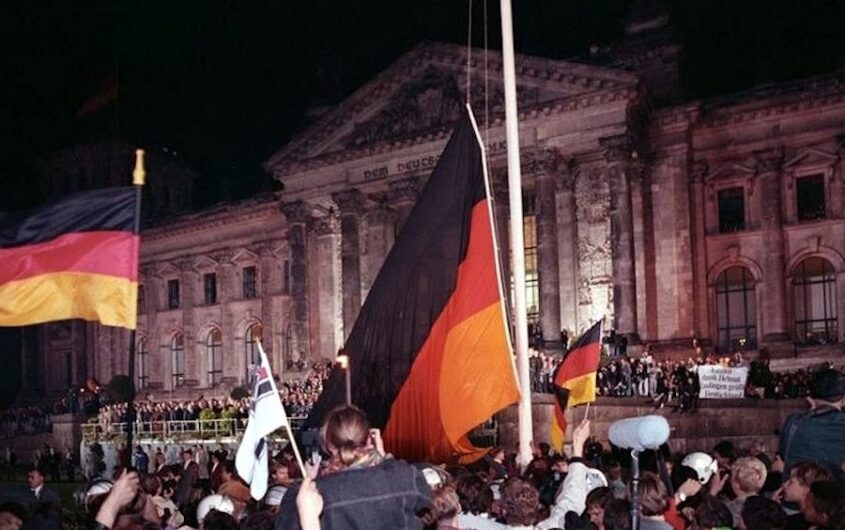
Although Heuss originally pushed for a completely new anthem, he accepted Adenauer’s proposal. After the reunification of East and West Germany, Chancellor Helmut Kohl and President Richard von Weizsäcker decided that the third stanza, entitled “Unity and Justice and Freedom,” would serve as the official national anthem of the newly reunified Germany. Prime Minister Lothar de Maizière proposed to incorporate the first stanza of the East German anthem. Western leaders rejected this proposal; Helmut Kohl was outraged to hear of this ask. Almost forty years after the fall of the Berlin Wall, some public figures are asking: are the Germans in need of a change?
Proposals
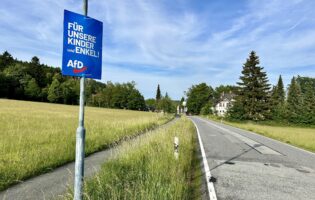
Recent events have been changing the perception of the Deutschlandlied. Last October in New York, members of the Alternative für Deutschland (AfD), in conjunction with members of the New York Young Republican Club, sang the nationalist first stanza of the unaltered Hoffmann-Haydn song. Another recurring example includes AfD state parliamentarian Björn Höcke’s usage of the lyrics “Deutschland über alles” (“Germany above everything”), which has led to legal trouble.
The AfD’s usage of the Deutschlandlied’s first stanza has certainly provoked negative memories linked to the Third Reich, but does this mean it is time for the song to go? Bundestag Vice President Bodo Ramelow, a member of die Linke (the Left) and Minister-President of Thuringia from 2014 to 2024, certainly thinks so. He has argued in favor of scrapping the Hoffmann-Haydn song, as well as the current German flag. In August 2025, he proposed that Bertolt Brecht’s Kinderhymne (Children’s Hymn) should replace the current anthem. He claims that eastern Germans have had trouble connecting to the Hoffmann-Haydn song, and he is not entirely wrong. However, this has failed to pick up speed time and time again.
Ramelow is not the only person who has called for an altered or new anthem. In 2018, Kristin Rose-Möhring, the Equality Commissioner at the time, proposed to alter certain phrases of the current anthem to be more gender-neutral. For example, “Fatherland” would be replaced with “Homeland,” while “Brotherly with heart and hand!” would be altered to “Courageously with heart and hand!” Ultimately, this initiative failed after being rejected by the government. Even then-Chancellor Angela Merkel, Germany’s first and only female chancellor, chose not to support these proposed changes.
Nearly forty years ago, Kohl and von Weizsäcker decided that the Federal Republic would not integrate the East and West German anthems. Speaking to Welt am Sonntag in 2010, de Maizière and Günther Krause, the East German negotiator of the Unification Treaty, reiterated their earlier support for this proposal. For Heribert Prantl, a writer at Süddeutsche Zeitung, it is time to reconsider combining the two anthems. Writing in 2023, he found that, in preparation for the seventy-fifth anniversaries of the Federal Republic and the Grundgesetz (Basic Law, Germany’s constitution) and the thirty-fifth anniversary of reunification, Berlin should reward itself with a gift. According to Prantl, this proposal has nothing to do with Ostalgie (East German nostalgia). Rather, he believed that adding the first stanza of “Auferstanden aus Ruinen” (“Risen from Ruins”) simply fits into the history of Germany:
From the ruins risen newly,
To the future turned, we stand.
Let us serve your good weal truly,
Germany, our fatherland.
Triumph over bygone sorrow,
Can unity be won?
For we shall attain a morrow,
When over our Germany,
There is the shining sun, there is the
shining sun!
The Anthem’s Future
Despite the plethora of proposals, the idea of an altered or new national anthem seems unlikely for the foreseeable future. Polling shows that 79 percent of Germans reject the possibility of a new Deutschlandlied. However, the difference between east and west is stark. 25 percent of those in eastern Germany support a change, while only 8 percent in western Germany back this proposal. Although most AfD supporters favor the anthem as it stands, an overwhelming 93 percent, many citizens in East Germany, where the AfD has been successful, have felt “cheated by history,” “denied the right to national pride and expression,” and “misunderstood and unheard.” Furthermore, other radical parties, such as the Left or the Sahra Wagenknecht Alliance, have voiced greater support for a change or overhaul of the national anthem, with 38 percent and 34 percent, respectively.[1] Perhaps, it is time for the Christian Democrats and the Social Democrats to think about this deeply cultural topic, as well.
Since reunification in 1990, eastern Germans have experienced a deep dissatisfaction, whether it be in the political process, economic gain, or with “West German arrogance.” Many eastern Germans feel that they are second-class citizens. To take some inspiration from Orwell, some Germans are more equal than others, in their minds. Much of this frustration, distrust, and dissatisfaction has manifested itself in disproportionately high support for the AfD, classified as a suspected far-right extremist group by Germany’s domestic intelligence agency. The party portrays itself as “the party of East German citizens,” and one look at polling numbers would certainly seem to confirm this.
Considering these factors, perhaps proposals for a new anthem are not out of the question. While a change, alteration, or overhaul of the Deutschlandlied would certainly not address the many complex and structural reasons in eastern Germany, it could be a start. de Maizière and Prantl’s proposal, although made as an apolitical gesture, could serve most effectively in alleviating issues between the east and the west. This could be a strong, powerful proposal that finally acknowledges the regional and personal histories of the German Democratic Republic.
The process of integration between the two former states continues to this day. A new anthem will not solve every issue, but it may allow Germans to overcome some lingering divides. As Johannes R. Becher and Hanns Eisler, the creators of the East German anthem, might argue, only then can the west lend a hand and unite in fraternity with the east.
[1] For a more detailed breakdown of polling results, see Tagesspiegel’s Survey following Ramelow’s proposal.