

David McKelvey via Flickr
The Effects of Majoritarian vs. Non-Majoritarian Political Systems on the Queer Community

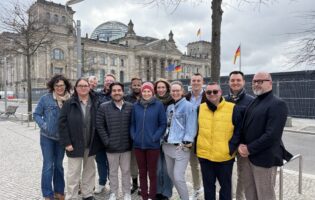
Joshua Acevedo
El Paso City Council
Josh Acevedo was born, raised, and resides in El Paso, Texas. He is a four-time graduate of The University of Texas at El Paso. He holds a Doctor of Education in Educational Leadership and Administration. He has served on the El Paso City Council since January 2024. He is currently leading efforts to pursue the UNICEF Child Friendly City designation for El Paso. Before being elected to the El Paso City Council, Josh served on the El Paso Independent School District Board of Trustees from 2019 to 2024.
In a prior role, Josh worked for Local Progress, a national nonprofit, where he helped school board members across the country with training and policy support. He has also managed two separate higher education programs – an internship program for university students and a backbone organization for mental health and emotional well-being in the Paso del Norte region.

Julian Urban
Hessian Ministry of Science and Art
Julian Urban is a senior cultural policy advisor and department head at the Hessian Ministry of Science and Art. With over a decade of leadership experience in government, parties and NGOs, he has shaped major initiatives in higher education, sustainability, and cultural development—including the state’s “Masterplan Kultur.” He has served in key roles spanning legislative affairs, political strategy, and international partnerships, notably with the Vietnamese-German University. Julian studied „Leadership for Sustainability“ at Malmö University and holds a Magister Artium in Political Science, History, and Law from Bonn University. He is also a certified trainer, passionate mentor, and engaged volunteer guardian for unaccompanied minors. Outside of work, Julian enjoys travel, literature, theater, and good food.
The United States and Germany have constructed their democratic political systems in distinct ways. These frameworks can pose particular challenges to achieving progress in the fight for LGBTQ+ rights. In the United States, a binary system of parties gives voters a choice between candidates who have taken increasingly polarizing positions over the last decade during federal, state, and local election cycles. In Germany, there are several political parties, and the party takes more importance than the actual candidate that is seeking office. In recent years, both countries have seen a rise in populism through far-right movements. During this time, strides have been made toward LGBTQ+ rights, while some elected leaders have used these political systems to claw back certain progress. The United States and Germany are seeing this erosion of LGBTQ+ rights in various ways, via majoritarian and non-majoritarian political systems, respectively, with the same intention of creating unequal rights for the citizens of both countries.
LGBTQ+ Rights in the United States: From Progress to Erasure
In the last decade, the White House has swung like a pendulum between parties. Voters, seemingly driven by their economic conditions or even the personality of leaders on the ballot, are voting for candidates at opposite ends of the political spectrum, with serious implications for the LGBTQ+ community. Judicial advocacy has catalyzed LGBTQ rights, and progress and backlash have come through executive action at the federal level as well as long-term trends at the state level.
Massachusetts was the first state to legalize same-sex marriage in 2004, laying a foundation for more states to follow over the next decade and ultimately for the U.S. Supreme Court to make it the law of the land in 2015 in the Obergefell v. Hodges decision. President Obama was supportive of LGBTQ+ rights, including ending the Don’t Ask, Don’t Tell policy and banning discrimination by federal contractors. Then-Vice President Biden’s support for marriage equality in 2012 was a catalyst that helped coalesce the majority of the Democratic Party around LGBTQ+ rights. During his administration, President Biden issued protections that prevented discrimination on the basis of gender identity or sexual orientation in the workplace. He also embraced diversity, equity, and inclusion (DEI) initiatives across federal government agencies. After legislators worried that the Supreme Court might revisit the legality of same-sex marriage, President Biden signed the Respect for Marriage Act into law in 2022, which provided some protections for same-sex and interracial marriages.
While the Biden administration was making strides on LGBTQ+ rights, states across the country began ramping up the introduction of anti-LGBTQ+ legislation—especially against transgender people. The plethora of bills targeted same-sex marriage and classroom discussions, prohibited access to gender-affirming care, established a binary definition of sex, prohibited transgender people from participating in sports, and made transgender people use public bathrooms based on the sex they were assigned at birth. To date, twenty-seven states have banned transgender people from participating in sports teams that align with their gender identity. Bathroom bills have also taken shape, and there are eight states that have banned transgender people from using restrooms consistent with their gender identity in government buildings and K-12 schools, with another nine states instituting bans in schools and at least some government buildings. These targeted places, especially schools, are where critical development happens for people in the LGBTQ+ community.
The states laid the groundwork for the second Trump administration to attack and deny basic rights to LGBTQ+ people under the guise of protecting women and children. Based on Project 2025 and through numerous executive actions, the administration has used this justification, paired with religion, to undo progress on diversity, define gender, and call for the Supreme Court to reverse marriage equality. The most vulnerable population by far is the transgender community, using a politics of eradication to wipe them from existence. The progress for the LGBTQ+ community made during the Obama and Biden administrations has been reversed, as voters swung to the opposite side of the political spectrum.
The swift implementation of an anti-LGBTQ+ agenda at the various levels of government has exposed how fragile minority protections can be in a two-party system. Court challenges to anti-LGBTQ+ actions are one way to preserve rights, but the process is slow. Activists need to craft messages that resonate with the average voter in order to ensure pro-LGBTQ+ leaders are elected.
Political Representation of the queer community in Germany
In Germany, voters do not elect a personality to office, but first and foremost a party. The German system of proportional representation, or more precisely, mixed-member proportional representation, combines two votes. With the first vote (Erststimme), voters choose the constituency candidate in their district; with the second vote (Zweitstimme), they choose a party. The distribution of seats in the Bundestag (the federal parliament) is determined almost exclusively by this second-vote result, which is the basis for allocating seats in proportion to votes received. A party that receives, say, twelve percent of the second votes obtains roughly twelve percent of the seats. These seats are filled first by the winning constituency candidates, those who received the most first votes in their respective districts. The remaining seats are then filled by the parties from their state-level lists, drawn up in advance by the parties themselves. Whoever stands high enough at the top of such a list enters the Bundestag; those placed further down hope for a strong election result.
This mechanism sounds unspectacular, but it has far-reaching consequences for the balance of power between the individual and the organization. Who appears on the list is decided not by the voter, but by the party’s rank and file. Although the precise mechanism varies by party—the Christian Democratic Union (CDU), for example, traditionally has its leadership propose candidates who delegates then ratify, while progressive parties more often hold internal regional primaries followed by contested votes at party conventions—the common feature is that party delegates, not voters, are the central actors. So, the German system shifts the central political contest inward: it is not the charismatic individual candidate who carries their campaign to a majority, but the party that negotiates with itself over what its programmatic line should be. Anyone who deviates from that line risks losing their list position and with it, their political existence. Thus, in Germany, a pronounced party discipline (Fraktionszwang) is the norm. Because of the many parties vying for seats in the government, coalitions are required to form majorities. Compromise and consensus are required from the governing parties and their members.
For queer politics, this yields a double truth. The sobering side first: as long as no party with an emancipatory program is part of the government, little can be achieved. The individual queer MP within a conservative caucus may be as committed as they like, but without backing in the party’s program, they remain a symbolic figure. The fate of Paragraph 175, the paragraph that criminalized sex between men, makes this brutally clear. In the run-up to the 1980 federal election, Social Democratic (SPD) Chancellor Helmut Schmidt is said to have rebuffed his liberal Free Democrat (FDP) coalition partner’s push to abolish the paragraph, threatening to break the coalition and allegedly declaring that he had no intention of going down in history as “the gays’ chancellor.” The result: the paragraph remained in force until 1994 after having been modified in 1969 and 1973.
This is precisely where the productive flip side of the system reveals itself. Once a programmatic commitment has been made, it is implemented with considerable binding force. The Self-Determination Law of 2024 was anchored in the coalition agreement of the governing “traffic-light” coalition (SPD, Greens, FDP) and was pushed through against considerable resistance, including from within parts of the government itself, because none of the three governing parties could publicly distance themselves from it without forfeiting their own credibility. The introduction of marriage equality (Ehe für alle) in 2017 is the instructive exception: only when Angela Merkel recognized that the CDU’s opposing stance left her in the minority both among the electorate and among potential coalition partners ahead of the looming campaign did she suspend party discipline and let the vote proceed—an emergency exit that confirms the rule precisely by having to circumvent it. With that move, Merkel, who voted against marriage equality, could be at once the chancellor who made marriage equality possible and one of its public opponents, thereby satisfying both a public that increasingly supported same-sex marriage and a party whose majority did not.
From this follows a strategic consequence for the queer community: the decisions are not primarily achieved by general public advocacy but in internal party representation. Those who draft motions at party conferences, serve on platform committees, and have a hand in deciding, or competing for, list placements shape the political agenda of the next legislative term. Queer organizations within the parties are therefore more than symbolic forums. They are the actual battlefields on which the lived realities of queer people are decided, long before any bill reaches the floor. Post-World War II German politics has been chronically wary of charismatic leaders, and this actually benefits queer rights and representation: there is no need for individual activists to build a personal following before they can speak on an issue. On the contrary, most German politicians build their standing by championing issues within their parties first. To put it another way: intra-party pluralization is the German counterpart to American lobbying with the peculiarity that the binding force of victories won there is incomparably greater.
Majority Building vs. Consensus Building
The contrast we have traced maps onto the distinction political scientist Arend Lijphart drew between majoritarian and consensus democracies.[i] Majoritarian systems—the Westminster model, with the United States as a partial example—concentrate power in winning parties or electoral coalitions and reward action and charismatic leadership. Consensus systems, of which Germany is a textbook case, disperse power through proportional representation and multiple veto points. Policy emerges through negotiation rather than electoral conquest. Lijphart’s comparative evidence indicates that consensus democracies tend to produce more durable commitments and better outcomes for minorities, although they move more slowly and offer fewer cathartic moments of public triumph.
The two systems thus offer instructive contrasts rather than clean verdicts. The American majoritarian model rewards charismatic candidates, public mobilization, and judicial advocacy, but it exposes hard-won rights to swift reversal whenever electoral or judicial tides turn. The German proportional model is slower to grant recognition and demands intense behind-the-scenes work inside party structures, but once changes are enshrined in platforms and coalition agreements, they prove markedly more durable. Even the Selbstbestimmungsgesetz, which faced fierce opposition from the CDU, is unlikely to be fully reversed: there may be adjustments, but with a Federal Constitutional Court ruling requiring legislative action in this area, and the SPD as junior coalition partner unwilling to permit a total rollback, the progress already achieved cannot easily be undone.
Neither structure immunizes queer citizens against populist backlash: the far-right Alternative for Germany (AfD) pushes its corrosive program through party platforms in much the same way that MAGA pushes it through executive orders. What the comparison shows is less about which system is “better” than which strategic terrain each one creates. In the United States, the fight is waged publicly, swiftly, and repeatedly. In Germany, it is waged internally, slowly, and, if won, conclusively.
[i] Arend Lijphart, Patterns of Democracy: Government Forms and Performance in Thirty-Six Countries, 2nd ed. (Yale University Press, 2012).
This article is part of the project “Building LGBTQ+ Communities in Germany and the United States: Past, Present, and Future” and is generously funded by the Transatlantik-Programm der Bundesrepublik Deutschland aus Mitteln des European Recovery Program (ERP) des Bundesministeriums für Wirtschaft und Energie (BMWE) (Transatlantic Program of the Federal Republic of Germany with Funds through the European Recovery Program (ERP) of the Federal Ministry for Economic Affairs and Energy (BMWE)).