
Simon Dawson / No 10 Downing Street via Flickr
The Macroeconomy Strikes Back at France’s G7 Summit

Peter S. Rashish
Vice President; Director, Geoeconomics Program
Peter S. Rashish, who counts over 30 years of experience counseling corporations, think tanks, foundations, and international organizations on transatlantic trade and economic strategy, is Vice President and Director of the Geoeconomics Program at AICGS. He also writes The Wider Atlantic blog.
Mr. Rashish has served as Vice President for Europe and Eurasia at the U.S. Chamber of Commerce, where he spearheaded the Chamber’s advocacy ahead of the launch of the Transatlantic Trade and Investment Partnership. Previously, Mr. Rashish was a Senior Advisor for Europe at McLarty Associates, Executive Vice President of the European Institute, and a staff member and consultant at the International Energy Agency, the World Bank, UN Trade and Development, the Atlantic Council, the Bertelsmann Foundation, and the German Marshall Fund.
Mr. Rashish has testified before the House Financial Services Subcommittee on International Monetary Policy and Trade and the House Foreign Affairs Subcommittee on Europe and Eurasia and has advised three U.S. presidential campaigns. He has been a featured speaker at the Munich Security Conference, the Aspen Ideas Festival, and the European Forum Alpbach and is a member of the Board of Directors of the Jean Monnet Institute in Paris and a Senior Advisor to the European Policy Centre in Brussels. His commentaries have been published in The New York Times, the Financial Times, The Wall Street Journal, Foreign Policy, and The National Interest, and he has appeared on PBS, CNBC, CNN, NPR, and the BBC.
He earned a BA from Harvard College and an MPhil in international relations from Oxford University. He speaks French, German, Italian, and Spanish.
The mantra of “manufacturing overcapacity”—in other words, China’s unfair competitive advantage in world markets owing to heavy state and provincial subsidies—has dominated the geoeconomic narrative on either side of the Atlantic. The Trump administration has mostly looked at this problem through a trade policy lens, deploying several iterations of tariffs since early in 2025 not only against China but also other countries with which the United States runs a deficit in industrial goods. In the EU, the focus has mainly been on industrial policy, especially the Industrial Accelerator Act announced in March 2026 that seeks to boost Europe as a platform for advanced manufacturing.
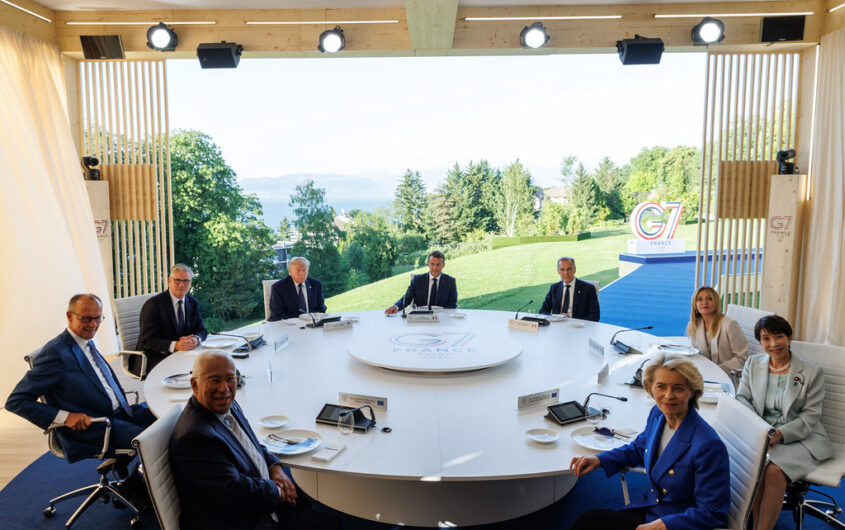
While the challenge of Chinese overcapacity and subsidized exports remains, at the June 15-17 G7 summit in Évian-les-Bains on the shores of Lake Geneva, the issue was reframed. In the “Leaders’ statement for a more balanced, durable, and resilient growth,” the term manufacturing overcapacity does not appear once. Instead, the governments of Canada, France, Germany, Italy, Japan, the United States, and the UK (along with partner countries Egypt, Kenya, and Korea) zero in on “global imbalances” or “imbalances” more than a dozen times.
In part this shift from “overcapacity” to “imbalances” is semantics. Both terms refer to excess exports in some parts of the world and excess imports in others. But the connotations are different. The first idea draws attention to the external impact of China’s economic policies; the second takes a more inclusive, systemic approach. As the statement points out, “reducing global imbalances could facilitate achieving more durable and balanced growth” for all countries—including China. That is why the leaders “confirm the need to address these large and persistent imbalances, which is of common interest for both surplus and deficit economies.”
Another notable aspect of this shift in perspective is the G7’s analysis of what is at the root of these imbalances. For the leaders assembled in Évian, “global current account imbalances stem in large part from underlying savings–investment dynamics.” In other words, from a macroeconomic rather than a trade policy phenomenon. The G7 also attributes these imbalances to “national growth models, such as non-market policies and practices, as well as sectoral and fiscal policies.” Because these imbalances are not just a bilateral U.S.-China matter or even one that a common transatlantic effort can solve but rather global in nature, the G7 asserts that “coordinated action would be welcome.”
The shift at the G7 summit from “overcapacity” to “imbalances” is not only semantic. The first idea draws attention to the external impact of China’s economic policies; the second takes a more inclusive, systemic approach.
Beyond bringing the global economy into better balance among surplus and deficit countries, the G7 also featured discussion of the economic security and technology agendas.
On the first, the leaders agreed to reduce imports of rare earths and permanent magnets from non-G7 countries to below 60 percent by 2030. Building on earlier U.S-EU cooperation in Washington this year, the statement on critical minerals reinforced the strategic role that trade policy can play, saying that “ensuring the long-term viability of diversified supply capacities requires an appropriate market environment and closer cooperation with trusted partners, including through plurilateral trade agreements.”
On technology, artificial intelligence dominated the last day of the gathering, with senior executives from Anthropic, OpenAI, Google, and Mistral joining the talks. While European governments remain alert to their technological sovereignty faced with dominant U.S. platform companies, the issue of AI drew out some shared concerns and objectives. One of these was the idea of standing up a trusted partners arrangement to facilitate tech sharing between the United States and like-minded countries. Whether this idea will evolve into a plurilateral trade agreement like the one mooted for critical minerals is uncertain. But the issue of governance made a modest yet noticeable comeback in Évian.