
Zach Pippin via Henry McMaster on Flickr
Tariffs, Germany, and South Carolina

Stephen F. Szabo
Senior Fellow
Dr. Stephen F. Szabo is a Senior Fellow at AICGS, where he focuses on German foreign and security policies and the new German role in Europe and beyond. Until 2017, he was the Executive Director of the Transatlantic Academy, a Washington, DC, based forum for research and dialogue between scholars, policy experts, and authors from both sides of the Atlantic. Prior to joining the German Marshall Fund in 2007, Dr. Szabo was Interim Dean and Associate Dean for Academic Affairs and taught European Studies at The Paul H. Nitze School of Advanced International Studies, Johns Hopkins University. He served as Professor of National Security Affairs at the National War College, National Defense University (1982-1990). He received his PhD in Political Science from Georgetown University and has been a fellow with the Alexander von Humboldt Stiftung, the Woodrow Wilson International Center for Scholars, and the American Academy in Berlin, as well as serving as Research Director at AICGS. In addition to SAIS, he has taught at the Hertie School of Governance, Georgetown University, George Washington University, and the University of Virginia. He has published widely on European and German politics and foreign policies, including. The Successor Generation: International Perspectives of Postwar Europeans, The Diplomacy of German Unification, Parting Ways: The Crisis in the German-American Relationship, and Germany, Russia and the Rise of Geo-Economics.
Bavaria West
German business loves South Carolina, and South Carolina loves German business. Currently, there are over 270 German companies employing over 44,000 people based in South Carolina. They have been attracted by the low cost of doing business, a fast-growing labor force; a right-to-work state, which limits the impact of unions and work stoppages; excellent transportation infrastructure, including access to Charleston’s deep-water port; and a favorable tax and incentive environment.
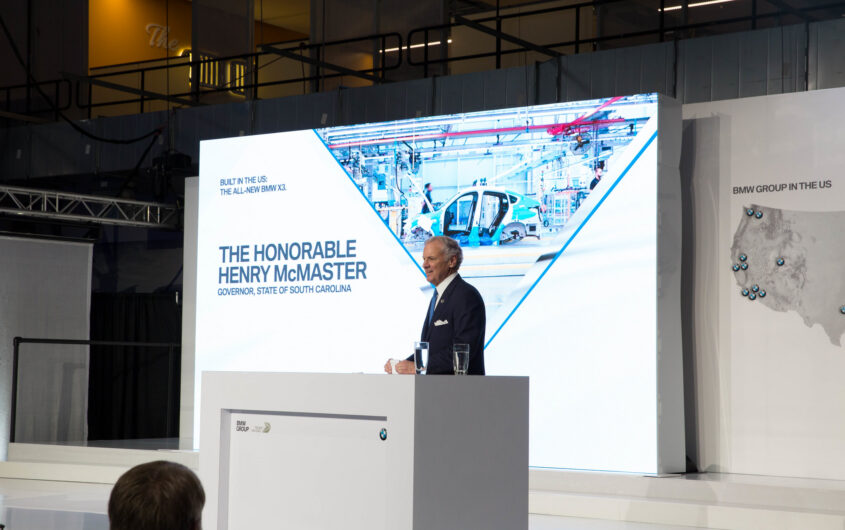
South Carolina has been a leader in reaching out to European business, opening an office in Brussels in 1975 , then Frankfurt in the 1980s, and Munich in 1999, where it is based today. Trade between South Carolina and Germany totaled $13 billion in 2025. Overall, South Carolina exports increased to $38.5 billion, a seven-year high. It leads the nation in the export of passenger vehicles, thanks to the presence of German companies in the state with 18 percent of the national market share. Germany remained the state’s leading export partner. Even with the tariff chaos, German companies increased sales by 3.5 percent over the previous year with $5.1 billion in sales revenue. In November, Governor Henry McMaster signed a Declaration of Intent with Germany (JDI) to promote innovation and job creation, especially in energy resiliency and sustainability, automotive and mobility technologies, and life sciences. A working group will “meet to coordinate joint initiatives like workforce development, identify opportunities for further business partnerships, exchange technical and scientific information, and facilitate research and development collaboration.”
The South Carolina-Germany relationship is a microcosm of the broader changes occurring in the relationship between the two countries. South Carolina has banked on globalization and foreign investment while at the same time being a deep red state. It now confronts a possible conflict between its political preferences and its economic interests. The Trump tariffs and the broader rupture in relations with Europe are threatening not only German companies but also South Carolina’s major stake in this relationship. How is this playing out in both South Carolina politics and the views of German businesses located there?
Spartanburg and BMW
A key case study is the role of BMW’s presence in Spartanburg in the upstate. The region had been known as the textile capital of the world in the 1970s, but its economy collapsed by the 1990s due to automation and cheaper overseas labor. The arrival of BMW revived the region. The car manufacturer came to the upstate because of the skilled labor force left from textiles and related companies and has invested over $13 billion since opening its plants in 1994, employing 12,000 people and producing 1,500 vehicles per day, including all of its X models. A recent report on the state of manufacturing in the state prepared by Joseph von Nessen, research economist at the University of South Carolina, found that auto manufacturing has a high multiplier effect creating thirty-six jobs elsewhere in the state for every ten in the sector. Its business model is based on the concept of being close to customers, developing a supply chain, and getting more U.S. projects while avoiding U.S. import tariffs with local production and exporting globally. With half its production going abroad, BMW last year exported 90,000 vehicles to Europe, all of which are subject to the 15 percent EU tariffs on imported vehicles. The Trump tariffs also hit BMW due to its global supply chain and the 25 percent rate on foreign-made auto parts, which increased the cost of a vehicle by an estimated $3,000 to $7,000. In addition, the firm has had to deal with a 50 percent tariff on imported steel and aluminum. However, BMW is well placed to ride out and even benefit from the tariffs. The trade deal cut with the EU before the recent court reversal includes an EU tariff exemption for 185,000 cars built in the United States by European companies. “Our footprint in the United States is helping us limit the impact of tariffs,” BMW’s finance chief Walter Mertl said in July 2025. While profits slid in the second quarter, Mertl said the company’s global footprint would allow it to “adapt swiftly to changing market conditions.”
One German auto analyst has argued,
German automakers can now build cars cheaper in Alabama than in Stuttgart. A German expert predicts 78,000 automotive jobs will migrate to America. That’s 10 percent of Germany’s entire auto workforce…. The real winners are BMW and Mercedes. Both OEMs already build cars in U.S. plants, which they export to Europe. Annually around 185,000 of their vehicles go back to Europe. With EU tariffs on U.S. imports disappearing, these models get cheaper and more attractive. Mercedes already builds some GLC models in Alabama. Now they want to move even more production there. Also for the European market. I’m sure BMW is considering a similar strategy.
The New Normal
From the perspective of German companies, as Professor Morgan Koerner of the College of Charleston and the founder of the College’s annual German-American Business Summit observed, “German companies are all-in and are thus going to wait and see.”[1] The German business community remains upbeat about its future in the state, as demonstrated by the recently signed JDI. Given all the changes that have buffeted the trade environment over the past year, it is unclear whether South Carolina will come out a winner. Overall, German car exports to the United States declined by 15 percent in the first three quarters of 2025. Automakers have also repeatedly warned of the potential impact of tariffs and surrounding uncertainty, and the German car industry cut 51,500 jobs in one year due to tariffs and Chinese EV competition. The problems of the German auto industry go beyond tariffs to infrastructure, environment, and, especially, the move to electric vehicles, which is a new engineering model for companies used to producing combustion engines. All this requires different investment strategies. Yet the job cuts were primarily in Germany, not in foreign production facilities.
A report commissioned by the German Foreign Office characterizes the Trump tariffs as the “new normal” for German exports to the United States. Unlike Audi and Porsche, which do not have U.S. manufacturing plants, BMW is advantageously positioned to deal with this new normal. “Free trade and open markets enable growth and prosperity,” said Milan Nedeljković, a Member of the Board of Management of BMW AG responsible for production. “Our plants—and above all the strong supplier networks in each respective region—benefit from this.” However, as Ludger Reckmann, an engineer with decades of experience working with companies in South Carolina, put it, “All major German companies are putting their projects in the United States on hold…The worst thing is not the tariffs but the unpredictability.”[2] Joseph von Nessen has warned that “unpredictability breeds paralysis and that can sometimes put a hold on major new investments,” but he believes that the state is more resilient than most, as it has the fastest population growth rate in the country and is well situated geographically to reach markets in the eastern half of the country.[3]
Politics and Business
South Carolina is a deep red state with a governor, both Senators, a large Congressional delegation, and control of the state legislature from the Republican Party. The Republican senators from South Carolina, Lindsey Graham and Tim Scott, as well as Ralph Norman, a current candidate for Governor and the congressman whose district includes Spartanburg, have supported the tariffs and criticized the recent Supreme Court decision reversing them. During the 2024 presidential campaign, candidate Trump stated that foreign automakers are “getting away with murder by making parts in Germany and assembling them in plants in South Carolina. They say, ‘Oh yes, we’re building cars.’ They don’t build cars. They take ’em out of a box, and they assemble ’em. We could have our child do it.” White House trade advisor Peter Navarro attacked this presence in April 2025, telling CNBC that, “this business model where BMW and Mercedes come into Spartanburg, SC, and have us assemble German engines and Austrian transmissions—that doesn’t work for America. It’s bad for America. It’s bad for our economics. It’s bad for our national security.” (Mercedes is in Charleston, not Spartanburg.)
The Palmetto State has been very successful in providing a stable and predictable business environment, a crucial factor in foreign companies’ investment decisions.
Navarro’s critique was rebuffed by Senators Scott and Graham and Governor McMaster, as well as the Greenville Chamber of Commerce. Governor McMaster stated that the arrival of BMW brought well-paying jobs and “sent the word around the world that this is a great manufacturing state.” Graham was also effusive: “BMW has proved to be one of the best corporate citizens in our state. Their presence is a major benefit to the South Carolina economy and it is much appreciated” Workers in Spartanburg and the broader community were not amused by Navarro and Trump’s comments. Yet like his Republican colleagues, McMaster supports Trump’s tariffs and his goal of American self-sufficiency. Graham issued the following statement:
As to the power of tariffs on the national security front, it is undeniable what President Trump has been able to do by using and threatening tariffs. One of the chief reasons that our border is so secure is President Trump threatened to put tariffs on countries that were allowing illegal immigrants to pour in through our southern border and held them accountable for the problem. When it comes to finding fentanyl and other dangerous products coming into the country, President Trump has used tariffs extremely effectively.
While there has been pushback at the local level and in a searing opinion piece in The State asking “Will our leaders stand up?”, both political and business leaders have been generally silent while adding a new set of lobbyists in Washington. President Trump has been relatively restrained in his relationship with Germany and Chancellor Merz, perhaps in part due to signals he gets from state and Congressional leaders. It is one thing to poke blue states, but there is no appetite in the White House to alienate red ones. The pushback from the ICE raids at a Hyundai plant in Georgia was a clear lesson on what not to do. At the same time, some pressure from Washington on Brussels could assist foreign investors in the state. BMW’s CEO Oliver Zipse at the beginning of Trump’s second term called for the EU to heed Trump’s call to lower its tariffs on car exports from the United States to 2.5 percent, in line with the current U.S. import tariff on car imports from Europe. The EU was going to lower the rate to 0 percent on autos, while the comparable U.S. rate on EU auto imports would fall to 15 percent. The EU put a hold on the agreement in the wake of the Supreme Court’s ruling in February voiding the Trump tariffs imposed under the International Emergency Economic Powers Act and the administration’s response to impose a new 10 percent tariff on nearly all countries under Section 122, which are scheduled to expire after 150 days. But on March 26, the EU hold on the agreement was lifted by the European parliament meaning that German cars produced in the U.S. and sold in the EU will have the agreed-to tariff exemption.
The Future of Standort South Carolina
Overall, the German relationship with South Carolina is an important stabilizing factor that may get it through the turbulent Trump years and the longer-term changes in the international environment. While the balance sheet has been in the Palmetto state’s favor, it faces several key challenges if it wants to remain a place for Germans and other nations to invest.
From the state’s perspective, the need to educate a rapidly growing workforce, both through its network of technical colleges as well as some adaptation of an apprentice program used by German companies, is key for the future and an area where German expertise is needed. As Professor Koerner notes, “South Carolina has lagged behind in providing skilled labor as it does not have the equivalent of the German apprentice system.”[4] As Ludger Reckmann, also a professor of practice at the College of Charleston and a former executive with a number of German auto companies in the state points out, “When I ran programs for German companies in the state we always were lacking qualified people so we set up programs with the local community but we had problems getting qualified workers and it is getting worse as more companies are coming into South Carolina. They are all competing for the workforce.”[5] Sam Moses, a former managing director of the state’s office in Munich and a former Bosch Fellow in Frankfurt, points out that “some German companies have developed apprenticeship programs, in some cases with Apprenticeship SC and local technical college partners. The state should continue to double down on aligning its educational system with the needs of the future industries that will make up its growing economy, including with our German industry partners.”[6] Reckmann notes the classes he teaches at the College of Charleston are moving from autos to bioengineering and the medical field, suggesting the state has to think about more than automotive engineering. Von Nessen concurs and sees new growth potential in health care, advanced manufacturing, life sciences, and logistics.
The international perspective of state leadership going back decades is a real advantage and bodes well for the future. However, it must resist the temptation of exclusionist and nativist politics. As Sam Moses points out, the state must be sensitive to the backlash to growth, the rise of NIMBYism, and the sense that tax incentives are corporate welfare without minimizing the state’s industrial recruitment strategy that he says has benefited South Carolina and will continue to be critical to the state’s future. Growing demands on infrastructure, especially for energy generation and transmission for new industries, will have to be solved for the benefit of all stakeholders, from ratepayers to high demand commercial and industrial users. Dr. von Nessen points to the inherent tradeoffs between data centers, which generate tax revenue but don’t create many jobs, in contrast to 43,000 jobs that BMW has created in the state over its thirty years of operation. He argues that tariffs are a mixed bag and carry tradeoffs. While they can increase prices and the cost of living to the consumer, they also create incentives for foreign investment and can aid some local industries, as the tariffs on steel and aluminum have done in the state.
Complacency is a risk for workers like those in Spartanburg who have secure, well-paying jobs thanks to foreign investment. The Palmetto State has been very successful in providing a stable and predictable business environment, a crucial factor in foreign companies’ investment decisions. Its leaders will need to buffer the state from the unpredictable policies coming out of Washington as well as the costs of success at home. They will need to continue to make the case for the benefits of international engagement. A former State Representative and resident of Spartanburg summed up his feeling to the Washington Post, “saying he trusted Trump’s negotiating prowess, ‘What detractors call market chaos will produce better deals for America. Still, policy for a brighter future shouldn’t ignore lessons from the past. We would not be seeing what we see now without BMW.’ He also loves his bluish gray 530.”
[1] Morgan Koerner, interview with the author, March 11, 2026.
[2] Ludger Reckmann, interview with the author, March 16, 2026.
[3] Joseph von Nessen, interview with the author, March 19, 2026.
[4] Koerner, March 11, 2026.
[5] Reckmann, March 16, 2026.
[6] Sam Moses, interview with the author, March 16, 2026.