
Raimond Spekking via Wikimedia Commons
AGI Profiles: Bärbel Bas

Livia Baker-McKee
Halle Foundation/AGI Intern
Livia Marie Baker-McKee is a fall 2025 Halle Foundation Intern at the American-German Institute. Livia attends the Elliot School of International Affairs at George Washington University, where she majors in international affairs with a concentration in comparative politics, economics, and social systems and a minor in music.
Livia has worked in creative and political spaces. In Spain and Germany, Livia worked for an artist management company and a music studio, before coming to DC and working for the Cultural Office of the Embassy of Spain. In summer 2025, she was a policy intern for the Konrad-Adenauer-Stiftung.
Livia’s interests in American-German relations stems from her father’s many deployments that brought her family to Germany. She has witnessed the importance of this relationship, and she looks forward to contributing to transatlantic understanding through her research and work.
Federal Minister of Labor and Social Affairs
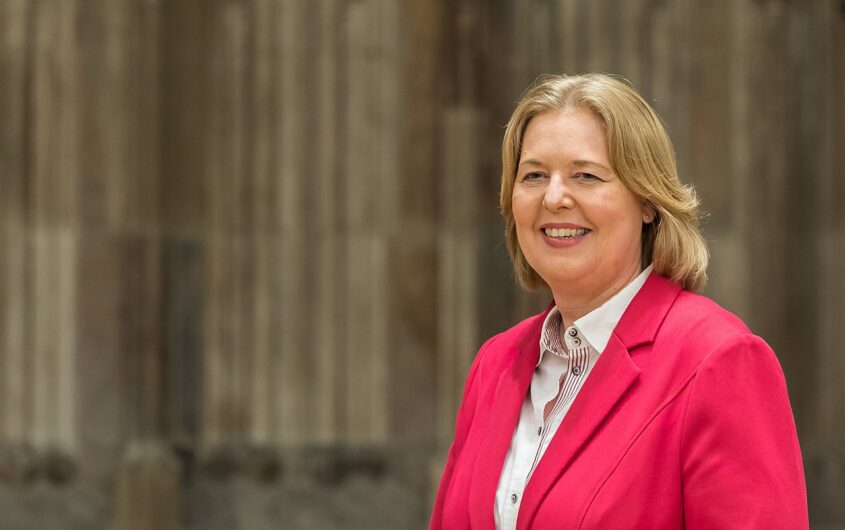
Over the last few years, Bärbel Bas has emerged as one of the more prominent figures in German politics. At the 2025 party conference, she was elected as a co-leader of the Social Democratic Party (SPD), alongside Lars Klingbeil, who has held the position since 2021. She has also led the Federal Ministry of Labor and Social Affairs since the CDU/CSU-SPD government came to power in May 2025.
In 1988, Bas joined the SPD at the age of twenty. It was the party’s foundational ethos of representing everyday working people—aligning with her upbringing—that motivated her to join. Coming from a working-class background in Duisburg, a city in western Germany that was long known for its blue-collar workers, steel industry, and large inland port, her unconventional political journey has led her to the highest levels of the German government. She is widely praised for her fairness and savvy across political party lines.
Career
Bas attended a technical secondary school and completed vocational training. She has said that because her older brother dropped out of university-track high school, there was a social expectation that she as a woman should not be studying if her brother was not. Her vocational training led to a job as an office assistant for a Duisburger Verkehrsgesellschaft (Duisburg Transportation Company, DVG) in her hometown. From 1985 to 1990, she advanced in the company and developed an interest in human resources, becoming a specialist in various labor rights areas, such as social security, health insurance, business administration and instruction, and human resource economics.
In 2004 she was appointed Deputy Chairwoman of the Jusos (the youth arm of the SPD), and in 2009, she was elected to the Bundestag. In 2021, she was elected the fourteenth president of the Bundestag, an office constitutionally ranked second in the German state after the president and before the chancellor. In Chancellor Friedrich Merz’s government, Bas is the Federal Minister of Labor and Social Affairs.
Compared to other politicians—such as her party co-leader Klingbeil—who began working in politics from the beginning of their careers and studied at university, Bas’s journey from vocational training to federal minister is atypical. In fact, only 15 percent of members of parliament have completed vocational training with no additional university degree. Her upbringing, however, has provided unique experiences that a university degree does not. Growing up in a working-class family led to her to empathize with and eventually advocate for the “Beschäftigten” (workers). As labor minister, she has invested in in at-risk sectors like steel and manufacturing and ensured that living wages are achieved. She believes that “upward social mobility should not be the exception,” approaching the challenges of the working-class differently from other politicians, especially her co-leader, Klingbeil.
SPD Leadership
As co-leaders, Bas represents the left-leaning social profile of the party, known as the Parlamentarische Linke, and Klingbeil represents the more centrist wing, the Seeheimer Kreise. As vice chancellor and minister of finance, he has emphasized trade with China and supported the changes to military conscription policy, whereas Bas advocates for workers and tries to ensure that the party does not lose sight of its working-class roots.
There has been frustration over Klingbeil’s leadership within the SPD, especially after the party got a record low 16 percent of the vote in February 2025. After being named vice chancellor, he appointed loyalists to key ministries, which was seen by many members of his party as a power grab. As a consequence, Klingbeil was only endorsed by 65 percent of the party at the June 2025 congress, whereas Bas got a strong endorsement from her party, receiving 95 percent of the vote. Many in the SPD have put their hopes on her to reinvigorate the party and manage challenges facing the party and the government.
Since its founding in 2013, the AfD (Alternative für Deutschland) has grown in popularity with its anti-immigration and right-wing policies, finding ways to appeal to the SPD’s former working-class base. It is estimated that in the 2025 federal election, 720,000 voters supported AfD after voting SPD in the previous election. Indeed, 38 percent of working-class voters voted for the AfD; only 9 percent supported the SPD. A key task for the current SPD leadership is to win back these voters in both eastern and western Germany.
Bas must also work with the SPD’s coalition partner the center-right Christian Democrats and Chancellor Merz to achieve the government’s goals. The two parties clash on many issues, such as migration, welfare benefits, retirement age, minimum wage, Gaza, Russia, and even the appointment of a new Constitutional Court judge. When Chancellor Merz commented that the welfare state could no longer be financed with what is produced in the economy, Bas publicly called it ‘nonsense,’ a negative look for both parties. While Bas later said she supported the chancellor (while still defending her position), this tension reminds the public of the collapse of the previous SPD-led coalition in 2024. Continued infighting will only lead to distrust in the government and further loss of voter support.
Work ahead
If Bas is to succeed, she will have to strengthen cooperation across political boundaries, as well as rebuild trust with the public for the SPD. She must manage high expectations at a time of low confidence for the SPD and a challenging economic environment for workers especially in the deeply troubled legacy industries. If she continues to be outspoken and a voice of the people, she could end her term having successfully regained some support from the working class, while improving the economy as well as the lives of the German people.