

Roy Zuo via Wikimedia Commons
AGI Profiles: Ulrich Siegmund

Jacobsen Gamble
Halle Foundation/AGI Intern
Jake Gamble is a Spring 2026 Halle Foundation Intern at the American-German Institute and a first-year graduate student in the Master of Arts in European Studies (MAES) program at Georgetown University’s Walsh School of Foreign Service. Prior to Georgetown, he earned a Bachelor of Arts in International Relations and Security Studies from the University of Lynchburg, with minors in German, History, and Political Science. While there, he partook in a semester abroad at Freie Universität Berlin to enhance his understanding of German language, politics, history, and culture.
Jake’s research interests include Germany’s role in matters of foreign and security policy, especially pertaining to the Russo-Ukrainian War; the growing influence of the Alternative für Deutschland on German political culture; transatlantic relations, and democracy and authoritarianism more broadly. During his internship at the American-German Institute, he hopes to focus on the increasing intersection of security and culture in Germany.
Member of the Landtag of Saxony-Anhalt; AfD Parliamentary Group Leader
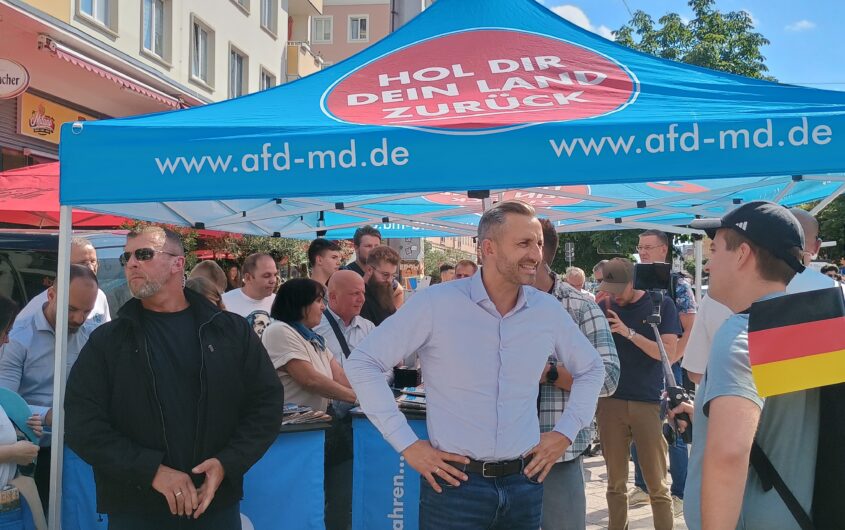
Ulrich Siegmund is becoming a star within the ranks of the Alternative für Deutschland (AfD). He is a salesman by training and has a bachelor’s degree in business administration and business psychology. Born on October 25, 1990, in Havelberg, he is a native of Saxony-Anhalt, a state in the former East Germany, and he understands his constituents. His background, combined with his social media savvy and charismatic personality, has turned him into a leading figure within the AfD. With over 600,000 followers on TikTok, he has been dubbed the “TikTok-Posterboy” of the AfD by Die Zeit, while Tagesspiegel referred to him as the “schönste AfD-Mann” (“most handsome AfD man”).
However, buried underneath his chic façade and marketing know-how may lie a true radical who plans on taking Germany by storm. This process seems to be underway in Saxony-Anhalt, where Siegmund was selected as the AfD’s Spitzenkandidat (lead candidate) for the office of Ministerpräsident (Minister-President) in the September 2026 state election.
“Ich liebe es zu verkaufen;” the Salesman
Prior to his political career, Siegmund worked in various positions, which included jobs in wholesale and foreign trade, account management, and entrepreneurial endeavors. In between hours on the job, he was earning his bachelor’s degree. In 2015, he even participated in management training in Beijing, China. Siegmund’s career in business seems to have culminated in his founding of the fragrance company Berlin-Duftet, literally “Berlin smells good,” which campaigned to have the company’s scents installed in Berlin’s S-Bahn and U-Bahn. He is a family man, as well, with a wife, who works at a school, and a young daughter.
He became active in politics in 2008. Initially a member of the Christian Democratic Union (CDU), he switched party loyalties in 2014 to the AfD due to their positions on the Eurozone debt crisis. In 2016 and 2021, he was elected to Saxony-Anhalt’s Landtag (state parliament). In 2022, parliamentary colleagues selected him to co-lead the AfD in the Landtag with Oliver Kirchner. Throughout his tenure in office, Siegmund has made a name for himself, notably for his extreme views. Although he retains a polished appearance and is characterized as “friendly and approachable” by Landtag members across the political spectrum, he has made his extreme views well known, specifically regarding the Holocaust and immigration. Germany has cultivated a memory culture that seeks to atone for the crimes of the National Socialists, and Siegmund, like other AfD members, presents an alternative and inaccurate historical outlook.
When I say “Sieg!” you say “Mund!”
At local AfD rallies, when he prepares to go on a stage, a moderator will chant “Sieg!”, for which spectators reply “Mund!” Any student of Germany will immediately draw comparisons to the “Sieg Heil” salute used by Adolf Hitler and his National Socialists. The usage of other Nazi slogans, such as Alles für Deutschland (everything for Germany), has led to legal trouble for fellow AfD member Björn Höcke. Siegmund has defended the utilization of his rally cry, as well as attacked Germany’s restrictions on using Nazi-era slogans, stating that there should be no “language police.” When asked if the crimes committed during the Holocaust were the worst of all time, he has stated, “I find this interpretation to be grossly exaggerated and completely detached from reality” and “I don’t presume to judge that, because I can’t process the whole of mankind.”
These statements are not the only examples of extremism. In November 2023, a group of right-wing extremists met in Potsdam, outside of Berlin, in what was dubbed the Geheimplan gegen Deutschland (secret plan against Germany). There, politicians, including AfD and CDU members, and wealthy business executives, discussed a “‘master plan’ to deport migrants and ‘unassimilated citizens.’” This led to sharp criticism, specifically from then-Chancellor Olaf Scholz and a slight dip in the polls for the AfD. The meeting also drew comparisons to the Nazis’ Final Solution to the Jewish Question. According to German investigative outlet Correctiv, Siegmund solicited the attendees to donate to his political campaign and stated that he wanted to make life in Saxony-Anhalt “as unattractive as possible for this clientele.” The clientele? Immigrants.
The Federal Office for the Protection of the Constitution (BfV) recently classified the AfD as a verified far-right extremist group. According to the BfV, the AfD considers Muslim residents and citizens to be “non-equal members of the party’s ethnically defined German population.” Siegmund embodies this outlook, as he has been a champion of “remigration,” stating that he wants to “separate the chaff from the wheat” and that if “you don’t behave here, you can get on the plane immediately and start your journey home.” He believes in the great replacement theory and believes that the country needs to be reorganized around ethnic values and principles. He has made this well known, stating in a TikTok post in June 2025: “Together we will succeed, together we will reclaim our beautiful old country.”
He has plans for drastically altering the education system, public spending, the freedom of the press, and, essentially, any institution that has been critical of the AfD. In education, he wants to allow homeschooling and group learning, approaches that emphasize smaller groups of students, and to “restore reasonable conditions in [Germany’s] schools and ensure proper curricula.” As for public spending, Siegmund has advocated for austere and responsible government spending. However, his policy of frugality could clash with migration policy; it is likely that remigration plans may be more expensive than the AfD claims. Additionally, he plans on significantly reducing the number of state ministries and agencies, either by merging or eliminating them. In terms of the press, he wants to eliminate left-wing “indoctrination” by establishing a “basic radio” which includes two television and radio stations and only reports factually. Siegmund has stated that nobody “should be forced to pay for disinformation” that has supposedly been distributed by ARD and ZDF, Germany’s two largest public broadcasters.
Momentum
Since September, the AfD has topped German polls, tied with and occasionally surpassing the governing Christian Democrats. In Mecklenburg-Western Pomerania and Saxony-Anhalt, they have put on their top performance; September elections there are the party’s two best chances at finally entering a state government. In Saxony-Anhalt, the AfD is polling at roughly 39 percent; the prospect of the Brandmauer (firewall) holding against the far-right in the September 2026 elections seem faint, and if Siegmund gains enough support, it may be meaningless. The party is aiming for a majority of votes and wants him to govern the state on the AfD’s terms. Siegmund’s goal is to achieve 45 percent of the vote. He would still need a majority of the vote to rule, which could be tenable given the possible failure of other parties, such as the Free Democrats or Greens, to achieve the 5 percent threshold to enter parliament. Although the Sahra Wagenknecht Alliance (BSW) has formally ruled out a sort-of illiberal alliance with the AfD in the past, the idea may be explored, according to Benjamin Höhne, a political scientist at the Chemnitz University of Technology. The BSW is polling at 6 percent in Saxony-Anhalt and holds similar views, such as anti-immigrant, Euroskeptic, and pro-Russia stances. If Siegmund maintains his forceful campaign, strong presence on social media, and embraces his “regular-guy persona,” then he very well may be running Saxony-Anhalt in 2027.
What seems guaranteed is the level of support Saxony-Anhalt can expect to receive from the national AfD. According to Hannes Gnauck, an AfD member of the Bundestag, if the party forms a single-party government, then “all the breadth and expertise of the party [will go] to Saxony-Anhalt.” If Siegmund does win office, he would administer the police, the state office of the BfV, refugee policy, and billions in tax dollars, as well as have access to the federal government via the Bundesrat (the Federal Council, the upper house of the German legislature) and the Ministerpräsidentenkonferenz (Conference of Minister-Presidents). Following the founding of the AfD’s new youth wing, Generation Deutschland, in Giessen and the ensuing anti-fascist protests and riots, Siegmund claimed that such left-wing violence would “be unthinkable under [his] leadership.” Is the punishment of political views to be expected? He has a clear, far-right agenda that is detailed in his “Vision 2026,” but particulars are lacking regarding implementation. When asked for specifics, Siegmund stated: “What exactly we will tackle is currently being discussed in the relevant committees of our party.”
The Brandmauer is set to experience its largest threat come September. Siegmund claims to be “a normal citizen, taxpayer and resident of [Germany].” However, a recent nepotism investigation conducted by ZDF may challenge the AfD’s anti-establishment narrative. More specifically, this scandal could hurt Siegmund’s chances, considering his role in securing a position for his father with Thomas Korell, an AfD Bundestag member. Although this is not technically illegal, it is likely to be frowned upon, especially given Siegmund’s father’s impressive salary of over €92,000 per year. However, the AfD have successfully evaded scandal before. Regardless, it is clear to Benjamin Höhne that Siegmund and the AfD “would massively challenge the institutional framework of consensus democracy in Germany.” Ulrich Siegmund’s goal is to land Germany back on its feet. If he wins, Germany may be standing in a new reality.




_AfD_Ulrich_Siegmund_160704907.jpg)