
blu-news.org via Wikimedia Commons
AGI Profiles: Hans-Thomas Tillschneider
Ryan Schrum
Halle Foundation/AGI Intern
Ryan Schrum is a Fall 2026 Halle Foundation Intern at the American-German Institute and a first-year graduate student at George Mason University’s Schar School of Policy and Government, where he is pursuing an MA in Public Administration. He graduated from George Mason University in Spring 2026 with a bachelor’s degree in Government and International Politics. During his undergraduate studies, he participated in an International Security Studies semester abroad program based in Fribourg, Switzerland. As part of the program, he and fellow George Mason students and faculty visited the European Commission and NATO Headquarters in Brussels and the United Nations in Geneva, while also engaging with senior diplomats from Ukraine and Canada.
Ryan has intermediate German-language skills and a strong interest in German history, culture, society, and politics. His research interests include Germany’s energy policy, the rise of populism in German politics, and Germany’s evolving security role within the European Union and the broader transatlantic alliance.
Vice President of the Saxony-Anhalt Landtag and Deputy Chairman of the AfD Parliamentary Group in Saxony-Anhalt
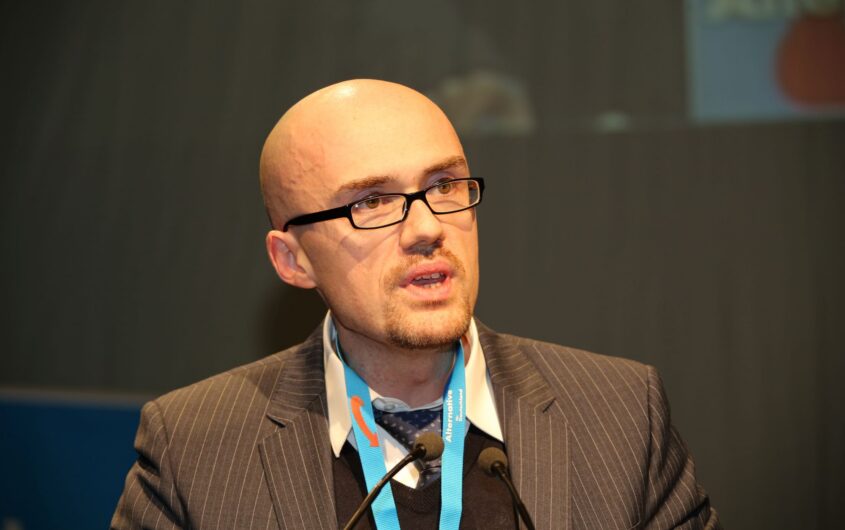
When voters went to the polls in the eastern German state of Saxony-Anhalt on September 6, 2026, the right-wing Alternative for Germany party (AfD) made history by receiving nearly 44 percent of the vote and becoming the largest party in the Landtag (state parliament) with 39 of 83 seats. Since then, much of the attention has been placed on lead candidate Ulrich Siegmund, whose social media presence has helped him to become the party’s younger face. But behind the AfD’s popular minister-president candidate is Hans-Thomas Tillschneider, an academic-turned-politician. As deputy chairman of the AfD in Saxony-Anhalt and the newly elected vice president of the Landtag, Tillschneider is a senior figure in the regional party hierarchy who has been described as the party’s “Vordenker” (ideologue or intellectual mastermind).
A Different Kind of German Story
Tillschneider’s biography is unorthodox for a politician whose beliefs place such a strong emphasis on German national identity. He was born in 1978 in Timișoara, Romania, as a member of the Danube Swabian ethnic minority group. He came to Germany as a young child and grew up in Freudenstadt, Baden-Württemberg. Before entering politics, Tillschneider pursued an academic career, studying Arabic, philosophy, and German literature alongside his specialization in Islamic Studies in Freiburg, Leipzig, and Damascus. He earned a Magister degree in 2004 and a doctorate in Islamic Studies in 2009. He completed his habilitation in 2018, in which he examined the hadith system, a body of traditions concerning the sayings and actions of the Prophet Muhammad. From 2010 to 2016, he worked as an academic counselor at the University of Bayreuth’s Chair of Islamic Studies, where he researched Islamic jurisprudence and taught several classes.
Tillschneider briefly joined the Free Democratic Party (FDP) in 1996. He joined the newly established AfD in 2013. He was elected to the Saxony-Anhalt Landtag three years later. His decision to join the AfD was shaped partly by disagreements over higher education and the place of Islam in German public life. In an August 2026 interview, he recalled opposing the Bologna Process, which restructured German higher education around bachelor’s and master’s degrees. He supported the AfD’s early calls to restore traditional German qualifications, including the Magister, Staatsexamen, and Diplom. He also opposed Islamic religious education and theology programs developed in cooperation with Muslim religious associations, arguing that Islam should instead be studied through established academic disciplines.
From 2016 to 2021, Tillschneider represented the Bad Dürrenberg-Saalekreis constituency in the Landtag. In 2026, he won the Querfurt constituency with 54.85 percent of the vote. Despite being born in Romania and raised in western Germany, he has made eastern Germany central to his political identity. On his Abgeordnetenwatch profile, he states that he has lived in eastern Germany since 2000 because he “considers eastern Germany the better Germany.” His political career has developed alongside the AfD’s growth and consolidation as a major political force at the state level. At the 2020 party conference in Dessau, Tillschneider was elected deputy state chairman of the AfD in Saxony-Anhalt with 85 percent of the vote, a post he still holds today.
Tillschneider was also drawn into a controversy over alleged nepotism within the AfD. In February 2026, it was reported that his wife had worked for several months in the Bundestag office of fellow AfD politician Jan Wenzel Schmidt, earning a reported €900 (~$1000) per month.
Ideas, Identity, and Influence
Tillschneider’s academic background in Islamic Studies provides context for his political views on Islam, although his scholarship and political conclusions should be distinguished. His research has examined Islamic legal interpretation and traditions concerning the circumstances of Quranic revelation. His political rhetoric, however, has increasingly presented Islam as a threat to German national identity.
At the AfD’s 2016 party convention, Tillschneider declared that “Islam is foreign to us,” as the party adopted a manifesto stating that Islam was not part of Germany. His position has also shifted over time. In a 2014 essay, he considered the possibility of a “German Islam” that would allow Muslims to become German while retaining their religion. By 2017, however, he was comparing Islam to a fungus growing on a German oak. Tillschneider has offered his own explanation for the apparent tension between his academic specialization and his political opposition to Islam. In an interview, Tillschneider explained that his interest in Islamic Studies stemmed from “curiosity about the foreign.” He argued that studying Islam should remain distinct from Western traditions, criticizing what he saw as an effort within contemporary Islamic Studies to integrate Islam into the Western intellectual tradition. In his view, understanding Islam does not necessarily imply integrating it into German or Western society but can instead serve to maintain the distinction between the two.
Tillschneider’s influence has also reached the AfD’s policy agenda. Tillschneider played a central role in developing and coordinating the party’s internal working group for the 2026 state election program. Tillschneider wrote large portions of the program and helped shape its tone.
Tillschneider has been closely associated with the figures of the far-right faction of the AfD. In March 2015, he was one of the initial signers of the “Erfurter Resolution” (Erfurt Resolution), a document that became closely associated with the emergence of the AfD’s “Der Flügel” (The Wing) faction led by Björn Höcke and Andreas Kalbitz. The network became an important center of influence within the AfD that rejected any collaboration with mainstream parties. A 2024 ruling by the Higher Administrative Court of North Rhine-Westphalia identifies Höcke, Kalbitz, and Tillschneider as the former leaders of Der Flügel. In February 2020, reports emerged that Germany’s Federal Office for the Protection of the Constitution had begun monitoring Tillschneider using intelligence-gathering measures, alongside Andreas Kalbitz and Björn Höcke. Although the group dissolved in 2020 after the extremist designation, the relationships formed through the Flügel network have not entirely remained in the past. In July 2026, that former AfD politician Landtag office, although the exact nature of his role was not publicly disclosed.
Tillschneider has also advocated closer political ties with Russia during its invasion of Ukraine, earning him the nickname “Moscow’s Holy Warrior.” In 2022, he was one of a handful of AfD politicians to visit Moscow and publicly announce his support for Vladimir Putin. He visited the Russian enclave of Kaliningrad in 2024 and has written a monthly column for the Russian newspaper Vedomosti since 2023. In his Vedomosti columns, Tillschneider criticizes the European Union, opposes military aid to Ukraine, and advocates closer German-Russian relations. He also criticizes Germany’s established parties for their support of Ukraine, claiming that they are prioritizing foreign interests over national sovereignty.
What Happens Next
On October 6, 2026, Tillschneider was elected vice president of the Saxony-Anhalt Landtag by a vote of 44 to 38. The AfD enters the new legislative period as the largest faction but without a majority. His new position gives him procedural and representative responsibilities, including the ability to preside over parliamentary sessions.
That role took on added significance during the October 14 special session (Sondersitzung) on Germany’s policy toward Russia and Ukraine. The session followed a joint AfD–Sahra Wagenknecht Alliance (BSW) initiative calling for renewed peace negotiations and an end to military assistance to Ukraine and sanctions against Russia. Tillschneider was not among the motion’s formal signatories but was expected to help preside over the session alongside Landtag President Tobias Rausch. Although foreign policy falls under federal jurisdiction, the session gave Tillschneider and the AfD a platform to promote their positions on Russia and Ukraine and draw attention to their political pet projects.
Tillschneider’s importance within the AfD lies not only in his position in the state parliament, but also in his role in shaping the party’s ideological direction. His academic background, involvement in developing the AfD’s political platform, connections to its more radical faction, and advocacy for closer relations with Russia have helped establish him as an influential voice within the party. As vice president of the Landtag, he now holds a prominent institutional position while remaining a key figure in the AfD’s regional leadership. How far he can translate his ideological priorities into parliamentary action remains an important question as Saxony-Anhalt enters a new legislative period.