
Arne Müseler via Wikimedia Commons
One of 83 Million
Tim Eydelnant
Tim Eydelnant is a former senior U.S. Foreign Service Officer with more than two decades of experience in transatlantic affairs, diplomacy, humanitarian response, and public policy.
Most recently, he served as Executive Director of the Shalom Hartman Institute’s Washington, DC, Center for Judaism, Israel, and Public Policy, where he helped build a new platform for engagement with policymakers, think tanks, and international organizations around questions of democratic resilience, antisemitism, pluralism, and the future of the transatlantic relationship.
Previously, he was a Senior Diplomatic Fellow at the Wilson Center, where his research focused on the rise of antisemitism and extremism in eastern Germany following October 7, as well as broader societal fragmentation in Central and Eastern Europe.
During his Foreign Service career, Tim served as Principal Officer (Consul-General) at the U.S. Consulate General in Leipzig, Germany, where he directed U.S. engagement in Saxony, Saxony-Anhalt, and Thuringia, worked closely with Jewish communities and civil society partners, and led initiatives related to Holocaust remembrance, democratic resilience, and U.S.-German relations in eastern Germany. His diplomatic assignments also included Jerusalem, Iraq, Austria, Brazil, Russia, and Finland, as well as senior Washington roles in the Bureau of Energy Resources, the Bureau of Population, Refugees, and Migration during the Syrian refugee crisis, Consular Affairs, and the State Department Operations Center.
He is a graduate of Georgetown University’s School of Foreign Service and the National Defense University’s Eisenhower School.
Last week, two sports figures offered very different answers to a deceptively simple question: what does it mean to stand with your country? In Washington, Capitals hockey legend Alexander Ovechkin was back in the headlines after appearing in a campaign advertisement for United Russia, Putin’s ruling party. Asked about it, Ovechkin said, “I am Russian, and I support my country,” while also insisting that he stood for “peace and love.” The tension is hard to miss. Ovechkin was not simply expressing affection for Russia; he was lending his celebrity to the party that dominates Russia’s political system (receiving almost 58 percent in Sunday’s tightly-controlled Russian parliamentary elections) while that government continues its war against Ukraine.
Across the Atlantic, Jürgen Klopp offered a very different way of connecting sports, country, and belonging. Announcing his first squad as Germany’s national soccer coach, Klopp appeared wearing a cap in Germany’s colors bearing the words “Einer von 83 Millionen”—“One of 83 million.” His timing gave the message particular resonance. Less than two weeks earlier, the Alternative for Germany (AfD) had emerged as the largest party in the September 6 state election in Saxony-Anhalt (and would go on to win the most votes in Mecklenburg-Vorpommern on September 20, though without a majority to govern alone). Klopp argued that Germans should not surrender national pride to “the wrong people.” Instead, he called for what he described as “positive patriotism”: pride in a Germany that could also be open, diverse, and compassionate.
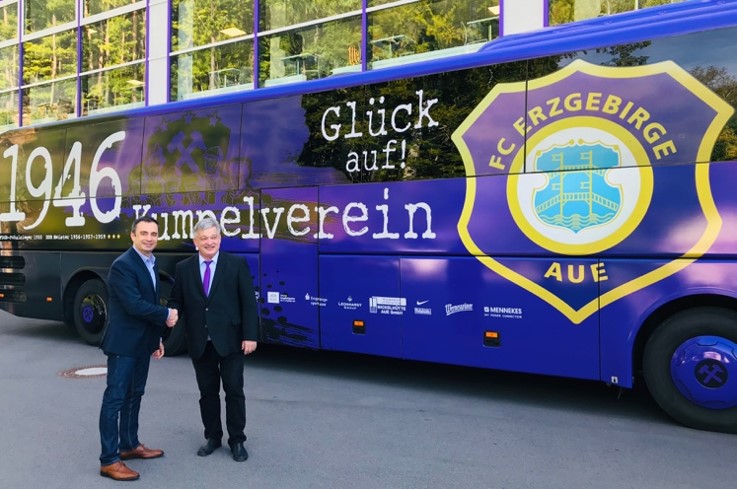
As a lifelong soccer fan, I found his message particularly powerful. Soccer was one of my windows into eastern Germany during my years in Leipzig. I went to matches whenever I could, from Dynamo Dresden to 1. FC Magdeburg and FC Erzgebirge Aue. The clubs inhabit very different worlds, but each reinforced how closely soccer, place, and identity remain intertwined.
If the region’s traditional clubs showed me how deeply soccer is rooted in local identity, RB Leipzig showed me how that identity could also open outward. Its business model was controversial, especially among supporters of Germany’s traditional clubs. But the RB I knew was also unmistakably international. American midfielder Tyler Adams became one of its young stars. Players from across Europe and beyond came together in an eastern German city, wore Leipzig on their shirts, and represented it on soccer’s biggest stages. The American connection continued after I left, when Jesse Marsch (current coach of Canadian national team) became the club’s coach.
When the Leipziger Volkszeitung interviewed me before I left the city in 2020, the newspaper titled the article “RB ist ein Fenster in die Welt” (“RB is a window onto the world”). I told the paper that soccer connects countries and peoples and that sometimes its power to do so can be stronger than diplomacy. I still believe that.
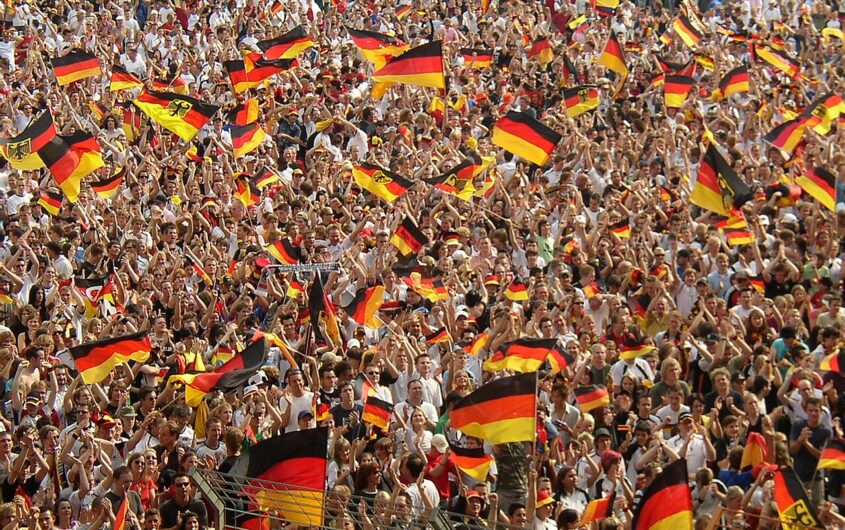
My affection for German soccer long predates Leipzig. I have followed the national team for years partly because, at its best, it has reflected the country Germany was becoming. The 2006 World Cup helped make waving a German flag feel more natural after decades in which national symbols remained understandably burdened by history. By 2014, the world champions included players with family histories stretching from Poland and Turkey to Ghana and Tunisia. Their backgrounds did not have to disappear for them to belong to the same team or the same country.
That is what makes Klopp’s intervention more than abstract moralizing. It challenges the premise that national belonging has an ethnic or ideological owner. That challenge carries particular weight now. AfD gains in eastern Germany have pushed questions of identity, representation, and national culture to the center of political debate. Klopp’s answer is not that Germans should feel less attached to their country. It is that those who believe in an open and pluralistic Germany should feel no need to surrender the flag, the national team, or the language of belonging to anyone else.
Soccer makes that idea visible. A supporter can be fiercely attached to Leipzig, Dresden, or Magdeburg and still cheer for the same national team. A player with a Turkish, Polish, or Ghanaian family history can wear Germany’s shirt without contradiction.
One of 83 million.