
Mitch Altman via Flickr
Change at All Costs
Courtney Flynn Martino
Bertelsmann Foundation
Courtney Flynn Martino is the Assistant Director of Transatlantic Relations at the Bertelsmann Foundation. She manages the Transatlantic Barometer, a snapshot policy tool that provides overviews on key issues for 30 countries and the EU, and the Transatlantic Periscope, a bilateral relationship tracker that features reliable, credible information on U.S. engagement with over 25 European countries. Courtney leads the U.S.-Germany research project at Bertelsmann, with a focus on eastern Germany and far-right extremism. She is also co-author of the transatlantic edition of the public opinions survey “eupinions,” a joint project with the Bertelsmann Stiftung.
Before joining the Bertelsmann Foundation in 2022, Courtney spent five years with the Friedrich Naumann Foundation in Washington, DC, where she managed an economics-focused exchange platform for international experts from over 50 countries.
Courtney graduated with an MA in German and European Studies from Georgetown University’s School of Foreign Service with a Certificate in Diplomatic Studies. She has a double BA in German and Classical Studies from Wake Forest University. Courtney was a Fulbright grant recipient to Stadtroda, Germany. She is originally from Staten Island, NY.
Election Impressions from Saxony-Anhalt
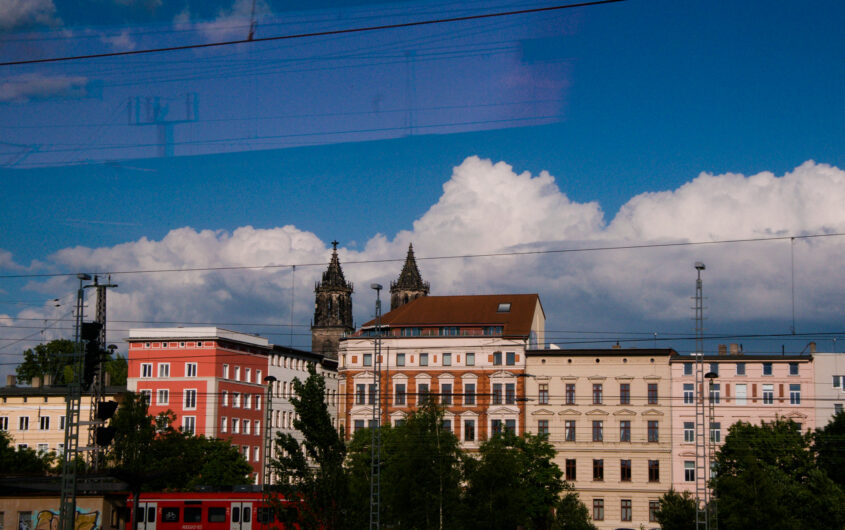
At 5:59 pm on Sunday, September 6, the anticipation in the whimsical restaurant tucked inside Magdeburg’s historic Millennium Tower was palpable. With all screens turned to Germany’s public broadcaster ARD, the entire room began counting down like it was New Year’s Eve. These excited chants quickly turned to a gasp of collective disbelief as the results of Saxony-Anhalt’s state election rolled in: the far-right Alternative for Germany (AfD) party ultimately captured 43.8 percent of the vote, while the center-right Christian Democratic Union (CDU), who has governed the state for the last twenty-four years, netted 17.4 percent, less than half their previous showing in 2021. The initial shock gave way to muted cheers as the center-left Social Democratic Party (SPD) and the Green Party both exceeded expectations at 9.3 percent and 8.9 percent, respectively. The Left Party, a staple in the east, netted its worst result in the state at 8.6 percent, while the neo-liberal Free Democrats, part of the current governing coalition, missed the threshold for re-entry with a paltry 2.6 percent. The socially conservative and economically socialist BSW, the election’s dark horse, cleared this hurdle with 5.3 percent.
Amidst speeches from party officials that celebrated the victory and thanked the collective effort of staff and volunteers alike, the mood was uneasy. It was clear to everyone in the room that while the immediate performance goal was achieved, it paled in comparison to the larger objective hanging precariously in the balance: preventing a far-right government from taking power in Germany for the first time in postwar history. Months of polling and campaigning apparently did not prepare even the most seasoned politicos for this reality. Every conversation I had that evening quickly gave way to the question on everyone’s mind: what happens next?
Saxony-Anhalt, Germany’s oldest and poorest federal state and formerly part of communist East Germany, is on a demographic collision course. Although nearly two generations removed from reunification, the impact of this rapid, all-encompassing transformation has created long-term imbalances in how voters see the world. One state official described it to me as three distinct groups: those who were young when the Wall fell and found the whole world open to them; those who were middle-aged and watched their life crumble away overnight; and those born post-1990 who subscribe to a rosy, carefully curated vision of the East that ignores the repressive political reality. The latter two groups are fertile ground for the far-right and their desire to completely overhaul the current order, as evidenced by the AfD’s campaign slogan, “anything is possible.”
Nearly everyone I spoke to in Magdeburg, whether they were official party representatives or voters on the street, cited this deep desire for change. Over and over again, I heard that since the AfD has not yet governed, they should have the opportunity to try and do something new. One person I spoke to said that for many, this need for change was almost more important than the actual outcome. This explains in part why a number of AfD voters cast ballots ostensibly against their own interests. A member of senior leadership for a progressive party told me that his father-in-law is a staunch AfD supporter. What makes this striking is that his father-in-law is deaf, requiring a sign language interpreter at work. The AfD has been very vocal about rolling back support for individuals with disabilities, such as interpreters or handicapped access to buildings. This will also create issues for the man I saw in an AfD t-shirt rolling down the streets of Magdeburg in his wheelchair.
Nearly everyone I spoke to in Magdeburg cited this deep desire for change.
One member of a mainstream party’s youth group told me that if not for his political involvement, his own mother may have cast her vote for the AfD. As a single mother who worked tirelessly during his childhood, she is upset by the notion that refugees come to Germany and receive such generous benefits, an issue the AfD repeatedly rails against. While she does not align with the party on most issues, it is hard to deny this perceived injustice. It does not help that their small town has a 20 percent migrant population, since it was selected by the state as the site for several large refugee housing centers.
When I asked my taxi driver what he thought would happen on Sunday, he said firmly that there would be a democratic election. After a short pause, he made an emphatic declaration that “40 percent of Saxony-Anhalt are not Nazis!”—a likely reference to the Green Party poster plastered across the city that read “If you don’t want Nazis to take power: vote Green.” On Saturday morning, I walked by a man speaking his mind to SPD campaign volunteers, letting them know that he did not care who fixed the problems in the state, so long as someone did something. He went on to say that political parties should “stop calling everyone a Nazi” and actually talk to one another. He, too, was casting his vote for the AfD.
The motto of Saxony-Anhalt is “think modern,” a call to action in a state that is trying to chart a course for its future. That future rode the streetcar home with me on election night, in the form of a group of teenage boys. Although seemingly too young to have cast a ballot, they were animatedly discussing the election results and what it would mean for them. One was excited about the prospect of no longer needing to attend school, a hope pinned on the AfD’s proposed changes to compulsory education. Two boys compared the size and cleanliness of their basements, since “that’s where the refugees will need to hide.” One kept interrupting the banter to reiterate just how radical the AfD was, and “how bad things are going to get.” Eventually, they all tucked their soccer balls under their arms and exited the train.
What happens next in Saxony-Anhalt remains unanswered, both for short-term decisions on government formation and long-term impact on democratic attitudes. But it is clear that this election has ushered in a period of irrevocable change: just as voters demanded.