
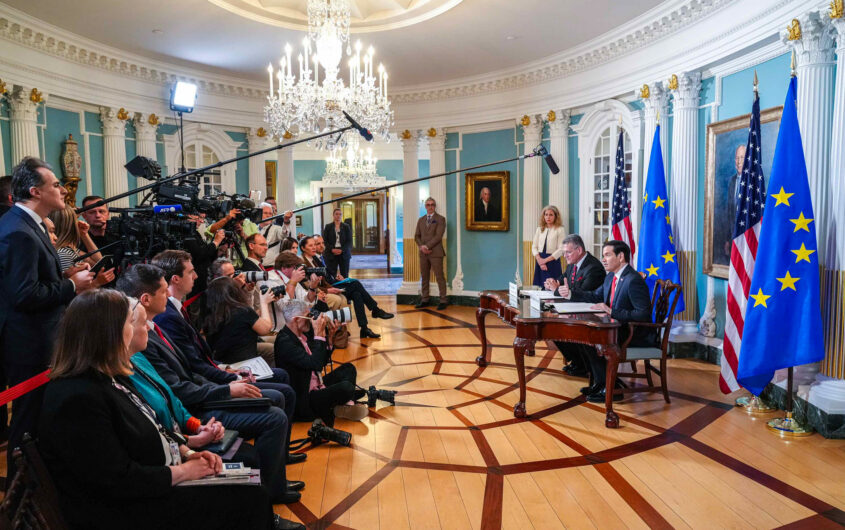
Official State Department photo by Freddie Everett via Flickr
Can a Critical Minerals Pact Compartmentalize Transatlantic Trade?

Peter S. Rashish
Vice President; Director, Geoeconomics Program
Peter S. Rashish, who counts over 30 years of experience counseling corporations, think tanks, foundations, and international organizations on transatlantic trade and economic strategy, is Vice President and Director of the Geoeconomics Program at AICGS. He also writes The Wider Atlantic blog.
Mr. Rashish has served as Vice President for Europe and Eurasia at the U.S. Chamber of Commerce, where he spearheaded the Chamber’s advocacy ahead of the launch of the Transatlantic Trade and Investment Partnership. Previously, Mr. Rashish was a Senior Advisor for Europe at McLarty Associates, Executive Vice President of the European Institute, and a staff member and consultant at the International Energy Agency, the World Bank, UN Trade and Development, the Atlantic Council, the Bertelsmann Foundation, and the German Marshall Fund.
Mr. Rashish has testified before the House Financial Services Subcommittee on International Monetary Policy and Trade and the House Foreign Affairs Subcommittee on Europe and Eurasia and has advised three U.S. presidential campaigns. He has been a featured speaker at the Munich Security Conference, the Aspen Ideas Festival, and the European Forum Alpbach and is a member of the Board of Directors of the Jean Monnet Institute in Paris and a Senior Advisor to the European Policy Centre in Brussels. His commentaries have been published in The New York Times, the Financial Times, The Wall Street Journal, Foreign Policy, and The National Interest, and he has appeared on PBS, CNBC, CNN, NPR, and the BBC.
He earned a BA from Harvard College and an MPhil in international relations from Oxford University. He speaks French, German, Italian, and Spanish.
On April 24, U.S. Trade Representative Jamieson Greer and EU Trade and Economic Security Commissioner Maros Šefčovič agreed to an Action Plan for Critical Minerals Supply Chain Resilience, committing the two sides to “a plurilateral trade initiative with like-minded partners on trade in critical minerals which would support the objective of securing mutual supply chain resilience.” On the same day, the EU Commissioner met with U.S. Secretary of State Marco Rubio to sign a Memorandum of Understanding for the U.S.-EU Strategic Partnership on Critical Minerals to provide a broader diplomatic context to these joint efforts.
Critical minerals are essential to the technology, energy, and defense sectors, among others. China is increasingly dominant in this area: according to the International Energy Agency, in nineteen out of twenty strategically important minerals, it is the leading refiner with an average market share of 70 percent. While some have been lifted, Beijing imposed export controls on several of these raw materials last year, demonstrating its ability to leverage these dependencies.
While last week’s announcements may be surprising amid the frictions in transatlantic trade relations—including higher U.S. tariffs as part of the “Turnberry agreement” signed in August last year and ongoing uncertainty surrounding Section 232 national security levies on steel—momentum had been building between the United States and potential partner countries on critical minerals cooperation for several months.
First, on January 12 of this year, the Treasury Department held a Finance Ministerial that included G7 countries as well as Australia, India, Mexico, and Korea—in other words, the kind of “G7+” gathering that has been increasingly relied on in the last few years to discuss key geoeconomic matters. Then, on February 4, the State Department convened a wider Critical Minerals Ministerial with a diverse group of fifty-four producer and consumer countries.
While last week’s announcements may be surprising amid the frictions in transatlantic trade relations, momentum had been building between the United States and potential partner countries on critical minerals cooperation for several months.
The demonstration in Washington last Friday of critical minerals cooperation between the United States and the European Union is a logical next step. If translated into a binding agreement, it could advance their economic security interests by reducing key dependencies on China. It may also mean that Washington and Brussels are able to compartmentalize their trade relations so that tariff conflict need not prevent strategic alignment.
Some hurdles remain. The Action Plan could include “market and trade measures based on reference prices, such as border-adjusted price floors, standards-based markets, price gap subsidies, or offtake-agreements” as ways to favor the use of critical minerals by like-minded countries. But in the run-up to the unveiling of the deal, concerns were reportedly expressed by such countries that a price floor would not only raise costs for companies but also provoke retaliation from China.
There is also a broader question about global trade governance. When the Action Plan says “border-adjusted” price floors, that may mean a common external tariff on non-members—something that, depending on how it is implemented, could be inconsistent with current World Trade Organization rules. One likely reason that Biden-era talks stalled on a U.S.-EU led Global Arrangement on Sustainable Steel and Aluminum (GASSA) to push back against unfairly subsidized and carbon-intensive Chinese steel exports was the EU’s concern about how it would fit with the WTO’s non-discrimination clause.
In that context, it is worth noting that Commissioner Šefčovič has recently floated the idea of “steel ring-fencing, aligning our approaches towards third countries” to bring down U.S. metal tariffs, which suggests a form of border adjustment. The issue of how to square economic security with multilateral trade rules is gaining momentum.