
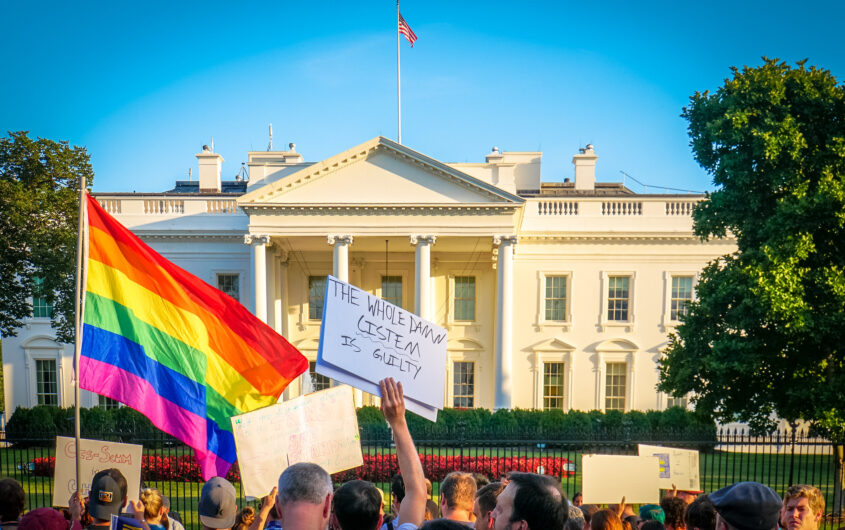
Ted Eytan via Flickr
Building Resilience

Cecelia Parks
University of Virginia
Cecelia Parks is a librarian, historian, labor activist, and equestrian. She is currently an Undergraduate Student Success Librarian at the University of Virginia, where she leads first-year information literacy instruction and assessment efforts. Cecelia has published on a variety of topics, including queer Southern oral history (specifically the queer history of Charlottesville, Virginia), queerness and privacy, and information literacy instruction. She is also an active member of United Campus Workers of Virginia, a labor union for Virginia public higher education workers. In her free time, Cecelia enjoys riding horses, teaching riding lessons, going to concerts, reading, and playing with her dog Delta.

Danijel Cubelic
Office of Equal Opportunities for the City of Heidelberg
Danijel Benjamin Cubelic is a seasoned Anti-Discrimination Expert with over ten years of leadership experience in advancing municipal diversity, equality, and anti-racism initiatives. He specializes in policy development, program management, and applied research, with a strong focus on diversity and anti-discrimination strategies. Danijel is skilled in leading international working groups, contributing to academic and policy publications, and teaching in the fields of diversity and gender studies.
He currently serves as Director of the Office of Equal Opportunities for the City of Heidelberg (2017–present) and Vice President of the European Coalition of Cities against Racism (ECCAR) (2020–present). Additionally, he is a Deputy Board Member of the German Federal Anti-Discrimination Agency (since 2019) and an Advisory Council Member for the LGBTIQ+ Action Plan in Baden-Württemberg (since 2017).
How LGBTQ+ Organizations in Germany and the United States Navigate Right-Wing Backlash
Participants in the American-German Institute program “Building LGBTQ+ Communities in Germany and the United States” gathered in Washington, DC, in September 2025 to meet with LGBTQ+ leaders in Washington and to learn from each other. This convening occurred at a tumultuous time in American politics: President Donald Trump had been in office for nine months, instituting sweeping changes in the federal government including significant reductions in the federal workforce, supported by a Republican Congress and a right-leaning Supreme Court. LGBTQ+ people—specifically trans people—were the target of attacks from the Trump administration and other political leaders across the country, and the Supreme Court could re-examine their 2015 marriage equality decision (though the Supreme Court has since declined to consider that case). In short, LGBTQ+ Americans were facing existential threats to the social and legal progress made in the past decades, and LGBTQ+ leaders and organizations were determining how best to fight the onslaught of attacks from the political right.
Across the Atlantic, Germany is facing its own moment of political tension. After the collapse of the “traffic light” coalition government in early 2025, the political landscape has grown increasingly polarized. Debates over migration, national identity, and LGBTQ+ rights have become focal points of a widening culture war. Empirical evidence underscores this shift: the 2025 Vielfaltsbarometer (Diversity Barometer) shows that overall acceptance of diversity has declined from 68 points in 2019 to 63 points in 2025, with the share of respondents viewing diversity as a societal enrichment dropping from 63 percent to 45 percent. Acceptance of sexual and gender diversity has also fallen sharply, decreasing from 77 to 69 points, with significantly higher levels of skepticism toward trans identities.
Reports from the Lesbian and Gay Federation (LSVD) highlight parallel developments in LGBTQ+ related violence and harassment: in 2024, more than 2900 incidents targeting people were documented, representing an increase of roughly 18 percent for cases regarding sexual orientation and 35 percent regarding gender identity compared to the previous year. These trends are increasingly reflected in political responses. The center-right Christian Democratic Union (CDU) has positioned itself as a vocal critic of the Self-Determination Act—Germany’s new legal framework that allows individuals to change their legal gender marker and first name through a simple administrative process rather than medical or judicial approval—arguing for its reversal or significant tightening and framing the law as out of step with public sentiment. Although LGBTQ+ Germans achieved substantial legal progress in recent years, including expanded anti-discrimination protections and the passage of this law, the current political climate raises the prospect of a legal backlash in areas where public attitudes are shifting.
Far-right actors in Germany have adopted American-style rhetoric. Language around “gender ideology” or the supposed “protection of children” has migrated from U.S. discourse into German political and media spaces. These transnational narratives fuel polarization, amplified by digital disinformation and populist campaigns. Comparable rhetorical strategies are also visible in Germany: presenting gender equality policies as an elite project, questioning the legitimacy of scientific expertise, and portraying public institutions such as schools, youth welfare offices, or equality bodies as ideologically driven. Analyses of the European anti-gender movement show that these narratives are part of a coordinated international strategy that aims to weaken trust in democratic and knowledge producing institutions and to undermine the legitimacy of equality frameworks.
A striking illustration is the case of Frauke Brosius Gersdorf, a legal scholar nominated for a seat on the Federal Constitutional Court, who withdrew after an intensive online campaign targeting her academic work on abortion. The episode shows how digital mobilization around questions of gender ethics can become a proxy for broader institutional conflicts. A similar pattern emerged when a public reading by drag artists for children in Munich triggered threats and protests framed as child protection; comparable incidents have since occurred in many other German cities. A further escalation is visible in attacks on queer visibility in public space: in 2024, a Pride parade in Bautzen was targeted by several hundred right-wing activists who marched under slogans against “gender propaganda,” carried Reich flags, and burned rainbow symbols. Reports from the Federal Anti Discrimination Agency document a steady increase in hate speech, violence and exclusion targeting LGBTQ people; complaints related to racism have also risen sharply. Commissioner Ferda Ataman has described this convergence of rising discrimination across several grounds as a “crisis of discrimination,” pointing to wider risks for social cohesion.
Amid these challenges, German queer organizations are responding with creativity and determination. They are building stronger regional infrastructures, advocating for inclusive municipal policies, and creating safe spaces for dialogue and education. In smaller towns and rural regions, where visibility often comes with personal risk, grassroots networks are vital to sustaining solidarity and resilience. Recent developments show that this work is expanding beyond the major metropolitan centers: a growing number of mid-sized cities and rural communities now host their own Pride events, often organized by small volunteer collectives and supported by local alliances. These Prides are more than symbolic gestures; they function as visible markers of democratic participation and help counter isolation in areas where queer life remains underrepresented or contested. Studies on queer life outside major cities highlight both the challenges—including limited infrastructure and higher exposure to hostility—and the emerging sense of empowerment that comes with local visibility initiatives. The German LGBTQ+ movement, like its U.S. counterpart, is navigating an era of uncertainty that tests both its resilience and its organizational strength.
Transatlantic cooperation can provide valuable insights and solidarity, as anti-LGBTQ+ narratives increasingly circulate globally.
LGBTQ+ leaders inside and outside the American federal and local governments shared in meetings with AGI program participants how they were dealing with ongoing attacks on LGBTQ+ people and how they planned to counter right-wing politicians and organizations and regain power. Several noted that many of the most pressing issues faced by LGBTQ+ Americans were not directly tied to their identity: the destruction of many federal government programs has far-reaching impacts on the material realities of millions of Americans, especially members of marginalized groups. For example, restrictions on food assistance programs and cuts to Medicaid will disproportionately harm LGBTQ+ people even if they are not the direct targets of those actions, because LGBTQ+ people rely on programs like SNAP and Medicaid at higher rates than their straight counterparts.
Some organizations, especially those affiliated with the federal government, were making plans to undo the damage done by the Trump administration when Democrats regain power; others were focused on mitigating the impacts of the Trump administration’s changes by adopting service models or resource streams that minimize their interactions with the federal government. For example, the Whitman-Walker Medical Clinic, a clinic founded to provide LGBTQ+ healthcare in Washington, DC, is considering moving their provision of gender-affirming care into a separate division of their organization so they can maintain their status as a federally qualified health center and continue to provide gender-affirming and other related services for transgender patients.
These organizations were clear-eyed about their lack of real political power at the moment: they are not able to effectively work through the formal political process right now. One strategy several of them are using to specifically combat attacks against LGBTQ+ people is focusing on messaging and storytelling. The political right has effectively shifted the narrative around trans people in particular, and groups like the Human Rights Campaign (HRC) are attempting to develop new narratives that center trans people, humanizing them and bringing complexity, nuance, and authenticity to a narrative space full of misinformation and hate. HRC, alongside many other organizations, successfully used storytelling along with other forms of advocacy to shift public perception on marriage equality in a short period of time in the 2000s-2010s and are hoping to use similar strategies to change public opinion and reduce the viability of attacks on trans people as a political strategy.
A common thread through many of the conversations with LGBTQ+ leaders was the need for optimism and hope despite the extremely challenging circumstances faced by their organizations and by LGBTQ+ people across America. The current situation is unprecedented and difficult in many ways, but despair is not an effective organizing strategy.
For LGBTQ+ organizations in Germany, this moment calls for strategic reflection and preparation. They can learn from the experience of their U.S. counterparts, who have developed ways to remain active under adverse political conditions: by diversifying funding structures, reducing dependency on government support, and strengthening internal resilience. Building stable regional networks and alliances across different social movements will be key to sustaining equality work in uncertain times. Transatlantic cooperation can provide valuable insights and solidarity, as anti-LGBTQ+ narratives increasingly circulate globally. By sharing strategies and maintaining open channels of exchange, organizations in Germany can better anticipate challenges and respond collectively. What is needed now is not only resistance but also a forward-looking approach—one that focuses on institutional sustainability, mutual support, and a clear commitment to a society in which diversity and equal participation remain fundamental principles.
This article is part of the project “Building LGBTQ+ Communities in Germany and the United States: Past, Present, and Future” and is generously funded by the Transatlantik-Programm der Bundesrepublik Deutschland aus Mitteln des European Recovery Program (ERP) des Bundesministeriums für Wirtschaft und Energie (BMWE) (Transatlantic Program of the Federal Republic of Germany with Funds through the European Recovery Program (ERP) of the Federal Ministry for Economic Affairs and Energy (BMWE)).