
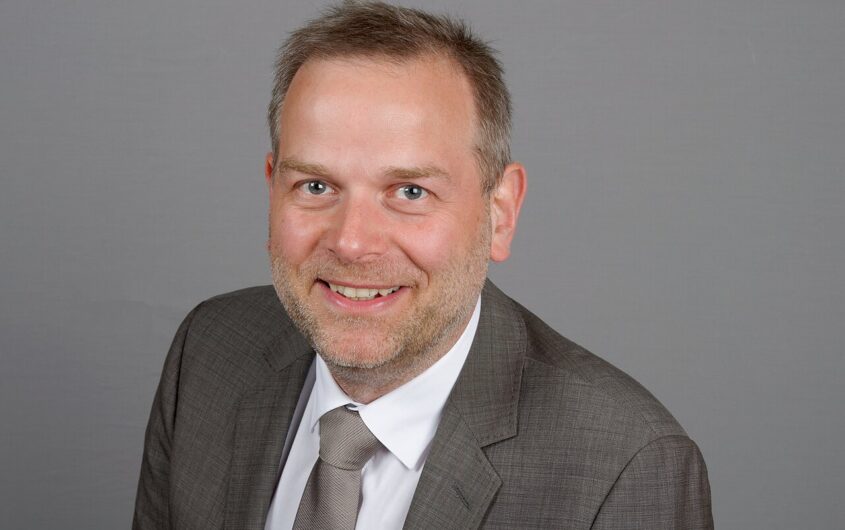
Jonas Rogowski via Wikimedia Commons
AGI Profiles: Leif-Erik Holm
Lilith Edwards
Halle Foundation/AGI Intern
Lilith Edwards is a spring 2026 Halle Foundation Intern at the American-German Institute and a graduate of Emory University where she majored in German Studies and minored in Linguistics. During her time in university and with support from the Halle Foundation, she lived and studied in Vienna and Freiburg, immersing herself in and learning about the history and dialects of the respective regions. Prior to joining the American-German Institute, Lilith taught in a dual-language German immersion program to elementary school children in Atlanta, Georgia, where she received special training for second language and immersion instruction.
Lilith’s interest in fostering the American-German relationship stems from a personal interest in the intersections of various cultures and a desire to facilitate connection and knowledge-sharing amongst international communities. Her research interests are in climate policy, sustainability efforts, migration policy, and public discourse on civil rights and identity.
Member of the Bundestag; AfD State Chairman in Mecklenburg-Western Pomerania
Leif-Erik Holm is a father, politician, loyal party member, local celebrity, and a “nice guy.” A founder of the Alternative for Germany (AfD) branch in Mecklenburg-Western Pomerania, Holm’s roots in the party go deep. However, he does not fit the stereotype most picture for AfD members. Instead, Holm presents a moderate take on the AfD, welcoming discussion around key issues, like migration, while avoiding the overt borrowing of Nazi rhetoric and style of some of his fellow members. Serving the AfD in whatever way he can, Holm has gone from party leader to state representative to national representative. Now, his sights are set on an important goal for the AfD: leading the state government of Mecklenburg-Western Pomerania, his home.
Path to Leadership
Born in 1970, Holm grew up in Mecklenburg-Western Pomerania in rural Klein-Trebbow, near the capital city of Schwerin. Raised by an electrician and a nurse with a “sheltered” childhood in Communist East Germany, Holm graduated high school and went on to follow his father, apprenticing as an electrician. After a short military service, he then studied economics at the Technical University of Wismar and at Humboldt University in Berlin before deciding to DJ during the chaotic period of German Reunification, working with several radio stations over the next twenty years. He was good at it, too, according to his station, which claimed he had the best jokes in the area.
This is fitting for the man everyone describes as avuncular; a man who has a friendly smile, a familiar voice, and speaks clearly and passionately about his beliefs; a man who cares about the future of his community. It was only natural, then, when Holm decided to go into politics in spring 2013. Spurred to action by Germany’s bailouts of Greece in 2012, Holm joined the only party reflecting his outrage, the freshly minted AfD. Alongside founder Bernd Lucke, Holm helped establish the AfD’s state branch in Mecklenburg-Western Pomerania and became the state party’s leading candidate for the federal elections in 2013 and 2017. Lending his voice to the AfD to speak on his concerns for Germany adopting the Euro, the broken party system in Germany, the prevalence of political influence in public broadcasting, and the importance of policy to limit immigration, Holm has always been in line with the core ideals of the far-right party.
A state chairman for the AfD in Mecklenburg-Western Pomerania since 2013, with a short interruption in 2014, Holm has been a fixture in the regional party. Growing alongside the AfD, Holm worked in the office of Beatrix von Storch during her time in the European Parliament, where he learned how to become a serious politician. Then in 2016, Holm ran his own campaign for a seat in the state parliament of Mecklenburg-Western Pomerania and won, marking his first successful parliamentary election. Just a year later, he ran in the Bundestag election, entering the federal parliament, alongside the AfD, for the first time. Between then and now, Holm’s efforts have gone toward securing his position and increasing his influence to ensure his voice is heard at home and in Berlin. In 2023, Holm tried his hand at local government, running in the Schwerin mayoral election. Though he did not win, he earned a runoff election, showcasing both his own popularity and that of the AfD in Mecklenburg-Western Pomerania’s capital city. In 2025, Holm went on to win the direct mandate for the Bundestag election with 35.9 percent of the vote. This was his first time winning the direct mandate, and he did it in an election that gave the AfD sixty-nine new seats in the Bundestag overall, further demonstrating just how far Holm and the AfD have come together.
As a longtime member, Holm’s connections within the party are widespread. Holm generally falls in Alice Weidel’s camp of the AfD, which seeks to bring more professionalism to the party and turn it into a serious party in the eyes of outsiders. However, he maintains links with the more extreme side of the AfD as well. In response to alarming comments by AfD colleague Maximilian Krah about the innocence of some SS soldiers, Holm defended the stance, saying, “in every criminal organization there are people who are not themselves guilty.” In other instances, Holm has actually promoted members with extremist inclinations, such as Dario Seifert, former leading member of the disbanded, extremist youth branch of the AfD, Young Alternative (Junge Alternative). Holm maintains support throughout the party while, like the AfD of his home state, avoiding being labelled a definitively right-wing extremist.
2026 Candidate for Minister-President
In 2026, there will be five state elections in Germany, three in the east and two in the west. While the AfD has made substantial gains in the west, including a best-ever result in Baden-Württemberg, the influence of the rising far-right extremist party is strongest in the east. In two of the eastern elections, Mecklenburg-Western Pomerania and Saxony-Anhalt, the AfD is projected to claim the most votes. This year will prove key in assessing the popularity of the AfD across the country and could prove pivotal in the future growth of the party. Leif-Erik Holm’s role in these events could be one step forward in that growth.
This September, Holm will run for minister-president of Mecklenburg-Western Pomerania. As a current Bundestag member, Holm is jumping at an opportunity that may cause him to forfeit his seat in the federal parliament. Moving from the Bundestag to the Landtag would seem to be an odd choice, like giving up hard-earned federal power for the party, but Holm hopes to become the state executive. Should the AfD lead the state government, Holm would have more direct power over his home state’s legislation than he has yet had and could have as a Bundestag member. The AfD has not listed Holm on the state list, ensuring that if the AfD does not lead the governing coalition, he will simply remain in the Bundestag as before. This election offers Holm and the AfD the opportunity to claim a prominent state position.
Holm could be the first AfD member to hold the minister-president position in the history of the party. With 37 percent projected support for the AfD over the Social Democrats (SPD) at 23 percent in the latest polls, the far-right party continues to hold strong in the state. Though its lead over the ruling SPD has shrunk some since September 2025 polls, the party has grown in popularity since the last state elections in 2021. Holm’s personal popularity is less strong, with SPD opponent Manuela Schwesig polling at 46 percent as the preferred minister-president, almost double that of Holm’s 25 percent. Despite the current odds, though, much can still change between now and September. German state elections tend to favor incumbent parties in the final months before an election, despite long periods of polling poorly. This was the case for the 2021 state election in Mecklenburg-Western Pomerania, where the ruling Social Democrats (SPD) lost favor in the polls to the Christian Democrats (CDU) until late summer 2021. The SPD eventually won the fall elections of that year, 26 percentage points ahead of the CDU. The SPD could similarly rally against the AfD this election cycle, but Holm is seeking to upset the incumbent. An AfD minister-president would give immense control over a state parliament and further legitimacy to the far-right party. Holm said as much about the party’s goal for Mecklenburg-Western Pomerania in his nomination speech last year, stating, “We want a single-party government in Mecklenburg-Western Pomerania. That is our big goal.”
Holm and His Home
From his role in the budding AfD, his many campaigns, his membership in the state parliament, and to his bid for mayor, Holm is doing his best to nurture the AfD in Mecklenburg-Western Pomerania and secure his own place in its growth. The minister-presidency is the next step in this goal, extending the AfD’s power to a high-ranking position with immense influence on state policies.
Holm’s priorities as minister-president would likely focus on immigration and the economy. In a 2024 interview on the AfD’s stance on immigrants, Holm affirmed the party’s support for migrants as a source of skilled labor, with the caveat of their “contribut[ing] to Germany’s prosperity” and complying with German cultural and legal expectations. Speaking as the economic advisor to the AfD in the Bundestag, Holm reinforces the core economic policies of his party, such as deregulating industries and returning to nuclear energy, while dismissing the anti-immigrant reputation the AfD has garnered. On the campaign trail, though, his stance has hardened. He has called migration an “existential” threat and said that incoming refugee centers and greater European integration efforts jeopardize the identity and safety of the German people.
Holm’s exact direction for Mecklenburg-Western Pomerania remains unclear. In his campaign platform he prioritizes tightening immigration policy and reducing energy costs. However, like many AfD members, Holm does not offer a clear policy plan for the state. Broadly, he will likely maintain stances his party holds, pushing economic issues like low wages and failing infrastructure to the forefront, with social issues like housing shortages and ending public broadcasting close behind. Meanwhile, we can expect Holm to continue the party habit of laying blame for the economy on refugees and on other parties rather than laying out a clear policy plan of his own.
A Chink in the Firewall
Leif-Erik Holm already plays a key role in the AfD and its efforts to remove the “firewall” in government. Holm sits in a special position of potential, where his uncle-ish charm, his relatively mild rhetoric, and openness to debate appeal to the AfD’s opposition just enough to open the door to minor collaboration. In October of 2025, the Association of Family Entrepreneurs (Verband der Familienunternehmer) invited Holm to a meeting to discuss the AfD’s goals for the economy and business. A seemingly innocuous occurrence were it with any other party, this invitation marked early cracks in the firewall. The Association’s president Marie-Christine Ostermann responded to critiques of the invitation that, “the political concept of completely excluding the AfD has failed,” a stance she renounced just days later. As non-governmental organizations begin to open up, so, too, may political parties start to come to the same conclusions and feel the pressure to collaborate increase. Indeed, this year’s elections may just be the push that causes the firewall to fall in places where, like Mecklenburg-Western Pomerania, the AfD could be the strongest political force.
Even if the AfD does not lead the government, the odds are good that the party’s membership will increase in the state parliament this fall. Either way, Holm is a key player in the AfD’s plans, and as more organizations seek him out for debate, legitimacy for the AfD rises. For the far-right party, the veteran member, Leif-Erik Holm, is a promising figure, be it in the Bundestag or state government. Holm’s positions on limiting immigration and protecting the economy are well received by his many followers, while his moderate posturing and growing influence could become increasingly attractive to outsiders and opposition members making concessions and seeking collaboration.