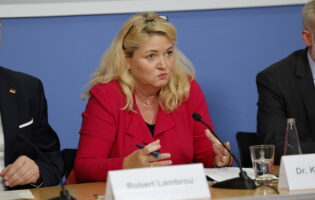
AGI Profiles: Kristin Brinker
Member of the Berlin House of Representatives; AfD State Chairwoman in Berlin The outcome of Berlin’s September 20, 2026, election is far from clear. Polling remains volatile, with the positions …

Watching Ceuta, Thinking About Magdeburg
What Spain’s Border Tells Us About Eastern Germany In the last week of July, tens of thousands of people crossed from Morocco into the Spanish enclave of Ceuta. Spain’s Interior …

AGI Profiles: Nina Warken
Head of the Federal Chancellery Following the resignation of Jen Spahn, Chancellor Friedrich Merz’s cabinet has been shaken up. Nina Warken was selected as Merz’s head of the Federal Chancellery, …
Episode 153: The Greens’ Next Steps
Germany’s Green Party is no longer part of the federal government and is seeking a comeback. How can the party mobilize the electorate and counter growing fragmentation and extremism in …

Shifting Partisan Trends among Young Germans
Rising Youth Polarization The 2025 Bundestag election revealed serious generational divides in German voting patterns. While the Christian Democrats (CDU) and Social Democrats (SPD) received solid support from older Germans, …
Recent Authors
AGI provides knowledge, insights, and networks as tools to solve the challenges ahead.
Support Our Work
Simon Morris-Lange, DAAD/AGI Research Fellow
AGI is pleased to welcome Simon Morris-Lange as a DAAD/AGI Research Fellow in August and September 2026. Dr. Simon Morris-Lange is Head of Research at Allianz Foundation in Berlin, where …

Reopening Germany’s Surrogacy Debate
A recent public revelation about a member of the Christian Democratic Party’s (CDU) leadership having a child through surrogacy unleashed a political storm in the party and has dramatically illuminated …

Looking for Germany’s Future in the Former East
A Week in Saxony On a warm Friday evening in late June, nearly 140 people gathered inside the former synagogue in Görlitz, Germany’s easternmost city. They had come from the …

Militant Democracy
The Party Banning Process in Germany The prospect of banning Germany’s premier right-wing populist party, the Alternative für Deutschland (AfD), now classified as a suspected extremist party, is a topic …

Building LGBTQ+ Communities in Germany and the United States: Past, Present, and Future
A Three-Year AGI Project – Final Conference Summary The American-German Institute held a final conference in Washington, DC, for the three-year project, “Building LGBTQ+ Communities in Germany and the United …

The Effects of Majoritarian vs. Non-Majoritarian Political Systems on the Queer Community
The United States and Germany have constructed their democratic political systems in distinct ways. These frameworks can pose particular challenges to achieving progress in the fight for LGBTQ+ rights. In …
Episode 150: Valuing Civil Society Organizations
Civil society organizations are funded differently in the United States and Germany, and LGBTQ+ organizations must take different approaches when seeking financial support from the public and private sector. Preston …

Heated Relations
The Past, Present, and Future of the LGBTQ+ Community in Germany and the United States For over a century, LGBTQ+ communities in Germany and the United States have fought for …
The AfD’s New Transatlantic Network
Tracking the AfD’s Engagement with the United States As the Alternative for Germany (AfD) has gained support domestically—exemplified by 20.8 percent of the vote in the 2025 Bundestag election—they have …