

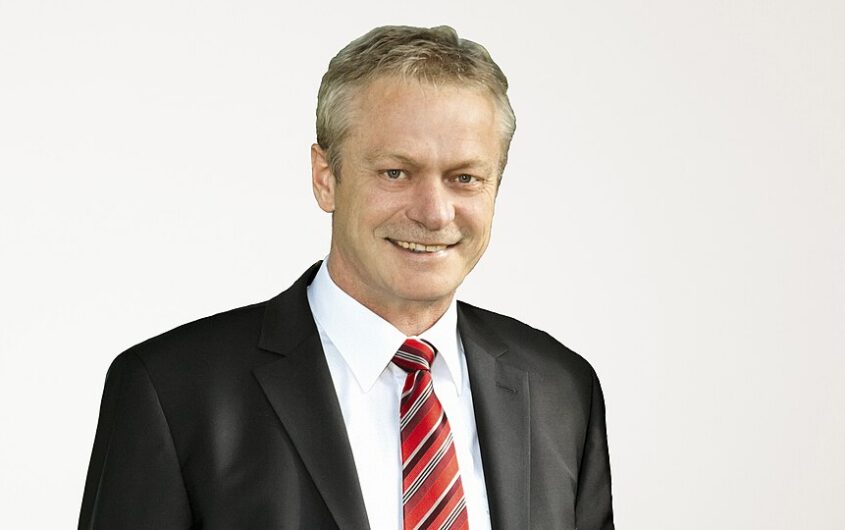
Foto Eiglsperger via Wikimedia Commons
AGI Profiles: Alois Rainer

William Wolgemuth
Halle Foundation/AGI Intern
William Wolgemuth is a Summer 2026 Halle Foundation intern at the American-German Institute and a recent graduate from the University of Georgia, where he majored in International Affairs and minored in Chinese and Religious Studies. He has experience researching various regional dynamics throughout the globe, while holding a particular interest in the transatlantic partnership, due to its complex security and economic implications. William’s previous experience includes geoeconomic research throughout Asia, supply chain security analysis, and assisting in courses related to regional economic integration. William’s interest in the American-German partnership stems from a passion for intercultural understanding and enhancing bilateral relationships. His particular research interests include Germany’s history, domestic politics, and its regional cultural differences.
Minister of Agriculture, Food, and Regional Identity
Alois Rainer is a member of the Bundestag from Straubing, Bavaria, and serves as Minister of Agriculture, Food, and Regional Identity (Bundesminister für Landwirtschaft, Ernährung und Heimat). Rainer bears all of the associated imagery of a rural Bavarian: he is Catholic, formerly involved in the agricultural industry, and embedded within the partisan infrastructure of the Christian Social Union (CSU). Rainer’s family is strongly tied to Bavarian politics, as his father, Alois Rainer Sr., and sister, First Deputy Leader of the parliamentary group Gerda Hasselfeldt, have both served as CSU members in the Bundestag. His transition to government was not a complicated one, due to his strong local connections and his inherited name recognition. Outside of politics, Rainer followed in his father’s footsteps in the private sector, taking over his position as a butcher. In 2002, Rainer completed perhaps his crowning achievement as a butcher by producing a world-record-breaking 825-meter-long weißwurst, thus solidifying his Bavarian credentials and his status as a local legend. Rainer’s roots have molded him into the political actor that he is today, as his meat industry experience influences his approach to agriculture policy and his small-town Bavarian upbringing contributes to his skepticism of governmental overreach.
Political Career
Alois Rainer entered politics by joining the CSU in 1989 and subsequently serving as mayor of Haibach in rural Lower Bavaria from 1996 to 2014. When asked about his successes as mayor, Rainer highlighted civic projects, such as renovating the school and the town hall. Rainer first entered the Bundestag following the 2013 election; during the campaign he improved his name recognition by producing and distributing 15,000 cans of sausage, with his picture and the slogan: “Because it matters who represents you in the Bundestag.” Throughout his tenure in Berlin, Rainer accrued a reputation for being an outspoken pragmatic conservative, described by CSU leader Markus Söder as a “black butcher” (alluding to black being the traditional color of the CDU/CSU) unafraid to take on “tofu nonsense.” Söder’s quip makes apparent reference to the vegetarianism of the previous Minister of Agriculture, Cem Özdemir of the Green Party. Despite lacking a high-profile relationship with Söder, his reliable track record and loyalty to the party contributed to his selection for a position in cabinet. Rainer has nevertheless portrayed himself as an independent voice, rather than an idealogue, emphasizing, “I listen to many opinions, bring them together, and then make decisions. That’s how I understand politics.” It is difficult to find issues where Rainer significantly deviates from the CDU/CSU line; however, the quote demonstrates his desire to shed his image as a partisan culture warrior. In stark contrast with Merz’s image as a globally-minded businessman, Rainer has an obvious appeal to the traditionalist CDU/CSU base, with his down-to-earth charm and everyman image.
Within his role as a minister, Rainer has been vocal about his support for a social market economy, which reduces barriers for farmers, while promoting the “Made in Germany” brand. Following rising food costs in early 2026, Rainer opposed the Social Democratic Party’s (SPD) proposal to artificially lower the prices of staple goods, viewing it as unnecessary governmental interference that distorts market forces. In the international sphere, Rainer has organized trips to China and South Africa to increase the visibility of German products in foreign markets. Rainer fights for the commercial viability of farmers within Germany as well as for the competitiveness of German agriculture throughout global markets.
Advocacy for Farmers’ Interests
Rainer’s political advocacy stems from his personal and professional background, as he advocates for the protections and interests of the German food industry. Rainer views unnecessary bureaucracy or regulatory oversight as inefficient and disruptive to the traditional practices of German farmers. He opposed to a proposed EU restriction on naming conventions for vegetable-substitute products on the basis of reducing bureaucracy. The law would ban producers from using names like “veggie schnitzel” or “tofu burger” on the grounds that the terminology may be confusing for consumers. Rainer also advocates for EU funding for farmers to provide for greater agricultural self-sufficiency. His pro-farmer sensibilities are further evidenced by his position on wolf culling. Rainer has defended the practice as necessary for farmers to protect their livestock, pushing back against environmentalists concerned with animal rights.
Furthermore, Rainer is unafraid to champion meat consumption, marking a significant break from his predecessor, Cem Özdemir. Özdemir, beyond his personal preference for vegetarianism, promoted a higher tax on meat, as well as the greater consumption of plants and vegetables, highlighting specific concerns with the food industry’s environmental impact and standards in animal husbandry. Rainer, by contrast, views the politicization and judgement of consumption habits as a “culture war on our plates” and has reemphasized the value of meat in school diets. Rainer viewed the implicit endorsement of reducing meat consumption as placing an unjust penalty on farmers and butchers, as well as an affront to the traditional meat-heavy German diet. Regarding the impact of raising livestock on the environment, Rainer has expressed little interest in taking an active stand on the matter. Such hesitancy is not uncommon for those in the agricultural industry, who are wary of the economic implications of a more aggressive environmental policy.
Food Security
Food security has become an increasingly relevant concern internationally, following the economically disruptive conflicts in Ukraine and Iran. Supply chain inefficiencies, whether they pertain to fertilizer or energy shortages, contribute to rising food costs. According to the latest data, Germans spend around 14 percent of their budget on food and drinks, which is relatively low for the global average; however, the percentage has risen in the wake of various geoeconomic shocks. Beyond the domestic sphere, it is critical for German security that the state be prepared to feed thousands of NATO soldiers in the case of a crisis escalation. In the midst of these uncertain circumstances, Rainer has sought to raise awareness of the importance of reliable food production for German national security and emphasized the need for the German armed forces to consider farms as vital infrastructure. Also within his framework of food securitization, Rainer has advocated for the state to invest in stocking canned foods so that hot meals can be immediately provided should a crisis arise. In contrast to his typical pro-market sensibilities, Rainer believes in state oversight for food security: “In a crisis, [the state] must ensure the population’s supply, and we are committed to this responsibility.”
Alois Rainer has represented himself as the political embodiment of the small-town Bavarian farmer, but he has demonstrated a keen awareness of Germany’s agricultural concerns. With the issues of food prices, national security, and sustainability becoming increasingly pressing, Rainer will be tested on whether or not he can ensure that all Germans are adequately fed.