
The White House via Flickr
The With-Limits Partnership

Jeff Rathke
President of AGI
Jeffrey Rathke is the President of the American-German Institute in Washington, DC.
Prior to joining AGI, Jeff was a senior fellow and deputy director of the Europe Program at CSIS, where his work focused on transatlantic relations and U.S. security and defense policy. Jeff joined CSIS in 2015 from the State Department, after a 24-year career as a Foreign Service Officer, dedicated primarily to U.S. relations with Europe. He was director of the State Department Press Office from 2014 to 2015, briefing the State Department press corps and managing the Department's engagement with U.S. print and electronic media. Jeff led the political section of the U.S. Embassy in Kuala Lumpur from 2011 to 2014. Prior to that, he was deputy chief of staff to the NATO Secretary General in Brussels. He also served in Berlin as minister-counselor for political affairs (2006–2009), his second tour of duty in Germany. His Washington assignments have included deputy director of the Office of European Security and Political Affairs and duty officer in the White House Situation Room and State Department Operations Center.
Mr. Rathke was a Weinberg Fellow at Princeton University (2003–2004), winning the Master’s in Public Policy Prize. He also served at U.S. Embassies in Dublin, Moscow, and Riga, which he helped open after the collapse of the Soviet Union. Mr. Rathke has been awarded national honors by Estonia, Latvia, and Lithuania, as well as several State Department awards. He holds an MPP degree from Princeton University and BA and BS degrees from Cornell University. He speaks German, Russian, and Latvian.
__
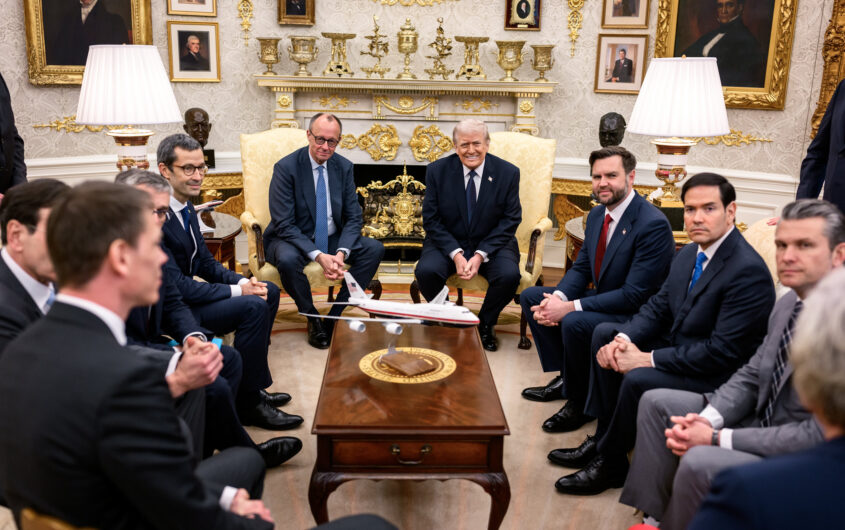
The March 3 visit of German Chancellor Friedrich Merz to Washington was planned well before the launch of the American and Israeli war on Iran. While the U.S. military action in the Middle East dominated the public theatrics—especially the characteristically cacophonous Oval Office press spray—the visit also highlighted the emerging political balance between Europe and the United States and the impact of the distinctions that the chancellor sketched out a few weeks earlier at the Munich Security Conference.
The chancellor on the one hand was accommodating toward President Trump’s characterization of Iran as a threat, and he even said Germany was “supporting the United States and Israel to get rid of this terrible terrorist regime,” a statement that would hardly have been imaginable coming from any of Merz’s predecessors. This has something to do with the strategy of many foreign leaders to avoid direct public disagreements with Trump, especially on the president’s home turf in the White House, where the dynamics of the media frenzy are impossible for the visitor to control. It also has to do with Germany’s deep support for Israel and the keen sense of the threat that Iran’s nuclear and missile programs represent. Indeed, the chancellor later in an interview with German television echoed one of the justifications for war from the Trump administration and the Israeli government, stating that “Iran was close to having nuclear weapons” in only a few weeks, although the U.S. government has presented no convincing intelligence to that effect.
The chancellor announced on social media before his trip to Washington that now was “not the moment to lecture our allies, but to stand together in unity.” This was also made easier by the fact that the Trump administration has not asked its European allies for any significant material contributions to the war. But in his own way, the chancellor also expressed clear skepticism toward the Trump administration’s approach, even while sitting next to the Oval Office fireplace: “We are looking forward to a day after, and we have to talk about the strategy, what is following after this regime is away.” After lengthy meetings in the White House, Merz expressed to German television the importance of this point: “This military action is not without risks, and most of all there is the question, what comes after? Is there a strategy afterward for the future leadership of Iran? Do we all share the understanding that Iran as a state must be preserved and governed and led in a democratic way?” He concluded with the dry observation: “These questions apparently have not all been answered.” In his press conference, he said that “The American government, according to my information, does not have a formulated strategy for the future civilian leadership of that country.” The chancellor deflected responsibility for addressing the future of Iranian governance to Israeli Prime Minister Netanyahu, “I will ask this question again of the Israeli government, because it makes no sense to carry out such a military operation, only to remain confronted with the Mullah regime, just without the same weapons for the next five or ten years and in a different personnel configuration. That is a very important and, thus far, unanswered question.”
This sober recognition goes hand-in-hand with the acknowledgment the chancellor delivered a few days earlier at the Munich Security Conference, in what probably was the most consequential speech of the gathering. Merz asserted that the international order based on rights and rules “no longer exists” and assessed that “the United States’ claim to leadership is being challenged, perhaps even forfeited.” That did not change the “potential that our partnership with the United States continues to offer, in spite of all the difficulties.” The result of this analytical insight, and the gaps between European power and its normative aspirations, is that Germany is realistic about its dependencies on the United States and its limited ability to influence President Trump’s global foreign policy. Chancellor Merz therefore seemed reluctant to amplify disagreements with Trump when he was unable to offer an alternative path forward—for example, in the Middle East.
Where Germany has clearer interests and influence, however, the chancellor was concise and politely persistent in advancing Germany’s and Europe’s positions: the Russian war in Ukraine and the trade deal between the United States and Europe. Merz laid down these markers at the start of his meeting with Trump but declined to debate them in front of rolling cameras. He was more candid after the White House meetings; in previous administrations, a major bilateral visit would be capped by a joint press availability in which the president and a foreign visitor would present a reasonably coherent picture of their positions and the way forward. In the second Trump term, this has been inverted, with a free-for-all in the Oval Office before any discussion has been held and each side left to interpret the outcomes unilaterally. Merz did this in a solo press conference and in multiple appearances on the German nightly news.
Germany is realistic about its dependencies on the United States and its limited ability to influence President Trump’s global foreign policy.
With regard to the U.S.-EU trade deal reached in the summer of 2025, Merz highlighted the uncertainty resulting from the February 2026 Supreme Court decision invalidating tariffs that Trump had sought to impose under the International Emergency Economic Powers Act. The Trump administration now has to carry out the administrative procedures required for employing other tariff authorities, and Merz said that he had emphasized Europe’s bottom line, warning against any U.S. attempt to go beyond the terms of the August 2025 deal with the EU. He claimed that Trump and his cabinet were in agreement.
Merz also explained the discussion of Ukraine. He called for an end to the fighting that would not just be a rest period in which Russia gathered its strength to renew its attacks, and he said Trump agreed with him. He also called for increased pressure on Russia, asserting that Moscow did not appear to be genuinely interested in peace and thereby thwarting Trump’s own goals. He related how he had brought maps to the meeting, which he and Trump reviewed together, achieving a better understanding of why Ukraine could not withdraw from the current front lines. More pointedly, Merz said that Europe needed to be included in the negotiations between the United States, Ukraine, and Russia, and that Trump understood that any peace would only be durable if it was supported and legitimated by Europe. Whether the White House would express these outcomes on trade and Ukraine in the same way is unclear, but there have been no denials from the Trump administration of Merz’s characterization of their discussion.
Between the bombast and the tacit understanding appears an outline of a modus vivendi. The chancellor in Munich stated his desire to establish a new transatlantic partnership, insulated from the United States’ culture wars, more honest about differing views, and in which we “will have to negotiate on the right way more often and perhaps even argue about it. If we do this with new strength, new respect and self-respect, it will be of benefit to both sides.” The unanswered question remains whether Germany and its partners will strengthen their own capabilities and resolve quickly enough to make this new partnership a viable model for the tests that are sure to face the United States, Germany, and Europe.