
AICGS
Engaging the Next Generation of Leaders

Elizabeth Hotary
Communications Officer
Elizabeth Caruth Hotary is the Communications Officer at AGI, where she leads strategic communications, digital content management, and public engagement initiatives designed to elevate the Institute’s profile and expand its reach among policymakers, scholars, donors, and the public. She coordinates AGI’s research agenda; manages the editorial process from concept through distribution for AGI’s articles, publications, and digital content; produces AGI’s podcast, The Zeitgeist; and oversees the Institute’s media outreach efforts. She collaborates with leadership teams and external partners to ensure AGI produces high-quality, timely, and impactful content. She also manages relationships with AGI’s Board of Trustees and Non-Resident Fellows.
In over ten years at AGI, Ms. Hotary has contributed to research on populism and extremism, workforce education, and immigration and integration. She has co-led AGI study tours across the United States and Germany.
Before joining AGI, Ms. Hotary taught English at a secondary school in Herne, Germany, through the Fulbright Program. During her time as a Fulbrighter, she volunteered with the U.S. Consulate Düsseldorf’s MeetUS program, traveling to schools across North Rhine-Westphalia to engage secondary school students in discussions about the United States. She has previous experience at the Josef Korbel School of International Studies at the University of Denver and WorldDenver, a nonprofit global affairs organization.
Ms. Hotary received her MA from the Josef Korbel School of International Studies at the University of Denver, where she was a Marc Nathanson Fellow. She graduated magna cum laude from the University of Arkansas with degrees in International Relations, European Studies, and German. She is also an alumna of the Aspen Seminar for Young European Leaders, “Next-Gen Europe: Leading for Values.”
__
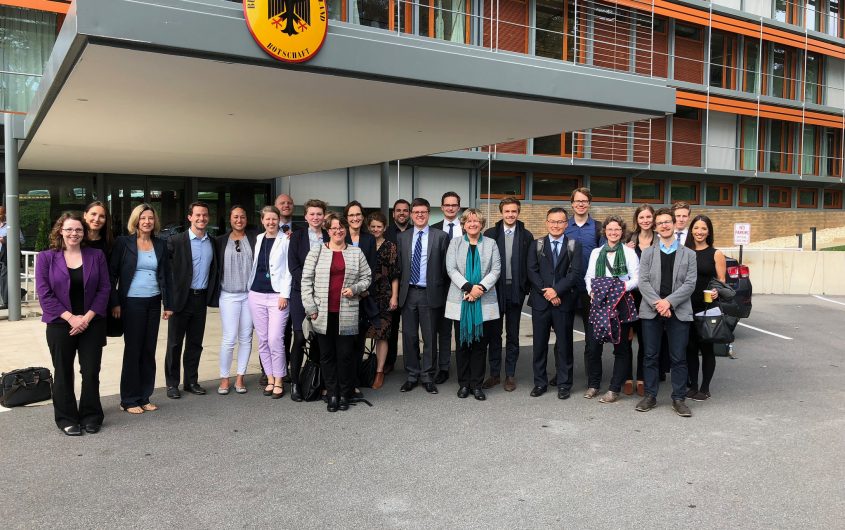
The AGI project “A German-American Dialogue of the Next Generation: Global Responsibility, Joint Engagement” engages young Americans and Germans in discussions of current issues of concern for the transatlantic relationship. The project participants are young leaders in a variety of fields who have been working together for several months in three groups representing the AGI Program Areas (Foreign & Domestic Policy; Society, Culture & Politics; and Geoeconomics) with the intent to frame and deliberate on the issues and create solutions to a variety of global challenges facing the United States and Germany. On April 9 and 10, the 24 young transatlantic leaders held a conference to highlight the results of the year-long project.
Reflect, Redefine, Renew: Priorities for Transatlantic Relations
The Foreign & Domestic Policy Program Group focused their recommendations on four core issues: energy and climate, trust and populism, security and defense, and Iran. The current U.S. administration and the EU and Germany have divergent policies and ideas on many of these issues. The actionable recommendations move cooperation beyond areas of disagreement, widen the scope of cooperation to new (or less utilized) actors, and emphasize fostering transatlantic ties on the federal, state, local, and personal level.
Group Members: Laura Daniels, Niklas Helwig, James Hoobler, Lisa Kastner, Julian Mueller-Kaler, Peter Rough, Pia Seyfried, Sonja Thielges, Kirsten Verclas
Civil Society in a World of Challenge and Change
The Society, Culture & Politics Program Group was concerned with three questions: what is the current state of U.S.-German relations? What is Germany’s role in the international arena, specifically regarding conflict resolution and reconciliation? How can and should the United States and Germany cooperate in international relations? The group went back to basics to identify commonalities and differences in the two countries, and how that has changed since the beginning of the relationship after World War II. The recommendations refocus the relationship on the younger generation and new social movements to revitalize existing structures and stakeholders for civil society actors or create new ones in a digitalized, globalized twenty-first century world.
Group Members: Felix Berenskötter, Annika Frieberg, Julie Hamann, Yangmo Ku, Rachel Seavey, Lukas Welz, Christiane Wienand
Challenges and Opportunities for the Transatlantic Economic Relationship: Building Common Ground in the Light of Brexit and America First
The Geoeconomics Program Group’s discussions were framed by policy disagreements on trade and international monetary norms between Europe and the Trump administration. However, despite the increasing frostiness between the transatlantic allies, the Geoeconomics Group saw opportunities for shared interests and cooperation on a variety of economic issues. The group’s recommendations focused on three issue areas: something old (a common approach to China), something new (new technology, the burden and benefit of re-skilling workers, innovation ecosystems), and something blue (a resilient and self-sufficient European Union).
Group Members: Sven Hilgers, Monika Kerekes, Manuel Kilian, Megan Leary, David Livingston, Sidney Rothstein, Angela Stanzel