
conceptphoto.info via Flickr
Two Shades of Liberalism

Luca Vozzi
Georgetown University
Luca Vozzi is a master’s student in the European Studies program at Georgetown University’s School of Foreign Service, focusing on transatlantic relations and comparative politics. He currently works as a Research Assistant to Prof. Eric Langenbacher, contributing to research on German and American political developments as well as the broader dynamics of U.S.-European relations.
Before coming to Georgetown, Luca Vozzi earned his bachelor’s degree in Political Science from the Freie Universität Berlin, where he specialized in international relations and political institutions.
He has professional experience within German politics, including positions at the German Bundestag, the Federal Foreign Office, as well as work for the Christian Democratic Union (CDU).
His research interests center on comparative governance, foreign policy, and the evolving role of Germany in Europe and the transatlantic partnership.
D66’s Rise in the Netherlands and the FDP’s Collapse in Germany
When Dutch voters returned to the polls in late October 2025 after the collapse of the short-lived Schoof government, they delivered an unexpected message. The social-liberal Democrats 66 (D66), long a mid-sized party of progressive reformers, emerged as the narrow winner of the election with 16.9 percent of the vote and twenty-six out of 150 seats in the primary parliamentary chamber, the Tweede Kamer—its best result to date. The outcome marked a striking reversal of the country’s rightward drift in 2023, when Geert Wilders and the Party for Freedom (PVV) had finished far ahead of all competitors.
Only eight months earlier, German voters had handed the Free Democratic Party (FDP)—the FDP and D66 share the same European party family Renew Europe—its worst result since the party’s existence. With just 4.3 percent of the vote, the party fell below the 5-percent threshold and exited the Bundestag entirely for the second time in twelve years. Whereas D66 positioned itself as the principal alternative to a discredited right-wing coalition experiment, the FDP became the principal casualty of a fractured German political center. Taken together, the two elections raise a broader analytical question: why does liberalism in the Netherlands appear resilient, even resurgent, while its German counterpart seems to be losing political ground?
Any comparison must begin with structural differences. The Netherlands uses a highly proportional electoral system: the entire country forms a single 150-seat constituency, and seats are allocated strictly according to vote share. There is no formal threshold; the effective entry level is roughly 0.67 percent—one seat. As a result, political fragmentation is not only normal but expected. Parties rarely disappear entirely, and even mid-sized liberal or centrist parties can maintain influence through coalition bargaining.
Germany’s electoral system, by contrast, contains a hard 5-percent threshold. Falling short of it means total exclusion from parliamentary representation (unless a party wins three constituencies). This binary dynamic—full parliamentary presence or complete absence—creates a structural vulnerability for smaller parties, especially those that position themselves as junior partners in government. The FDP entered the 2025 election after three years in the “traffic-light” coalition, which was partly perceived as quarrelsome and ineffective. As a visible contributor to the coalition’s breakdown, the party faced the consequences of this electoral architecture more severely than its Dutch counterpart would.
Yet institutions alone do not explain the divergence. The deeper contrast lies in the way both parties have defined—and narrated—their liberalism.
D66’s electoral success in 2025 did not arise from a single issue but from a careful repositioning of its political identity. Led by Rob Jetten, the party presented itself as a young, pragmatic, and progressive alternative to the exhausted right-wing governing project. Its platform paired traditional liberal priorities—civil liberties, education, and pro-European integration—with robust commitments to climate policy, public investment, and social protections.
In economic terms, D66 embraced a model of what many Dutch analysts describe as “social liberalism”: market-friendly but not market-dominant, open to moderate tax increases on wealth and higher incomes as a means to finance public goods. Its rhetoric was explicitly optimistic—forward-looking, pro-innovation, and consistently framed around fairness and opportunity. Even on migration, where D66 adopted a somewhat firmer tone in 2025, the party maintained a rights-based approach and avoided co-optation of far-right narratives.
The broader context also helped. The collapse of the PVV-backed Schoof cabinet reinforced perceptions of instability on the right. Progressive voters sought a responsible governing alternative; centrist voters sought competence without radicalism. D66 offered both. In the Dutch political imagination, it came to embody not a doctrinaire liberalism but a constructive middle ground.
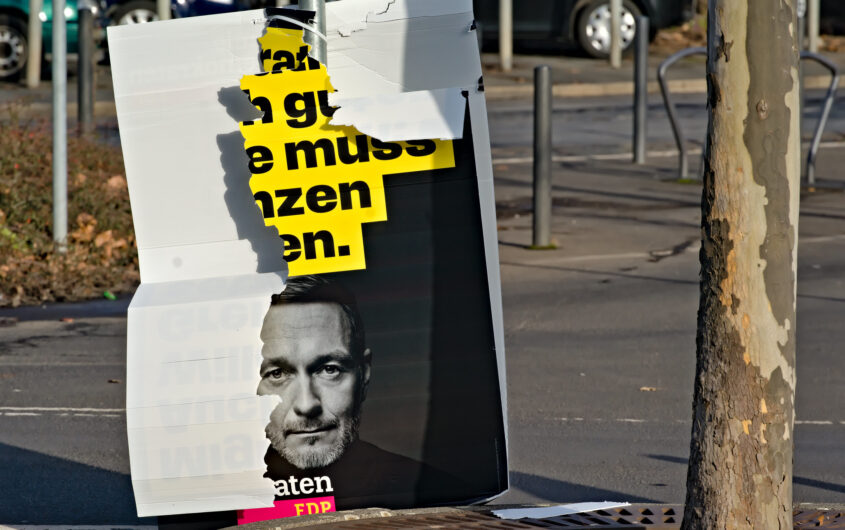
Germany’s FDP, on the other hand, entered the 2025 election in a vastly different position. After serving as the fiscally conservative anchor in the traffic-light coalition, the party struggled to articulate a positive account of its governing role. Public perception was shaped less by tangible achievements—tax threshold adjustments, digitalization measures, and resistance to tax increases—than by the sense that the FDP had primarily acted as a brake on its partners. Its insistence on the debt brake, opposition to regulatory initiatives, and role in the coalition’s collapse combined into a narrative of obstruction rather than problem-solving.
The party’s strategic dilemma was compounded by Germany’s shifting political landscape. The conservative Christian Democratic Union and Christian Social Union (CDU/CSU) regained much of the economically liberal center-right; the Greens appealed to younger urban professionals; and the far-right Alternative for Germany (AfD) attracted disaffected economically liberal voters who prioritized protest over policy. The FDP’s traditional constituencies—entrepreneurs, upwardly mobile professionals, and economically liberal centrists—were thus fragmented. By 2025, the party could no longer rely on the informal “loan-vote” arrangements that once helped it clear the 5-percent threshold.
But the core issue ran deeper: the FDP’s version of liberalism remained narrowly fiscal, emphasizing constraints rather than possibilities. In a period marked by geopolitical uncertainty, rising energy costs, and public- and private-sector challenges, an agenda focused almost exclusively on limiting state action appeared misaligned with voter expectations. Where D66 paired liberal rights with social and ecological ambition, the FDP often seemed to offer liberalism without a societal narrative.
The Dutch and German cases show how liberal parties succeed when they present themselves not merely as custodians of market rulebooks but as architects of a credible societal future.
Thus, the comparison reveals not simply two different electoral outcomes, but two distinct models of liberal thought in practice. D66 represents a form of social liberalism that combines civic rights and democratic reform with a strong commitment to social responsibility and public investment. Its political project links individual freedom to state capacity, arguing that investment in climate policy, housing, education, and public services is not a contradiction to liberal principles but a prerequisite for sustaining them. In this understanding, markets remain central, yet they are embedded within a broader framework of collective problem-solving and long-term societal resilience.
The FDP’s model of liberalism, by contrast, remains firmly rooted in Germany’s ordoliberal tradition. Its core emphasis lies on fiscal discipline, tax restraint, and regulatory minimalism, coupled with a strong belief in technological innovation driven primarily by market forces rather than state guidance. This approach proved electorally viable in periods of economic growth and political stability, when limiting government intervention resonated with voters. In the current context, however—marked by energy insecurity, climate adaptation, widening social inequalities, and geopolitical uncertainty—this narrowly economic conception of liberalism has struggled to address voters’ demand for visible solutions to structural challenges.
Historically, the party has encompassed both a left-liberal strand rooted in civil liberties, social modernization, and a pro-European reform agenda and a more conservative, market-liberal wing emphasizing fiscal restraint and deregulation. In the context of the traffic-light coalition, the FDP’s public profile became closely associated with the latter, reinforcing its image as the guardian of the debt brake and a veto player on redistribution and climate-related spending. D66’s 2025 success may therefore point to an underexplored space for a distinctly left-liberal project in contemporary German politics: one that combines economic openness with state capacity, and individual freedom with investment-driven modernization. Whether the FDP can regain relevance may depend, at least in part, on how it balances these competing liberal traditions in a post-coalition landscape.
Neither trajectory should be overstated. Liberal parties across Europe face headwinds, and D66’s success may prove contingent on Dutch-specific dynamics and the collapse of the previous right-wing experiment. Still, the Dutch and German cases show how liberal parties succeed when they present themselves not merely as custodians of market rulebooks but as architects of a credible societal future.
The divergent fortunes of D66 and the FDP illustrate how political liberalism adapts—or fails to adapt—to changing voter expectations. In the Netherlands, D66 benefited from a proportional system, a discredited right-wing government, and a message of constructive reform. In Germany, the FDP faced a polarized electorate, a stringent electoral threshold, and a perception of negativity that limited its appeal.
Ultimately, the question for Germany is not whether a liberal party can succeed, but what form liberalism must take to remain electorally relevant. The Dutch experience suggests that a synthesis of rights, social investment, and ecological modernization may resonate more strongly with contemporary voters than a focus on fiscal restraint alone. Whether German liberalism can evolve in this direction—or whether its future lies in a different strategic renewal—remains open.